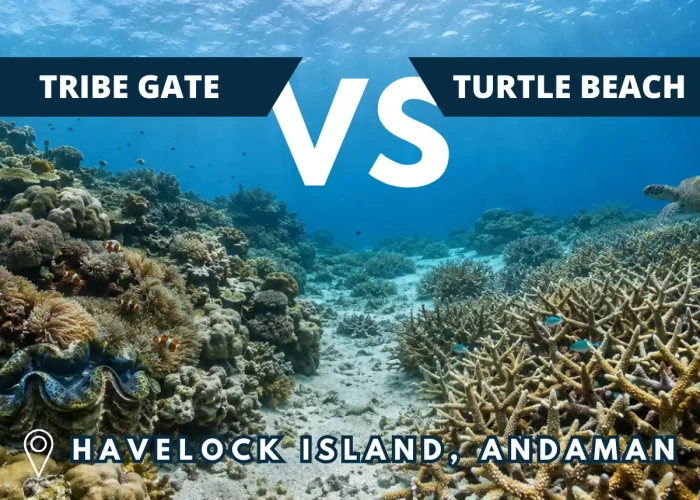
The scuba diving age limit in Andaman for a try dive is 10 years, and there is no upper age limit. We follow RAID, the agency we train with: from 10 you practise in shallow water up to 5 metres, then dive in the sea up to 12 metres. Children aged 8 and 9 can do a Try Dive Cadet in shallow water, no deeper than 2 metres. Older guests only need a doctor if the medical form throws up a yes.
Most weeks a parent messages us on WhatsApp with the same question, and it usually comes in two parts. Can my 9 year old dive? And, a little quieter, can my father come too, he is 63? Both fair questions. Some of the answer is the agency’s rules and some of it is just what I have learnt on the boat, and I will tell you which is which.
Age limits for diving and snorkelling in Havelock at a glance
Each activity has its own age window. Here is the short version.
| Activity | Minimum age | Upper age and medical | How deep |
|---|---|---|---|
| Snorkelling at Nemo Reef (from the beach) | 6 | No upper limit, tell us about any health condition | At the surface |
| Snorkelling at the boat sites | 8 | No upper limit, tell us about any health condition | At the surface |
| Try Dive Cadet (ages 8 and 9) | 8 | Shallow water only, parent signs the forms | 2 m maximum |
| Try dive (no certificate needed) | 10 | No upper limit. Medical form for everyone, doctor only if any answer is yes | 5 m in shallow practice, then 12 m in the sea |
| Fun dives (already certified) | 12 | From 50, bring a doctor’s fitness certificate | Up to your certification limit |
| RAID Open Water course | 10 (junior card 10 to 14, full card from 15) | Medical form for everyone, doctor’s approval if any answer is yes | Shallow for juniors, up to 18 m in Andaman waters |
| Island hopping by boat | 5 | No upper limit | No diving needed |
For try dives, the rule written on all our pages is this: Minimum age for a try dive is 10 years: shallow-water practice up to 5 m, then an open-water dive up to 12 m. Children aged 8 and 9 can do the RAID Try Dive Cadet in shallow water only, up to 2 m. There is no upper age limit. Everyone fills in a medical form, and you only need a doctor’s sign-off if you answer yes to any medical question.
Why 10, and what 8 and 9 year olds can do
We train with RAID, and these are RAID’s Try Dive rules. We follow them for every try dive we run.
From 10, a child can do the full Try Dive. First comes skills practice in calm, shallow water, no deeper than 5 metres. Then a dive in the sea, to a maximum of 12 metres. At 8 and 9, RAID allows the Try Dive Cadet instead. It stays in shallow, calm water, no deeper than 2 metres, and there is no dive out on the reef at that age. The Cadet is not on our booking page, so message us on WhatsApp with your child’s age and we will set it up.
Honestly, the number on the birth certificate matters less than a few simple things. A 10 year old can be a lovely little swimmer and still not be ready for what diving asks of them. The big one is saying “my ear hurts” out loud instead of quietly pushing through it, and staying calm when the mask lets in a little water. If your child can do that, 10 is fine. If not yet, the Cadet session or snorkelling is the kinder start, and nobody minds.
My child is under 10. What can they do?
They can snorkel, and at 8 or 9 they can also do the shallow Cadet session. For a young child, snorkelling is often the better morning anyway.
From age 6 they can snorkel with us at Nemo Reef, walking in from the beach into shallow, calm water. From age 8 they can come out on the boat to the snorkelling sites further out. They see the same clownfish, the same parrotfish and sometimes a turtle, just from the surface, with a guide next to them and their face in the water rather than a regulator in their mouth. Guided snorkelling at Nemo Reef is ₹2,000, or ₹1,500 if they are confident swimmers, and the rest of the options are on our snorkelling in Havelock page.
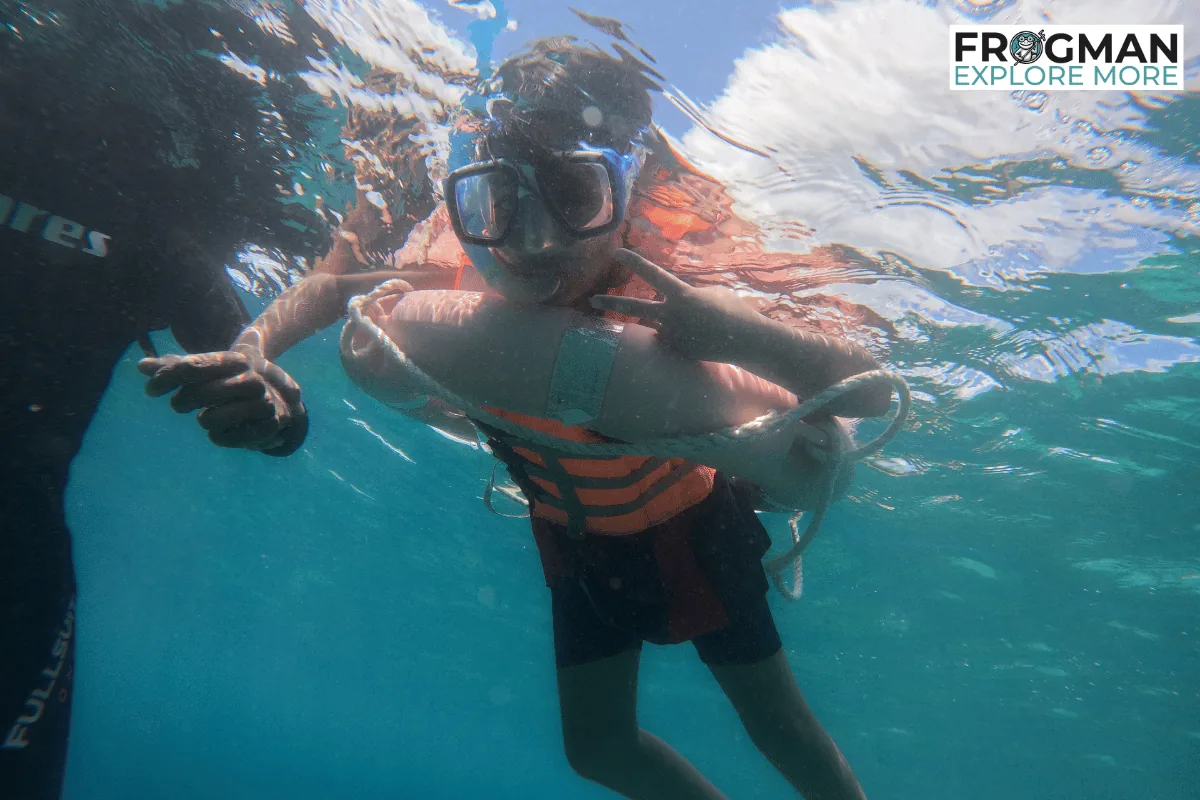
A common plan that works well: the parents do a try dive while the younger child snorkels close by, and then everyone swaps stories at lunch. When that child turns 10, you have a reason to come back.
Kids aged 10 to 14: what is different
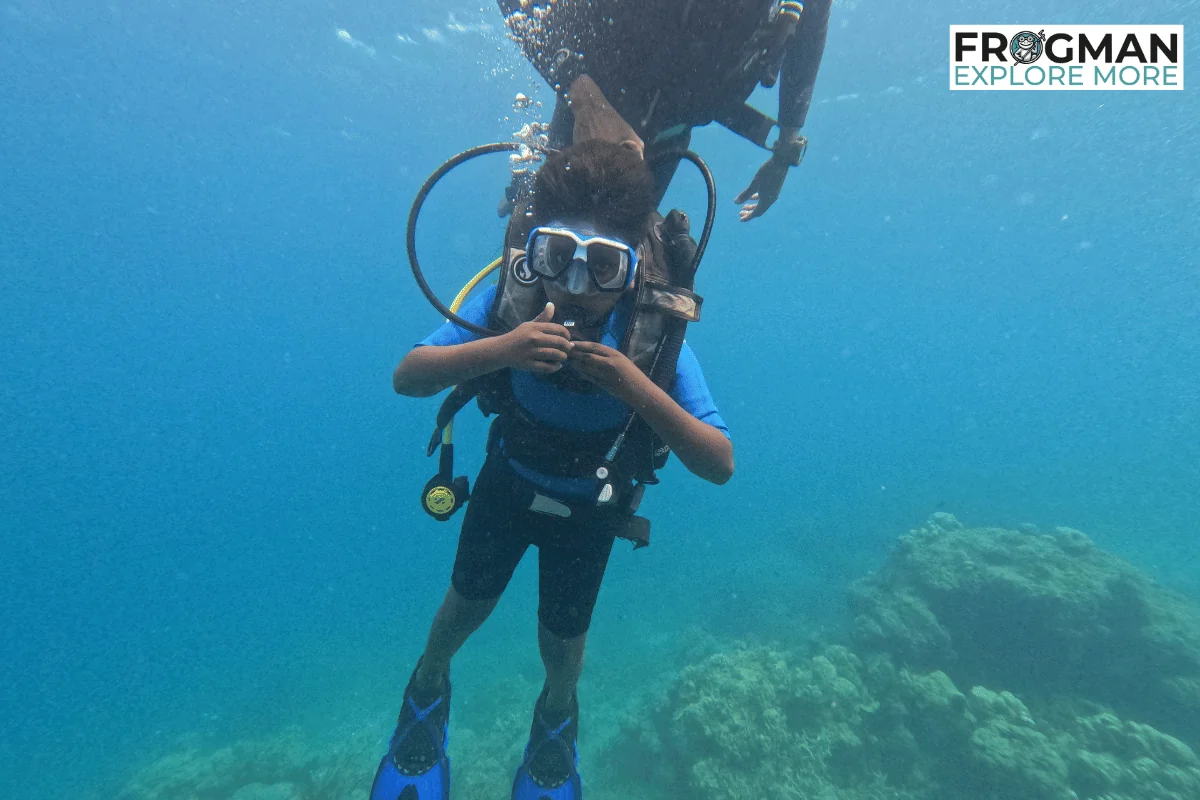
They dive the same way adults do on a try dive, one instructor to one diver and no deeper than 12 metres, but a few things need more attention.
Ears
Children’s Eustachian tubes, the small tubes that let you clear your ears, are narrower and flatter than an adult’s. They block up more easily, especially after a cold. So we go down slowly, and your child’s instructor stops every metre or so to let them equalise. If the ear will not clear, we stop and wait, or we come up. Nobody gets pushed.
Getting cold
The water here is 27 to 30 degrees, which feels warm for the first ten minutes. But a thin 10 year old loses heat much faster than an adult, and they are usually too busy looking at fish to tell you they are cold. A wetsuit only keeps them warm if it fits close. A loose one keeps letting cooler sea water in, and the child never warms up. We have kids’ sizes in wetsuits, BCDs (the jacket that holds the tank) and fins, so tell us your child’s height and weight when you book and we will have the right size ready.
Attention and nerves
Teenagers are often braver than their parents on the day. What catches them out is attention span. A long briefing loses them. So the briefing is short, done standing in shallow water, and the instructor keeps checking with simple hand signals. Ears okay? Want to go up? A 13 year old answers honestly if you ask often enough.
What we need from the parent
A parent or guardian signs the forms for anyone under 18. That one is a RAID rule. Fill in your child’s medical questions honestly, and mention anything like asthma or ear trouble, even if it feels small. If you are nervous, you are welcome to snorkel above them while they dive, or dive yourself in the same group.
Would I start a 10 year old at a boat site? Usually no. I would start them at the shore dive and let them walk in. More on that below.
Is there an upper age limit for scuba diving?
No. There is no upper age limit for a try dive. What decides it is the medical form, not your birth year.
I would much rather take a fit 66 year old who walks every morning than a 40 year old who gets breathless on the stairs. Birth year is a poor measure of whether someone is safe underwater. What your heart, lungs and ears are doing is a good one. That is what the medical form asks about, and what the doctor checks if the form sends you to one.
If you are already certified, the line comes a bit earlier. For fun dives we ask for a doctor’s certificate from age 50, because certified diving goes deeper and longer than a try dive and the effort involved is higher.
The medical form, and when you need a doctor
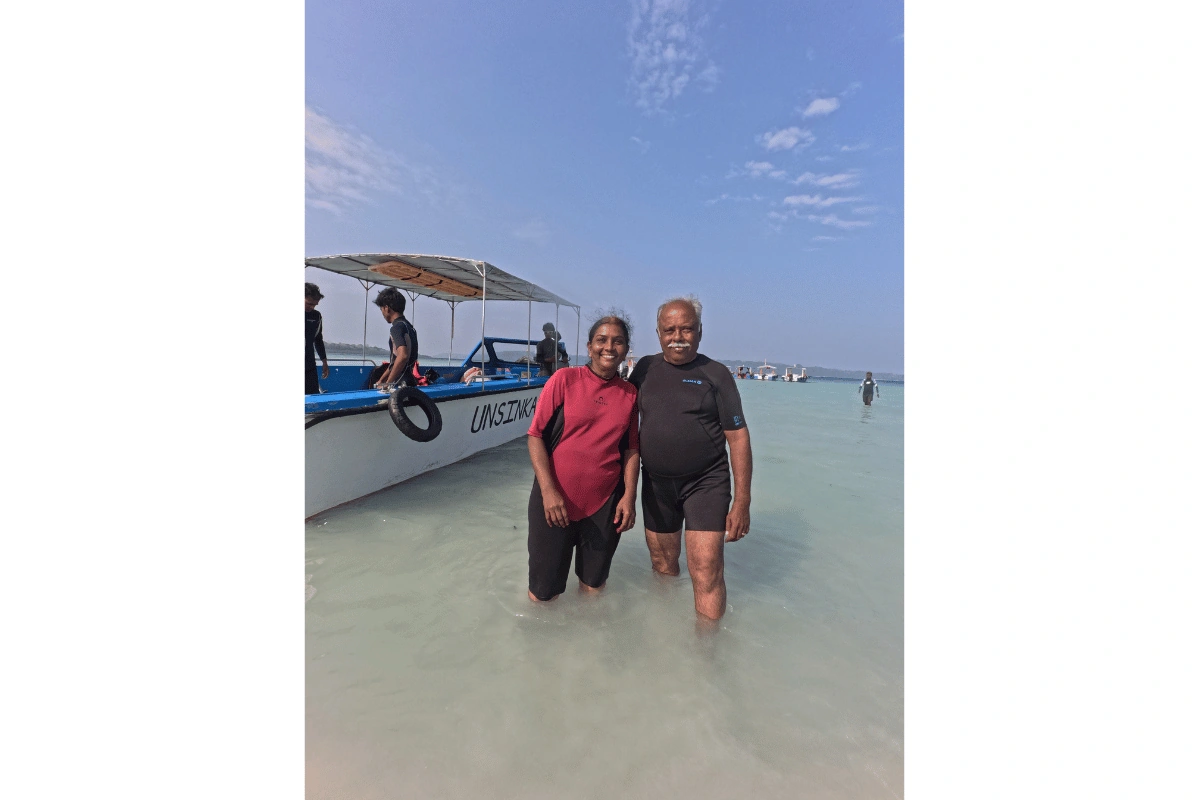
Everyone who dives with us fills in a medical form, whatever their age. If every answer is no, you sign it yourself. If any answer is yes, you need a doctor to sign that you are fit to dive.
The form asks about the usual things. Heart problems. Lung problems, including asthma. Blackouts, fits or epilepsy. Diabetes. Recent surgery. Pregnancy. Medicines you take every day. It also asks about age: if you are over 45 and you smoke, or you have high cholesterol, high blood pressure or a close family history of heart trouble, that counts as a yes.
There is also a plain fitness question, and I like it because it is so practical. Can you walk 1.6 kilometres in about 14 minutes, or swim 200 metres without stopping? If that would be a struggle, the doctor needs to see you first.
My one strong piece of advice here: if the form says you need a doctor, get the certificate from your own doctor at home, before you travel. Your doctor knows your history and your medicines. And Havelock is a small island with limited medical services, so finding a doctor who can examine you properly on the morning of your dive is not something to count on. Fill in the form honestly. A yes does not stop you from diving. It just means a doctor looks at it first. The people who worry me are the ones who tick no to everything to save time.
Diving in your 50s, 60s and beyond: what actually matters
Four things. If the medical form sends you to a doctor, they will look at all of them.
Your heart
Getting into water pushes more blood towards your chest, and swimming against even a light current makes the heart work harder. A doctor may want a stress test (an ECG while you walk on a treadmill) if you have had heart trouble before.
Blood pressure tablets
Well-controlled blood pressure is usually fine for diving. Some tablets, though, keep your heart rate low on purpose, which can make you tire quickly when you suddenly need effort. Tell the doctor you are planning to dive so they can check which tablets you are on.
Diabetes
Many people with well-controlled diabetes dive. It needs a doctor’s approval, a steady routine, and some glucose tablets or a sweet drink with you on the day. Low blood sugar underwater is the thing to avoid.
Getting in and out
This is the part people forget. The boat ladder with a tank on your back is often harder than the dive itself. That is why, for older first-timers, I nearly always suggest the shore dive: you walk in from the beach, there is no ladder, and the water stays shallow for a while.
None of this is meant to put you off. Some of the calmest divers I have seen on our reefs were grandparents. They listen, and they have nothing to prove to anyone on the boat. I wish more 25 year olds dived like that.
Ears: the thing that stops kids and older divers most
In my experience, ears end more try dives early than anything else, and that is true for kids and older divers alike.
Children have those narrow tubes. Older divers sometimes have old sinus problems, a past nose operation, or tissue that just does not open as easily as it used to. The fix is the same for both: equalise early, equalise gently, and go down slowly.
Most beginners are taught to pinch the nose and blow. That works, but blowing hard is a mistake. It can hurt the ear. Your instructor will show you gentler ways too, like swallowing while you pinch your nose, or pushing your tongue up against the roof of your mouth with your nose pinched (divers call it the Frenzel method). Some people find those much easier.
If you have a cold or a blocked nose, tell us and move your dive by a day. Diving with a blocked nose is how people end up with sore ears for the rest of their holiday. More tips like this are in our scuba diving tips for beginners.
Where we take kids and older first-timers
Nearly always to Nemo Reef, the shore dive, which costs ₹3,500 including GST.
You walk in from the beach. The reef slopes down gently from waist-deep water, it is sheltered, and there is usually no current worth talking about. Clownfish in their anemones within a few minutes. For a nervous 10 year old or a 65 year old with a slightly stiff knee, starting in water they can stand up in makes a real difference. If you want the longer comparison, we wrote one on shore dive vs boat dive in Andaman.
If they are comfortable and want a boat dive next, Tribe Gate is a five minute boat ride and ₹4,500 including GST. Short enough that nobody has time to feel seasick.
And no, nobody in the family needs to be able to swim for a try dive. The instructor is with each diver the whole time. The full explanation is in our guide to scuba diving in Andaman for non-swimmers.
What happens if something goes wrong
Every dive centre in the Andamans must keep pure oxygen and an emergency plan ready, and our boats carry an oxygen kit on every trip. That is the first treatment for most diving injuries.
Havelock does not have a recompression chamber. The nearest one is run by the Indian Navy’s diving unit in Port Blair, and serious cases go there by boat, through the government hospital. Diving injuries on beginner dives to 12 metres are very rare, but I would rather you knew the real picture than a sales version of it. It is another reason we keep kids and older first-timers shallow and slow.
One last rule that catches people out: the Andaman guidelines do not allow a dive less than 24 hours before a flight. So plan your last dive at least a full day before you fly out of Port Blair. Our guide on flying after scuba diving explains why.
Quick questions about age limits
What is the minimum age for scuba diving in Andaman?
The minimum age for a try dive with us in Andaman is 10. We follow RAID’s rules: from 10 you practise in shallow water up to 5 metres, then dive in the sea up to 12 metres. Children aged 8 and 9 can do the RAID Try Dive Cadet in shallow water only, up to 2 metres. A parent or guardian signs the forms for anyone under 18.
Is there an upper age limit for scuba diving in Havelock?
No. There is no upper age limit for a try dive. Everyone fills in a medical form, and you only need a doctor’s sign-off if you answer yes to any question on it. Certified divers need a doctor’s certificate from age 50 for fun dives.
Can a 10 or 11 year old scuba dive in Havelock?
Yes. From age 10 a child can do the full RAID Try Dive: shallow-water practice up to 5 metres, then a dive in the sea up to 12 metres, with an instructor next to them the whole time. We usually start kids at the Nemo Reef shore dive, where they walk in from the beach.
Can an 8 or 9 year old scuba dive?
Yes, in shallow water. RAID’s Try Dive Cadet is for ages 8 and 9. It stays in calm, shallow water no deeper than 2 metres, and there is no dive out on the reef. Message us on WhatsApp to set it up. Snorkelling is open to them too.
Can a 65 year old do a try dive?
Yes. There is no upper age limit. Fill in the medical form honestly, and if any answer is yes, get a doctor’s sign-off from your own doctor before you travel, because Havelock has limited medical services. We usually suggest the Nemo Reef shore dive for older first-timers, because you walk in from the beach and there is no boat ladder.
Do kids or seniors need to know swimming for scuba diving?
No, not for a try dive. An instructor stays with each diver the whole time, one to one, and you stay no deeper than 12 metres. Being comfortable with your face in the water helps, and you learn that in the shallow water before you go down.
When do I need a doctor’s certificate for scuba diving?
You need one if you answer yes to any question on the diver medical form: heart or lung problems including asthma, epilepsy, diabetes, recent surgery, pregnancy, daily medicines, or being over 45 with a heart risk factor such as smoking or high blood pressure. Age on its own does not mean you need one.
Bring the whole family
The best mornings we have are often the family ones. A teenager surfacing and talking too fast, while the youngest one, who snorkelled above everybody, wants to know how many years until it is their turn.
Before you book, message us on WhatsApp with everyone’s ages and any health conditions. We will tell you who can dive and what paperwork to bring from home. If anyone needs a doctor’s certificate, get it done before the trip. Then you only have to decide who goes in first.