The scuba diving tips for beginners that actually matter: never hold your breath underwater, equalize your ears early and often on the way down, slow your exhale when you feel nervous, be honest on the medical form, pick a dive centre that keeps groups small, and do not fly within 18 hours of your last dive. Get those right and the rest is just enjoying yourself.
I have watched a lot of people gear up for their first dive, and here is the pattern: the ones who struggle are almost never the unfit ones or the scared ones. They are the ones who skipped the boring basics. So this article is the boring basics, with the reason behind each one, because you follow a rule better when you know why it exists.
Be honest on the medical form
Every proper dive centre will hand you a medical questionnaire before you get near the water. Fill it truthfully. It asks about your ears, lungs, heart, and things like asthma, seizures, and diabetes, because pressure does real things to the body and some conditions need a doctor’s sign-off first. That is not the dive centre being difficult. It is the one piece of paper standing between you and a problem twelve meters down.
The one that catches most people is much smaller: a blocked nose. If you show up with a cold, you will not be able to equalize your ears, and the dive becomes a fight instead of a holiday. Tell us, reschedule, drink water, sleep. The ocean is not going anywhere.
And a tip inside the tip: if a dive shop never asks you for a medical form at all, notice that. It tells you what else they skip.
You do not need to be a swimmer for your first dive
For a try dive, what we call Try Scuba Diving, you do not need to know how to swim. Your instructor stays with you the whole time, often with a hand on your gear, and you start shallow at a calm site. At Nemo Reef, where we run most first dives, the bottom is at 6 to 12 meters and the water usually sits at 27 to 30 degrees. It is about as gentle as the ocean gets. I have written more about this in our guide to scuba diving in Andaman for non-swimmers.
Certification is different. If you go for an Open Water course later, you will need to swim 200 meters (any stroke, no time limit) and float for 10 minutes. That is a safety baseline, not a fitness test. But you do not need any of it to find out whether you love diving. Try dive first. Worry about the rest after.
Learn to equalize before you get wet
Equalizing is the one physical skill worth practising before your trip. The reason: the biggest pressure change of your entire dive happens in the first ten meters. Your ears feel it as squeeze, and your job is to push a little air into them to balance it out.
The method is simple. Pinch your nose and blow against it, gently, like you are trying to fog a mirror through your ears. Some people just swallow or wiggle their jaw. All fine. The part beginners get wrong is timing: equalize early and often, starting at the surface, every meter or so on the way down, before anything hurts. If you wait for pain, the tube that lets air into your ear has already been squeezed shut, and now blowing harder does nothing.
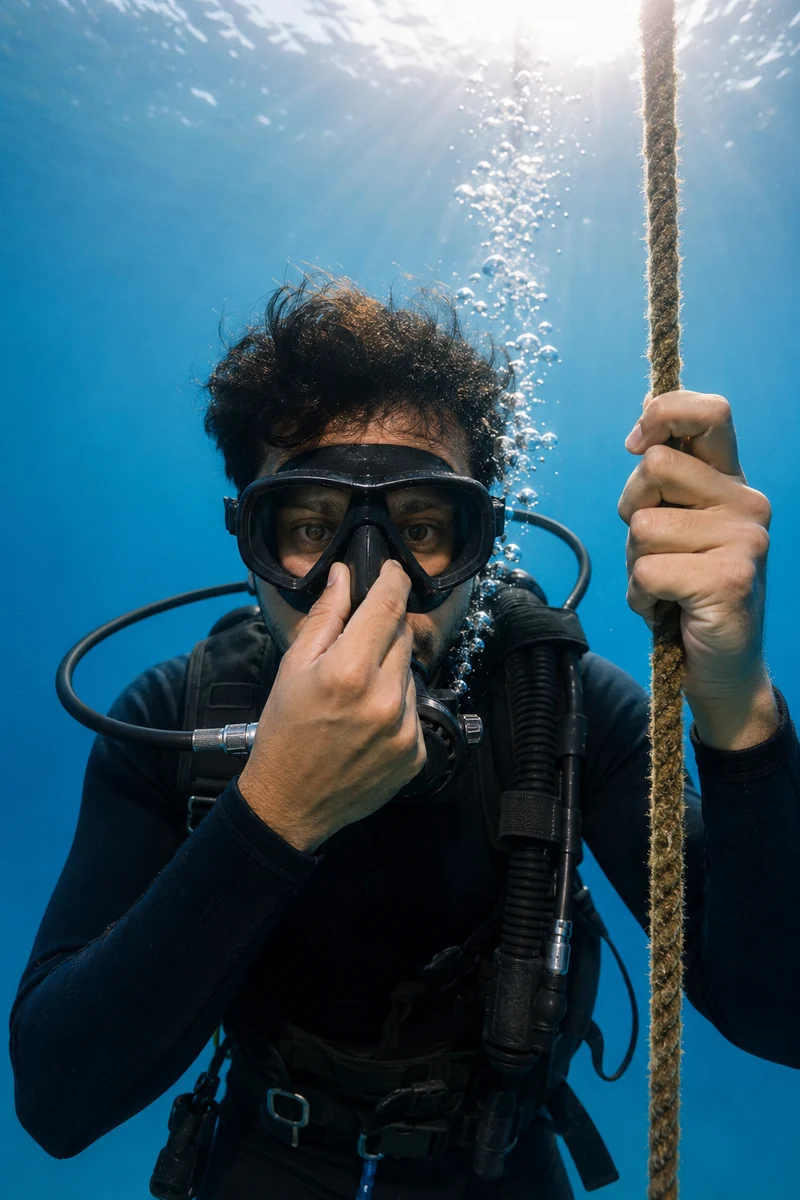
If an ear will not clear, there is no drama. Signal your guide, come up a meter, try again, descend slower. Nobody worth diving with will rush you.
One more small thing on the way down: breathe a little air out of your nose into your mask now and then. If you forget, the mask starts suctioning onto your face, and you can surface with bloodshot eyes that look dramatic in photos for two weeks. Your instructor will remind you. It still helps to know it now.
Rule number one: never hold your breath
This is the most repeated line in all of diving, and it earns the repetition. The air in your lungs expands as you come up, because there is less pressure squeezing it. If you are breathing normally, that expanding air just leaves with every exhale. If you are holding your breath while rising, it has nowhere to go, and lungs do not enjoy that.
On a guided first dive you will not be deep and your instructor controls the ascent, so this is not something to fear. It is a habit to build. Breathe the whole time, slow and steady. That is the entire rule.
When you feel nervous underwater, make your exhale longer
Let me tell you what underwater panic actually is, because it is not what people imagine. It is almost never a shark or a broken piece of equipment. It is breathing.
When you get anxious, you take short, shallow breaths. Underwater, shallow breaths do not flush carbon dioxide out properly, so it builds up in your blood, and rising carbon dioxide is exactly the signal your brain reads as “I am not getting air.” So you breathe faster and shallower, which makes it worse, even though your tank is full and your regulator is working perfectly.
The way out is the exhale. Breathe in for about four counts and out for about six. A long, slow exhale is a switch built into your own nervous system: it tells your body the emergency is over. Pair it with this: stop moving. Hold the line, or a rock, or your instructor’s arm. Stop, breathe, then think. In that order.
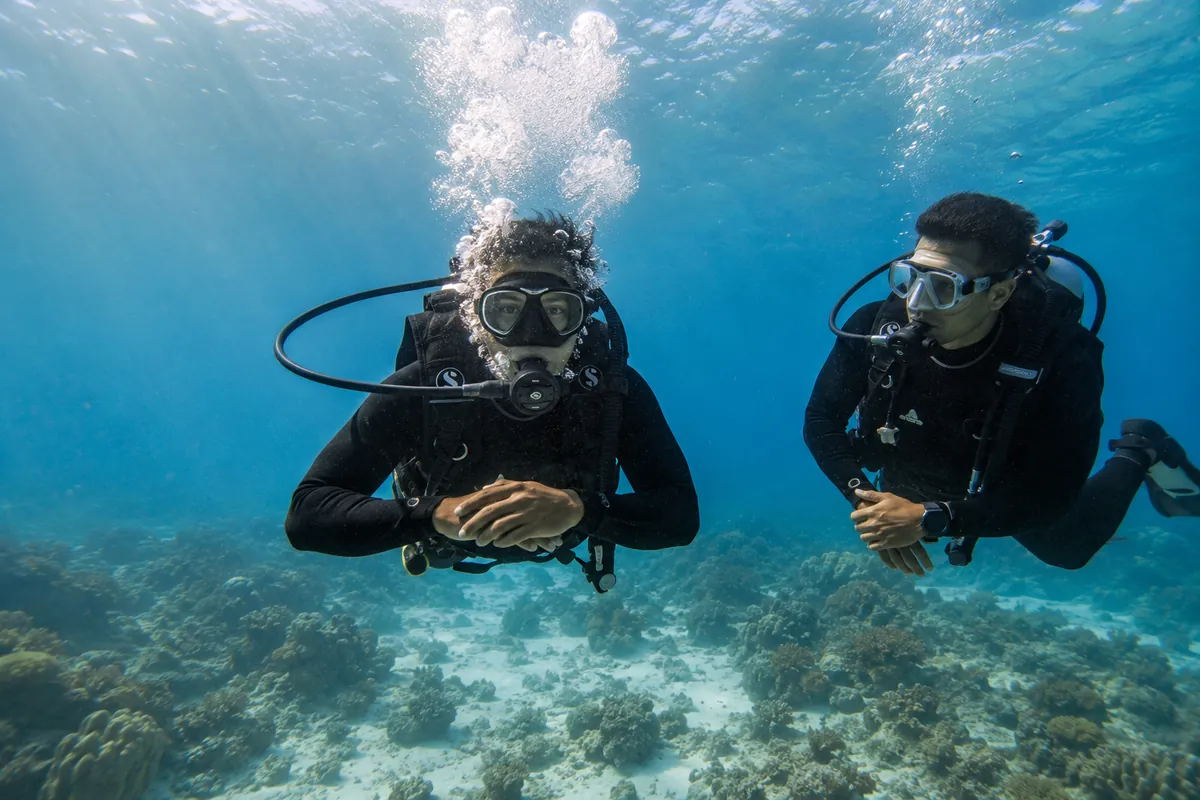
And honestly? Almost every beginner is convinced they will panic. Almost nobody does. Breathing underwater feels strange for about ninety seconds, and then it feels normal, and then it feels like the best thing you have ever done.
Sort your mask out on the boat, not underwater
A foggy mask spoils more first dives than fear does. That is my honest ranking after years of watching both.
If you buy a new mask for the trip, know that it ships with an invisible film of silicone on the glass from the factory. Until you scrub that off, no anti-fog trick will work. Rub plain white toothpaste (not gel) onto the dry lens, let it sit, rinse well. Do it twice if you like. Then, on dive day, a drop of baby shampoo diluted in water, or plain spit if you are old-school, rubbed on the inside and rinsed once. Spit works, it just wears off in about half an hour, so the shampoo mix lasts longer.
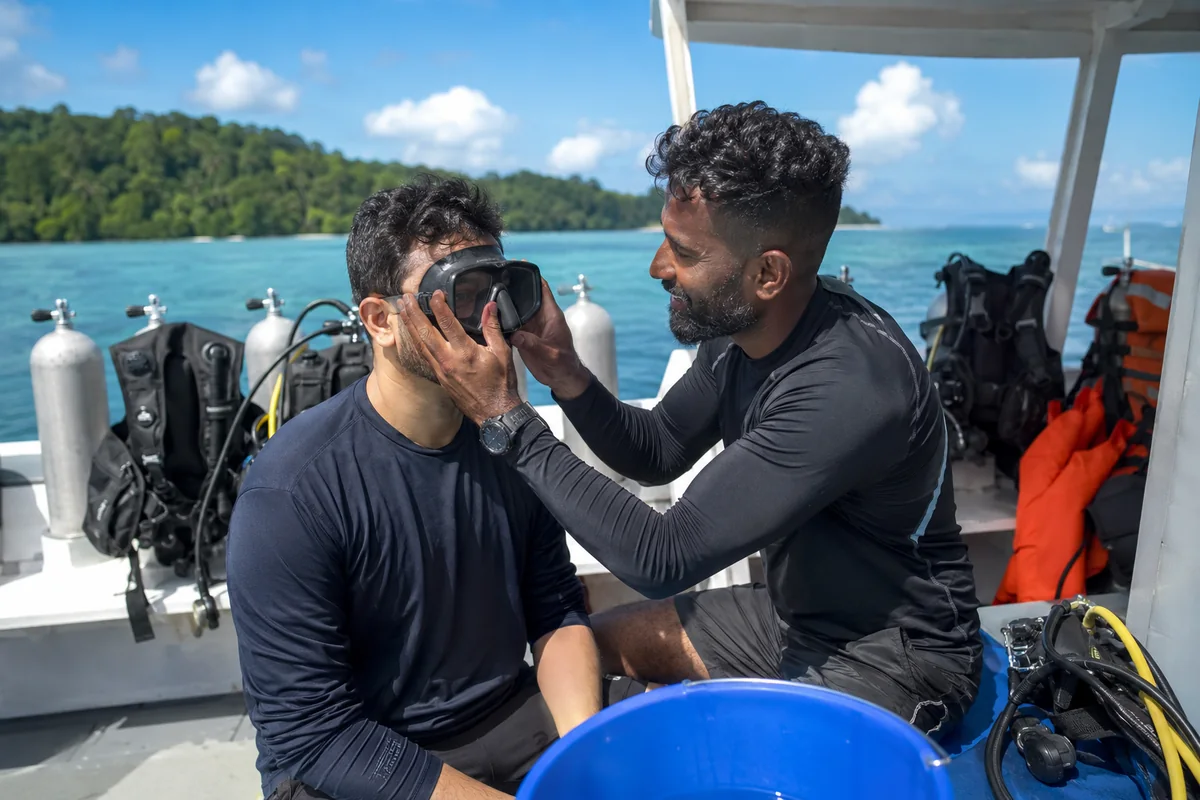
If you are renting a mask from us, we handle the defog. Your job is just to tell us if it leaks on the surface, because a mask that does not fit your face will leak all dive, and no amount of adjusting the strap fixes a wrong shape. Which leads to the next point.
Rent the big gear, buy the small stuff later
You do not need to own anything to become a diver. For a try dive, and even for a full Open Water course, rental gear is the sensible option: the tank, the jacket (BCD), the regulator all get serviced by the centre, and you avoid airline baggage drama.
If you get hooked, and plenty of people do, the first things worth buying are a mask that fits your face and fins that fit your feet, because fit is personal and those two items cause most of the small miseries. A dive computer and your own regulator come much later, when you are diving often enough to justify servicing them every year. Anyone who tells a beginner to buy a full kit before their first course is selling something.
The dive centre you pick matters more than the logo on the door
Here is the honest version of the certification-agency debate: RAID, SSI all follow the same international safety standards, and all their cards work worldwide. What varies wildly is how each individual dive centre runs its day. So judge the centre, not the acronym.
Things worth checking, and yes, you are allowed to ask all of these:
- How many students per instructor? The rules technically allow up to eight. I think that is too many for beginners. Look for four or fewer.
- Is there an emergency oxygen kit on the boat? There should be.
- What does the rental gear look like? Rinsed and hung up says one thing. Dumped in a crate, faded and frayed, says another.
- Did they ask for your medical form without you raising it? Good sign.
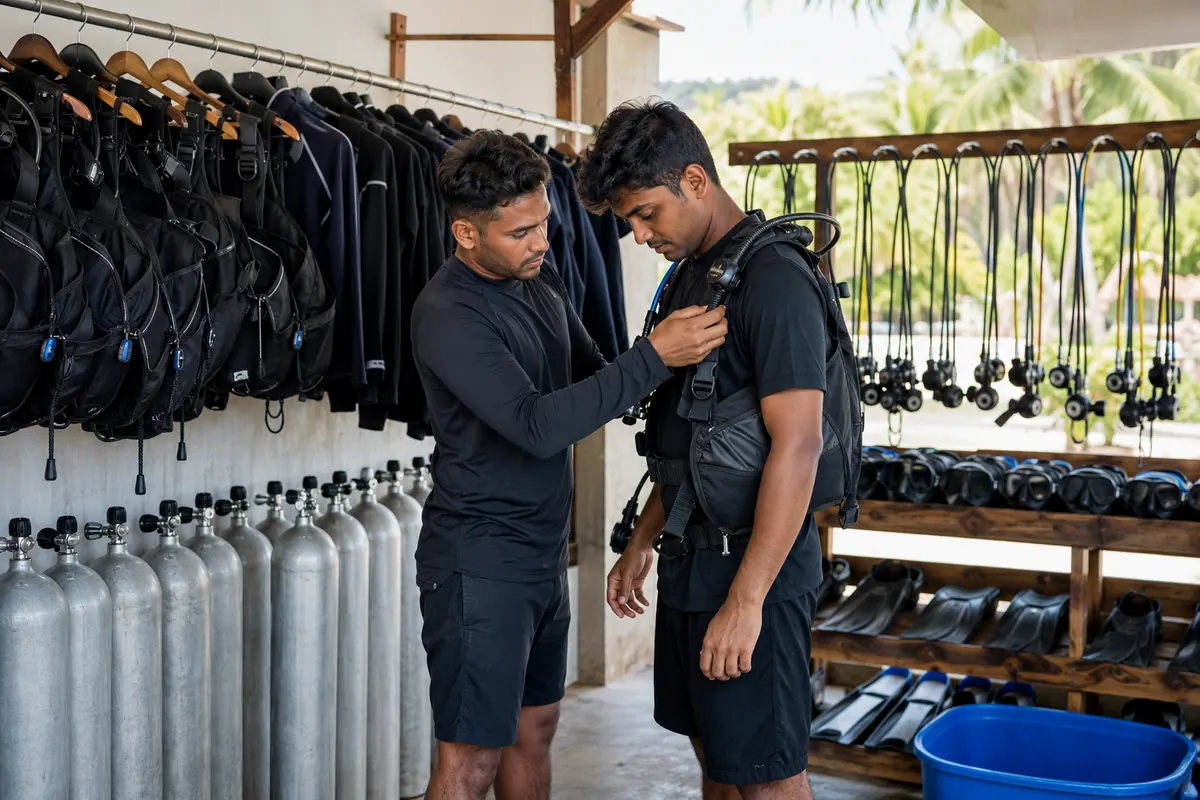
The cheapest intro dive in a crowded group is not the bargain it looks like. You get one first dive in your life. Spend it with someone whose full attention you have.
Do not dive right before your flight home
During a dive your body quietly absorbs extra nitrogen from the compressed air. It leaves again on its own over the hours after you surface, as long as you stay at sea level. Get on a plane too soon and the drop in cabin pressure can pull that nitrogen out of your tissues as bubbles, which is decompression sickness, and it is exactly as unpleasant as it sounds.
The standard guidance: wait at least 12 hours after a single dive, and at least 18 hours after multiple dives or several days of diving. I have covered the full rules in a separate post on flying after scuba diving, but the short version I give our guests is to keep the whole last day dry, full stop. Plan your dives early in the trip and save the final day for Radhanagar beach, kayaking, or doing nothing at all, which Havelock is genuinely good for. Tell us your flight out of Port Blair when you book and we will build the schedule around it.
Leave the reef the way you found it
Last one, and it is short. Keep your fins up off the bottom, touch nothing, chase nothing. Coral is an animal, and a careless knee can kill a patch that took years to grow. As for turtles: the divers who stay still are the ones that get the close pass. Chase one and all you will see is how fast a turtle can actually swim.
This is not a lecture. It is just how divers behave, and from your first dive onward, you are one.
Quick answers to the questions I get asked most
Do I need to know swimming to try scuba diving?
No. A Try Scuba dive needs no swimming ability, because your instructor is with you every second. You only need the 200 meter swim and 10 minute float if you go for the Open Water certification later. There is a full post on whether scuba diving is safe for non-swimmers if you want the long answer.
What should I do if my ears hurt while going down?
Stop descending, come up a meter, and equalize again before continuing down slowly. Never push through ear pain. If it happens on a guided dive, just point to your ear and your guide will handle the rest.
Can I scuba dive with a cold?
No, and I know that is annoying to hear on a short holiday. A blocked nose means you cannot equalize on the way down, and congestion can also trap expanding air on the way up, which hurts more. Push the dive by a day or two instead.
When is the best time for diving in the Andamans?
The season for scuba diving in Andaman runs roughly October to May, when the sea is calm and visibility runs 15 to 25 meters on good days, sometimes more. The monsoon months in between are when the boats mostly stay in.
How long after diving can I fly?
Wait 12 hours after one dive and 18 hours after multiple dives or dive days. We plan this for you: share your return flight when you book and your last dive will land safely inside the window.
Come try it
If reading this made diving feel a little less mysterious, good. That was the whole point. None of it is hard, it is just new, and new is the fun part.
If you are planning an Andaman trip, message us your travel dates before you lock your ferries and flights, so we can slot your dives in with proper gaps. Worst case, you do one dive at Nemo Beach and go home with a story. Best case, we see you back for the Open Water course. It happens more often than you would think.