Stargazing in Havelock Island | Night Sky Experience | Frogman Adventures
Stargazing in Havelock Island – guided night sky experience Andaman
Course Code: FRG-STAR-HVL

Stargazing in Havelock Island – Night Sky Experience, Andaman

₹2,000 + GST
4.9 1,800+ Google reviews

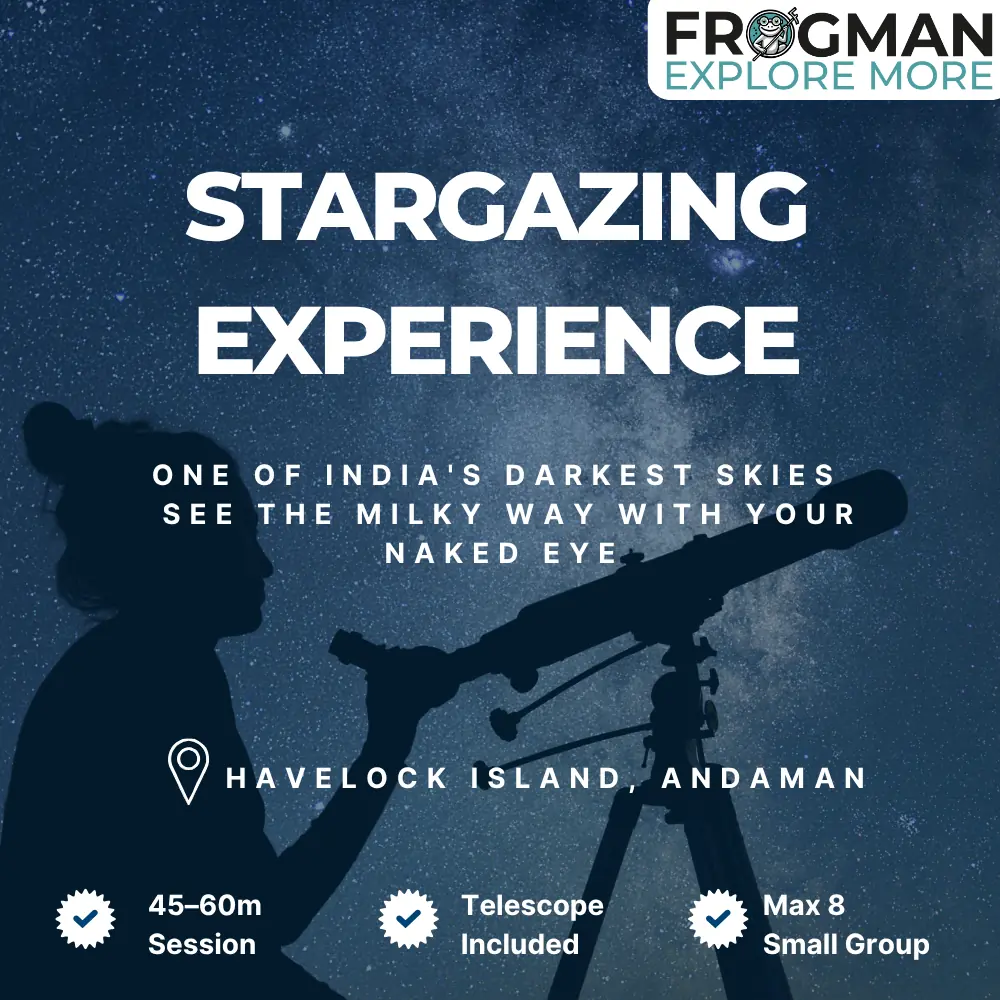
One of India's rarest night sky experiences – Havelock Island's Bortle Class 2–3 dark sky, guided telescope viewing of planets, nebulas, and constellations.

⚡ Only 8 spots per session — Peak season dates fill up fast. Book now to secure your night.

Things to Know
Booking confirmation sent via WhatsApp within 30 minutes
Free cancellation up to 48 hours before your dive
Secure payment 10+ years experience 4.9★ rated

Stargazing in Havelock

Havelock Island sits at 12 degrees north latitude, surrounded entirely by ocean, with almost no artificial light pollution. On a clear night, thousands of stars invisible from any city fill the sky, and planets are bright enough to resolve in detail through the telescope. Most people from Indian cities have genuinely never seen a sky like this.

No astronomy knowledge needed. The guide walks you through everything at a relaxed pace - what each object is, how far away it is, and what you're actually seeing when you look through the eyepiece. Most people are surprised by how much is visible.

Duration
45-60 minutes
Timing
7:30 PM (confirmed day before)
Group Size
Small group (max 8 people)
Suitable For
All ages, families welcome
Best Conditions
Clear sky & new moon period
Meeting Point
Frogman Centre, Beach No. 3

Why Havelock for stargazing?

  • Bortle Class 2-3 sky - among the darkest in India, on par with remote Himalayan valleys
  • No mountains blocking the horizon - 360 degree open sky, ocean on all sides
  • Southern sky visibility - at 12 degrees north you can see constellations not visible from most of mainland India
  • Warm evenings year-round - the sea breeze keeps mosquitoes manageable
  • No light dome - no nearby cities, so the sky stays dark all the way to the horizon

Best months to visit

October - February
Peak stargazing season

Post-monsoon clear skies. Orion, Taurus, the Pleiades, and Scorpius are all up. Driest period with the fewest cloudy nights.

March - May
Good conditions

Mostly clear skies. Scorpius rises in the east, Leo is overhead, and the sky stays clear most nights before the monsoon arrives.

New moon windows
Best any month

Moon phase matters more than season. Even a half-moon washes out faint objects. Book around new moon for the clearest views.

This is a weather-dependent activity. We confirm the session the evening before based on cloud cover and sky conditions. If the sky is unsuitable, we reschedule to the next available clear night or offer a full refund.

What you'll see

The exact objects visible depend on the time of year and moon phase, but here is what Havelock's skies regularly offer:

Moon

Crater detail visible through the telescope in striking clarity, even on a crescent phase. A close-up view that most people have never had before.

Jupiter and its moons

The four Galilean moons (Io, Europa, Ganymede, Callisto) visible as small dots lined up beside Jupiter through the telescope. Jupiter's cloud bands are often visible too.

Saturn's rings

Clearly visible through the telescope when Saturn is in season. Saturn is often the moment people go quiet. It looks too perfect to be real.

Nebulas

The Orion Nebula (M42) and other nebulas visible through the telescope - actual gas and dust clouds where stars are forming, thousands of light years away.

Galaxies

The Andromeda Galaxy, 2.5 million light years away, visible through the telescope in October to February. The furthest object most people ever see.

Stars and constellations

Thousands of stars invisible from any Indian city, plus major constellations including Orion, Scorpius, Sagittarius, and the Southern Cross, with their stories explained by the guide.

Astrophotography tips

Your phone can capture more than you'd expect. The guide will help you set up:

  • Through the telescope (moon, planets) - hold your phone over the eyepiece, the guide positions it for you. Use the volume button as shutter to avoid shake
  • iPhone - Night Mode on, exposure set to max, propped against something stable
  • Android - Pro or Manual mode, ISO 1600-3200, shutter 15-25 sec, f/1.8 if available
  • Dedicated camera - bring a tripod if you have one (we have basics on site); the guide will help dial in settings

What's included at ₹2,000

Telescope viewing

Quality reflector telescope set up and operated by the guide. Everyone gets time at the eyepiece - planets, moon, nebulas, and galaxies, up close.

Guided constellation tour

A full walkthrough of the visible sky - names, shapes, mythology, and how to find each constellation using bright stars as anchors. Works whether you know a lot or nothing at all.

Talk science

The guide explains the scale and distance behind what you're seeing - simply, not like a lecture. What's a light-year? How far is Andromeda? Why does Saturn have rings?

Red-light torches

Red light preserves night vision (white light resets it). We provide these for the group so your eyes stay dark-adapted throughout the session.

Small group setting

Maximum 8 people per session - small enough to ask questions freely and spend real time at the telescope without much waiting.

Astrophotography help

The guide helps you set up your phone or camera for shots through the telescope and open sky. You'll actually come away with photos, not just black rectangles.

What to bring

  • Light jacket or shawl (evenings near the beach can be breezy)
  • Insect repellent
  • Your phone or camera, and a tripod if you have one
  • Comfortable footwear for walking to the viewing spot

Weather & rescheduling

Stargazing depends entirely on the sky. We check cloud cover and forecasts before each session. If conditions are unsuitable on your booked night:

  • Free rescheduling to the next available clear night during your stay
  • Full refund if no suitable night is available before you leave
  • We don't run sessions with heavy cloud cover - it's not worth it for anyone

Frequently asked questions

Do I need any astronomy knowledge?

None at all. The guide starts from scratch - what you're looking at, why it's interesting, and how to find things yourself. People with no background often enjoy it more because everything is new.

What if it's cloudy on my booked night?

We check the forecast in the afternoon and confirm by 5 PM. If the sky is unsuitable, we reschedule to the next clear night during your stay, or offer a full refund if you're departing. We don't run sessions in bad conditions.

What time does the session start?

7:30 PM. We confirm the session the evening before and send a WhatsApp message by 5 PM with weather status and meeting details.

Is it suitable for children?

Yes. Looking through a telescope at Saturn's rings for the first time tends to make an impression on kids of any age. Families are very welcome.

Can I take photos through the telescope?

Yes, though results depend on your phone and the object. The Moon, Jupiter, and Saturn photograph reasonably well. The guide will help you position your phone at the eyepiece. Bring a tripod if you have one - it helps a lot.

Does the full moon affect the experience?

Yes, quite a bit. A bright moon washes out faint stars and makes nebulas harder to see. We still run sessions during full moon periods - the moon itself is worth looking at through a telescope - but new moon windows give the best results overall.

Can this be combined with other Frogman activities on the same day?

Yes. The session starts at 7:30 PM so there's no conflict with morning or afternoon activities. Some guests do a morning dive, an afternoon kayak, and finish with stargazing.

What Guests Say

From travelers who did the stargazing experience in Havelock

P
Priya Sharma
April 2026

Came for scuba and added stargazing on the last night almost as an afterthought. Really glad we did. The guide set up the telescope and gave us each a proper turn looking at Saturn, Jupiter and its moons. He explained everything in plain language, not a rehearsed script. One of those evenings that sticks with you.

R
Rahul Mehta
January 2026

Had zero expectations honestly. But the moment you look through the telescope and see Saturn's rings, your jaw drops. It looks unreal. Small group, relaxed pace, guide was genuinely passionate about astronomy. My 10 year old son was asking questions the whole time and the guide answered every single one. Would do it again.

A
Ananya Desai
February 2026

Best experience in Havelock, no question. The sky here is something else compared to any city. We saw Jupiter's four moons as tiny dots next to the planet, the Orion Nebula, and Saturn clearly through the telescope. The guide knew a lot and shared it in a way that felt interesting, not overwhelming. Really special evening.

A
Akshay Kulkarni
March 2026

Did the morning dive and booked stargazing the same evening on impulse. Worked out perfectly. The guide helped us get photos through the telescope with our phones, which I did not expect to actually work, but they came out great. The group was small so it felt personal and not rushed. Very good experience overall.

V
Vivek Tiwari
March 2026

Saw the Orion Nebula through a telescope for the first time in my life. Also Jupiter with its moons and Saturn's rings. The guide spent time with each person and explained the science in a casual way that did not feel like a lecture at all. Havelock's dark sky is real. The stars here are genuinely different from anything near a city.

D
Divya Nair
January 2026

Traveling with my family and this was the highlight for everyone, including my parents who were a bit skeptical going in. Looking through the telescope at Saturn was a moment none of us will forget. The guide was patient with the kids, knew when to explain and when to just let people look. Good value, great experience.

Had a great stargazing session with us? Share your experience on Google.

Write a Review on Google