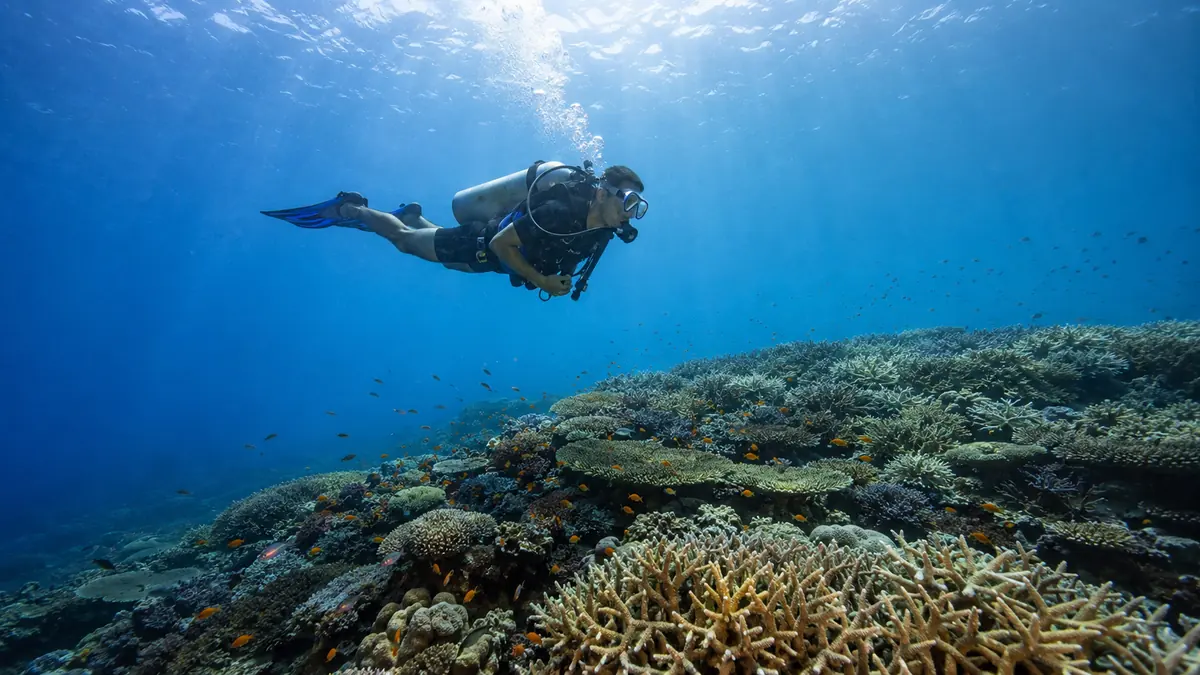
The best place for scuba diving in Havelock depends on your experience. If it is your first ever dive, we take complete beginners and non-swimmers at calm reefs like Nemo Reef, Tribe Gate, Red Pillar, the Aquarium, Juvi’s and Lighthouse, and Lighthouse is the one most first-timers come up raving about. Experienced divers head for the deep sites: The Wall, Dixon’s Pinnacle and Johnny’s Gorge. The best months are December to May, when visibility runs 15 to 30 meters.
People ask me this almost every day on the boat. And the longer answer is that there isn’t one single best site. There is a best site for you, and it depends entirely on whether you have never breathed underwater before, or whether you have two hundred dives in your logbook and you want a current that pulls.
I have guided some of these dives a few hundred times, everyone from people shaking on the boat ladder to divers with more logged hours than me. So instead of handing you a list of twenty sites with the same five adjectives next to each one, I am going to do what I do on the boat. I will ask who you are, and then tell you where to go.
Quick orientation before we start. The diving here is good because the island sits on a drowned mountain range, so you get everything within a short boat ride: shallow sandy reefs, vertical walls, and deep pinnacles out in the blue. The water is warm, roughly 27 to 30 degrees, and on a good day you can see fifteen to twenty-five meters in front of you. Most of our sites are about a ten-minute boat ride from shore. You will barely finish your briefing before we are tying onto the mooring.
So which dive site in Havelock is actually the best?
Here is the real version: there is no single best dive site in Havelock, only the best one for you. For a first dive, that is Nemo Reef. For an experienced diver, it is a deep site like The Wall or Dixon’s Pinnacle. A deep pinnacle full of sharks is wasted on someone doing their first dive, because you will be so busy learning to breathe and equalise that you will not look up. And a calm training reef will bore a diver who has fifty logged dives and wants action.
So I have split this the way I actually think about it: your first ever dive, fun dives once you are certified, the deep stuff for experienced divers, and the one big expedition that everyone asks about. Find yourself in there.
Best for your first ever dive: Nemo Reef, Lighthouse and a few more
Here is something a lot of people do not realise: your first ever dive does not have to be at the training reef. We run Try Scuba dives for complete beginners, non-swimmers included, at a handful of calm reefs: Nemo Reef, Tribe Gate, Red Pillar, the Aquarium, Juvi’s and Lighthouse. Same care, one instructor for every one beginner, no experience needed.
And do not think of these as baby sites. They are properly good dives, the kind experienced divers come back for too. The only difference for a first-timer is that here we can slow everything down and make you comfortable. That is really the whole job, taking a nervous person and getting them breathing easy underwater.
You are probably wondering if you can do this without being a swimmer. You can. For a Try Scuba dive your instructor is holding your gear strap the entire time, and under the current Andaman rules there is one instructor for every one beginner in the water, no groups of four being herded around. You breathe, you look around, and if you want to come up, you give a thumbs up and your instructor brings you up. That is the entire deal.
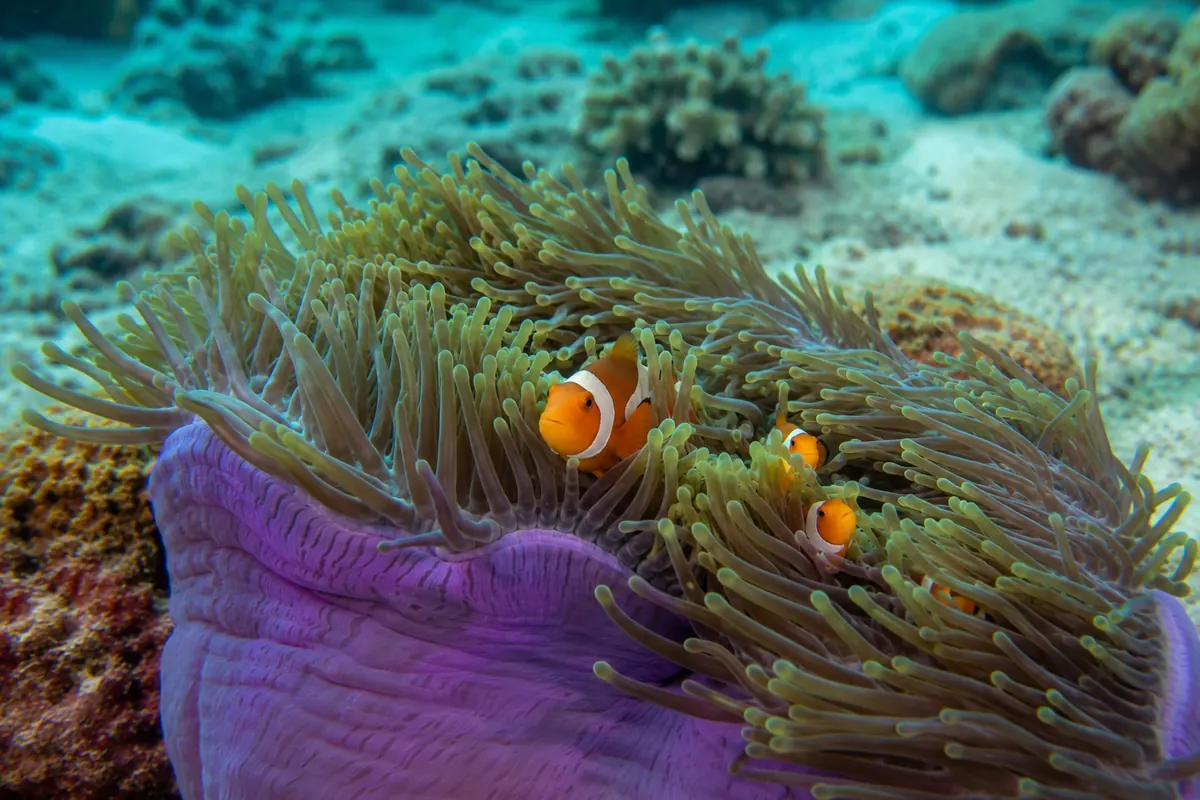
If you want the calmest, gentlest start, go with Nemo Reef. It sits just off Beach No. 2, it is shallow (we usually keep first-timers around six to eight meters, the reef goes to about twelve), and it is protected from the open-ocean current. Clownfish guarding their anemones like tiny angry landlords. Our shore dive there is ₹3,500, inclusive of GST, and it is the easiest place to get used to the strangest part, which is breathing underwater for the first time. (Torn between the two styles? Read my shore dive vs boat dive comparison.)
But if I am honest, the dive most first-timers come up grinning about is Lighthouse. It is a boat dive, a bit further out, with bigger reef structures and more to look at, and people who were nervous on the ladder surface from it absolutely buzzing. It runs ₹6,000. Tribe Gate (₹4,500), Red Pillar (₹4,000) and Juvi’s (₹5,500) sit in between, all good first dives with more coral than the training reef. Tell us how nervous you are and we will pick the right one for you.
Not sure you even want a full dive yet? Snorkeling at Nemo Reef starts at ₹1,500 and lets you see the same reef from the surface. A lot of people do that first, then come back the next morning for a dive once they have seen what is down there.
Best fun dives once you are certified
If you already have your card, you do not need the training wheels. Book fun dives and we take you straight to the good stuff. One dive is ₹3,500, two dives in a day is ₹6,500, which is the better value if you have the time. Bring your card and your last logbook entry so we can match you to the right site.
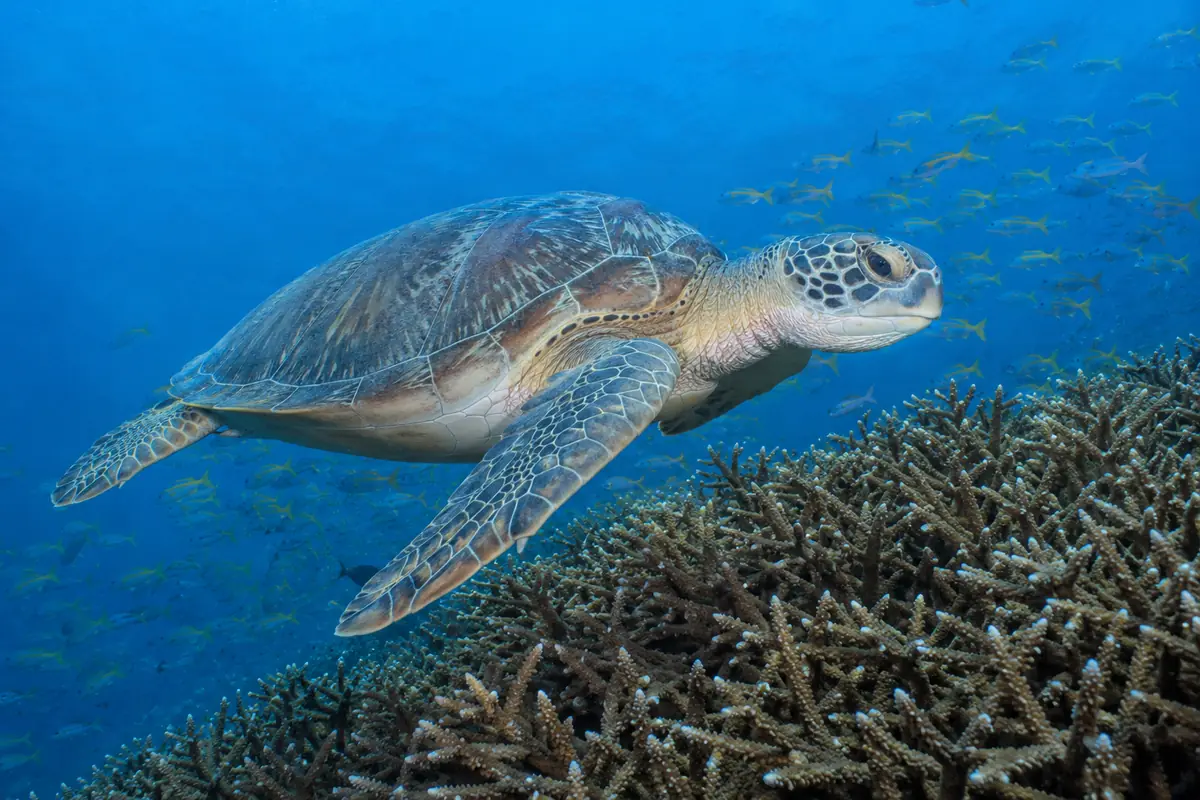
Where do we send certified fun divers? Often the same reefs, honestly. Turtle Beach has sloping staghorn coral and a very good chance of green and hawksbill turtles feeding, not bothered by you at all. Red Pillar is a soft coral garden full of fusiliers, the kind of dive where nothing dramatic happens and you surface grinning anyway. The Aquarium has walls of glassfish and easy, predictable water, good for buoyancy and GoPro footage. Lighthouse, Juvi’s and Tribe Gate are all worth your air too. If it comes down to those last two, we put Tribe Gate and Turtle Beach side by side on prices, depths and what you actually see.
Best for experienced divers: The Wall, Dixon’s Pinnacle and the deep sites
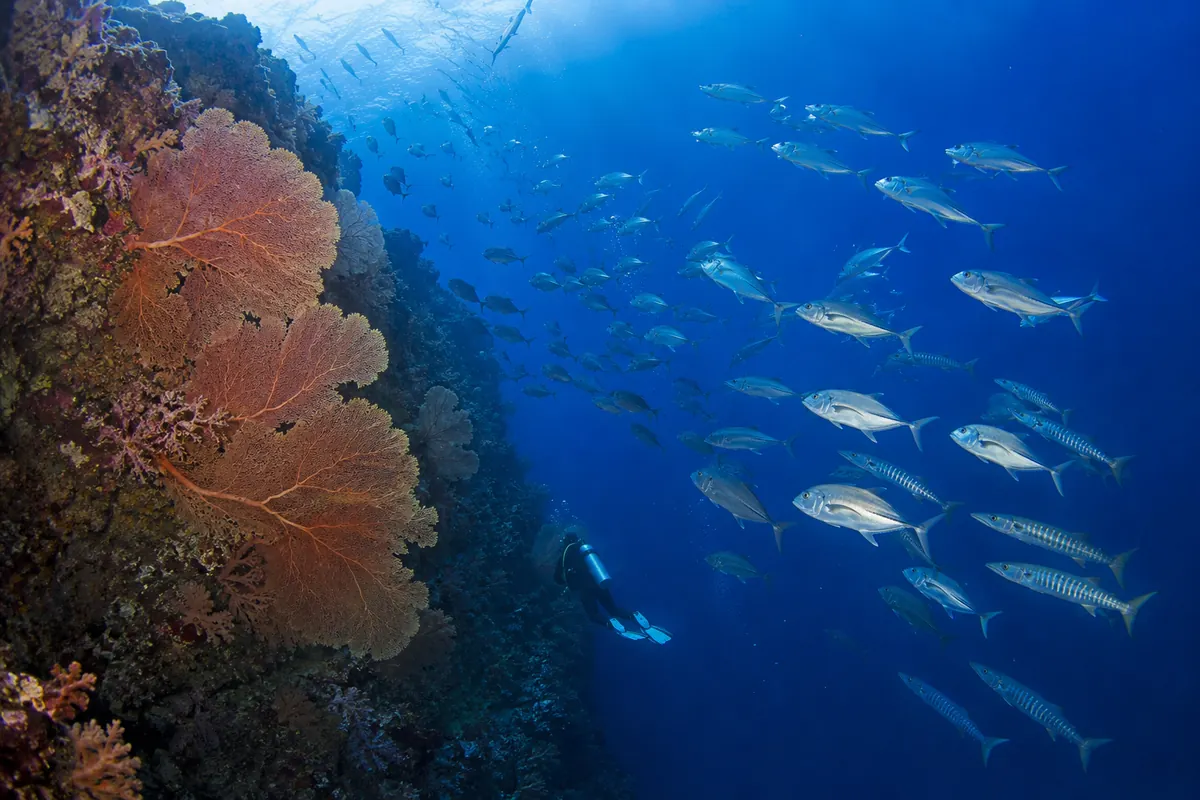
Now we are talking. If you are properly certified and have the dives to back it up, Havelock has a set of deep sites that are as good as anywhere in the Indo-Pacific. This is where I get excited, so let me be specific instead of throwing “world-class” at you.
The Wall sits in the channel between Havelock and Peel Island. It starts as a ridge around ten meters and then just drops, straight down past fifty. The current accelerates over the edge, the sea fans get huge, and the wall draws in hunting trevally and barracuda above the drop-off. There is a resident Napoleon wrasse the divers named Pierre. It is a real wall dive, so it is for people who already have their buoyancy and their air consumption sorted.
Dixon’s Pinnacle is the famous one. Three underwater mountains rising out of the deep, covered in soft coral, and it works as a cleaning station, which means manta rays and, in season, the occasional whale shark come through to get groomed. Johnny’s Gorge and Jackson’s Bar round out the trio of deep sites that divers here half-jokingly call the holy trinity. Johnny’s is all schooling fish and the predators that follow them. Jackson’s Bar has a real current and a sandy bottom carpeted with stingrays, which is why people call it Stingray City.
I want to be straight with you about these. They are deep and some of them have serious current. Under the 2026 Andaman rules, advanced sites are off limits below your certification level, and honestly that is correct. We run them in small groups only, and we will check your logbook before we agree to take you. If you have always wanted to dive sites like these but you are not certified yet, the answer is not to push your luck, it is to do your Open Water and then Advanced, and come back. You can see all twenty-one of our sites and where each one sits on the Havelock dive sites page.
The big one: Barren Island, India’s only active volcano
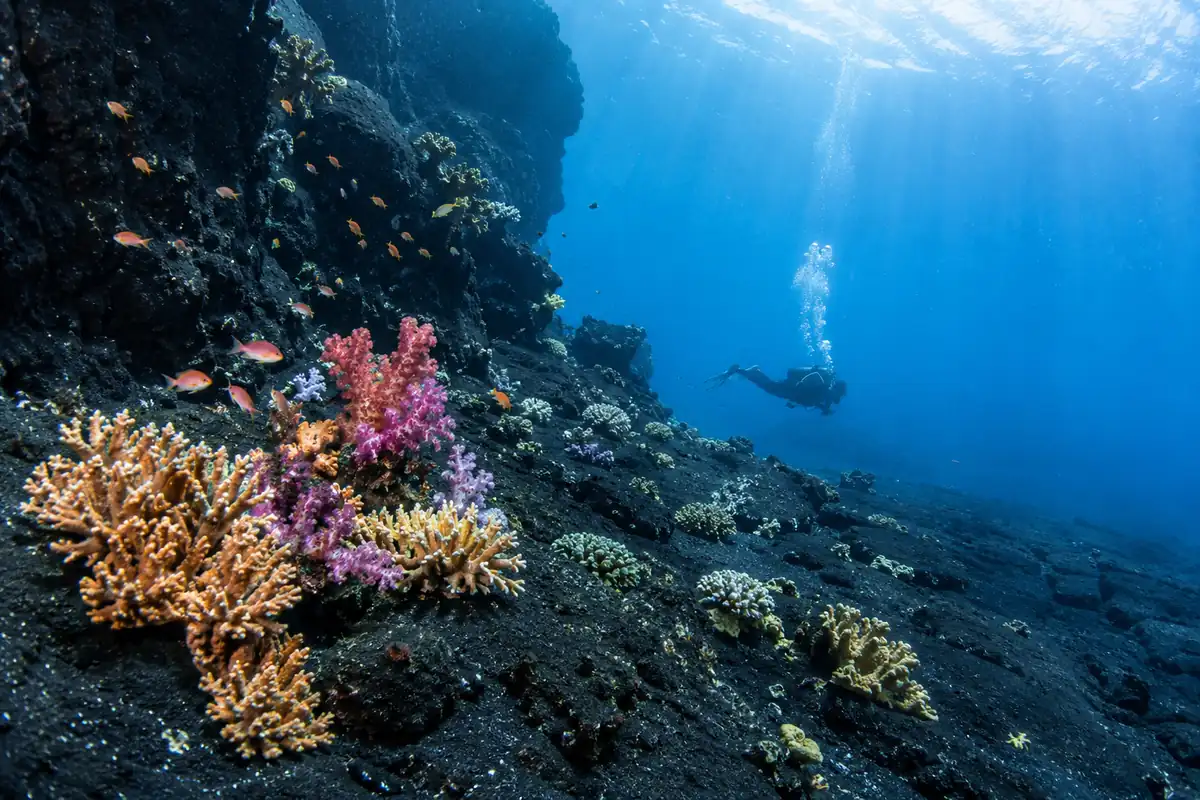
This is the dive everyone reads about, so let me set expectations. Barren Island is an active volcano about 135 kilometers out, and the diving is along black volcanic walls dropping into the deep, with visibility that often beats anything inshore. It is also an advanced-only, all-day, weather-dependent expedition. The open-sea crossing takes around three and a half hours each way, so this only really runs in calmer months, roughly February to April.
It is a premium trip and it is priced like one: ₹40,000 per certified diver for two dives, inclusive of GST, with Forest Department permits (₹500 for Indians, ₹2,500 for foreign nationals) on top. If you are a confident diver with a spare day and the budget, it is one of the most memorable dives in the country. If you are newer, park it. It will still be there when you are ready.
When is the best time to dive in Havelock?
If you can choose, come between December and May. The sea is calm, the water sits around 28 to 30 degrees, and visibility is at its best, fifteen to thirty meters and sometimes more out at the pinnacles. This is also when the big pelagic action is most reliable at the deep sites.
The southwest monsoon, roughly June to September, brings wind and swell, and a lot of the deep and offshore diving simply stops because the sea is too rough to cross safely. Some sheltered inshore diving still runs, and the marine life is actually very active in that nutrient-rich water, but visibility drops and plans get cancelled by weather. October and November are a quieter shoulder season, calmer than the monsoon and less crowded than peak. My honest take: if Barren Island or the deep pinnacles are on your wishlist, plan for February to April and nothing else.
How to spot a legit dive centre (and why I am wary of the ₹2,500 boat dive)
This part matters more than which reef you pick, so read it. In 2026 the Andaman and Nicobar Administration brought in a proper set of dive regulations (the official Directorate of Tourism guidelines), and they were overdue. A few things you can actually use as a checklist when you choose any operator, not just us.
Registered operators are sorted into categories. Category A centres are certified to international (WRSTC and ISO) standards and are the ones legally allowed to run advanced and deep dives. There are hard depth limits now: 12 meters for an introductory Try Scuba dive, 18 meters for entry-level certified divers, around 30 meters for Advanced, and 40 for deep specialties. Every dive boat has to carry medical oxygen and a first-aid kit. Air cylinders have to be pressure-tested under PESO (the Petroleum and Explosives Safety Organisation), and there is a mandatory one-instructor-to-one-beginner ratio for non-swimmers and try-dives. Boats are no longer allowed to drop anchor on coral, they tie onto fixed mooring buoys instead, which is a quiet but huge win for the reef.
Now, the honest bit. You will see ₹2,500 boat dives advertised around the island. There is a name for it in the industry, “tea-bag diving”, because they dip you in for fifteen rushed minutes with no real training and move you on to maximise numbers. A legitimate Try Scuba dive, with proper confined-water skills first and a real 40-plus minute dive, with one instructor on you the whole time, costs what it costs because of all the rules above. If a price looks too cheap to include oxygen on the boat, tested cylinders, and one-on-one supervision, it probably does not include them. Your safety underwater is not the place to save five hundred rupees.
Getting to Havelock: ferries and permits
Havelock has no airport. You fly into Port Blair (officially Sri Vijaya Puram now), then take a ferry across, about 70 kilometers. Private high-speed catamarans like Makruzz, Nautika and ITT Majestic do the crossing in around 90 minutes, with air-conditioned cabins and online booking, which is what I would tell most visitors to use. Green Ocean is a little slower but has an open deck. There are cheaper government ferries too, but they are hard to book online and run on island time, so they are risky if your dive days are fixed. Book your private ferry in advance during peak season, the good slots sell out.
Permits are simpler than people fear. Indian nationals need no special permit for Havelock, just a government photo ID for ferry boarding and check-in. Foreign nationals need a passport valid for six months and an Indian visa; the old Restricted Area Permit has largely been waived for the main tourist islands like Havelock. Citizens of a few specific countries still need a Special Area Permit arranged in advance, so check that early if it applies to you. Small forest-access permits for places like Barren Island are handled by us as part of the trip, so you do not have to chase them yourself.
So what should you actually book?
Let me make it simple.
Never dived, nervous, maybe not a strong swimmer: a Try Scuba dive at Nemo Reef to ease in, or Lighthouse if you want the dive most first-timers rave about. Done a dive or two and loved it: a beginner boat dive at Tribe Gate or Red Pillar. Already certified, here to enjoy yourself: fun dives, two in a day. Experienced and want the deep sites: tell us your logbook and we will plan The Wall or Dixon’s. Want to turn this into a real skill: the Open Water course is the best money you will spend here, because it unlocks every site on this list for the rest of your life, not just one trip.
Quick questions people ask before they book
What is the cheapest legit dive in Havelock?
Our shore Try Scuba dive at Nemo Reef is ₹3,500, inclusive of GST. That includes real training and one-on-one supervision. Be careful of anything advertised well below the going rate, because the cost floor exists for a reason now: oxygen on the boat, tested cylinders, insurance, and one instructor per beginner all cost money.
Can I dive if I cannot swim?
Yes, for a Try Scuba dive. You do not need to be a swimmer, and your instructor will be holding your gear the whole time. We go slow, you stay shallow, and you can surface whenever you want. We wrote more about this in is scuba diving in Andaman safe for non-swimmers.
What is the best month to dive in Havelock?
December to May is the sweet spot: calm sea, warm water, the best visibility, and the most reliable big-animal sightings at the deep sites. The monsoon months, June to September, are the ones to avoid for serious diving.
How many dives should I plan for one trip?
If you are certified, two or three days of diving lets you see the easy reefs and at least one of the deeper sites without rushing. If you are starting from zero, give the Open Water course three to four full days. Remember you cannot fly for 18 to 24 hours after your last dive, so leave a buffer before your flight home.
Is scuba diving in Havelock safe?
It is, when you dive with a properly registered centre that follows the 2026 rules: trained instructors, oxygen on the boat, tested cylinders, and dives kept inside your certification limits. That is exactly what those regulations are for, and it is how we run every trip.
Come dive with us
If any of this made you want to actually get in the water, come find us in Havelock. The easiest thing to do is message us your travel dates before you lock your ferries, so we can fit your dives around the crossings and the tide and get you on the right site for your level. You do not have to decide today. But if you are coming to the Andamans anyway, do at least one dive. Worst case, you tried something most people never do. Best case, we see you again for the Open Water course before you fly home.