Tribe Gate suits most people better: a 5 minute boat ride, 3 to 15 metres deep, ₹4,500 for a try dive. Turtle Beach costs ₹7,000 and about a 30 minute boat ride each way, and what you buy is a staghorn coral garden, white sand and almost nobody else in the water. First dive, tight budget or tight schedule: pick Tribe Gate.
We get asked this on WhatsApp most weeks, usually by someone who has both pages open in two tabs and cannot see why one costs two thousand rupees more than the other. Fair question. Both of them are our dives, so I have no reason to push you either way, and I would rather you spent the money on the one that actually matches your morning.
Book Tribe Gate if
Tribe Gate
₹4,500 incl. GST
It is your first dive, you are nervous about the boat ride, or you want the most reef per rupee. Clownfish and giant clams within a minute of going down.
Book Turtle Beach if
Turtle Beach
₹7,000 incl. GST
You have dived before, or you are a first-timer who feels ready for a longer morning. Best staghorn coral within reach of Havelock, and no other boats on the reef.
Tribe Gate vs Turtle Beach at a glance
| Tribe Gate | Turtle Beach | |
|---|---|---|
| Boat ride | 5 minutes | About 30 minutes |
| Depth | 3 to 15 m | 2 to 18 m, sand deeper still |
| Try dive, uncertified | ₹4,500 | ₹7,000 |
| Fun dive, certified | ₹3,500 | ₹10,000 for two dives |
| The reef | Oval seamount, coral boulders, the 2010 coral ruins | Fringing reef, staghorn over most of it, white sand |
| Known for | All five Andaman clownfish species, giant clams | Staghorn garden, Kuhl’s stingrays, the odd turtle |
| Visibility | 15 to 20 m on a normal day | 20 to 40 m, widest in December and January |
| How busy | Often a few other boats | Usually nobody else |
| Monsoon, June to September | Sheltered, often still runs | Exposed, cancels often |
| Best for | First dives, training, macro, snorkelling | Coral, photography, confident first-timers |
What Tribe Gate is actually like
Tribe Gate is a small underwater hill sitting on its own in the channel between Havelock and John Lawrence Island, which is why some people call it Oval Reef.
The boat ride is 5 minutes. You will still be adjusting your mask strap when the engine cuts. Your instructor takes you down a mooring line to the top of the reef at about 3 or 4 metres, and from there the coral falls away in steps to a sandy edge at 14 or 15 metres. You circle the hill and come back up the same line. There is nowhere to get lost, which matters more than people expect on a first dive.
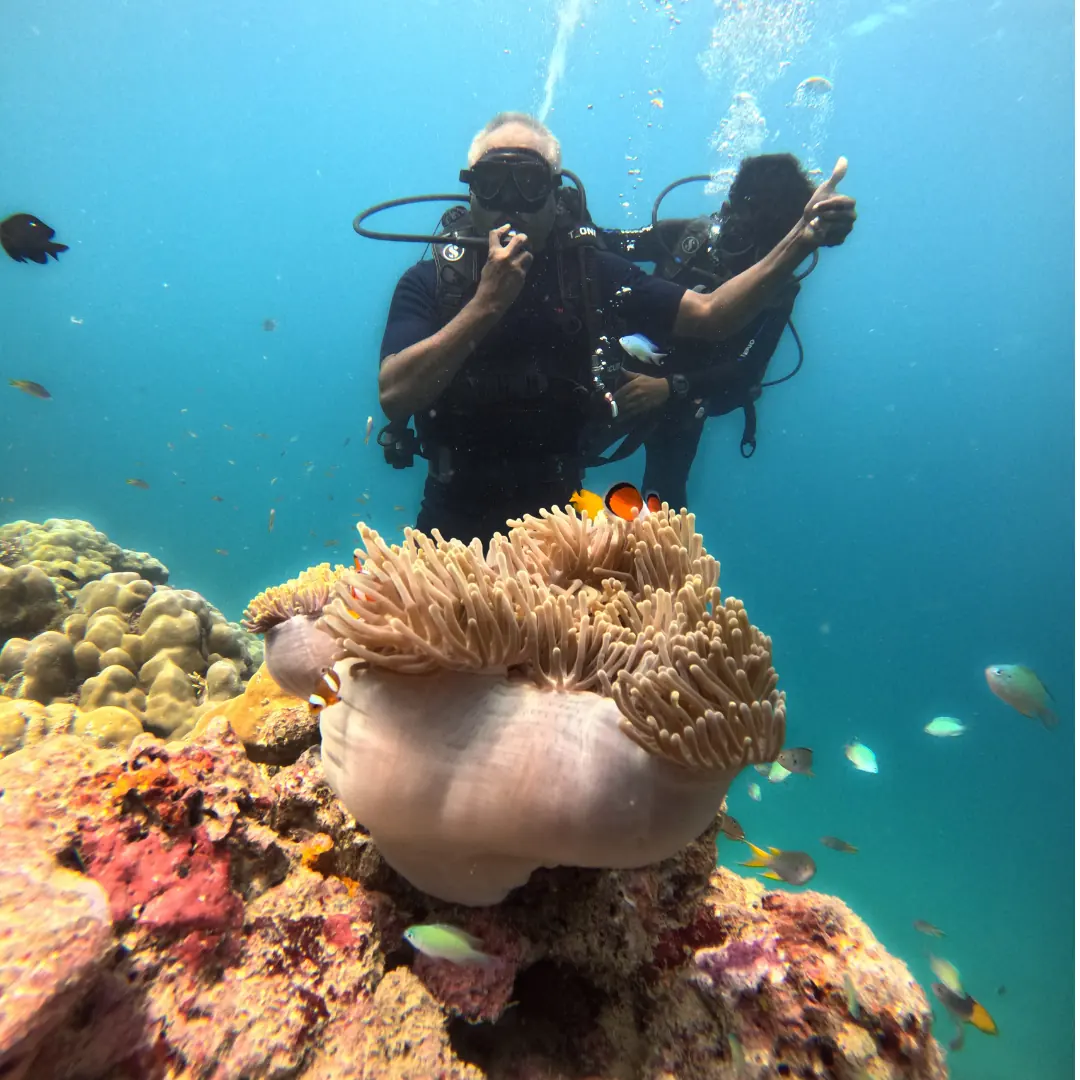
The top of the reef is anemones. Tribe Gate is the one site around here where all five of the Andaman’s clownfish species live, and while you will not tick off all five in a single dive, you will be looking at clownfish within about a minute of leaving the surface.
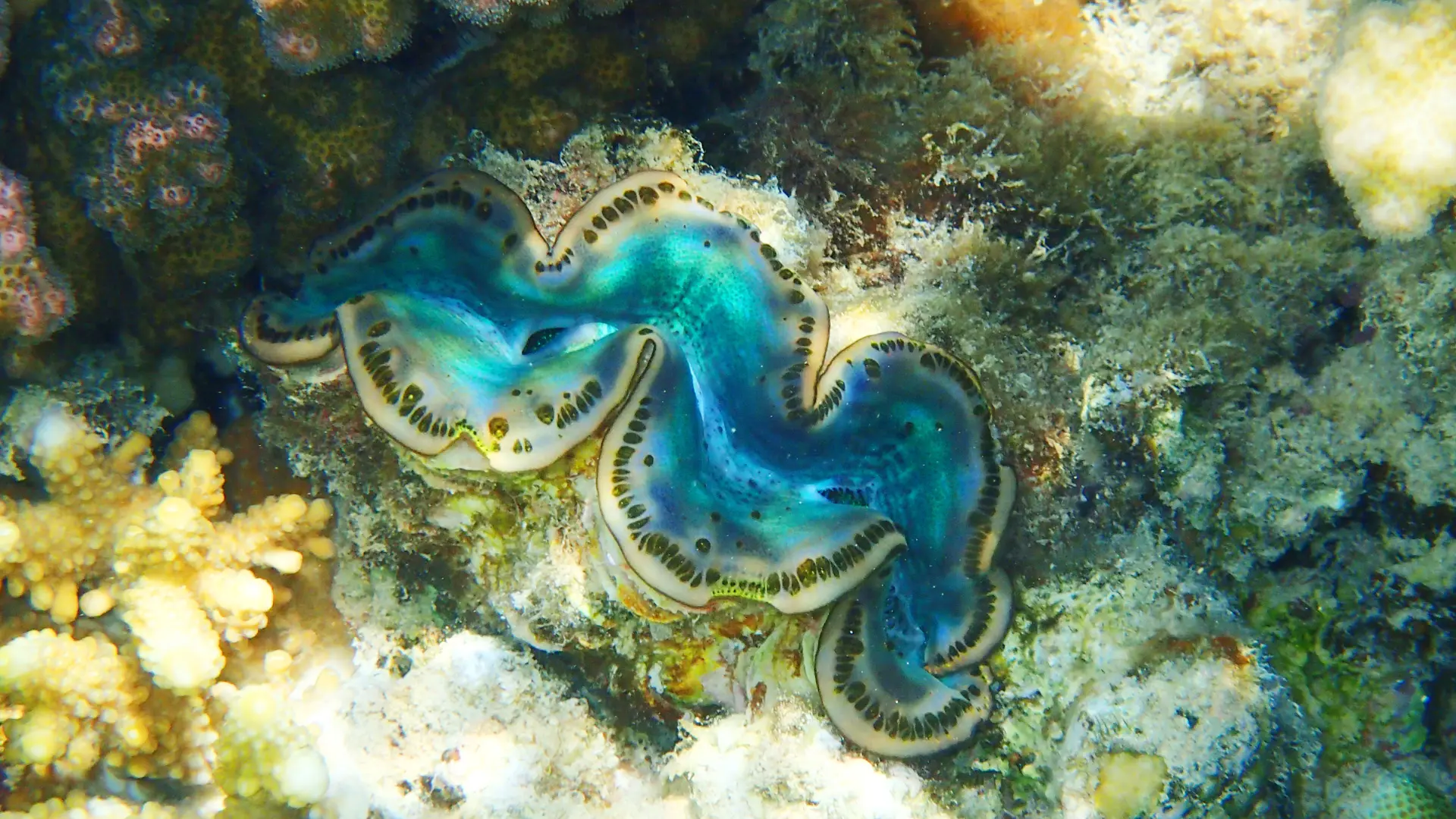
The other thing this reef has more of than anywhere else nearby is giant clams. Tridacna, half a metre across, with mantles in electric blue and green. Swim your shadow over one and it shuts. Kids love that. So do adults, they just pretend otherwise.
Then there is the part I like most, which is technically a graveyard. In 2010 the sea got too warm for too long and a whole stand of Pavona coral here died. The skeletons never collapsed. They are still standing, a low field of pale pillars and gaps, and over fifteen years sponges and encrusting growth have covered them. Moray eels live in the holes now. Octopus, stonefish, nudibranchs the size of your thumbnail. It is more alive dead than a lot of reefs are alive.
Visibility runs about 15 to 20 metres on a normal day. Currents are mild. It is a calm, busy, close-up sort of dive.
What Turtle Beach is actually like
Turtle Beach is a fringing reef along the south-east coast of the island, about a 30 minute boat ride away, and the difference hits you before you get in the water.
Nobody is there. Most of Havelock’s dive traffic works the sites near the jetty, so at Turtle Beach you often have the reef to yourselves. On a Tribe Gate morning there may be three other boats on the mooring. Here, usually none.
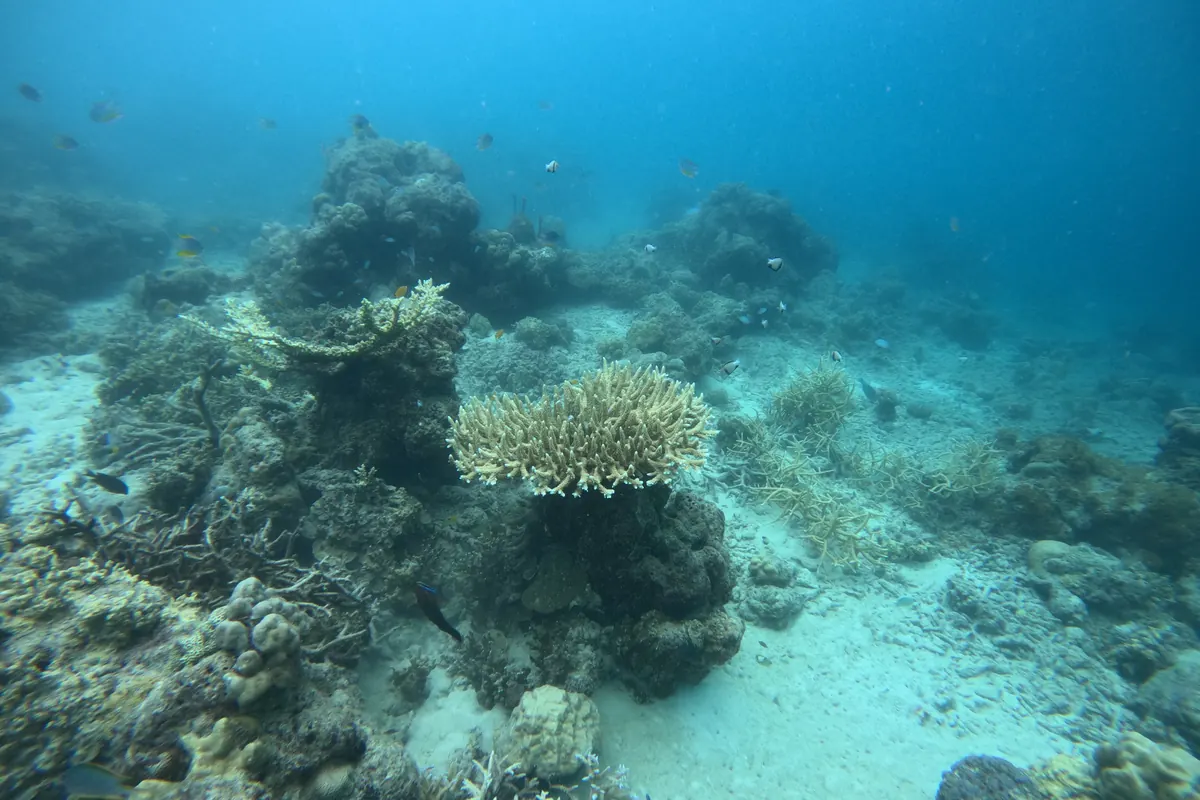
The reef starts at 2 or 3 metres and slopes down over white sand to 18 metres and more, and most of that reef is staghorn coral. Acropora, the branching kind, growing in stands you swim along rather than around. It is the healthiest big field of it I know within reach of Havelock, and it is healthy exactly because it is far and awkward to get to.
The sand is the other thing. It is fine and white and it throws light back up under the coral, so the whole dive is brighter than it should be at that depth. Visibility here runs 20 to 40 metres, and in December and January it can be silly.
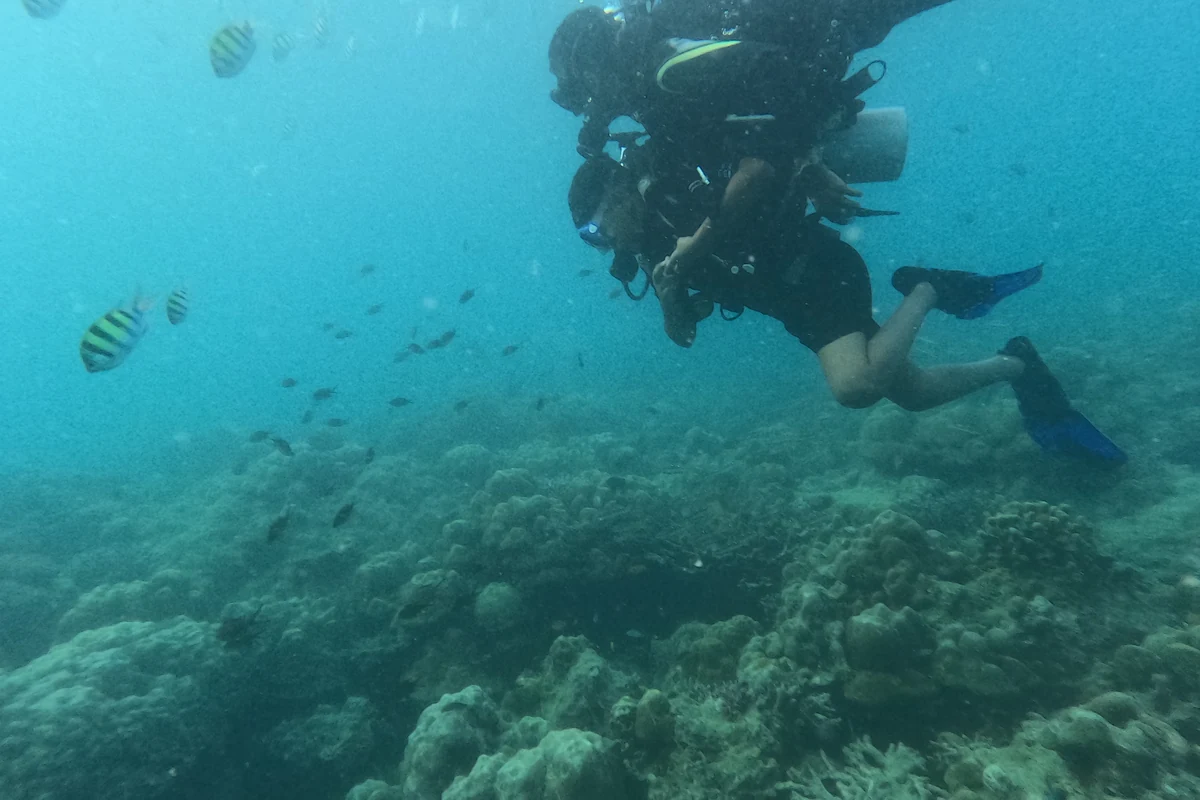
You will often spot Kuhl’s stingrays parked on the sand with just their eyes showing. Bannerfish in loose schools. Humphead parrotfish you hear before you see, because they crunch coral like someone eating an apple two rows behind you at the cinema.
The whole dive is slower and wider than Tribe Gate. Less to peer at up close, more to look across.
About that name: you are not guaranteed a turtle
The name comes from turtles nesting on the sand there years ago. It was never a description of what you would see underwater.
Sea turtles once nested on beaches all around Havelock. These days the serious nesting beaches in the Andamans are much further out on the remote southern islands, and Havelock’s own beaches see very little of it. The name outlived the turtles that earned it.
Underwater the odds are better. Green and hawksbill turtles feed along the deeper edge of this reef and they do turn up. Some weeks we see one on most dives. Some weeks nobody sees one for days.
Worth saying plainly: nobody, us included, can guarantee you a specific animal on a specific morning. Book Turtle Beach for the coral and the quiet. If a turtle shows up, that is your morning made.
Why Turtle Beach costs ₹2,500 more
The gap is fuel and boat hours. Nobody is charging you extra for the word turtle.
A Tribe Gate boat can do three trips in a morning because the site is 5 minutes away. A Turtle Beach boat does one, because an hour of the morning goes on getting there and back, with a captain and crew on board the whole time. That hour has to be paid for by the people on the boat, and there are only so many of you.
So what the extra ₹2,500 actually buys is boat time and an empty reef, with better coral thrown in. It does not buy a better dive by any objective measure. On pure things-to-look-at-per-minute, Tribe Gate holds its own easily.
If this is your first ever dive
Take Tribe Gate. I would say the same thing if we did not run it.
Everything a nervous first-timer needs is stacked in its favour. A five minute boat ride means very little time to sit and think about it, and almost no chance of feeling seasick. The reef top at 3 metres means your instructor can settle you in shallow water where the light is bright and there is something to look at immediately. And the mooring line gives you a physical thing to hold on the way down. Going down a line at your own pace is the single biggest difference between a good first dive and a bad one.
You do not need to swim, and you do not need to be fit. Try dives run one instructor to one diver, and you stay above 12 metres, which is well inside what Tribe Gate offers anyway. If you want the longer version of that reassurance, we wrote a whole guide on scuba diving for non-swimmers.
Half an hour underwater is the standard Tribe Gate try dive at ₹4,500. The Pro version at ₹5,500 buys you 45 minutes and more photos, and for a first dive I think that is the better ₹1,000 you will spend all day, because the first ten minutes usually go to just getting your breathing settled.
None of that means Turtle Beach is closed to you. We take beginners there, and we are happy to, as long as you are ready for it.
Ready means a few simple things. You are calm about a longer boat ride. You are comfortable being in water you cannot stand up in, even with an instructor holding you. And you actually want to be there, rather than being talked into it by someone else in your group. Meet those and your instructor will take you, on the same 12 metre limit and the same one to one ratio as anywhere else.
If you are not there yet, we will tell you. It is a bigger, longer, more expensive morning, and starting your diving life feeling rushed is a poor trade for prettier coral. So tell us straight how you feel about water when you book, and we will put you on the right boat. We would rather have that conversation than sell you the wrong morning.
If you are already certified, read this bit
For certified divers the gap widens and the answer changes.
A fun dive at Tribe Gate is ₹3,500. Turtle Beach is a premium site, sold as two dives for ₹10,000, because it sits in our premium tier. That same premium tier also holds Johnny’s Gorge, Dixon’s Pinnacle and Jackson’s Bar. Same ₹10,000 for two dives, which a booking page will not go out of its way to mention.
So if you have a card and you are chasing big fish, spend that ₹10,000 at Johnny’s Gorge instead, where white-tip reef sharks and walls of barracuda are the normal outcome rather than the lucky one. Turtle Beach at ₹10,000 for two dives makes sense when you specifically want coral, sand, macro and an empty reef. Both are good reasons. They are just different reasons, and I would hate for you to pay deep-site money expecting deep-site fish.
If you want two dives in a morning, the standard pair is ₹6,500 and the premium pair is ₹10,000. Bring your own gear and knock ₹500 off each dive.
The month you visit might decide it for you
From roughly October to May both sites run almost every day, and this whole comparison is a real choice.
In the monsoon it stops being one. Tribe Gate sits in a sheltered channel with land on both sides breaking the wind, so it keeps running on days when much of Havelock’s diving is off. Turtle Beach faces open water on the south-east side and takes the south-west monsoon swell straight on, so from June to September it is the first thing we cancel and the last thing to come back.
If you are here between December and February you will get the best of Turtle Beach: 30 metres of visibility and flat water. If you are here in July, do not build your trip around it.
Can you do both?
Yes, and it is the pattern I would suggest if you have three days on the island.
Tribe Gate first. Get your breathing sorted, find out whether you actually enjoy being underwater, and spend the small money finding out. Then Turtle Beach on another day, once you are relaxed enough to look around properly instead of concentrating on your regulator.
Doing it the other way round works, it is just an expensive place to discover that you do not like the mask on your face.
If you end up loving it, the maths changes again. Four days and ₹29,000 gets you the RAID Open Water course and a certification that works anywhere in the world, and some of your training dives happen on these same reefs.
Questions we get about these two sites
Which is better for beginners, Tribe Gate or Turtle Beach?
Tribe Gate, for most beginners. The 5 minute boat ride, the shallow 3 metre reef top and the mooring line to hold on the way down all make the first fifteen minutes easier, and that is the part that decides whether someone enjoys their first dive. We do take beginners to Turtle Beach as well, on the same 12 metre limit and the same one to one ratio, as long as you are confident in the water and happy with the longer boat ride.
Will I see a turtle at Turtle Beach?
Sometimes, not always. Green and hawksbill turtles feed along the deeper edge of the reef and show up on a decent share of dives, but no dive centre can promise you one. The site takes its name from turtles that used to nest on the beach above the waterline, which is a piece of history rather than a forecast.
Is Turtle Beach worth ₹2,500 more than Tribe Gate?
It depends on what you want from the morning. The extra cost covers about an hour of boat time and a much quieter reef, and the staghorn coral there is genuinely better than anything close to the jetty. If it is your first dive, or you are counting rupees, Tribe Gate gives you more per rupee. If you have dived before and want space and coral, Turtle Beach earns it.
How deep do you go at each site?
Tribe Gate runs from about 3 metres at the reef top to 14 or 15 metres at the sandy edge. Turtle Beach starts at 2 to 3 metres and the sand drops past 18 metres. Uncertified divers stay above 12 metres at both, so on a try dive the depth difference does not really affect you.
Can I snorkel these sites instead of diving?
Tribe Gate is the better snorkel of the two, because the reef top sits at 3 to 4 metres and you can see the clownfish and the clams clearly from the surface. We run it as a separate Tribe Gate snorkelling trip. Turtle Beach snorkelling is usually sold as part of a longer boat day rather than on its own.
What is the best time of year for both?
December to February is the strongest window: flat seas, warm water and the widest visibility of the year. March to May is nearly as good and less busy. October and November are underrated, because the fish activity after the monsoon is excellent even if the water is not quite as clear. June to September is monsoon, and Turtle Beach in particular closes often.
Still not sure?
Message us on WhatsApp with two things: whether you have dived before, and how many days you have on Havelock. That is usually enough for us to tell you which of the two fits, and if the answer is that you should do the shore dive first instead, we will say so.
Book before you lock your ferry dates rather than after, because slots in season go quickly. And keep your last dive at least 18 to 24 hours before your flight home. If you want to see the rest of what is out there first, the full list is on our Havelock dive sites page.
{
“@context”: “https://schema.org”,
“@type”: “FAQPage”,
“mainEntity”: [
{
“@type”: “Question”,
“name”: “Which is better for beginners, Tribe Gate or Turtle Beach?”,
“acceptedAnswer”: {
“@type”: “Answer”,
“text”: “Tribe Gate, for most beginners. The 5 minute boat ride, the shallow 3 metre reef top and the mooring line to hold on the way down all make the first fifteen minutes easier. Beginners can dive Turtle Beach too, on the same 12 metre limit and the same one to one ratio, as long as they are confident in the water and happy with the longer boat ride.”
}
},
{
“@type”: “Question”,
“name”: “Will I see a turtle at Turtle Beach in Havelock?”,
“acceptedAnswer”: {
“@type”: “Answer”,
“text”: “Sometimes, not always. Green and hawksbill turtles feed along the deeper edge of the reef and show up on a decent share of dives, but no dive centre can promise you one. The site takes its name from turtles that used to nest on the beach above the waterline, which is a piece of history rather than a forecast.”
}
},
{
“@type”: “Question”,
“name”: “Is Turtle Beach worth 2000 rupees more than Tribe Gate?”,
“acceptedAnswer”: {
“@type”: “Answer”,
“text”: “It depends on what you want from the morning. The extra cost covers about an hour of boat time and a much quieter reef, and the staghorn coral there is better than anything close to the jetty. For a first dive, Tribe Gate gives you more per rupee at 4,500 against 7,000.”
}
},
{
“@type”: “Question”,
“name”: “How deep do you dive at Tribe Gate and Turtle Beach?”,
“acceptedAnswer”: {
“@type”: “Answer”,
“text”: “Tribe Gate runs from about 3 metres at the reef top to 14 or 15 metres at the sandy edge. Turtle Beach starts at 2 to 3 metres and the sand drops past 18 metres. Uncertified divers stay above 12 metres at both sites.”
}
},
{
“@type”: “Question”,
“name”: “Can I snorkel at Tribe Gate or Turtle Beach instead of diving?”,
“acceptedAnswer”: {
“@type”: “Answer”,
“text”: “Tribe Gate is the better snorkel of the two, because the reef top sits at 3 to 4 metres and you can see clownfish and giant clams clearly from the surface. Turtle Beach snorkelling is usually sold as part of a longer boat day rather than on its own.”
}
},
{
“@type”: “Question”,
“name”: “What is the best time of year to dive Tribe Gate and Turtle Beach?”,
“acceptedAnswer”: {
“@type”: “Answer”,
“text”: “December to February is the strongest window: flat seas, warm water and the widest visibility of the year. March to May is nearly as good and less busy. June to September is monsoon, and Turtle Beach in particular closes often because it faces the open sea.”
}
}
]
}