A reef guide to the islands

Corals of Andamanand how to tell them apart

54 corals you can see on a coral reef in Andaman: table corals, brain corals, soft corals, sea fans and more. Each one has a photo, what to look for and where it has been recorded. The facts are checked against Zoological Survey of India surveys and the IUCN Red List. Tap any coral to open its page.

  • 54corals in this guide
  • 523hard coral species recorded in A&N
  • Sch. Ilegal protection for every hard coral
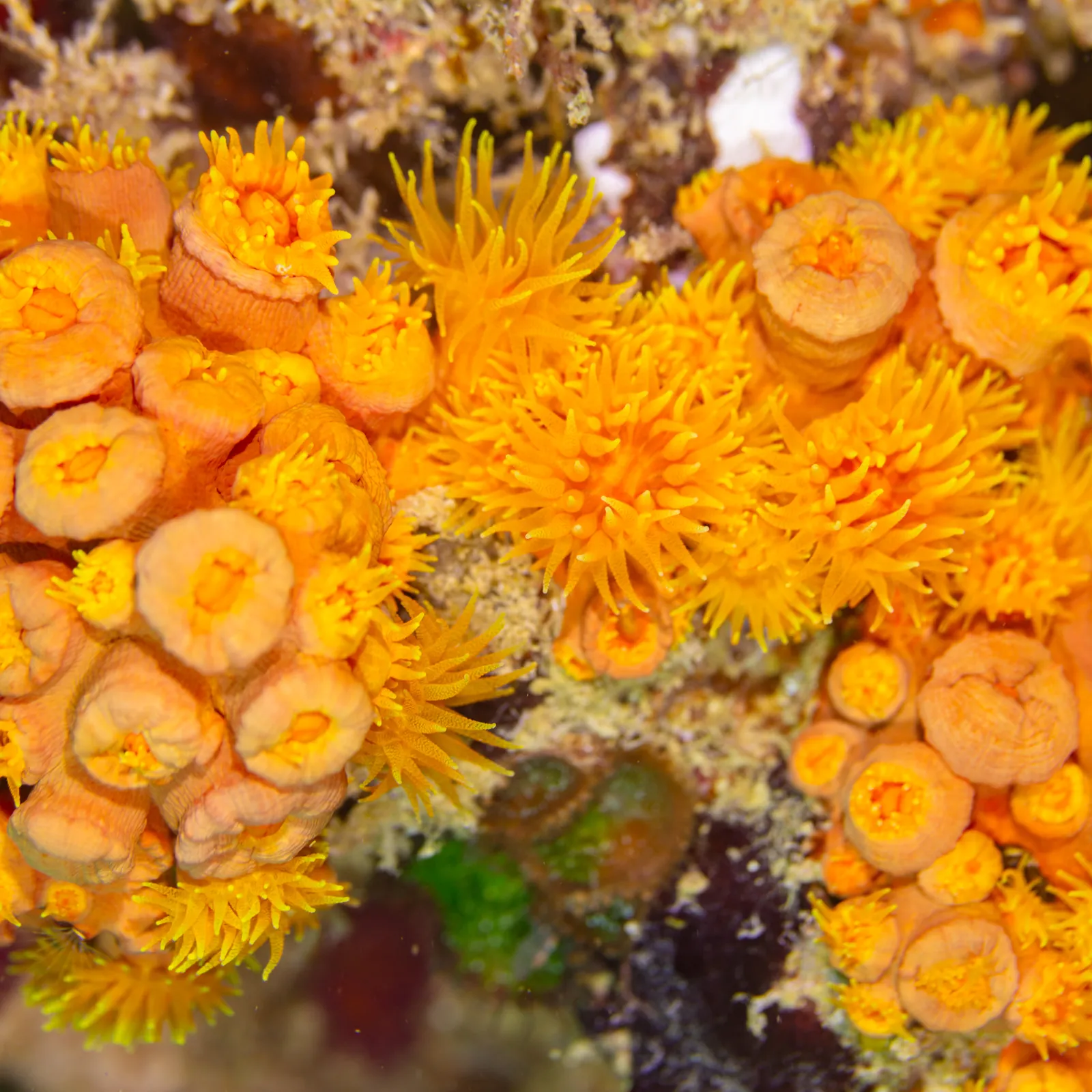
Orange Cup Coral (Tubastraea coccinea)

Photo: Harvinder Chandigarh

The coral reefs of the Andaman and Nicobar Islands hold more hard coral species than any other reef area in India: 523 in the latest checklist (2020). Most are fringing reefs that grow close to the shore, so many corals sit in water shallow enough to see with a mask and snorkel. The calm season for reef trips is roughly November to April.

Know the shapes first

Hundreds of coral species live here, and few people can name them. You do not need to. The easiest way to sort the types of coral is by shape. Tap a shape to see the corals that grow that way.

All 54 corals

Filter by shape, or search by any name, old scientific names included. Each coral opens its own page with ID tips, notes on how it lives and the places in Andaman where it has been recorded.

Showing 54 corals. Tap any coral to read about it.

PLATE 01Hard coralIUCN: EndangeredSchedule I

Tabling Acropora

Acropora cytherea

Also called Table coral

A big, flat table coral made of thousands of fine branchlets. Tables can grow up to about 5 m across, so a large one is hard to miss on the upper reef slope.

Family
Acroporidae
Shape
Wide, thin, flat table
Size
Tables up to about 5 m across
Depth
About 3-25 m
Colours
Pale cream, brown or blue
Polyps
Often out by day

Older Indian coral lists record it under other names, such as Acropora efflorescens.

How to identify it

  • A wide, flat, thin table with a fine, lacy top.
  • Short branchlets point upwards.
  • The cup at the tip of each branchlet sticks out above the rest.
  • Tentacles are often out during the day.

Where to see it in the Andamans

Upper reef slopes, drop-offs and lagoons, at about 3-25 m. A ZSI survey of Ritchie's Archipelago recorded it at Havelock (Swaraj Dweep) and Neil (Shaheed Dweep), and at seven other islands. It also appears in a 2018-19 CMFRI photo survey of reefs at Havelock, Neil, North Bay and Wandoor, though that paper pools the four sites and calls its IDs tentative.

Did you know?

Look for its tentacles in daylight. This table coral often feeds by day, when most corals keep theirs pulled in until night.

How it lives

The tiny algae inside it make food from sunlight and pass most of it to the coral. It also catches tiny drifting animals with its tentacles.

Easy to confuse with

  • Brush Coral: The cup at each branchlet tip does not stick out, and the side cups form small rosettes.

Sources: Mondal et al. 2012 (Ritchie's Archipelago survey), De et al. 2020 (hard coral checklist), Pillai 1983, Laxmilatha et al. 2021, Krishnan et al. 2011, WoRMS

PLATE 02Hard coralIUCN: EndangeredSchedule I

Finger Coral

Acropora humilis

A low clump of thick, finger-like branches on shallow reef tops and reef flats. Each finger tapers to one large, dome-shaped cup at the tip. A 2018-19 CMFRI photo survey of reefs at Havelock, Neil, North Bay and Wandoor named it among the main corals (sites pooled, IDs tentative).

Family
Acroporidae
Shape
Low clump of thick fingers
Size
Fingers usually under 20 cm long
Depth
About 3-10 m
Colours
Cream, brown, purple or blue, often with blue or cream tips

How to identify it

  • A low clump of thick fingers, usually under 20 cm long.
  • Each finger tapers to a large, dome-shaped cup at the tip.
  • Small side branches or extra tip cups at the base of the fingers.
  • Side cups of two sizes, the bigger ones in rows.

Where to see it in the Andamans

Reef flats, reef tops and upper reef slopes open to the waves, at about 3-10 m. The Zoological Survey of India's survey of Ritchie's Archipelago found it at Havelock (Swaraj Dweep) and Neil (Shaheed Dweep), and at seven other islands.

Did you know?

Blue colonies of this coral can come out purple in photos, so a "purple" finger coral in a picture may be blue in real life.

How it lives

Each finger is covered in tiny polyps, the small animals that build the coral. Most of their food comes from algae living in their tissue. The polyps also catch tiny drifting animals, mostly at night.

Easy to confuse with

  • Digitate Acropora: Much thinner fingers, often rising from a flat plate.
  • Acropora gemmifera: The tip cup is smaller, and the side cups get longer towards the base of each finger.

Sources: Mondal et al. 2012 (Ritchie's Archipelago survey), Pillai 1983, Laxmilatha et al. 2021, Krishnan et al. 2011, WoRMS, SeaLifeBase (IUCN status)

PLATE 03Hard coralIUCN: EndangeredSchedule I

Staghorn Coral

Acropora muricata

Also called Acropora formosa (old name)

The staghorn coral of the Indian Ocean and Pacific, with round branches like a deer's antlers. It grows into thickets on reef slopes and in lagoons. Under its old name, Acropora formosa, it was named as one of the main Acropora corals in a 2010 bleaching survey of Andaman reefs.

Family
Acroporidae
Shape
Branching, like antlers
Size
Grows into thickets
Colours
Cream, brown or blue, with pale branch ends

Some guides call this Acropora cervicornis, but that staghorn lives only in the Caribbean and western Atlantic. The staghorn of the Andamans is Acropora muricata, long known as Acropora formosa.

How to identify it

  • Tree-like colonies of round branches, like antlers.
  • Forms thickets.
  • Short, compact branches in shallow water; longer, more open branches deeper down.
  • The cup at each branch tip sticks out; the side cups are small tubes.
  • Branch ends are usually paler.

Where to see it in the Andamans

Reef slopes and lagoons. Under its old name it was named as one of the main Acropora corals in a 2010 bleaching survey of seven Andaman reef sites, two of them at Havelock (the Aquarium and Wall dive sites); the paper does not say which sites each coral grew at. The 2018-19 CMFRI photo survey listed it too (Havelock, Neil, North Bay and Wandoor pooled, IDs tentative).

Did you know?

A single stand of this staghorn can spread over more than 10 metres of reef.

How it lives

It gets most of its food from tiny algae living inside it, and catches tiny drifting animals with its tentacles, mostly at night. The branches are short and compact in shallow water and grow longer and more open deeper down.

Heat, bleaching and threats

Very sensitive to heat. In April and May 2010 the sea around the Andamans stayed above 31°C for a long time, and branching Acropora corals were the worst hit. Large Acropora beds at South Button were almost 100% bleached.

Easy to confuse with

  • Acropora intermedia: Another staghorn. Its side cups look rough, like a file.
  • Acropora cervicornis: Looks the same, but lives only in the Caribbean and western Atlantic, not in the Andamans.

Sources: De et al. 2020 (hard coral checklist), Pillai 1983, Krishnan et al. 2011, Laxmilatha et al. 2021, WoRMS

PLATE 04Hard coralIUCN: EndangeredSchedule I

Catch Bowl Coral

Isopora palifera

Also called Acropora palifera (old name)

A sturdy coral that grows as thick plates with upright ridges, columns or blades. It was once placed in Acropora, but it usually has no single big cup at the branch tip.

Family
Acroporidae
Shape
Thick plates with upright ridges or columns
Size
Branches usually under 10 cm across
Depth
About 2-20 m
Colours
Pale cream or brown

How to identify it

  • Thick, crust-like plates with upright ridges, columns or blades.
  • Tall and upright in calm water; low and uneven where waves are strong.
  • Usually no bigger cup at the branch tip (Acropora has one).
  • Cups are smooth, rounded and stick out a little.
  • Pale cream or brown.

Where to see it in the Andamans

Found in all kinds of reef, at about 2-20 m, and can take over wave-washed parts of the reef. In a survey of Ritchie's Archipelago, the Zoological Survey of India found it at Havelock (Swaraj Dweep) and Neil (Shaheed Dweep), and at five other islands (under its old name, Acropora palifera).

Did you know?

On the northern Great Barrier Reef it is the most common coral of all, and the main coral on most outer reef slopes open to the waves.

How it lives

The shape of each colony follows the waves. In calm water it grows tall ridges and columns. On reef beaten by waves it stays low and lumpy.

Easy to confuse with

  • Isopora cuneata: Smaller, flatter branches and finer, rounder cups. Hard to tell apart unless both grow side by side.

Sources: Mondal et al. 2012 (Ritchie's Archipelago survey), Pillai 1983, Laxmilatha et al. 2021, Krishnan et al. 2011, WoRMS, SeaLifeBase (IUCN status)

PLATE 05Hard coralIUCN: EndangeredSchedule I

Blue Rice Coral

Montipora tuberculosa

Also called Rice coral

An encrusting coral that spreads over rock as a sheet or as low lumps, covered in tiny bumps. The tips of the bumps are often a different colour, which gives it a speckled look.

Family
Acroporidae
Shape
Crusts and low lumps covered in tiny bumps
Depth
0-52 m
Colours
Brown or green, sometimes bright blue

Divers in the Andamans call the bright blue, bumpy Montipora they see "blue rice coral". In books that name belongs to Montipora flabellata. The Zoological Survey of India lists M. flabellata for the islands, but coral experts map it only in Hawaii and a few nearby Pacific atolls, so the blue ones here are probably another Montipora, such as M. tuberculosa. Telling them apart needs a close look at the skeleton.

How to identify it

  • Flat crusts or low, lumpy colonies.
  • Surface covered in small bumps, each about as wide as one cup.
  • Tiny cups, some raised, some sunk into the surface.
  • Blue colonies may look pink or purple in photos.

Where to see it in the Andamans

Most kinds of reef, from the surface down to about 52 m. Recorded at Havelock (Swaraj Dweep), Nicolson and Inglis islands in a ZSI survey of Ritchie's Archipelago. A CMFRI photo survey in 2018-19 also lists it for the Havelock, Neil, North Bay and Wandoor reefs, with the sites pooled and the IDs marked tentative.

Did you know?

Most colonies are plain brown or green. The bright blue ones are less common, and they are the ones divers remember. On camera the blue can turn pink or purple.

How it lives

There is one polyp in each tiny cup: a small animal with a ring of tentacles. The algae in its tissue supply most of its food, and at night the polyps also catch tiny drifting animals.

Easy to confuse with

  • Montipora monasteriata: Has larger bumps between the cups.
  • Montipora aequituberculata: Grows as thin, overlapping plates or whorls, not lumps.

Sources: Mondal et al. 2012 (Ritchie's Archipelago survey), Laxmilatha et al. 2021, Pillai 1983, WoRMS, SeaLifeBase (IUCN status), IUCN 2024 coral reassessment

PLATE 06Hard coralIUCN: EndangeredSchedule I

Brush Coral

Acropora hyacinthus

Also called Table coral

The classic table coral. A long-lived colony can grow into a table several metres wide, held up on one central stalk. All its fine branchlets reach the same height, which keeps the top flat.

Family
Acroporidae
Shape
Flat tables or tiers of plates
Size
Tables can reach several metres across
Depth
0-52 m, mostly shallow
Colours
Cream, brown, grey or green, sometimes with blue edges

How to identify it

  • Wide, flat plates or tables, or tiers of small plates.
  • Held up on a central stalk.
  • Fine branchlets all point up to the same height.
  • Side cups form tiny rosettes.
  • Blue edges may look pink in photos.

Where to see it in the Andamans

Upper reef slopes and outer reef flats, most common in shallow to middle depths. Of the 11 islands in a ZSI survey of Ritchie's Archipelago, it was found on eight, Havelock (Swaraj Dweep) and Neil (Shaheed Dweep) among them.

Did you know?

Divers usually just call it a table coral. "Brush Coral" is its English name on the IUCN Red List.

How it lives

A table is one colony: thousands of tiny polyps joined by a thin living skin over a stony skeleton. Big tables are long-lived.

Heat, bleaching and threats

One of the corals that bleaches most easily. In Palau its death rate after bleaching was estimated at close to 100%.

Easy to confuse with

  • Tabling Acropora: The cup at each branchlet tip sticks out, and the side cups do not form rosettes.

Sources: Mondal et al. 2012 (Ritchie's Archipelago survey), Pillai 1983, Krishnan et al. 2011, WoRMS, SeaLifeBase (IUCN status), IUCN Red List

PLATE 07Hard coralIUCN: EndangeredSchedule I

Digitate Acropora

Acropora digitifera

A low coral of short, thin fingers on a flat base plate. It lives in very shallow water, even on reef flats between the tides. Plates are often more than 1 m across.

Family
Acroporidae
Shape
Short fingers on a flat plate
Size
Plates often over 1 m across
Depth
About 0-12 m
Colours
Purple, pale brown, cream or yellow, with paler tips

This coral has no widely used English name, so the guide uses a plain description.

How to identify it

  • Short, small fingers rising from a flat plate.
  • Fingers round or slightly tapered, sometimes with side branches.
  • Side cups are small tubes, all the same size, with slightly flared lips.
  • Branch tips are often pale blue, cream or yellow.

Where to see it in the Andamans

Wave-washed back edges of reefs and reef flats between the tides, from the surface to about 12 m. The Zoological Survey of India's survey of Ritchie's Archipelago found it at Havelock (Swaraj Dweep) and Neil (Shaheed Dweep).

Did you know?

It was the first coral to have its full set of genes read, in 2011. Scientists counted about 23,700 genes.

How it lives

Tiny algae living inside the coral make most of its food from sunlight. Its genes suggest it may need them for more than food: it seems to lack an enzyme needed to make cysteine, one of the building blocks of protein, so it may get cysteine from its algae.

Easy to confuse with

  • Finger Coral: Much thicker, larger fingers.
  • Acropora monticulosa: Much larger, cone-shaped branches.

Sources: Mondal et al. 2012 (Ritchie's Archipelago survey), Shinzato et al. 2011, OIST 2011, Krishnan et al. 2011, WoRMS, SeaLifeBase (IUCN status)

PLATE 08Hard coralIUCN: EndangeredSchedule I

Finger Montipora

Montipora digitata

A branching coral with smooth, upright fingers. It looks like an Acropora at first, but its branches have no bigger cup at the tip.

Family
Acroporidae
Shape
Upright fingers, sometimes joined
Depth
0-33 m, mostly shallow
Colours
Pale cream or brown, sometimes pink or blue

A descriptive name; in English it is usually just called a pore coral, like other Montipora.

How to identify it

  • Upright fingers or small tree shapes.
  • Branches sometimes fuse together.
  • Smooth surface with tiny cups sunk into it.
  • No cup sticking out at the branch tip.

Where to see it in the Andamans

Shallow reefs, from the surface to about 33 m. In a survey of Ritchie's Archipelago, the Zoological Survey of India found it at Havelock (Swaraj Dweep) and Neil (Shaheed Dweep), and at Nicolson and Outram islands. It has also been photographed near Sunrise Island at Sri Vijaya Puram (Port Blair) and at other spots in South Andaman.

Did you know?

Unlike most corals, it can be the main coral on shallow, muddy flats.

How it lives

Its polyps sit in tiny cups sunk into the smooth surface. Food comes mostly from the algae in its tissue, plus tiny drifting animals caught at night.

Easy to confuse with

  • Yellow Finger Coral: ZSI notes the two are often confused in the Andamans. Porites has tiny pitted cups, and its polyps are often out by day.
  • Staghorn Coral and other Acropora: Acropora branches end in a cup that sticks out. Montipora branches are smooth.
  • Montipora samarensis: A very similar branching Montipora; needs a close look.

Sources: Mondal et al. 2012 (Ritchie's Archipelago survey), Pillai 1983, WoRMS, SeaLifeBase (IUCN status), IUCN 2024 coral reassessment, IUCN Red List

PLATE 09Hard coralIUCN: EndangeredSchedule I

Cushion Acropora

Acropora millepora

A small, cushion-shaped Acropora made of many short branchlets of even height. A 2018-19 CMFRI photo survey of reefs at Havelock, Neil, North Bay and Wandoor named it among the main corals (sites pooled, IDs tentative).

Family
Acroporidae
Shape
Low cushions of short branchlets
Depth
Shallow water
Colours
Brown or muddy green, sometimes blue or purple

A descriptive name: this coral has no widely used English name.

How to identify it

  • Low, rounded cushions or clumps.
  • Short branchlets, all about the same height.
  • Side cups all the same size, with rounded, flared lower lips.
  • Side cups form rosettes near the branchlet tips.
  • Usually brown or muddy green.

Where to see it in the Andamans

Mostly on reef flats, also in lagoons and on upper reef slopes. Recorded at Havelock (Swaraj Dweep) and five other islands in a ZSI survey of Ritchie's Archipelago.

Did you know?

Its name, millepora, sounds like Millepora, the fire corals. They are very different animals: fire corals are not true corals at all.

How it lives

Like other Acropora, it lives mostly on food made by the algae in its tissue. Its tentacles also catch tiny drifting animals, mostly after dark.

Easy to confuse with

  • Acropora spathulata: Clumps with thicker branchlets.

Sources: Mondal et al. 2012 (Ritchie's Archipelago survey), Pillai 1983, Laxmilatha et al. 2021, Krishnan et al. 2011, WoRMS, IUCN Red List

PLATE 10Hard coralIUCN: EndangeredSchedule I

Lace Coral

Pocillopora damicornis

A small, bushy coral whose short branches are covered in little bumps. In the Andamans it grows mostly on reef flats, and a ZSI survey of Ritchie's Archipelago found it on every island it checked.

Family
Pocilloporidae
Shape
Bushy clump of short branches
Size
Clumps, can reach several metres across
Depth
Usually 1-15 m (records to 26 m)
Colours
Pale brown, pink or greenish
Polyps
Out at night

Indian coral lists name only Pocillopora damicornis here, but some Andaman colonies may be the look-alike Pocillopora acuta. Both are listed as Endangered.

How to identify it

  • Compact, bushy clump of short, uneven branches.
  • Small bumps that merge into the branches, with no clear line between bump and branch.
  • Thick, sturdy branches where waves are strong; thin and open in calm or deeper water.
  • Pale brown, pink or greenish.

Where to see it in the Andamans

Almost any shallow place, from reef fronts beaten by waves to mangroves and jetty pillars, usually at 1-15 m. In the Andamans it grows mostly on reef flats. A ZSI survey of Ritchie's Archipelago recorded it at Havelock (Swaraj Dweep), Neil (Shaheed Dweep) and all the other islands.

Did you know?

The "lace coral" you see may really be a look-alike species. When scientists DNA-tested 210 lace-coral colonies around Phuket and nearby islands in Thailand, on the far side of the Andaman Sea, every one turned out to be Pocillopora acuta. We know of no such test in the Andaman Islands yet.

How it lives

Its polyps usually come out only at night. Most of its food comes from the algae in its tissue.

Heat, bleaching and threats

Corals of its family bleach very easily. After the 1998 heat wave in Okinawa, Japan, they were among the worst hit, together with branching Acropora.

Easy to confuse with

  • Pocillopora acuta: Finer branches with pointed ends. Only a DNA test can tell them apart for sure.
  • Cauliflower Coral: Upright branches with clear, separate bumps, which give a rough, ragged look.
  • Bird's Nest Coral: Thin, needle-like branches with no bumps.

Sources: Zoological Survey of India, Mondal et al. 2012 (Ritchie's Archipelago survey), Loya et al. 2001, Krishnan et al. 2011, Fiesinger et al. 2023

PLATE 11Hard coralIUCN: EndangeredSchedule I

Cauliflower Coral

Pocillopora verrucosa

Also called Rasp coral

A rounded clump of thick branches, each covered in bumps of different sizes, a little like a cauliflower. The Zoological Survey of India describes Andaman colonies as reddish pink.

Family
Pocilloporidae
Shape
Rounded clump of thick, upright branches
Size
Seldom more than 50 cm across
Depth
Mostly shallow (records to about 54 m)
Colours
Cream, brown or pink, sometimes blue
Polyps
Out at night

How to identify it

  • Rounded clump of thick, upright branches.
  • Clear bumps of uneven size on the branches, which give a rough, ragged look.
  • Thick and compact on reefs beaten by waves, thinner and more open in calm water.
  • Seldom more than 50 cm across.

Where to see it in the Andamans

Most shallow habitats, from exposed reef fronts to sheltered reefs near the shore. In the Andamans it often grows mixed with Hood Coral and Lace Coral. It turned up at Havelock (Swaraj Dweep), Neil (Shaheed Dweep) and eight other islands in the Zoological Survey of India's survey of Ritchie's Archipelago.

Did you know?

It has bodyguards: small Trapezia crabs live between its branches and drive off coral-eating crown-of-thorns starfish. In experiments in French Polynesia, crabs raised the survival of young Pocillopora colonies by 32%.

How it lives

Its polyps usually come out only at night. Small crabs live between its branches and help protect it.

Easy to confuse with

  • Lace Coral: The bumps merge into the branches, with no clear line between them.
  • Hood Coral: Smooth, blunt branches with no bumps.
  • Pocillopora meandrina: Shorter, flatter branches with smaller bumps.

Sources: Zoological Survey of India, Mondal et al. 2012 (Ritchie's Archipelago survey), Loya et al. 2001, Krishnan et al. 2011, Rouze et al. 2014

PLATE 12Hard coralIUCN: Least ConcernSchedule I

Shoulderblade Coral

Pavona clavus

A coral of smooth, rounded columns and clubs, often in places with strong waves or currents. Colonies can be several metres across, and sometimes it forms big stands with no other coral in them.

Family
Agariciidae
Shape
Smooth columns or clubs
Size
Colonies several metres across
Depth
Shallow reef to deep slopes (records to about 65 m)
Colours
Pale grey, cream or dull brown
Polyps
Out at night in most Pavona

How to identify it

  • Smooth, rounded columns or clubs, like thumbs or shoulder blades.
  • Columns divide but never join back together.
  • Can also grow as flat plates.
  • Small, thick-walled cups, with ridges of two different sizes running out from each.
  • Plain pale grey, cream or dull brown.

Where to see it in the Andamans

Places with strong waves or currents, from shallow reef to deep slopes. The Zoological Survey of India and older coral checklists list it for the Andaman and Nicobar Islands, but we found no published survey that names a site for it here.

Did you know?

Its columns keep dividing but never join back together, so a big stand looks like a crowd of separate thumbs.

How it lives

In most Pavona corals the polyps come out only at night, so by day the columns look smooth and bare.

Heat, bleaching and threats

In Palau it was recorded with a high level of bleaching and a high death rate.

Easy to confuse with

  • Pavona duerdeni: Same kind of cups, but grows as dense mounds, not clubs.
  • Pavona bipartita: Looks like the flat-plate form. Check for columns nearby.
  • Column-shaped Porites: Porites cups are tiny (under 2 mm), and the surface looks finely pitted.

Sources: Zoological Survey of India, Pillai 1983, WoRMS, SeaLifeBase (IUCN status), Corals of the World

PLATE 13Hard coralIUCN: VulnerableSchedule I

Hedgehog Coral

Echinopora lamellosa

A plate coral that grows thin, frilly plates in whorls or tiers. On flat, shallow reef it can take over large areas, and stands more than 5 m across are not unusual.

Family
Merulinidae
Shape
Thin, frilly plates in whorls
Size
Stands over 5 m across are not unusual
Depth
About 3-35 m
Colours
Brown, amber or greenish; greyish green in the Andamans
Polyps
Out at night

How to identify it

  • Thin, frilly plates in whorls or tiers, like lettuce.
  • Small, well-spaced cups (2.5-4 mm) on the top side, often darker than the plate.
  • Surface looks slightly rough or spiny close up.
  • In the Andamans greyish green, sometimes with a pink edge.

Where to see it in the Andamans

Shallow reefs with flat bottoms, at about 3-35 m. In a survey of Ritchie's Archipelago, the Zoological Survey of India found it at Havelock (Swaraj Dweep), Neil (Shaheed Dweep), Wilson and Sir William Peel islands.

Did you know?

A specimen collected at Elephant Beach, Havelock (8 m deep, 5 July 2009) is kept in the national zoological collection at Port Blair. The Zoological Survey of India uses its label as the model example in its coral book.

How it lives

Its polyps come out only at night. By day you see the plates and their small, darker cups.

Heat, bleaching and threats

In the May 2010 bleaching, it was the main fully bleached coral at North Bay, near Sri Vijaya Puram (Port Blair).

Easy to confuse with

  • Merulina Coral: Its plates carry short ridges and valleys that fan out from the centre, not separate round cups.
  • Echinopora gemmacea: Plates, crusts or lumps, sometimes with twisted branches, and slightly bigger cups (3.5-4.5 mm).

Sources: Zoological Survey of India, Mondal et al. 2012 (Ritchie's Archipelago survey), Krishnan et al. 2011, WoRMS, SeaLifeBase (IUCN status)

PLATE 14Hard coralIUCN: Least ConcernSchedule I

Galaxy Coral

Galaxea fascicularis

A coral made of separate tube-shaped cups, each with sharp edges that look like a little star. Its tentacles are usually out in the day, often with bright white tips. It is common on Andaman reef flats.

Family
Euphylliidae
Shape
Cushions, mounds or columns of star-like cups
Size
Large colonies often over 5 m across
Depth
About 3-25 m
Colours
Green, grey, red or brown; tentacle tips often white
Polyps
Out by day

How to identify it

  • Separate tube-shaped cups with sharp, star-like ridges.
  • Cups of mixed sizes, usually under 10 mm wide.
  • Tentacles out in the day, often with white tips; they can hide the skeleton.
  • Small colonies are cushions or low domes; big ones become mounds or columns.

Where to see it in the Andamans

Reefs sheltered from strong waves. In the Andamans it grows on reef flats, in crevices and on muddy bottoms. Recorded at Havelock (Swaraj Dweep), Neil (Shaheed Dweep) and eight other islands in a ZSI survey of Ritchie's Archipelago.

Did you know?

It fights its neighbours. Besides its normal tentacles, it can grow long "sweeper" tentacles armed with a different kind of stinging cell, used to sting nearby corals and keep its space.

How it lives

It has tiny algae living in its tissue, which make food from sunlight. It also catches small prey with its tentacles.

Easy to confuse with

  • Galaxea astreata: Smaller cups (3-4.5 mm), and its tentacles are seldom fully out in the day.

Sources: Zoological Survey of India, Mondal et al. 2012 (Ritchie's Archipelago survey), Yosef et al. 2020, Krishnan et al. 2011, WoRMS

PLATE 15Hard coralIUCN: Least ConcernSchedule I

Encrusting Horn Coral

Hydnophora exesa

A coral covered in small cones, the mark of the horn corals. It can grow as a crust, a lumpy mound or short branches, sometimes all in one colony. Its long, shaggy tentacles are often out in daylight.

Family
Merulinidae
Shape
Crust, mound or short branches covered in cones
Depth
Shallow reef (records to 40 m)
Colours
Cream or dull green
Polyps
Often out day and night

How to identify it

  • Surface covered in small cones (5-8 mm).
  • Crust, lumpy mound or short branches, sometimes all three in one colony.
  • Long, shaggy tentacles of the same length, often out by day, make it look furry.
  • Cream or dull green.

Where to see it in the Andamans

All kinds of reef, especially lagoons and sheltered slopes. In the Andamans it grows on wave-washed reef flats. A ZSI survey of Ritchie's Archipelago recorded it at Havelock (Swaraj Dweep), Nicolson, Wilson, Outram and Sir William Peel islands.

Did you know?

It is described as an extremely aggressive coral. Its surface is often dotted with tiny barnacles that live only inside corals.

How it lives

Unlike most horn corals, its tentacles are often out by day as well as at night. The tentacles grow in a ring around the base of each cone.

Easy to confuse with

  • Branching Horn Coral: Upright, often flattened branches, usually with no crust at the base, and tentacles mostly out only at night.
  • Hydnophora microconos: A rounded mound with smaller cones.
  • Hydnophora pilosa: Dark brown polyps with white-tipped tentacles.

Sources: Zoological Survey of India, Mondal et al. 2012 (Ritchie's Archipelago survey), Krishnan et al. 2011, WoRMS, SeaLifeBase (IUCN status)

PLATE 16Hard coralIUCN: VulnerableSchedule I

Bird's Nest Coral

Seriatopora hystrix

A delicate coral of thin, pointed branches that tangle like a bird's nest. In the Andamans it grows mostly on soft, muddy bottoms.

Family
Pocilloporidae
Shape
Bushy clump of thin, pointed branches
Size
Branches up to 15 cm long; can form large stands
Depth
Reef flats to about 20 m
Colours
Pink, cream, blue or green; cream to pale brown in the Andamans
Polyps
Out at night

How to identify it

  • Bushy clump of thin branches tapering to sharp, needle-like tips.
  • Branches often fuse together.
  • Tiny cups in neat rows along the branches.
  • Usually pink elsewhere; Andaman colonies are cream to pale brown.

Where to see it in the Andamans

Shallow reefs, from reef flats between the tides to about 20 m; thickets are mostly at 6-20 m. In the Andamans it grows mostly on soft, muddy bottoms. The Zoological Survey of India's survey of Ritchie's Archipelago found it at Havelock (Swaraj Dweep), Neil (Shaheed Dweep) and eight other islands.

Did you know?

Its branches are home to small crabs and other guests that guard it. In experiments in the western Pacific, crown-of-thorns starfish ate it far more readily once these guests were removed. Guard crabs were the best defenders.

How it lives

Its polyps stay in during the day and come out at night. Small crabs and other animals live among its branches.

Heat, bleaching and threats

Corals of its family bleach easily. The IUCN rated it Least Concern in 2008 and Vulnerable in 2023.

Easy to confuse with

  • Hood Coral: Thick branches with blunt tips.
  • Lace Coral: Branches covered in bumps, not smooth needles.
  • Seriatopora caliendrum: Thicker branches that do not taper to a point.

Sources: Zoological Survey of India, Mondal et al. 2012 (Ritchie's Archipelago survey), Loya et al. 2001, Krishnan et al. 2011, Pratchett 2001

PLATE 17Hard coralIUCN: Near ThreatenedSchedule I

Hood Coral

Stylophora pistillata

A small, bushy coral with smooth, blunt-tipped branches. It does well in shallow water with strong waves, and can take over such reefs. In the Andamans it is common on shallow reef slopes.

Family
Pocilloporidae
Shape
Short, thick, blunt branches
Size
Up to about 50 cm across
Depth
Reef flat to middle depths
Colours
Cream, pink, blue or green; pink to brownish pink in the Andamans

How to identify it

  • Short, thick branches with blunt, rounded tips.
  • Big colonies become lumpy and almost solid.
  • Smooth surface with no bumps.
  • Each tiny cup has a small hood over it (needs a close look).
  • Pink to brownish pink in the Andamans.

Where to see it in the Andamans

Shallow reefs open to the waves, from the reef flat to middle depths. In the Andamans it is common on shallow reef slopes. In a survey of Ritchie's Archipelago, the Zoological Survey of India found it at Havelock (Swaraj Dweep), Neil (Shaheed Dweep), Wilson and Henry Lawrence islands.

Did you know?

It is one of the most studied corals in the world. In 2017 it became one of the first reef corals to have its full set of genes read.

How it lives

Colonies stay small, up to about 50 cm across, and live mostly on food made by the algae in their tissue.

Heat, bleaching and threats

Prone to bleaching. It is listed as Near Threatened on the IUCN Red List.

Easy to confuse with

  • Cauliflower Coral: Branches covered in bumps. Hood Coral is smooth.
  • Bird's Nest Coral: Thin branches tapering to needle points.
  • Stylophora danae: Very similar; needs a close look at the cups.

Sources: Zoological Survey of India, Mondal et al. 2012 (Ritchie's Archipelago survey), Voolstra et al. 2017, Loya et al. 2001, Krishnan et al. 2011

PLATE 18Hard coralIUCN: Least ConcernSchedule I

Yellow Finger Coral

Porites cylindrica

A branching Porites with thick, round fingers, often rising from a crusty base. It can take over lagoons and the back edges of reefs. In the Andamans it grows mostly on shallow reef flats.

Family
Poritidae
Shape
Thick, round fingers from a crusty base
Depth
Shallow (records to 48 m)
Colours
Cream, yellow, blue or green
Polyps
Often out by day

Not the same coral as the Finger Coral (Acropora humilis) in this guide.

How to identify it

  • Thick, finger-like branches, round in section.
  • Often rises from a crusty base.
  • Smooth surface: the cups are tiny and shallow.
  • Cream, yellow, blue or green.

Where to see it in the Andamans

Lagoons, back edges of reefs and shallow reef flats. ZSI's island-by-island survey of Ritchie's Archipelago lists it for Havelock (Swaraj Dweep), Neil (Shaheed Dweep) and seven other islands.

Did you know?

Its polyps are often out in the daytime, which is unusual for a Porites, and they make the branches look fuzzy.

How it lives

Each tiny cup holds one polyp, a small animal with a ring of tentacles. The cups are packed edge to edge.

Easy to confuse with

  • Finger Montipora: ZSI notes the two are often confused in the Andamans. Montipora has tiny sunken cups spaced apart; Porites cups are packed edge to edge.
  • Porites attenuata or Porites compressa: Flatter or more uneven branches; needs a close look.
  • Palauastrea ramosa: Easy to confuse underwater. Check the cups up close.

Sources: Raghuram & Venkataraman 2005, Zoological Survey of India, Mondal et al. 2012 (Ritchie's Archipelago survey), Krishnan et al. 2011, WoRMS

PLATE 19Hard coralIUCN: Least ConcernSchedule I

Merulina Coral

Merulina ampliata

A plate coral whose surface is lined with short ridges and valleys fanning out from the centre. Plates are often mixed with short branches in the same colony.

Family
Merulinidae
Shape
Flat plates with fan-shaped ridges
Depth
Shallow to middle depths (records to 40 m)
Colours
Pale blue or pale brown
Polyps
Out at night

How to identify it

  • Flat plates, often with short branches in the same colony.
  • Short, straight ridges and valleys fan out from the centre and then split.
  • Flat parts often show rings of growth lines.
  • Pale blue or pale brown.

Where to see it in the Andamans

Many kinds of reef, especially lagoons, from shallow to middle depths. In the Andamans it grows inside crevices and on steep, overhanging rocks. A ZSI survey of Ritchie's Archipelago recorded it at Havelock (Swaraj Dweep), Neil (Shaheed Dweep) and six other islands.

Did you know?

A camera can turn its pale blue into pink, so trust your eyes over the photo when you name it.

How it lives

Its tentacles usually come out only at night. The rings of growth lines on the flat parts show how the plate has spread outwards.

Easy to confuse with

  • Hedgehog Coral: Its plates carry separate round cups, not fan-shaped ridges.
  • Merulina scabricula: Very similar; usually more branching, and mostly on outer slopes.

Sources: Zoological Survey of India, Mondal et al. 2012 (Ritchie's Archipelago survey), Krishnan et al. 2011, WoRMS, SeaLifeBase (IUCN status)

PLATE 20Hard coralIUCN: Least ConcernSchedule I

Branching Horn Coral

Hydnophora rigida

Also called Spine coral

A bushy coral of uneven, slightly flattened branches. Look closely and the branches are covered in small cones, the mark of the horn corals. It can form large stands with no other coral in them.

Family
Merulinidae
Shape
Bushy, uneven branches covered in cones
Size
Branches 7-12 mm thick; can form large stands
Depth
Shallow reef (records to 40 m)
Colours
Cream or green
Polyps
Out at night

How to identify it

  • Bushy colony of uneven, often slightly flattened branches.
  • Usually no crusty base.
  • Branches 7-12 mm thick.
  • Small cones all over the branches, often joining into ridges down the sides.
  • Cream or green.

Where to see it in the Andamans

Shallow reefs, especially lagoons and sheltered slopes. In the Andamans it grows on calm upper slopes. The Zoological Survey of India's survey of Ritchie's Archipelago found it at Havelock (Swaraj Dweep), Neil (Shaheed Dweep), John Lawrence and Sir William Peel islands.

Did you know?

Its little cones are the giveaway. They form where the walls of neighbouring polyps meet, and they are the trademark of the horn corals (genus Hydnophora).

How it lives

Its polyps usually stay in until night, which leaves the little cones easy to see in daylight.

Easy to confuse with

  • Encrusting Horn Coral: Grows as crusts, mounds or stubby branches, and its long, shaggy tentacles are often out by day.

Sources: Zoological Survey of India, Mondal et al. 2012 (Ritchie's Archipelago survey), Krishnan et al. 2011, WoRMS, SeaLifeBase (IUCN status)

PLATE 21Hard coralIUCN: Least ConcernSchedule I

Greater Maze Coral

Platygyra spp.

Also called Brain coral, Worm coral

The classic brain coral: a rounded boulder covered in long, winding valleys. Six Platygyra species are recorded from the Andaman and Nicobar Islands.

Family
Merulinidae
Shape
Rounded or flat boulders covered in winding valleys
Size
Valleys about 3-10 mm wide
Depth
Reef flats to about 30-40 m
Colours
Often brown walls with grey or green valleys
Polyps
Out at night

Platygyra species need a close look at the skeleton to tell apart, so this card covers the genus. Older books place it in the family Faviidae.

How to identify it

  • A rounded or flat boulder covered in long, winding valleys and ridges.
  • In most species the valleys run on in long lines; a few (P. pini, P. verweyi) have short valleys or some single cups.
  • Often brown walls with grey or green valleys.
  • Valleys about 3-10 mm wide, depending on the species.

Where to see it in the Andamans

Most kinds of reef, from reef flats to about 30-40 m. In the Andamans it grows on wave-washed reef edges, outer reef slopes, shallow reef flats and the back edges of reefs. Recorded at Havelock (Swaraj Dweep) and Neil (Shaheed Dweep) in a ZSI survey of Ritchie's Archipelago, where one species, Platygyra lamellina, was found at 10 of the 11 islands checked.

Did you know?

A 2012 ZSI survey recorded five different Platygyra maze corals at Havelock and Neil.

How it lives

The polyps, the small animals that build the coral, come out only at night. One species, Platygyra sinensis, grows about 6-12 mm a year.

Easy to confuse with

  • Least Valley Coral: Much narrower, very even valleys, only about 3 mm wide.
  • Goniastrea: Looks alike underwater, but usually has a clear crown of small lobes inside each centre.
  • Radiating Brain Coral: Much wider, fleshy valleys (about 20-25 mm) with a groove along the wall tops.

Sources: Zoological Survey of India, Mondal et al. 2012 (Ritchie's Archipelago survey), Coral Trait Database, Krishnan et al. 2011, WoRMS

PLATE 22Hard coralIUCN: Least ConcernSchedule I

Lesser Star Coral

Goniastrea pectinata

A small coral that grows as low lumps or crusts. Its cups share thick walls and some join into short valleys. It grows on shallow reefs, often at the mouths of crevices.

Family
Merulinidae
Shape
Small lumps or crusts
Size
Cups 5-15 mm across
Depth
0-40 m
Colours
Usually pale brown or pink; dark brown in deep or murky water

How to identify it

  • Small, low lumps or crusts.
  • Cups share their walls; some join into short valleys, usually with fewer than four centres.
  • Thick walls, with a neat crown of small lobes inside each cup.
  • Usually pale brown or pink.

Where to see it in the Andamans

Most shallow reef areas, from the surface to about 40 m. In the Andamans it grows on shallow reefs, fixed at the mouths of crevices. In a survey of Ritchie's Archipelago, the Zoological Survey of India found it at Havelock (Swaraj Dweep).

Did you know?

ZSI scientists checked 11 islands of Ritchie's Archipelago in a 2012 survey. Havelock was the only one where this coral turned up.

How it lives

Tiny algae in its tissue make food from sunlight and share it with the coral.

Easy to confuse with

  • Goniastrea edwardsi: Much smaller cups.
  • Goniastrea retiformis: Small, neat cups with 4-6 sides and thin walls; colonies often over 1 m.
  • Larger Star Coral: No crown of lobes inside the cups, and teeth stick up above the walls.

Sources: Zoological Survey of India, Mondal et al. 2012 (Ritchie's Archipelago survey), Coral Trait Database, Krishnan et al. 2011, WoRMS

PLATE 23Hard coralIUCN: Least ConcernSchedule I

Crust Coral

Leptastrea transversa

A flat coral that spreads over rock as a crust. Its angular cups share their walls, like a honeycomb. It is not a common coral.

Family
Leptastreidae
Shape
Flat crust
Size
Cups about 5-9 mm across
Depth
About 1-20 m, recorded to 50 m
Colours
Grey, green or yellow, often with dark sides; greenish yellow in the Andamans
Polyps
Out at night

Its close relative Leptastrea purpurea looks very similar, so a crust like this may need a close look to name.

How to identify it

  • A flat, thin crust on rock.
  • Angular cups that share their walls.
  • Thin plates inside each cup slope steeply down to the centre.
  • Grey, green or yellow, often with darker sides.

Where to see it in the Andamans

A wide range of reef areas, usually at about 1-20 m. Recorded at Neil (Shaheed Dweep), and at no other island, in a ZSI survey of Ritchie's Archipelago.

Did you know?

Coral guides call it uncommon, and a 2012 survey of 11 islands of Ritchie's Archipelago found it only at Neil.

How it lives

In this genus the polyps usually stay in until night, so in daylight there is only the crust of cups to see.

Easy to confuse with

  • Leptastrea purpurea: Thin plates packed tightly in each cup, and cups of different sizes in one colony.
  • Leptastrea bottae: Round cups with a fine groove between them; white or cream with darker centres.
  • Cyphastrea: Small, round cups raised one by one, not sharing walls.

Sources: Zoological Survey of India, Mondal et al. 2012 (Ritchie's Archipelago survey), Coral Trait Database, WoRMS, IUCN Red List

PLATE 24Hard coralIUCN: Least ConcernSchedule I

False Pillow Coral

Pseudosiderastrea tayamai

A small encrusting coral of very shallow water. It grows on bare rock, often where the reef is partly out of water at low tide. It is uncommon.

Family
Rhizangiidae
Shape
Small crusts or low mounds
Size
Colonies up to about 16 cm; cups 3-6 mm
Depth
Very shallow, down to about 20 m
Colours
Pale grey with white walls; uniform brown in the western Indian Ocean

Indian coral lists spell it Pseudosiderastrea tayami. Older books place it in the family Siderastreidae.

How to identify it

  • Small crusts or low mounds, up to about 16 cm across.
  • Cups with straight sides that share their walls, 3-6 mm across.
  • Thin plates inside the cups join in fan-like groups, with fine saw-like teeth.
  • Pale grey with white walls (plain brown in the western Indian Ocean).

Where to see it in the Andamans

Very shallow water, attached to bare rock, down to about 20 m. A ZSI survey of Ritchie's Archipelago recorded it at Havelock (Swaraj Dweep), Neil (Shaheed Dweep), South Button and Sir Hugh Rose islands.

Did you know?

A colony is about 16 cm across at most, so it is easy to swim past without noticing.

How it lives

It stays small and spreads as a thin layer over rock.

Easy to confuse with

  • Siderastrea savignyana: Smaller cups (2-4 mm), colonies up to 1 m, and no saw-like teeth.
  • Crust Coral: Looks similar at first glance, but its cups are larger, about 5-9 mm.

Sources: Zoological Survey of India, Mondal et al. 2012 (Ritchie's Archipelago survey), Coral Trait Database, WoRMS, IUCN Red List

PLATE 25Hard coralIUCN: Least ConcernSchedule I

Hump Coral

Porites lutea

Also called Massive Porites

One of the big boulder corals of the reef. Colonies form smooth domes or helmets that can be over 4 m across.

Family
Poritidae
Shape
Smooth domes or helmet-shaped boulders
Size
Can be over 4 m across
Depth
Reef flats to about 50 m
Colours
Usually cream or yellow; brighter in shallow water

Porites species are very hard to tell apart underwater. In the Andamans it grows together with the look-alike Porites lobata.

How to identify it

  • A big, smooth dome or helmet-shaped boulder.
  • The surface looks smooth; each cup is only about 1 mm wide.
  • In very shallow water it can grow as a "micro-atoll": a flat dead top with living sides.
  • Usually cream or yellow.

Where to see it in the Andamans

From reef flats between the tides to about 50 m, on back reefs, lagoons and fringing reefs. In the Andamans it grows mostly with Porites lobata and Porites solida on outer reef slopes. The Zoological Survey of India's survey of Ritchie's Archipelago found it at Havelock (Swaraj Dweep), Neil (Shaheed Dweep), Sir William Peel and Inglis islands.

Did you know?

Dead Porites micro-atolls sit in the zone between the tides at Radhanagar beach on Havelock (Swaraj Dweep). Coral samples from Radhanagar have been dated to about 8,700-8,400 years old. These old corals are named only as Porites, not as this species.

How it lives

Colonies grow about 1-2 cm a year. The algae in its tissue supply most of its food.

Heat, bleaching and threats

In the May 2010 bleaching, massive Porites corals were fully bleached at some Andaman sites, though boulder corals bleached less overall than branching corals.

Easy to confuse with

  • Porites lobata: Cups look more open, and the surface is often lumpy. Very hard to tell apart underwater.
  • Honeycomb Coral: Much bigger cups (7-9 mm), each a low cone with a small mouth.

Sources: Zoological Survey of India, Mondal et al. 2012 (Ritchie's Archipelago survey), Coral Trait Database, Krishnan et al. 2011, Misra et al. 2024

PLATE 26Hard coralIUCN: Least ConcernSchedule I

Honeycomb Coral

Diploastrea heliopora

Also called Double-star coral

A slow-growing boulder coral that forms big, smooth domes. Up close, the surface looks like a giant honeycomb of low cones. It has been recorded at Havelock, including the Wall dive site.

Family
Diploastraeidae
Shape
Smooth, even domes
Size
Domes up to 2 m high and 5-7 m across
Depth
0-30 m
Colours
Usually cream or grey, sometimes greenish
Polyps
Out at night

It is the only species in its genus. Older books place it in the family Faviidae.

How to identify it

  • A smooth, even dome, like a giant honeycomb.
  • Each cup is a low cone with a small opening.
  • Very thick walls between the cups, which are about 7-9 mm wide.
  • Usually plain cream or grey.

Where to see it in the Andamans

Both exposed and sheltered reefs, from the surface to about 30 m. A Zoological Survey of India survey of Ritchie's Archipelago found it at Havelock (Swaraj Dweep), Outram, South Button, Sir Hugh Rose and John Lawrence islands. A 2010 bleaching survey also recorded it at the Wall dive site off Havelock.

Did you know?

At 2-3 mm a year, a dome 2 m high has taken a very long time to build. Coral experts call it one of the easiest of all boulder corals to recognise.

How it lives

Its tentacles come out only at night. It grows very slowly, about 2-3 mm a year in colonies measured in the Red Sea.

Heat, bleaching and threats

During the mass bleaching of May 2010, this coral was extensively bleached at the Wall dive site off Havelock.

Easy to confuse with

  • Knob Coral: Cups are not raised as low cones with small mouths, and the walls are thinner.
  • Hump Coral: Cups are tiny (about 1 mm), so the surface looks smooth, not like a honeycomb.

Sources: Zoological Survey of India, Mondal et al. 2012 (Ritchie's Archipelago survey), Coral Trait Database, Krishnan et al. 2011, WoRMS

PLATE 27Hard coralIUCN: Least ConcernSchedule I

Least Valley Coral

Leptoria phrygia

Also called Brain coral

A brain coral with very narrow, winding valleys, all the same width. The surface looks neat and even.

Family
Merulinidae
Shape
Boulders with very narrow winding valleys
Size
Valleys only about 3 mm wide
Depth
0-30 m
Colours
Cream, brown or green; walls and valleys in different colours
Polyps
Out at night

How to identify it

  • A rounded boulder with an even surface.
  • Very narrow, winding valleys, only about 3 mm wide.
  • Valleys all the same width across the colony.
  • Walls and valleys often in different colours: cream, brown or green.

Where to see it in the Andamans

Upper reef slopes and shallow reef flats, from the surface to about 30 m. On ZSI's list for Ritchie's Archipelago it appears at Havelock (Swaraj Dweep), Neil (Shaheed Dweep), Nicolson, Inglis and South Button islands.

Did you know?

Its skeleton is very dense, and its valleys keep the same 3 mm width across the whole colony.

How it lives

Its polyps come out only at night, so by day only the walls and valleys show.

Easy to confuse with

  • Greater Maze Coral: Wider, less even valleys.
  • Leptoria irregularis: Wider valleys that run straight at the edge of the colony.

Sources: Zoological Survey of India, Mondal et al. 2012 (Ritchie's Archipelago survey), Coral Trait Database, Krishnan et al. 2011, WoRMS

PLATE 28Hard coralIUCN: Least ConcernSchedule I

Larger Star Coral

Favites abdita

A common boulder coral whose cups share thick walls, like a honeycomb. It is described as common in all Indian reef areas.

Family
Merulinidae
Shape
Rounded or lumpy boulders
Size
Colonies sometimes over 1 m; cups 7.5-15 mm
Depth
Usually 1-20 m, recorded to 50 m
Colours
Pale brown with brown or green centres
Polyps
Out at night

How to identify it

  • A rounded or lumpy boulder, sometimes over 1 m across.
  • Cups share their walls, with no gap between them.
  • Round cups with thick walls, 7.5-15 mm wide.
  • Teeth on the thin inner plates stick up above the walls.
  • Pale brown with brown or green centres.

Where to see it in the Andamans

Most kinds of reef, usually at 1-20 m and recorded down to 50 m. A ZSI survey of Ritchie's Archipelago recorded it at Havelock (Swaraj Dweep), Neil (Shaheed Dweep) and seven other islands (9 of the 11 checked).

Did you know?

Favites cups share their walls. That is the quickest way to tell it from Dipsastraea, whose cups each have their own wall.

How it lives

Polyps in this genus stay hidden until night. In daylight, look for the thick walls the cups share.

Easy to confuse with

  • Favites halicora: Thicker walls, and the cups tend to pull apart; plain yellowish or greenish brown. Also recorded at Havelock and Neil.
  • Knob Coral: Each cup has its own wall, with a gap between neighbours.
  • Lesser Star Coral: A neat crown of small lobes inside each cup.

Sources: Zoological Survey of India, Mondal et al. 2012 (Ritchie's Archipelago survey), Coral Trait Database, Krishnan et al. 2011, WoRMS

PLATE 29Hard coralIUCN: Least ConcernSchedule I

Knob Coral

Dipsastraea pallida

Also called Favia pallida (old name)

A rounded boulder coral of round cups, each with its own wall. It is widespread in Ritchie's Archipelago: a ZSI survey found it at 10 of the 11 islands checked.

Family
Merulinidae
Shape
Rounded boulders of round cups
Size
Cups about 7-10 mm
Depth
0-50 m
Colours
Pale yellow, cream or green, with dark brown or green centres

Indian coral lists call it Favia pallida, its old name. "Knob coral" is the only English name found for it.

How to identify it

  • A rounded boulder.
  • Round cups, each with its own wall, 7-10 mm wide.
  • Cups packed close in shallow water, more spaced out deeper down.
  • Pale yellow, cream or green, with dark centres.

Where to see it in the Andamans

All kinds of reef, from the surface to about 50 m, often common on the back edges of reefs. In the Andamans it grows on reef flats and sheltered reef shelves. The Zoological Survey of India's survey of Ritchie's Archipelago found it at Havelock (Swaraj Dweep), Neil (Shaheed Dweep) and every other island except John Lawrence.

Did you know?

Its close cousin Dipsastraea favus, also recorded at Havelock and Neil, was assessed as Vulnerable by the IUCN in 2023. This coral is still Least Concern.

How it lives

Colonies measured on Pacific reefs grew about 3-6 mm a year. Most of its food comes from the algae in its tissue.

Easy to confuse with

  • Dipsastraea favus: Cone-shaped cups, often in mixed colours with pale centres.
  • Dipsastraea speciosa: More cone-shaped cups with finer, more numerous inner plates, and seldom dark centres.
  • Larger Star Coral: Cups share their walls, with no gap between them.

Sources: Zoological Survey of India, Mondal et al. 2012 (Ritchie's Archipelago survey), Coral Trait Database, Krishnan et al. 2011, WoRMS

PLATE 30Hard coralIUCN: EndangeredSchedule I

Lobed Brain Coral

Lobophyllia hemprichii

Also called Lobed cactus coral

A large-polyp coral made of big, fleshy lobes or short winding valleys. Single colonies can be more than 5 m across.

Family
Lobophylliidae
Shape
Flat or domed colonies of big fleshy lobes
Size
Can be over 5 m across; cups 1.5-2.7 cm
Depth
1-50 m
Colours
Greenish brown in the Andamans; elsewhere one colour or mixed

Older books place it in the family Mussidae.

How to identify it

  • A flat or domed colony of big, fleshy lobes or short winding valleys.
  • Very large cups, about 1.5-2.7 cm wide.
  • Soft, fleshy tissue hides the skeleton.
  • Colours often in rings around the mouths. Greenish brown in the Andamans.

Where to see it in the Andamans

Upper reef slopes, at about 1-50 m, where it can be the main coral and form big stands of one species. In a survey of Ritchie's Archipelago, the Zoological Survey of India found it at Havelock (Swaraj Dweep), Neil (Shaheed Dweep) and seven other islands (9 of the 11 checked).

Did you know?

Several colonies, even of different colours, can grow together into what looks like one big stand.

How it lives

Each big lobe is covered in thick, fleshy tissue that hides the stony skeleton.

Heat, bleaching and threats

The IUCN listed it as Endangered in 2022, because its numbers are expected to fall steeply in future.

Easy to confuse with

  • Radiating Brain Coral: Long, joined valleys with a groove along the wall tops, not separate lobes.
  • Lobophyllia robusta: Larger, more fleshy cups; bluish grey in the Andamans.
  • Lobophyllia corymbosa: Every cup has only one centre.

Sources: Zoological Survey of India, Mondal et al. 2012 (Ritchie's Archipelago survey), Coral Trait Database, WoRMS, IUCN Red List

PLATE 31Hard coralIUCN: Least ConcernSchedule I

Radiating Brain Coral

Lobophyllia radians

Also called Symphyllia radians (old name)

A brain coral with wide, fleshy valleys. On flat colonies the valleys often run straight out from the middle, like spokes. Walls and valleys are usually in different colours.

Family
Lobophylliidae
Shape
Domed or flat, with wide fleshy valleys
Size
Valleys about 20-25 mm wide
Depth
0-40 m
Colours
Red, grey, green or brown; walls and valleys in different colours
Polyps
Out at night

It has no settled English name; "radiating brain coral" is a plain description used in this guide. Indian coral lists call it Symphyllia radians, its old name.

How to identify it

  • A domed or flat colony with wide, fleshy, winding valleys.
  • Valleys about 20-25 mm wide, often running out from the middle.
  • A groove usually runs along the top of each wall.
  • Walls and valleys usually in different colours.

Where to see it in the Andamans

Upper reef slopes and fringing reefs, from the surface to about 40 m. Recorded at Havelock (Swaraj Dweep), Neil (Shaheed Dweep), Sir William Peel, Wilson, Outram and South Button islands in a ZSI survey of Ritchie's Archipelago (as Symphyllia radians).

Did you know?

Its valleys often run out from the middle of the colony like spokes. Radians is Latin for "radiating".

How it lives

In this group of corals the polyps come out only at night. Thick, fleshy tissue covers the skeleton by day.

Easy to confuse with

  • Lobophyllia recta: Narrower valleys, up to 15 mm, that wind more.
  • Lobophyllia agaricia: Wider valleys, about 35 mm.
  • Greater Maze Coral: Much narrower valleys, not fleshy.
  • Lobed Brain Coral: Separate fleshy lobes or short valleys, no groove along the walls.

Sources: Zoological Survey of India, Mondal et al. 2012 (Ritchie's Archipelago survey), Coral Trait Database, WoRMS, IUCN Red List

PLATE 32Hard coralIUCN: Least ConcernSchedule I

Bubble Coral

Plerogyra sinuosa

Also called Bladder coral

By day this coral is covered in smooth, water-filled bubbles the size of large grapes. At night the bubbles shrink and tentacles come out to feed. ZSI books record this genus in India only from the Andaman and Nicobar Islands.

Family
Plerogyridae
Shape
Covered in grape-sized bubbles by day
Size
Colonies up to about 1 m across
Depth
About 2-40 m
Colours
Cream, bluish grey or grey
Polyps
Bubbles by day, tentacles at night

Older Indian books place it in the family Euphylliidae or Caryophylliidae.

How to identify it

  • A mass of smooth, grape-sized bubbles by day.
  • Grey, cream or bluish grey.
  • The bubbles shrink only slowly, if at all, when touched.
  • Under the bubbles: tall, widely spaced, smooth-edged plates of skeleton.

Where to see it in the Andamans

Sheltered reefs, often in murky water, at about 2-40 m. It is usually uncommon. Recorded at Rutland Island, South Andaman, and listed in Zoological Survey of India (ZSI) checklists for the islands.

Did you know?

The Zoological Survey of India notes that bubble coral can sting people. Look, but do not touch.

How it lives

The bubbles (vesicles) are full of water and are blown up during the day. At night they go down and the tentacles come out to catch food.

Easy to confuse with

  • Pearl Bubble Coral: Smaller bubbles that cover the whole colony and pull in when disturbed.
  • Plerogyra discus: The closest look-alike in coral guides; not recorded from the Andamans in our sources.

Sources: Mondal et al. 2010, Mondal et al. 2015, Venkataraman et al. 2003, Cairns 1999, Zoological Survey of India

PLATE 33Hard coralIUCN: Not assessedSchedule I

Orange Cup Coral

Tubastraea coccinea

Also called Sun coral

A small cup coral that grows in bright orange clumps on shaded walls, in caves and on wrecks. It has no algae inside it, so it does not need sunlight. Surveys have found it at many Andaman sites, including three around Havelock.

Family
Dendrophylliidae
Shape
Small clumps of tube-shaped cups
Size
Clumps up to about 14 cm; cups up to 11 mm
Depth
Shallow to about 60 m; in the Andamans to 43 m
Colours
Orange to red, with yellow to orange tentacles
Polyps
Open at night

Indian papers often spell the genus Tubastrea.

How to identify it

  • Small clumps of short, tube-shaped cups rising from one base.
  • Cups orange to red, each up to about 11 mm wide.
  • Grows in shade: walls, caves, overhangs, wrecks and jetties.
  • At night the cups are hidden by rings of yellow to orange tentacles.

Where to see it in the Andamans

Shaded walls, caves, overhangs, wrecks and jetties, down to 43 m in the Andamans (mostly 6-10 m in South Andaman). Surveys from 2009 to 2016 found it at three stations around Havelock (Swaraj Dweep), and at Outram, Henry Lawrence, Inglis, Wilson, Shoal Bay, Rutland, Cinque and other sites. A 2014 photo record from Radhanagar Beach on Havelock also shows it.

Did you know?

ZSI lists orange cup coral as the only invasive stony coral in Indian waters. It is invasive in the Atlantic, but the Indo-Pacific is part of its native range, and studies of its effect on Andaman reefs are still needed. Scientists think ships help spread it.

How it lives

Unlike most reef corals, it has no tiny algae living inside it, so it does not use sunlight. It feeds only on tiny drifting animals caught with its tentacles. The polyps open mostly at night.

Easy to confuse with

  • Black Sun Coral: Dark green to black, grows as a branching tree up to 1 m tall, with smaller cups.
  • Dendrophyllia cup corals: Very similar; told apart by details of the skeleton.

Sources: Mondal et al. 2010, Mondal et al. 2015, Mondal et al. 2018, Venkataraman et al. 2003, Venkataraman & Satyanarayana 2012

PLATE 34Hard coralIUCN: Least ConcernSchedule I

Common Mushroom Coral

Fungia fungites

Also called Mushroom coral

A round coral that lies loose on sand or rubble, not fixed to the reef. The top looks like the underside of a mushroom, with plates running out from the middle.

Family
Fungiidae
Shape
A single round disc lying loose
Size
Up to 28 cm across
Depth
0-50 m
Colours
Brown, sometimes mottled
Polyps
Short tentacles

Coral experts treat it as a group of very similar species.

How to identify it

  • A single round or slightly oval disc, lying loose.
  • Thin plates run out from the centre, with pointed, triangle-shaped teeth.
  • Tall, smooth, cone-shaped spines on the underside.
  • Up to 28 cm across; usually brown.

Where to see it in the Andamans

Reef slopes and lagoons, from the surface to about 50 m. In Ritchie's Archipelago, ZSI recorded it at Havelock (Swaraj Dweep), Neil (Shaheed Dweep), Henry Lawrence, Outram, Inglis, South Button and John Lawrence islands. Also recorded at Rutland Island, South Andaman.

Did you know?

Each "mushroom" is one single polyp, the small animal that builds a coral, and it can grow to 28 cm across.

How it lives

It has short, tapering tentacles. Its skeleton grew about 2 mm a year in a study in the Maldives.

Easy to confuse with

  • Lithophyllon repanda: Finer teeth on the plates. Also recorded in Ritchie's Archipelago (Wilson, Outram, Inglis and John Lawrence islands).
  • Danafungia horrida: Often mistaken for it; check the teeth and the spines underneath. Also recorded at Havelock.
  • Spiny Mushroom Coral: Long and oval, not round, with one groove along the middle.

Sources: Mondal et al. 2012 (Ritchie's Archipelago survey), Mondal et al. 2010, Mondal et al. 2015, Venkataraman et al. 2003, Cairns 1999

PLATE 35Hard coralIUCN: Least ConcernSchedule I

Hammer Coral

Fimbriaphyllia ancora

Also called Euphyllia ancora (old name), Anchor coral

A large-polyp coral whose thick, fleshy tentacles stay out day and night. Each tentacle ends in a pale tip shaped like an anchor or a hammer. It has been recorded in both the Andaman and the Nicobar Islands.

Family
Euphylliidae
Shape
Thick, fleshy tentacles over long valleys
Size
Colonies seldom over 1 m
Depth
About 6-30 m
Colours
Blue-grey to orange, with pale cream or green tips
Polyps
Out day and night

Indian papers and many coral guides still call it Euphyllia ancora.

How to identify it

  • Thick, tube-like tentacles, out day and night.
  • Each tentacle ends in an anchor-, hammer- or T-shaped tip.
  • The tips are usually paler (cream or green) than the stalk.
  • Under the tentacles: long, winding valleys with sharp walls.

Where to see it in the Andamans

Shallow reefs; ZSI notes it in calm, shallow water. Recorded at Rutland Island, South Andaman, and listed for both the Andaman and the Nicobar groups.

Did you know?

Its Latin name ancora means anchor, after the anchor- or hammer-shaped tips of its tentacles.

How it lives

Its big, fleshy polyps stay out day and night. Colonies are seldom more than 1 m across, but they can join into a cover many metres wide.

Heat, bleaching and threats

Listed as Vulnerable by the IUCN in 2008, then moved to Least Concern in 2023.

Easy to confuse with

  • Frogspawn Coral (Fimbriaphyllia divisa): Same skeleton, but each tentacle ends in many small, branched knobs.
  • Fimbriaphyllia paraancora: Same kind of tentacles, but grows as separate branches, not long valleys.
  • Euphyllia glabrescens: Plain tube tentacles with round tips, no hammer shape.

Sources: Mondal et al. 2014, Mondal et al. 2010, Mondal et al. 2015, Venkataraman et al. 2003, Venkataraman & Satyanarayana 2012

PLATE 36Hard coralIUCN: Not assessedSchedule I

Black Sun Coral

Tubastraea micranthus

Also called Green tree coral

A bushy, tree-like coral, dark green to black, with small cups all along its branches. Like orange cup coral, it has no algae inside it and catches all its food.

Family
Dendrophylliidae
Shape
Bushy, tree-like colony
Size
Up to about 1 m tall; cups 6-8 mm
Colours
Dark green to black
Polyps
Mostly open at night

How to identify it

  • A bushy, tree-like colony up to about 1 m tall.
  • Dark green to black, polyps and tentacles too.
  • Branches 1-3 cm thick, usually facing across the current.
  • Cups 6-8 mm wide, all along the branches.

Where to see it in the Andamans

Exposed surfaces and ledges, and also wrecks. In the Andamans ZSI notes it on vertical man-made structures and reefs with a soft bottom. Recorded at Havelock (Swaraj Dweep) in a ZSI survey of Ritchie's Archipelago, and also at Rutland Island, South Andaman.

Did you know?

In a ZSI survey of 11 islands in Ritchie's Archipelago (2009-2011), black sun coral turned up only at Havelock.

How it lives

It has no tiny algae living inside it, so it does not use sunlight. It feeds on tiny drifting animals caught with its tentacles. In this genus the polyps open mostly at night.

Easy to confuse with

  • Orange Cup Coral: Orange-red with yellow tentacles, in low clumps under 15 cm, with bigger cups.
  • Black Coral: Thin, wiry or feathery branches with tiny polyps, not fleshy cups. A different group of animals.

Sources: Mondal et al. 2012 (Ritchie's Archipelago survey), Mondal et al. 2010, Mondal et al. 2015, Venkataraman et al. 2003, Venkataraman & Satyanarayana 2012

PLATE 37Hard coralIUCN: Least ConcernSchedule I

Salad Coral

Turbinaria mesenterina

Also called Pagoda coral

A plate coral with thin, folded fronds that look like lettuce leaves. It can be the main coral in shallow, murky water.

Family
Dendrophylliidae
Shape
Thin plates that twist and fold like lettuce
Size
Usually under 1 m; cups about 2.5 mm
Depth
About 3-20 m
Colours
Grey-green or grey-brown

An old Andaman checklist prints it as "Tubastrea mesenterina", a misprint for Turbinaria. Coral experts treat it as a group of very similar species.

How to identify it

  • Thin plates that twist, fold and join like lettuce leaves.
  • More upright in shallow water, flatter in deeper or shaded water.
  • Small, crowded cups (about 2.5 mm) that stick out a little, so the surface feels rough.
  • Grey-green or grey-brown.

Where to see it in the Andamans

Shallow reefs, often in murky water, at about 3-20 m. Recorded at Rutland Island, South Andaman. A 2014 review lists it from the Andaman group but not the Nicobars.

Did you know?

The same species changes shape with light. Its plates can be tightly twisted and joined, upright or in tiers on upper reef slopes, and flat in deeper water.

How it lives

Its shape depends on how much light reaches it. The algae in its tissue need sunlight to make food.

Heat, bleaching and threats

The IUCN rated it Vulnerable in 2008. The 2023 reassessment put it at Least Concern.

Easy to confuse with

  • Yellow Scroll Coral: Yellow-green with a coloured rim, flatter plates and a smoother surface.
  • Turbinaria frondens: A look-alike with bigger cups (about 3.5 mm). Small colonies are cup-shaped, then grow broad fronds.

Sources: Mondal et al. 2014, Mondal et al. 2015, Venkataraman et al. 2003, Cairns 1999, Zoological Survey of India

PLATE 38Hard coralIUCN: Least ConcernSchedule I

Feather Coral

Polyphyllia talpina

Also called Sea mole coral, Slipper coral

A long, loose coral that lies on sand or rubble like a slipper. Its long tentacles are usually out during the day, so it looks furry. It is a relative of the mushroom corals.

Family
Fungiidae
Shape
Long, loose, slipper-shaped colony
Depth
About 1-30 m
Colours
Grey, greenish or cream, with white tentacle tips
Polyps
Out by day

How to identify it

  • A long, loose, slipper-shaped colony on sand or rubble.
  • Mouths spread all over the top, not only along a central groove.
  • Many long tentacles with white tips, usually out by day.
  • Sometimes shaped like a Y, T or X.

Where to see it in the Andamans

Reef slopes, at about 1-30 m, especially where mushroom corals are common. Recorded at Rutland Island, South Andaman. ZSI notes it on upper reef slopes in the Andaman and Nicobar Islands.

Did you know?

Most mushroom corals feed at night, but this one usually keeps its long tentacles out in daylight.

How it lives

One colony has many mouths spread over its top. Like its mushroom coral relatives, it lies loose and is not fixed to the reef.

Easy to confuse with

  • Tongue Coral: A clear groove full of mouths along the middle, and short tentacles out only at night.
  • Polyphyllia novaehiberniae: Its closest relative; told apart by skeleton details.

Sources: Mondal et al. 2010, Mondal et al. 2015, Venkataraman et al. 2003, Cairns 1999, Zoological Survey of India

PLATE 39Hard coralIUCN: Least ConcernSchedule I

Flowerpot Coral

Goniopora spp.

Flowerpot corals are covered in long polyps that look like a pot of small flowers. The species shown, Goniopora columna, grows as short columns and can form large stands.

Family
Poritidae
Shape
Columns, mounds or crusts, covered in flower-like polyps
Colours
Often with white mouth cones
Polyps
Long, flower-like

Photo guides often label this coral "white-coned flowerpot coral" (Goniopora albiconus), but in the Andamans that species is rare, and Goniopora species are hard to tell apart without a microscope. The card photo shows Goniopora columna.

How to identify it

  • A colony covered in long, flower-like polyps.
  • Each polyp has a ring of tentacles around a mouth cone, often white.
  • Goniopora columna grows as short columns.
  • Goniopora albiconus forms thin crusts with very large white mouth cones.

Where to see it in the Andamans

Goniopora columna was recorded at Havelock (Swaraj Dweep) and Outram Island in a ZSI survey of Ritchie's Archipelago, and at Rutland Island, South Andaman. It is described as common, and forms large stands of one species, especially in murky water. Goniopora albiconus has only a few records from the islands.

Did you know?

ZSI's 2012 account of Andaman and Nicobar corals lists nine Goniopora species. One of them, Goniopora columna, has been recorded at Havelock.

How it lives

Each polyp sits in a small cup in the stony skeleton and can pull back into it.

Easy to confuse with

  • Goniopora albiconus: Thin crusts with short polyps and very large white mouth cones. Underwater it looks like a patch of zoanthids.
  • Zoanthids (button polyps): Soft animals with no stony skeleton, from a different group.

Sources: Mondal et al. 2012 (Ritchie's Archipelago survey), Mondal et al. 2015, Mondal et al. 2014, Cairns 1999, Zoological Survey of India, WoRMS

PLATE 40Hard coralIUCN: Least ConcernSchedule I

Pearl Bubble Coral

Physogyra lichtensteini

Also called Small bubble coral

A bubble coral whose whole colony is covered in small bubbles during the day, like a heap of pearls. The bubbles pull in quickly when touched. It is reported as common in both the Andaman and the Nicobar Islands.

Family
Plerogyridae
Shape
Covered in small bubbles by day
Size
Colonies up to about 1 m
Depth
About 1-20 m
Colours
Pale grey, sometimes dull green
Polyps
Bubbles by day, tentacles at night

How to identify it

  • A mass of small, grape-sized bubbles over the whole colony by day.
  • Bubbles smaller than in bubble coral, and they pull in quickly when touched.
  • Under the bubbles: a solid colony with short, widely spaced valleys.
  • Pale grey, sometimes dull green.

Where to see it in the Andamans

Murky reefs, at about 1-20 m, often in crevices and under overhangs, especially where tidal currents run. Recorded at Sir William Peel Island in a ZSI survey of Ritchie's Archipelago, and at Rutland Island, South Andaman.

Did you know?

Like bubble coral, pearl bubble coral can sting people, according to the Zoological Survey of India.

How it lives

The bubbles are blown up during the day. The tentacles come out only at night to catch food.

Easy to confuse with

  • Bubble Coral: Bigger bubbles, the size of large grapes, that shrink only slowly, if at all.

Sources: Mondal et al. 2012 (Ritchie's Archipelago survey), Mondal et al. 2014, Mondal et al. 2010, Mondal et al. 2015, Venkataraman et al. 2003

PLATE 41Hard coralIUCN: Least ConcernSchedule I

Tongue Coral

Herpolitha limax

A long, loose coral shaped like a tongue, with a groove down the middle. It is a relative of the mushroom corals but has many mouths.

Family
Fungiidae
Shape
Long, tongue-shaped, lying loose
Depth
About 1-30 m
Colours
Pale or dark brown, or greenish brown
Polyps
Out at night

How to identify it

  • A long, loose, tongue-shaped colony with rounded ends.
  • A groove runs along most of its length, with mouths inside it.
  • Many smaller mouths outside the groove too.
  • Some are forked into a Y, T or X shape.

Where to see it in the Andamans

Reef slopes and lagoons where mushroom corals live, at about 1-30 m. The Zoological Survey of India's survey of Ritchie's Archipelago found it at Havelock (Swaraj Dweep), Neil (Shaheed Dweep), Wilson, Henry Lawrence and South Button islands. Also recorded at Rutland Island, South Andaman.

Did you know?

A tongue coral is one colony with many mouths, lying loose on the reef like a giant slipper.

How it lives

Its short, widely spaced tentacles come out only at night to feed.

Easy to confuse with

Sources: Mondal et al. 2012 (Ritchie's Archipelago survey), Mondal et al. 2010, Mondal et al. 2015, Venkataraman et al. 2003, Venkataraman & Satyanarayana 2012

PLATE 42Hard coralIUCN: Least ConcernSchedule I

Yellow Scroll Coral

Turbinaria reniformis

A plate coral with flat, yellow-green plates edged in a different colour. It can form big stands on fringing reefs where the water is murky. It is reported as common in both the Andaman and the Nicobar Islands.

Family
Dendrophylliidae
Shape
Flat plates, often in tiers
Size
Colonies up to about 5 m across
Depth
About 2-15 m
Colours
Yellow-green with a different coloured rim

An old Andaman checklist prints it as "Tubastrea reniformis", a misprint for Turbinaria. Coral experts treat it as a group of very similar species.

How to identify it

  • Flat plates, mostly level, sometimes stacked in tiers.
  • Yellow-green with a clearly different coloured rim.
  • Cups sunk into the surface, so the plate looks smooth.
  • Cups widely spaced, about 2.5 mm wide.

Where to see it in the Andamans

Fringing reefs in murky water, usually at about 2-15 m. Recorded at Rutland Island, South Andaman, and listed for both the Andaman and the Nicobar groups.

Did you know?

Underwater, its yellow-green colour is the quickest way to tell it from salad coral, which also has more upright, twisted plates.

How it lives

Colonies can grow up to about 5 m across.

Heat, bleaching and threats

The IUCN listed it as Vulnerable in 2008 and as Least Concern in 2023.

Easy to confuse with

  • Salad Coral: Grey-green or grey-brown, with more upright, twisted plates and a rougher surface.

Sources: Mondal et al. 2014, Mondal et al. 2015, Venkataraman et al. 2003, Cairns 1999, Zoological Survey of India

PLATE 43Hard coralIUCN: Least ConcernSchedule I

Phonograph Coral

Pachyseris speciosa

Also called Serpent coral

A plate coral covered in fine, even ridges that run in rings. There are no separate cups to see, only ridges and narrow valleys. It is most common on lower reef slopes.

Family
Pachyseridae
Shape
Thin, flat plates with fine ridges
Size
Colonies up to about 2 m; stands several metres across
Depth
Most common on lower slopes; recorded to 88 m
Colours
Pale brown to deep grey, often with pale edges

Older books place it in the family Agariciidae.

How to identify it

  • Thin, flat plates, usually level.
  • Fine ridges in rings, like the grooves of a record.
  • No separate cups you can see: only ridges and narrow valleys.
  • Pale brown to grey, often with paler edges.

Where to see it in the Andamans

All kinds of reef, most common on lower reef slopes, and recorded down to 88 m in the Coral Sea. In a survey of Ritchie's Archipelago, the Zoological Survey of India found it at Havelock (Swaraj Dweep), Neil (Shaheed Dweep), Sir William Peel, Nicolson, South Button, Sir Hugh Rose and John Lawrence islands. Also recorded at Rutland Island, South Andaman.

Did you know?

Its fine, even ridges look like the grooves on an old gramophone record, hence the name phonograph coral.

How it lives

Its cups sit in rows between the ridges, too small to see.

Easy to confuse with

  • Pachyseris rugosa: Upright, crumpled plates and ridges.
  • Pachyseris gemmae: The closest look-alike in coral guides.

Sources: Mondal et al. 2012 (Ritchie's Archipelago survey), Mondal et al. 2010, Mondal et al. 2015, Venkataraman et al. 2003, Cairns 1999

PLATE 44Hard coralIUCN: Least ConcernSchedule I

Spiny Mushroom Coral

Ctenactis echinata

Also called Fungia echinata (old name)

A long, oval mushroom coral that lies loose on the reef. It usually has just one mouth, in a groove along the middle.

Family
Fungiidae
Shape
Long, oval, lying loose
Size
Often about 25 cm long
Depth
About 1-20 m
Colours
Usually brown

It has no settled English name; "spiny mushroom coral" is a plain description of its spines used in this guide.

How to identify it

  • A long, oval coral lying loose on the bottom.
  • Usually only one mouth, in a groove along the middle.
  • Strong, spiny teeth on the plates.
  • Often about 25 cm long; usually brown.

Where to see it in the Andamans

Reef slopes and sheltered lagoons, at about 1-20 m. Recorded at Havelock (Swaraj Dweep), Neil (Shaheed Dweep) and all the other islands in a ZSI survey of Ritchie's Archipelago.

Did you know?

A ZSI survey found it at every one of the 11 Ritchie's Archipelago islands it checked, Havelock and Neil included.

How it lives

Like the other mushroom corals, it lies loose on the bottom rather than being fixed to rock.

Easy to confuse with

  • Ctenactis crassa: A row of several mouths along the central groove. Also recorded at Havelock.
  • Tongue Coral: Many mouths, in the groove and scattered over the surface.
  • Common Mushroom Coral: Round, not long and oval.

Sources: Mondal et al. 2012 (Ritchie's Archipelago survey), Mondal et al. 2010, Venkataraman & Satyanarayana 2012, Cairns 1999, Zoological Survey of India

PLATE 45Fire coral (not a true coral)IUCN: EndangeredSchedule I

Fire Coral

Millepora spp.

Also called Stinging coral, Hydrocoral

Fire coral looks like a hard coral, but it is a hydrozoan, a different animal that also builds a stony skeleton. Touch it with bare skin and you get a sharp sting. It has been recorded on the reefs off Havelock (Swaraj Dweep).

Family
Milleporidae
Shape
Crusts, knobby lumps, upright plates or net-like branches
Size
Small crusts to plate colonies 2-3 m across
Depth
Under 1 m to about 40 m
Colours
Light brown, with white growing edges
Polyps
Fine hairs from tiny pores

Fire corals are one genus, Millepora. Species are told apart by colony shape and tiny pore details, so this card covers the genus. A 2009 survey of Havelock reefs recorded Millepora exaesa.

How to identify it

  • A hard, smooth surface covered in tiny pin-prick pores, with no coral cups.
  • Fine hair-like polyps stick out of the pores.
  • Shape varies: knobby lumps and crusts, upright joined plates, or net-like branches.
  • Light brown, often with white growing edges.

Where to see it in the Andamans

Reef flats and upper reef slopes, from under 1 m to about 40 m, in both murky inshore water and clear offshore water. A 2009 snorkel and free-dive survey recorded Millepora exaesa on the reefs at Vijayanagar beach, Elephant beach and Radhanagar beach on Havelock (Swaraj Dweep), at about 3-10 m.

Did you know?

Fire coral is not a coral at all. It is a hydrozoan, a cousin of the tiny freshwater Hydra, that builds a stony skeleton like a coral.

How it lives

Two kinds of tiny polyps sit in the pores. Short feeding polyps carry knobs full of stinging cells, and long thin polyps catch small prey. Fire coral also has tiny algae living inside it (zooxanthellae), which need sunlight.

Heat, bleaching and threats

It stings if touched, so keep hands, knees and fins away. If you are stung, rinse the skin with vinegar and leave any blisters alone. See a doctor for an open wound or a bad reaction.

Because it has these algae, it can bleach in hot water like hard corals. The IUCN lists every fire coral recorded in India as Endangered (reassessed in 2022, one species in 2024), because a steep decline is expected in future. Protected under Schedule I. Do not touch, break or take any piece, even dead coral.

Easy to confuse with

  • Hard corals: Hard corals have small cups (corallites) on the surface. Fire coral is smooth, with only tiny pores.

Sources: Razak & Hoeksema 2003, Kaliyamoorthy et al. 2024, Zoological Survey of India, WoRMS, SeaLifeBase (IUCN status)

PLATE 46Blue coral (an octocoral)IUCN: Least ConcernSchedule I

Blue Coral

Heliopora coerulea

Also called Indo-Pacific blue coral

Blue coral is an octocoral, a relative of soft corals and sea fans, that builds a solid stony skeleton. So it looks like a hard coral. The living surface is brownish, and the blue only shows where a branch has broken.

Family
Helioporidae
Shape
Solid lobes or columns
Size
Colonies can be more than 1 m across
Depth
0-3 m, mostly under 2 m
Colours
Brownish outside, blue skeleton inside
Polyps
Small, in fine pores

How to identify it

  • Solid lobes or columns that look like a hard coral.
  • The living surface is brownish.
  • Where a branch has broken, the skeleton is bright blue.
  • The surface has small pores, with no coral cups.

Where to see it in the Andamans

Reef flats, the zone exposed at low tide and other shallow reef areas, mostly in less than 2 m of water. It lives only where the water stays above 22°C all year. It was recorded at the Vijayanagar, Elephant and Radhanagar beach reefs on Havelock (Swaraj Dweep) in a 2009 survey, and in a 2018-19 CMFRI survey that covered Havelock, Neil (Shaheed Dweep), North Bay and Wandoor.

Did you know?

Blue coral is a living relic. Close relatives are known as fossils more than 100 million years old, and it is the only octocoral that builds a massive stony skeleton.

How it lives

The polyps live in small tube-shaped pores in the skeleton, linked by smaller tubes. It has tiny algae living inside it (zooxanthellae), so it depends on light.

Heat, bleaching and threats

Because it depends on these algae, it can bleach in hot water. Protected under Schedule I.

Easy to confuse with

  • Lobed or column-shaped hard corals: Hard corals have small cups on the surface. Blue coral has only fine pores, and its skeleton is blue where broken.

Sources: Kaliyamoorthy et al. 2024, Laxmilatha et al. 2021, Zoological Survey of India, ZSI report (FAO), WoRMS

PLATE 47Organ-pipe coral (an octocoral)IUCN: Least ConcernSchedule I

Organ-pipe Coral

Tubipora musica

Organ-pipe coral is an octocoral that builds a skeleton of upright red tubes joined by flat cross-plates. When the polyps are open, a soft carpet of them hides the red. India names it in Schedule I of the Wild Life (Protection) Act.

Family
Tubiporidae
Shape
Mounds or crusts of upright tubes
Size
Up to about 50 cm across
Depth
Shallow reefs, more common deeper, to about 20 m
Colours
Red skeleton; polyps cream-brown, grey-green, yellow-green or bluish-white
Polyps
Feathery, 8 tentacles

How to identify it

  • A mound or crust of upright red tubes joined by flat cross-plates.
  • When alive, the tubes are hidden by a carpet of feathery polyps.
  • Each polyp has eight feathery tentacles.
  • The polyps pull back into the tubes when disturbed, and the red skeleton shows.

Where to see it in the Andamans

Many kinds of reef, but much less common in muddy coastal water. On the Great Barrier Reef it becomes more common with depth, down to about 20 m. A Zoological Survey of India report names it among the most common reef builders on the Nancowry reef platforms in the Nicobar Islands, and records list it for the Andaman and Nicobar Islands without exact sites.

Did you know?

Its red skeleton is used for jewellery and ornaments, and in some regions it is over-collected. India has named it in Schedule I since 2001, and it is also on CITES Appendix II, so its trade is controlled.

How it lives

Each tube is built and lived in by a single polyp, which can pull right back inside. The polyps have tiny algae living in them (zooxanthellae).

Heat, bleaching and threats

It is over-collected in some regions.

Easy to confuse with

  • Clavularia, Sansibia and Anthelia (soft corals): With the polyps open they look alike. Only organ-pipe coral has the red tube skeleton underneath.

Sources: ZSI report (FAO), Zoological Survey of India, WoRMS, SeaLifeBase (IUCN status), Fabricius & Alderslade 2001

PLATE 48Black coralIUCN: Mostly not assessed (one Indian black coral is Near Threatened)Schedule I

Black Coral

Antipatharia

Also called Wire coral, Thorny coral

Black corals are named for their skeleton, which is black to golden-brown. The living animal is not black, and it can look like a bush, a feather or a single long wire. India protects every black coral under Schedule I.

Family
Order Antipatharia (several families)
Shape
Bushes, feathers or single long wires
Size
Polyps a few mm to about 1 cm
Depth
From about 2 m to the deep sea; most below 50 m
Colours
Living tissue varies; skeleton black to golden-brown
Polyps
6 plain tentacles, cannot pull in

This card covers the whole group. Black coral species need lab work to identify. The Zoological Survey of India lists 25 black coral species for India, 16 of them from the Andaman and Nicobar Islands.

How to identify it

  • Looks like a bush, a feather or a single long wire.
  • Wire corals are single, unbranched whips.
  • The skeleton inside is black to golden-brown and covered in tiny spines.
  • Each polyp has six plain tentacles that cannot pull back in.

Where to see it in the Andamans

Hard surfaces with low light and strong current. A few live from about 2 m, but in the tropics most are found below 50 m. A Zoological Survey of India diving survey in 2009-2011 found eight black corals new to India. At the Wall dive site off Havelock (Swaraj Dweep) it recorded the wire coral Cirrhipathes anguina at 5-10 m and Myriopathes antrocrada at 25 m. The other sites were Long Island, Pongibalu (South Andaman) and Kamorta (Nicobars).

Did you know?

Black corals can be among the oldest animals on Earth. One deep-sea colony was dated at 4,265 years old.

How it lives

Black corals catch tiny drifting animals (zooplankton) with their polyps. Unlike hard corals, they generally do not depend on tiny algae living inside them. Shallow wire corals can grow fast: one in Indonesia grew up to 13 cm in a month.

Heat, bleaching and threats

Protected under Schedule I. Do not touch, break or take any piece, even dead coral.

Easy to confuse with

  • Sea Whip: Sea whip polyps have eight feathery tentacles. Black coral polyps have six plain ones.

Sources: Zoological Survey of India, Yogesh Kumar et al. 2012, Wagner 2011, Wagner et al. 2012, Roark et al. 2009

PLATE 49Soft coralIUCN: Not assessedSchedule I

Mushroom Leather Coral

Sarcophyton spp.

Also called Toadstool coral

A soft coral with no stony skeleton. A bare stalk holds up a wide fleshy disc, and when the polyps pull in, the top looks smooth like leather. In the Andamans, discs of 50-80 cm are a usual sight.

Family
Sarcophytidae (formerly Alcyoniidae)
Shape
A stalk with a wide fleshy disc, like a mushroom
Size
Small to over 1.5 m across
Depth
Low-tide zone and deeper; Andaman records to about 5 m
Colours
Brown, beige, yellow, green or cream
Polyps
Only on the disc; pull in fully

Species can only be told apart by tiny spicules seen under a microscope, so this card covers the genus. Experts now place it in the family Sarcophytidae; older books use Alcyoniidae.

How to identify it

  • A bare stalk topped by a wide fleshy disc.
  • Older colonies have a wavy, folded edge.
  • Polyps grow only on the top of the disc.
  • With the polyps pulled in, the top looks smooth and leathery.
  • Brown, beige, yellow, green or cream.

Where to see it in the Andamans

Reef flats and slopes, from muddy coasts to offshore reefs. A 1991-92 survey found dense mats of Sarcophyton trocheliophorum at 2-5 m at Wandoor, and Sarcophyton at Carbyn's Cove, Chidiyatapu, Digilipur and Mayabunder. Sarcophyton birkelandi was first recorded in India from Craggy Island in 2017.

Did you know?

Some mushroom leather corals can slowly move. Colonies of one species were seen to travel about half a metre in a few months.

How it lives

Each colony has two kinds of polyps: long feeding polyps up to 20 mm, and tiny pore-like polyps between them. The feeding polyps can pull right in, leaving the top smooth. Tiny algae living inside the coral (zooxanthellae) need sunlight.

Heat, bleaching and threats

It can bleach in hot water. Bleached leather corals may live on for weeks to months, shrinking while they wait.

The Wild Life (Protection) Act puts soft corals of the families it names in Schedule I. This genus was in one of them (Alcyoniidae) when the list was written, and the Zoological Survey of India counts it as Schedule I.

Easy to confuse with

  • Lobed Leather Coral: A thick crust with lobes and ridges on top. It has no clear stalk and disc.
  • Finger Leather Coral: Grows as knobby crusts, fingers or branches rather than a smooth disc on a bare stalk, and has only one kind of polyp.

Sources: Jaya Sree et al. 1996, Rajendra et al. 2017, Rajendra & Raghunathan 2024, Zoological Survey of India, WoRMS

PLATE 50Soft coralIUCN: Not assessedSchedule I

Finger Leather Coral

Sinularia and Sclerophytum spp.

A soft coral that comes in many shapes: low crusts with knobs, tall fingers, branches or leaf shapes. It is tough because of large chalky spicules inside. Six species were collected on Havelock in 1992.

Family
Sinulariidae and Sarcophytidae (formerly Alcyoniidae)
Shape
Crusts with knobs, fingers, branches or leaf shapes
Size
A few cm to colonies covering tens of square metres
Depth
Shallow water to at least 40 m
Colours
Brown, yellow, green or cream
Polyps
Small and short; pull in

Most species long called Sinularia are now placed in Sclerophytum. The 2025 Zoological Survey of India checklist lists 47 Sclerophytum species and one Sinularia for India. Species need a microscope to tell apart, so this card covers both.

How to identify it

  • Very variable: low crusts with knobs, tall finger-like lobes, branches or leaf shapes.
  • Tough and hard when the polyps are pulled in, because of chalky spicules inside.
  • Small polyps, often the same colour as the colony.
  • Brown, yellow, green or cream; polyps sometimes white or yellow.

Where to see it in the Andamans

Almost every kind of reef, from murky bays to clear water, down to at least 40 m. Some species live on reef flats and survive being exposed at low tide. In March 1992, six species were collected on Havelock (Swaraj Dweep) from the low-tide zone to 5 m, and the group was also found at Digilipur, Mayabunder, Rangat, North Bay and Chidiyatapu.

Did you know?

Some finger leather corals fuse their spicules into a rock-like material called spiculite, and can build reef structures from it.

How it lives

The polyps are small and short and can pull right in. Like the other leather corals, it has algae inside that need sunlight.

Heat, bleaching and threats

It can bleach. One bleached colony was still alive two months later, though it had shrunk.

The Wild Life (Protection) Act puts soft corals of the families it names in Schedule I. These genera were in one of them (Alcyoniidae) when the list was written, and the Zoological Survey of India counts them as Schedule I.

Easy to confuse with

Sources: Jaya Sree et al. 1996, Zoological Survey of India, WoRMS, Fabricius & Alderslade 2001, Wild Life (Protection) Amendment Act 2022

PLATE 51Soft coralIUCN: Not assessedSchedule I

Lobed Leather Coral

Lobophytum spp.

Also called Devil's hand coral

A firm soft coral that grows as a thick crust. Its top is covered in finger-like lobes or ridges with paler tips. It likes shallow, well-lit reefs.

Family
Sarcophytidae (formerly Alcyoniidae)
Shape
Thick crust with lobes or ridges on top
Size
Low colonies up to about 1 square metre
Depth
Reef flats to about 25 m; Andaman records to 4 m
Colours
Usually yellow-brown, sometimes greenish or cream-brown
Polyps
Two kinds, only on top

Species need a microscope to tell apart, so this card covers the genus. The 2025 Zoological Survey of India checklist lists 25 Lobophytum species for India.

How to identify it

  • A thick, firm crust with polyps only on the top.
  • The top has finger-like lobes or ridges, sometimes like a cock's comb.
  • Tips of the lobes are often paler than the sides.
  • Usually yellow-brown; polyps white, yellow or greenish-brown.

Where to see it in the Andamans

Shallow, well-lit reef flats, crests and upper slopes, down to about 25 m in clear water. It is rare in muddy places. In the Andamans it has been recorded from the low-tide zone to 4 m at Wandoor, North Bay, Burmanallah, Chidiyatapu, Mayabunder and Digilipur, and museum specimens come from Neil (Shaheed Dweep).

Did you know?

A Lobophytum new to science, Lobophytum andamanensis, was described from North Andaman in 2024.

How it lives

It has two kinds of polyps: large feeding polyps up to 10 mm, and tiny ones between them. Offshore species rarely open their polyps by day.

Heat, bleaching and threats

A 1996 study remarked that Lobophytum pauciflorum is rare on Havelock's reefs. It blamed the lack of rock and the over-exploitation of stony corals there.

The Wild Life (Protection) Act puts soft corals of the families it names in Schedule I. This genus was in one of them (Alcyoniidae) when the list was written, and the Zoological Survey of India counts it as Schedule I.

Easy to confuse with

Sources: Jaya Sree et al. 1996, Rajendra & Raghunathan 2024, Zoological Survey of India, WoRMS, Fabricius & Alderslade 2001

PLATE 52Soft coralIUCN: Not assessedSchedule I

Carnation Coral

Dendronephthya spp.

Also called Tree coral

A soft coral in bright red, orange, purple, yellow, pink or white. It swells up with water to feed and shrinks to a small lump when it closes. It has no algae inside and lives on food it filters from the water.

Family
Nephtheidae
Shape
Bushy, see-through tree
Size
Usually about 20 cm tall, some up to 2 m
Depth
Mostly below 20 m; shallower on steep walls
Colours
Red, orange, purple, yellow, pink or white
Polyps
Bunches at branch tips

Many Dendronephthya species were described in 1909 from Indian Ocean material collected by the survey ship Investigator, including Dendronephthya andamanensis and D. nicobarensis, named after these islands. This card covers the genus.

How to identify it

  • A bushy, see-through "tree" with bright bunches of polyps at the branch tips.
  • Looks spiky, from large spicules beside each polyp.
  • Swells up with water to feed, at night or in strong current.
  • Shrinks to a small lump when contracted.
  • The stalk is often pale.

Where to see it in the Andamans

Mostly below 20 m on slopes and walls with strong current, and shallower on steep walls. It also lives in muddy estuaries. Species such as Dendronephthya andamanensis and D. nicobarensis were described in 1909 from material collected by the survey ship Investigator, but those old records give no exact sites.

Did you know?

A Red Sea carnation coral, Dendronephthya hemprichi, was found to feed almost entirely on tiny drifting algae (phytoplankton), not on animal plankton.

How it lives

Bundles of 2-15 polyps sit on the twigs and cannot pull back in. They open at night and in strong current. With no tiny algae inside, it does not depend on light and filters its food from the water.

Heat, bleaching and threats

Schedule I covers it because it belongs to the family Nephtheidae.

Easy to confuse with

  • Other tree-like soft corals (Scleronephthya, Nephthea, Stereonephthya): Hard to tell apart without a close look at the polyp bundles and spicules.

Sources: Fabricius et al. 1995, Zoological Survey of India, WoRMS, Fabricius & Alderslade 2001, Wild Life (Protection) Amendment Act 2022

PLATE 53Sea fanIUCN: Not assessedSchedule I

Giant Sea Fan

Annella spp.

Also called Gorgonian

Giant sea fans are octocorals that grow as large, flat fans of joined branches around a smooth, horny core. Their small polyps filter food from the passing water. Photo records show them in Havelock waters.

Family
Subergorgiidae
Shape
Large flat fan of netted branches
Size
Can be over 2 m tall
Colours
Yellow or pinkish-yellow, sometimes red
Polyps
Small, all round the branches

Formerly placed in Subergorgia. Experts disagree on which Annella species live in the Andamans, so this card covers the genus.

How to identify it

  • A large, flat fan with a dense net-like mesh of joined branches.
  • Some fans have long, stretched meshes; others have finer, many-sided meshes.
  • Small polyps all round the thin branches.
  • Yellow or pinkish-yellow; looks orange or brown when the polyps are open.

Where to see it in the Andamans

Reef sides and ridges with strong current, below the reach of storm waves. It is absent from places with big waves or weak current. Photo records from Havelock waters (2025) show this genus.

Did you know?

A net-like sea fan named Subergorgia ornata (now Annella ornata) was described in 1909 partly from specimens collected in the Andaman Islands. Experts still disagree whether it is its own species or the same as Annella reticulata.

How it lives

It has no tiny algae inside, so it does not depend on sunlight. Its small polyps can pull in, and they filter food from the water.

Heat, bleaching and threats

Its family, Subergorgiidae, is named in Schedule I, so it is protected.

Easy to confuse with

  • Other net-like sea fans (Melithaeidae): Their core is jointed, with nodes. Giant sea fans have a smooth, horny core.

Sources: Ramvilas et al. 2023, Zoological Survey of India, WoRMS, Fabricius & Alderslade 2001, Wild Life (Protection) Amendment Act 2022

PLATE 54Sea whipIUCN: Not assessedSchedule I

Sea Whip

Junceella and Ellisella spp.

Sea whips are octocorals shaped like long whips. Junceella grows as a single unbranched whip that can be over 2 m long. Ellisella grows as a bush of long whip-like branches.

Family
Ellisellidae
Shape
Single whips (Junceella) or bushes of whips (Ellisella)
Size
Junceella over 2 m long; Ellisella at least 1 m high
Depth
Ellisella rare above 5 m
Colours
Red, orange, yellow-brown, beige, grey, yellow or white
Polyps
Contract to bumps, never fully in

This card covers two genera. Ellisella andamanensis was described from the Andamans in 1910. A 2023 expert review could not confirm any Indian record of a Junceella species, although India's checklist still lists four.

How to identify it

  • Junceella: one unbranched whip, can be over 2 m long.
  • Ellisella: a bush of long whip-like branches, up to at least 1 m.
  • The polyps cannot pull fully in.
  • Closed polyps form bumps, like small snake heads, along the whip.
  • Red, orange, yellow-brown, beige, grey, yellow or white.

Where to see it in the Andamans

Muddy bases of reefs with strong current, and deeper reef slopes. Ellisella is rare above 5 m. Ellisella andamanensis was described from the Andamans, and a 2024 photo record shows Ellisella at Havelock (Swaraj Dweep).

Did you know?

In some Junceella species, the tip of the whip can break off, fall to the seabed, stick down and grow into a new colony.

How it lives

Sea whips have no tiny algae inside, so they do not depend on sunlight. They filter food from the water with polyps all round the whip or in a few rows.

Heat, bleaching and threats

Protected under Schedule I, as a member of the family Ellisellidae.

Easy to confuse with

  • Black Coral (wire coral): Wire coral polyps have six plain tentacles. Sea whip polyps have eight feathery ones.
  • Viminella and Dichotella: Look the same underwater. Only experts can separate them, using spicules.

Sources: Ramvilas et al. 2023, Zoological Survey of India, WoRMS, Fabricius & Alderslade 2001, Wild Life (Protection) Amendment Act 2022

No coral matches that search. Try another name.

How to see corals without hurting them

Corals grow slowly and break easily. A few habits keep both you and the reef safe.

Hands and fins off

Even a light touch from a hand, fin or camera can damage the thin living skin of a coral. Kicking up sand can smother it. Keep your fins up and away from the reef.

Never stand on the reef

To rest or fix your mask, float on your back or ask your guide for help. Standing on coral breaks it.

Think about sunscreen

Lab studies show some sunscreen chemicals, such as oxybenzone and octinoxate, can harm corals. How much they harm real reefs is still not clear. A rash guard or a mineral sunscreen is the safer choice.

Take nothing home

Every hard coral, black coral, fire coral and organ-pipe coral is in Schedule I of the Wild Life (Protection) Act. Taking even a piece of dead coral is an offence, punishable with 3 to 7 years in jail and a fine of at least ₹25,000.

Pick the season

The calm season for reef trips is roughly November to April. From about mid-May to September the south-west monsoon brings rough seas, and some water activities stop.

Do not feed the fish

Feeding fish changes how they behave and can harm the reef. Take photos if you like, and leave everything as you found it.

Where to see coral reefs in Andaman

These places are named in published reef surveys.

Havelock (Swaraj Dweep)A 2012 ZSI survey of Ritchie's Archipelago recorded most of the corals in this guide here. Two Havelock dive sites, Aquarium and Wall, were part of a 2010 coral bleaching survey.
Neil (Shaheed Dweep)Surveyed island by island in the same 2012 study, with many of the same corals as Havelock.
North BayA reef near Sri Vijaya Puram (Port Blair). In 2010 it had the highest live coral cover of the sites surveyed, 81.6%.
Mahatma Gandhi Marine National ParkAt Wandoor, South Andaman. About 281.5 sq km, with 15 islands including Jolly Buoy and Red Skin.
Rani Jhansi Marine National ParkOutram, Henry Lawrence and John Lawrence islands in Ritchie's Archipelago. Havelock and Neil are close by but not part of the park.
ChidiyatapuSouth Andaman. ReefWatch runs a small coral restoration project here, tying naturally broken coral pieces to frames.

See the reef on Havelock

See the reef on Havelock with a guide

Snorkel over shallow corals with a guide, or try your first scuba dive with an instructor. You do not need any experience.

Snorkelling₹1,500from, per person, inclusive of GST
Try Scuba₹3,500from, per person, inclusive of GST
See snorkelling trips Try Scuba Ask on WhatsApp

Questions people ask

How many types of coral are found in Andaman?

The latest checklist of Indian hard corals (De, Venkataraman and Ingole, 2020) lists 523 hard coral species from the Andaman and Nicobar Islands, out of 585 for all of India. Soft corals, sea fans, black corals and fire corals are counted separately. Older lists gave lower numbers: a 2003 list had 177 species.

Can you see coral reefs in Andaman while snorkelling?

Yes. Most Andaman reefs are fringing reefs close to the shore, so many corals grow in shallow water. Branching, table and brain corals are often in the top few metres. Frogman runs guided snorkelling trips on Havelock from ₹1,500 per person, inclusive of GST.

Is it illegal to take coral from the Andaman Islands?

Yes. Hard corals, black corals, fire corals and organ-pipe coral have been in Schedule I of the Wild Life (Protection) Act, the highest level of protection, since 2001. The 2022 amendment kept them there and added blue coral and several soft-coral families. The ban covers dead coral too. The penalty is 3 to 7 years in jail and a fine of at least ₹25,000.

What is coral bleaching, and why do corals turn white?

Most reef corals have tiny algae living inside them. When the sea stays too hot, the coral pushes the algae out and turns white. This is called bleaching. A bleached coral can recover if the water cools in time, but it may die if the heat lasts. Andaman reefs bleached in 1998, 2010, 2016 and 2024.

Is coral a plant, a rock or an animal?

Coral is an animal. A coral colony is made of many tiny polyps, relatives of jellyfish and sea anemones. Hard corals build a stony skeleton of limestone, which is why they feel like rock. In most reef corals, much of the colour comes from algae living inside the polyps.

Which corals sting, and is fire coral dangerous?

Fire coral (Millepora) stings if you touch it. It is not a true coral but a hydrozoan, a different group of stinging animals. The Zoological Survey of India notes that bubble coral and pearl bubble coral can sting people too. Most other corals will not sting you, but their edges are sharp and can cut skin, so keep your hands off all of them.

What is the best time to see coral reefs in Andaman?

The calm season is roughly November to April, when seas are flatter and boats run every day. From about mid-May to September the south-west monsoon brings rain and rough seas, and some water activities stop.

Sources and photo credits

Facts on this page were checked in October 2026. Coral names follow the World Register of Marine Species (WoRMS); older names are listed in each coral's search, so you can still find them. Andaman records come from Zoological Survey of India publications and peer-reviewed surveys. Conservation status is from the IUCN Red List, which reassessed reef corals in 2022-2023. Legal status is from the Wild Life (Protection) Amendment Act, 2022.

  1. De, Venkataraman & Ingole 2020: The hard corals (Scleractinia) of India, a revised checklist
  2. Venkataraman et al. 2012: Scleractinia of Andaman and Nicobar Islands (ZSI)
  3. Krishnan et al. 2011: Elevated sea surface temperature during May 2010 and coral bleaching in the Andamans
  4. World Register of Marine Species (WoRMS)
  5. IUCN Red List of Threatened Species
  6. The Wild Life (Protection) Amendment Act, 2022
  7. Corals of the World (Veron et al.)
  8. NOAA: What is coral bleaching?
  9. NOAA confirms 4th global coral bleaching event (2024)
  10. Key Biodiversity Areas: Rani Jhansi Marine National Park
  11. ReefWatch: Re(ef)Generate, Chidiyatapu

Photo credits

  1. Tabling Acropora: Photo: MDC Seamarc Maldives, CC BY-SA 4.0, via Wikimedia Commons. Taken in Baa Atoll, Maldives.
  2. Finger Coral: Photo: Jean-Paul Boerekamps, CC0, via Wikimedia Commons. Taken in Raja Ampat area, West Papua, Indonesia.
  3. Staghorn Coral: Photo: Paul Muir, CC BY 4.0, via Wikimedia Commons. Taken in Poruma Island, Torres Strait, Australia.
  4. Catch Bowl Coral: Photo: Eric Crandall, CC BY 4.0, via Wikimedia Commons. Taken in Indonesia.
  5. Blue Rice Coral: Photo: Philippe Bourjon, CC BY-SA 4.0, via Wikimedia Commons. Taken in Reunion.
  6. Brush Coral: Photo: MDC Seamarc Maldives, CC BY-SA 4.0, via Wikimedia Commons. Taken in Baa Atoll, Maldives.
  7. Digitate Acropora: Photo: MDC Seamarc Maldives, CC BY-SA 4.0, via Wikimedia Commons. Taken in Maldives.
  8. Finger Montipora: Photo: Donald Davesne, CC BY 4.0, via iNaturalist. Taken in Thailand.
  9. Cushion Acropora: Photo: MDC Seamarc Maldives, CC BY-SA 4.0, via Wikimedia Commons. Taken in Baa Atoll, Maldives.
  10. Lace Coral: Photo: Ahmed Abdul Rahman, CC BY-SA 4.0, via Wikimedia Commons. Taken in Landaagiraavaru, Baa Atoll, Maldives.
  11. Cauliflower Coral: Photo: Diego Delso, CC BY-SA 4.0, via Wikimedia Commons. Taken in Ras Muhammad NP, Egypt.
  12. Shoulderblade Coral: Photo: Michael Bakker Paiva, CC BY 4.0, via iNaturalist. Taken in Port Glaud, Mahe, Seychelles.
  13. Hedgehog Coral: Photo: Ewout Knoester, CC BY-SA 4.0, via iNaturalist. Taken in Lungalunga, Kenya.
  14. Galaxy Coral: Photo: Diego Delso, CC BY-SA 4.0, via Wikimedia Commons. Taken in Mahe, Seychelles.
  15. Encrusting Horn Coral: Photo: Ryan McMinds / Joe Pollock, CC BY 2.0, via Wikimedia Commons. Taken in Ningaloo Reef, Western Australia.
  16. Bird's Nest Coral: Photo: Diego Delso, CC BY-SA 4.0, via Wikimedia Commons. Taken in Ras Muhammad National Park, Red Sea, Egypt.
  17. Hood Coral: Photo: Ryan McMinds / Joe Pollock, CC BY 2.0, via Wikimedia Commons. Taken in Lizard Island, Great Barrier Reef, Australia.
  18. Yellow Finger Coral: Photo: Philippe Bourjon, CC BY-SA 4.0, via Wikimedia Commons. Taken in La Réunion, western Indian Ocean.
  19. Merulina Coral: Photo: Ryan McMinds, CC BY 4.0, via iNaturalist. Taken in Sainte-Rose, La Réunion, western Indian Ocean.
  20. Branching Horn Coral: Photo: Ryan McMinds, CC BY 4.0, via iNaturalist. Taken in Helen Reef, Palau.
  21. Greater Maze Coral: Photo: Diego Delso, CC BY-SA 4.0, via Wikimedia Commons. Taken in Mahe, Seychelles.
  22. Lesser Star Coral: Photo: Diego Delso, CC BY-SA 4.0, via Wikimedia Commons. Taken in Red Sea, Egypt.
  23. Crust Coral: Photo: Debra Baker, CC BY 4.0, via iNaturalist. Taken in Yaqasa Island, Fiji.
  24. False Pillow Coral: Photo: Diego Delso, CC BY-SA 4.0, via Wikimedia Commons. Taken in Anilao, Philippines.
  25. Hump Coral: Photo: Philippe Bourjon, CC BY-SA 3.0, via Wikimedia Commons. Taken in La Réunion, western Indian Ocean.
  26. Honeycomb Coral: Photo: Ryan McMinds, CC BY 2.0, via Wikimedia Commons. Taken in Kelso Reef, Great Barrier Reef, Australia.
  27. Least Valley Coral: Photo: Philippe Bourjon, CC BY-SA 3.0, via Wikimedia Commons. Taken in La Réunion, western Indian Ocean.
  28. Larger Star Coral: Photo: Bernard DUPONT, CC BY-SA 2.0, via Wikimedia Commons. Taken in Muka, Bunaken Island, Sulawesi, Indonesia.
  29. Knob Coral: Photo: Philippe Bourjon, CC BY-SA 4.0, via Wikimedia Commons. Taken in La Réunion, western Indian Ocean.
  30. Lobed Brain Coral: Photo: Ryan McMinds, CC BY 2.0, via Wikimedia Commons. Taken in La Réunion, western Indian Ocean.
  31. Radiating Brain Coral: Photo: Ryan McMinds, CC BY 2.0, via Wikimedia Commons. Taken in Malathy Island, Saudi Arabia, Red Sea.
  32. Bubble Coral: Photo: Diego Delso, CC BY-SA 4.0, via Wikimedia Commons. Taken in Ambalihabe, Madagascar.
  33. Orange Cup Coral: Photo: Diego Delso, CC BY-SA 4.0, via Wikimedia Commons. Taken in Mahe, Seychelles.
  34. Common Mushroom Coral: Photo: Diego Delso, CC BY-SA 4.0, via Wikimedia Commons. Taken in Mahe, Seychelles.
  35. Hammer Coral: Photo: Nhobgood Nick Hobgood, CC BY-SA 3.0, via Wikimedia Commons. Taken in Timor-Leste.
  36. Black Sun Coral: Photo: Frédéric Ducarme, CC BY-SA 4.0, via Wikimedia Commons. Taken in Hulhudhoo, Baa Atoll, Maldives.
  37. Salad Coral: Photo: Ahmed Abdul Rahman for MDC Seamarc Maldives, CC BY-SA 4.0, via Wikimedia Commons. Taken in Baa Atoll, Maldives.
  38. Feather Coral: Photo: Kate Osborne, CC BY 4.0, via Wikimedia Commons. Taken in Masig Island, Torres Strait, Australia.
  39. Flowerpot Coral: Photo: Diego Delso, CC BY-SA 4.0, via Wikimedia Commons. Taken in Ras Muhammad NP, Egypt.
  40. Pearl Bubble Coral: Photo: Julien Bidet for MDC Seamarc, CC BY-SA 4.0, via Wikimedia Commons. Taken in Baa Atoll, Maldives.
  41. Tongue Coral: Photo: Diego Delso, CC BY-SA 4.0, via Wikimedia Commons. Taken in Mahé, Seychelles, western Indian Ocean.
  42. Yellow Scroll Coral: Photo: Diego Delso, CC BY-SA 4.0, via Wikimedia Commons. Taken in Ras Muhammad National Park, Red Sea, Egypt.
  43. Phonograph Coral: Photo: Ryan McMinds, CC BY 2.0, via Wikimedia Commons. Taken in Saint-Paul, La Réunion, western Indian Ocean.
  44. Spiny Mushroom Coral: Photo: Kerryn Johns, CC BY 4.0, via Wikimedia Commons. Taken in Poruma Island, Torres Strait, Australia.
  45. Fire Coral: Photo: Thomas Le Berre, CC BY-SA 4.0, via Wikimedia Commons. Taken in Landaa Giraavaru, Baa Atoll, Maldives.
  46. Blue Coral: Photo: Frédéric Ducarme, CC BY-SA 4.0, via Wikimedia Commons. Taken in Landaagiraavaru, Baa Atoll, Maldives.
  47. Organ-pipe Coral: Photo: Frédéric Ducarme, CC BY-SA 4.0, via Wikimedia Commons. Taken in Mayotte, western Indian Ocean.
  48. Black Coral: Photo: Frédéric Ducarme for MDC Seamarc, CC BY-SA 4.0, via Wikimedia Commons. Taken in Landaagiraavaru, Baa Atoll, Maldives.
  49. Mushroom Leather Coral: Photo: Diego Delso, CC BY-SA 4.0, via Wikimedia Commons. Taken in Mahé, Seychelles, western Indian Ocean.
  50. Finger Leather Coral: Photo: Nick Hobgood, CC BY-SA 3.0, via Wikimedia Commons. Taken in Timor-Leste.
  51. Lobed Leather Coral: Photo: Diego Delso, CC BY-SA 4.0, via Wikimedia Commons. Taken in Zanzibar, Tanzania, western Indian Ocean.
  52. Carnation Coral: Photo: Ahmed Abdul Rahman, CC BY-SA 4.0, via Wikimedia Commons. Taken in Baa Atoll, Maldives.
  53. Giant Sea Fan: Photo: Donald Davesne, CC BY 4.0, via Wikimedia Commons. Taken in Phi Phi Islands, Krabi, Thailand.
  54. Sea Whip: Photo: luluchouette, CC BY 4.0, via iNaturalist. Taken in Mu Ko Surin, Andaman Sea.
  55. Page background: Harvinder Chandigarh, CC BY-SA 4.0, via Wikimedia Commons. Taken in Elephant Beach, Havelock.