A field guide to the Andaman shore

Intertidal Species of Andamanwhat lives between the tides

A guide to 57 intertidal species of Andaman: the crabs, shells, sea stars, fish, corals and seaweeds you can find in tide pools and on reef flats at low tide. Each has photos, where on the shore to look, whether it can hurt you and whether the law protects it. Tap any one to open its page.

  • 57species in this guide
  • 5shore zones, top to bottom
  • 9protected under Schedule I
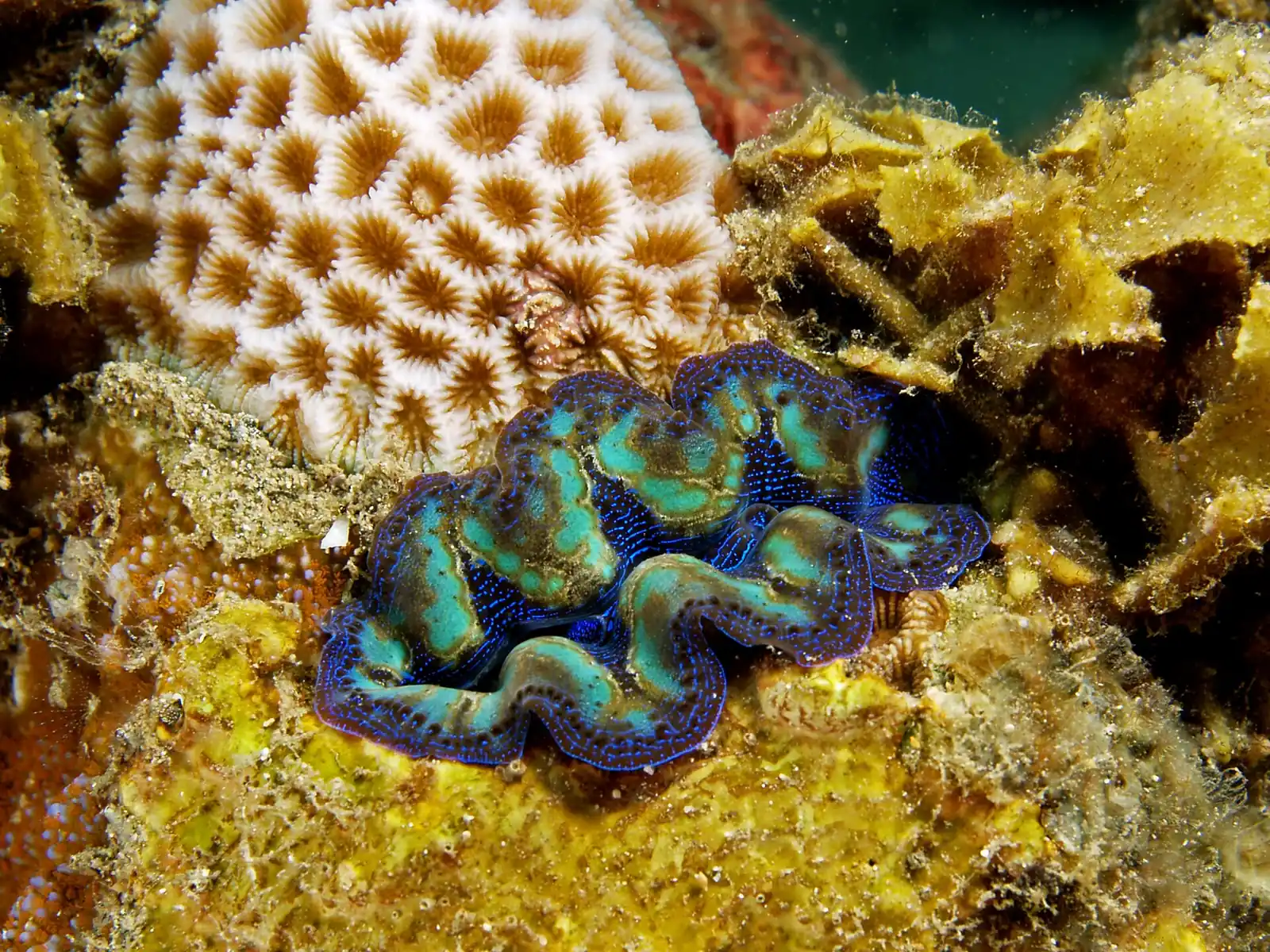
Boring Giant Clam (Tridacna crocea)

Photo: Vyacheslav Argenberg

The intertidal zone is the strip of shore the sea covers at high tide and uncovers at low tide. In the Andaman Islands it holds rock pools, reef flats, sand and mangrove mud. Crabs, snails, sea cucumbers, brittle stars, urchins, small fish, corals and seaweeds live here. Go at a spring low tide, a day or two after new or full moon, in the dry months, about November to May.

Where on the shore to look

The intertidal zone is layered like a staircase. Each band spends a different amount of time out of the water, so each has its own animals. Tap a name to open it.

High tideMid tideLow tideSeaLand
  1. Splash zone

    Only spray and storm waves reach it

    The top of the shore, wet from spray but rarely covered. Fast lightfoot crabs and land hermit crabs live here.

  2. High shore

    Covered only at the top of high tide

    Dry for long spells. Ghost crabs dig into the sand, goose barnacles wash up on driftwood, nerites hide at the foot of rocks and sea kraits rest in the rocks.

  3. Mid shore

    Covered and uncovered twice a day

    Rock pools, mangrove mud and cracks in the rock. Look for rockskippers, mudskippers, fiddler crabs, brittle stars, chitons, and barnacles that shut themselves in when the tide is out.

  4. Low shore & reef flat

    Uncovered only at the lowest tides

    The reef flat, seagrass and the richest pools, with sea cucumbers, urchins, giant clams, octopus, corals and seaweeds. Wear shoes: the stonefish lives here too.

  5. Just below low tide

    Always under water

    The reef edge just past the low-tide line. Look from the edge or with a mask and snorkel: sea stars, lionfish, rays and puffers.

Look, don't touch

Almost nothing on the shore will chase you. A few animals can still hurt you if you step on them or pick them up, and these are the ones to know.

All 57 species

Seashore animals, seaweeds and seagrasses, from the splash zone down to the reef edge. Filter by group or search by name. Each one opens a page that tells you how to recognise it, where to find it and whether it is safe to touch.

Showing 57 species. Tap any one to read about it.

PLATE 01Splash zone

Mottled Lightfoot Crab

Grapsus albolineatus

It lives on exposed rocky shores, often in big groups, sitting on bare rock in the splash zone above the water. Let your shadow fall on them and they scatter sideways. Andaman records go back to 1900.

Family
Grapsid shore crabs (Grapsidae)
Size
Shell up to about 5-6 cm long
Where on the shore
Wave-splashed rocks at the top of the shore
Food
Mostly algae, some animal food
Safe to touch?
Leave it be. It is too quick to catch anyway.
Protected?
Not listed

How to recognise it

  • A rounded, flat shell with green and white stripes running across it.
  • Many fine slanting lines on the sides of the shell.
  • The tips of the claws are shaped like small spoons.
  • Usually seen in a group on rocks above the water line.

Where to find it

Bare rocks hit by waves at the very top of the shore, and the tops of reefs where the waves break. It spends most of its time out of the water. On Neil there are photos of it on the rocks at Lakshmanpur.

Did you know?

Look closely at its claws: the tips are shaped like little spoons. Most of what it eats is algae from wave-splashed rock.

How it lives

It eats mostly algae from the wet rock, and some animal food as well. SeaLifeBase calls it a key species of healthy, exposed rocky shores.

Easy to confuse with

  • Other shore crabs (Metopograpsus): They lack the bold green-and-white stripes.

Sources: CMFRI, PubMed Central, WoRMS, SeaLifeBase, iNaturalist

PLATE 02Mid shore

Smooth Red-eyed Crab

Eriphia sebana

Peer into a crack in the rock at low tide and two bright red eyes may look back at you. A survey published in 1962 collected it at South Point, Port Blair, and it has since been photographed at Govind Nagar on Havelock.

Family
Red-eyed crabs (Eriphiidae)
Size
Shell up to about 8 cm wide
Where on the shore
Rock cracks and coral rubble, mid shore to shallow water
Food
Snails and hermit crabs
Safe to touch?
No. Its big claw is a shell-crusher.
Protected?
Not listed

How to recognise it

  • Bright red eyes on pale stalks.
  • A rounded shell with small bumps and small teeth along the front edge, brown to dark grey or purple.
  • Smooth claws of unequal size. The big one has heavy, molar-like teeth.
  • Hairy walking legs.

Where to find it

Wedged into cracks and holes in rock, under stones and in coral rubble, from the middle of the shore down into shallow water. You mostly see the eyes and the tip of a claw.

Did you know?

It has been seen crushing Turbo snail shells with its big claw to get at the hermit crabs living inside.

How it lives

It feeds at night and hides by day, wedging itself into a crack so tightly that it is very hard to pull out. The big claw cracks snail shells. It is known to be aggressive, so keep your fingers out of its hole.

Easy to confuse with

  • Pimply Red-eyed Crab (Eriphia smithii): Its big claws are covered in small bumps. This one has smooth claws.

Sources: CMFRI, WoRMS, SeaLifeBase, iNaturalist, Western Australian Museum: Red-eyed rock crab

PLATE 03High shore

Goose Barnacle

Lepas anserifera

Strictly speaking this is not a shore animal at all. Goose barnacles live far out at sea, hanging in clusters under floating logs, coconuts, plastic and boat hulls. When a storm pushes that debris onto the beach, the barnacles come with it. They are on India's barnacle checklist for the Andaman and Nicobar Islands, and one has been photographed washed up on the Kalapathar side of Havelock.

Family
Goose barnacles (Lepadidae)
Size
Shell up to about 4 cm, on a stalk about as long
Where on the shore
On driftwood and debris washed up on the beach
Food
Plankton, filtered from sea water
Safe to touch?
Harmless. Usually already dying when it reaches the beach.
Protected?
Not listed

How to recognise it

  • A flat, clam-like shell of thick white plates on a leathery stalk.
  • Fine grooves run across the plates.
  • The stalk is orange.
  • Grows in clusters on driftwood and floating rubbish.

Where to find it

Walk the drift line, the line of seaweed and rubbish left by the last high tide, especially after rough weather. Look on logs, coconuts, rope and plastic. Stranded goose barnacles usually die.

Did you know?

In medieval Europe people believed barnacle geese hatched out of these barnacles. That old story gave both the goose and the barnacle their names.

How it lives

It sweeps the water with feathery legs to catch plankton. It cannot move on its own once it settles, so it goes wherever its raft drifts, across whole oceans.

Easy to confuse with

  • Common Goose Barnacle (Lepas anatifera): Smoother plates and a dark purplish-brown stalk. To be sure you need a microscope, so photos of goose barnacles are often hard to name.

Sources: Trivedi, J., Patel, K., Chan, B.K.K., Doshi, M., Padate, V., ICES identification leaflet for plankton: Cirripedia,..., WoRMS, SeaLifeBase, iNaturalist

PLATE 04High shoreIUCN: Least Concern

Horn-eyed Ghost Crab

Ocypode ceratophthalmus

Big round holes with a spray of sand around them, high on a sandy beach, belong to this crab. It comes out mostly at night and runs down to the water's edge to feed. A specimen was collected on Neil Island in 1960, and the crab is still seen there and at Wandoor.

Family
Ghost and fiddler crabs (Ocypodidae)
Size
Shell about 6-8 cm wide
Where on the shore
Sandy beaches, in burrows near the high-tide line
Food
Scavenges dead animals, hunts small ones
Safe to touch?
Harmless. It runs away long before you get close.
Protected?
Not listed

How to recognise it

  • A box-shaped body, sandy or bluish grey with brown markings, often in an H shape.
  • Adults have a tall thin horn on top of each eye. Young crabs have no horns.
  • Long pointed legs. Pale claws, one bigger than the other.
  • Large burrow holes with a spray of sand, high on the beach.

Where to find it

Sandy beaches all around the islands, in deep burrows near or above the high-tide mark. Walk a beach after sunset with a torch to see them running.

Did you know?

It "talks" by rubbing a ridge on its claw against its face. The rasping sound probably warns other crabs to keep away.

How it lives

It eats dead fish, shrimps and worms washed up by the tide, and hunts small clams and snails at the water's edge. Its burrows go deep, so please do not dig them up.

Easy to confuse with

  • Smooth-eyed Ghost Crab (Ocypode cordimanus): No horns on the eyes. Remember that young Horn-eyed Ghost Crabs have no horns either.

Sources: CMFRI, WoRMS, SeaLifeBase, iNaturalist, Wild Singapore

PLATE 05Mid shore

Ring-legged Fiddler Crab

Austruca annulipes

A flat beside the mangroves can look empty until you stand still for a minute. Then dozens of small crabs come out, and the males start waving one huge pink-white claw. It was collected near Port Blair and at Mayabunder in 1960, and there are recent photos from Havelock.

Family
Ghost and fiddler crabs (Ocypodidae)
Size
Body about 1.5-2 cm wide
Where on the shore
Sandy-muddy flats beside mangroves
Food
Tiny food scraped from sand and mud
Safe to touch?
Harmless, and too shy to let you near.
Protected?
Not listed

How to recognise it

  • Males have one huge smooth claw, almost twice as long as the body is wide, pink to nearly white.
  • Females have two small claws.
  • A small squarish body, dark to pale, with dark, blue or white stripes. Eyes on long stalks.
  • Walking legs from dark to orange, brown or reddish.

Where to find it

Sandy or silty flats near the low-tide mark, often next to mangroves, each crab beside its own burrow.

Did you know?

The male's giant claw is no use for eating, so he feeds with his one small claw. Females use both claws and can eat twice as fast.

How it lives

They live in big groups and vanish into their burrows at a footstep or a shadow, so stand still and wait. They scoop up mud and sand and eat the thin film of food on the grains. At high tide each crab hides in its burrow and plugs the door with sand.

Easy to confuse with

  • Tetragonal Fiddler Crab (Gelasimus tetragonon): Usually blue or turquoise. Photographed on the sand and rubble flats of Havelock beaches, such as Beach No. 5.
  • Other Austruca fiddler crabs: Very alike. They are told apart by small details of the big claw, not by colour.

Sources: CMFRI, WoRMS, iNaturalist, Wild Singapore, The Wild Life

PLATE 06Splash zone

Land Hermit Crab

Coenobita rugosus

The little shells walking about under the beach trees at dusk are land hermit crabs. They live above the tide line and only visit the sea now and then. iNaturalist has many records from the Andamans, including Govind Nagar on Havelock.

Family
Land hermit crabs (Coenobitidae)
Size
Body about 3-6 cm long
Where on the shore
Upper beach, drift line and under beach trees
Food
Rotting leaves, fallen flowers, dead animals
Safe to touch?
Harmless. Look, then put it back where you found it.
Protected?
Not listed

How to recognise it

  • Lives in an empty snail shell and is seen on land, not in the water.
  • Left claw usually bigger than the right. Brownish, pale or dark purple.
  • A row of slanting ridges on the outer side of the left claw (you need a close look).
  • Eyes on short, flattened stalks.

Where to find it

Above the high-tide line: on the upper beach, along the drift line among rubbish and rocks, and under the trees and grass behind the beach. Most active at night.

Did you know?

It is so well suited to land that it would drown if kept under water. Its gill chambers work like lungs and only need a dip now and then to stay wet.

How it lives

It scavenges rotting leaves, fallen flowers of beach plants and dead animals. Big empty shells are scarce this high up the shore, so many crabs live in shells that are too small for them. They can be very common: one study in Phuket counted about seven per square metre.

Easy to confuse with

  • Other land hermit crabs (Coenobita brevimanus, C. violascens): No row of slanting ridges on the left claw. Most visitors can simply call them land hermit crabs.
  • Left-handed Hermit Crab: Lives in tide pools, in the water, not on dry sand.

The law

Please do not take hermit crabs or their shells home. Empty shells on the beach are the homes they move into next.

Sources: Bundhitwongrut, T., Thirakhupt, K. & Pradatsundarasar, A., WoRMS, SeaLifeBase, iNaturalist, Wild Singapore

PLATE 07Low shore & reef flat

Left-handed Hermit Crab

Calcinus laevimanus

Some of the snail shells in a reef-flat tide pool may be walking about. This small hermit crab is one to look for: its dark claws with white tips make it easy to spot. It has been recorded at Govind Nagar on Havelock, on Neil and at Corbyn's Cove.

Family
Left-handed hermit crabs (Diogenidae)
Size
Up to about 3 cm long
Where on the shore
Tide pools, reef flats and coral rubble
Food
Not well recorded
Safe to touch?
Harmless. Keep it in the water if you look closely.
Protected?
Not listed

How to recognise it

  • Left claw much bigger than the right.
  • Claws dark purplish-brown to black with white tips.
  • Eyestalks blue at the base and orange at the tip.
  • Walking legs brown with white bands at the tips.

Where to find it

In tide pools and on reef flats, rock platforms and coral rubble, from the low shore into shallow water.

Did you know?

The white patch on its big claw works like a badge of rank. A bigger, brighter patch seems to help it win fights over shells.

How it lives

It prefers round snail shells such as nerites and turban shells. It is a fighter and will battle other hermit crabs for a better shell.

Easy to confuse with

  • Clibanarius hermit crabs: Their two claws are about the same size.
  • Land Hermit Crab: Lives on dry sand above the tide, not in pools.

Sources: WoRMS, SeaLifeBase, iNaturalist, Marine Life Photography, The Wild Life

PLATE 08Low shore & reef flatPainful punch

Clubfoot Mantis Shrimp

Gonodactylus chiragra

Under a boulder on the reef flat you may find a stout, shrimp-like animal with big stalked eyes that watch you back. This is a mantis shrimp. It was recorded from the Andamans in 1913, and recent photos come from Govind Nagar on Havelock and from Neil.

Do not pick it up

Its club-shaped front limbs strike very fast and very hard. Smashing mantis shrimps have cracked aquarium glass, and they can hurt fingers. Never turn one over in your hand or poke into its hole.

Family
Smashing mantis shrimps (Gonodactylidae)
Size
Up to about 10.5 cm long
Where on the shore
Under rocks and in holes on reef flats
Food
Snails, hermit crabs, clams, crabs
Safe to touch?
No. Its punch can hurt your fingers.
Protected?
Not listed

How to recognise it

  • Looks like a big shrimp with stalked eyes that swivel.
  • Males dark green to brown. Females grey-green to whitish.
  • The folded front limbs end in a heavy club, used for smashing, not spearing.

Where to find it

On reef flats and tidal flats, hiding under rocks and boulders or in holes in coral and rock, from the upper shore into shallow water. Turn rocks carefully and put them back the same way.

Did you know?

It is a "smasher", not a "spearer". Its club-shaped arms punch hard enough to crack snail and crab shells.

How it lives

It hunts in the day, moving between coral heads, and breaks open snails, hermit crabs and clams with blows of its club. It lives in a hole that it trims to fit, and often blocks the entrance with sand and stones at night.

Easy to confuse with

  • Other Gonodactylus mantis shrimps: Two more species are recorded in South Andaman. They differ in small markings and are hard to tell apart on the shore.

Sources: Journal of Threatened Taxa, WoRMS, SeaLifeBase, iNaturalist, Bay of Bengal Biota

PLATE 09Low shore & reef flat

Powder Blue-clawed Swimming Crab

Thranita crenata

Look in the shallow water left on a sandy flat at low tide. Its pale blue claws with dark red tips set it apart from other swimming crabs. It was recorded at Aberdeen Bay, Port Blair, in 1960, and photographed at Kalapathar and Govind Nagar on Havelock.

Family
Swimming crabs (Portunidae)
Size
Shell about 5-7 cm wide, up to 8 cm
Where on the shore
Shallow sandy-muddy flats, seagrass, mangrove edges
Food
Slow-moving small animals, dead animals
Safe to touch?
No. Its claws are sharp and it will pinch.
Protected?
Not listed

How to recognise it

  • The last pair of legs is flattened into paddles for swimming.
  • Five spines of about equal size along each side of the front of the shell.
  • Six small rounded lobes between the wide-apart eyes.
  • Claws powder blue with dark red tips. Body sandy, olive or pinkish.

Where to find it

In shallow water at low tide on sandy-muddy flats, near seagrass and reefs, and around mangroves.

Did you know?

Swimming crabs are named for their flat, paddle-shaped back legs, which let them swim as well as walk.

How it lives

A hunter and scavenger. It feeds on slow-moving animals around the mangroves and also eats dead animals.

Easy to confuse with

  • Other swimming crabs (Thranita, Thalamita): Told apart by the number and size of the side spines and the lobes between the eyes.

Sources: CMFRI, WoRMS, SeaLifeBase, iNaturalist, Wild Singapore

PLATE 10Mid shore

Volcano Barnacle

Tetraclita sp.

The rough grey-green cones on wave-washed rocks are barnacles. Old Andaman records call them Tetraclita squamosa, but that name has since been split into several species that look alike, so we name only the genus here.

Family
Volcano barnacles (Tetraclitidae)
Size
Base up to about 3-3.5 cm across
Where on the shore
Rock faces and boulders with plenty of waves, mid shore
Food
Plankton, kicked in with feathery feet
Safe to touch?
Careful. The shells are sharp and cut bare feet.
Protected?
Not listed

How to recognise it

  • A thick, cone-shaped shell like a small volcano, greenish grey.
  • The shell has ridges or short lines and does not look like separate plates.
  • A small opening at the top, with a "door" set deep inside.
  • Fixed firmly to rock, often in groups.

Where to find it

On rocky shores, on big boulders and steep rock faces that get plenty of waves, often in places shaded at low tide.

Did you know?

A barnacle is a crustacean, a cousin of crabs. It spends its life glued to the rock by its head, kicking food into its mouth with its feet.

How it lives

When the tide covers it, it opens its door and sweeps the water with feathery feet to catch plankton. At low tide it shuts the door to stay moist, and its thick, air-filled shell keeps out the heat.

Easy to confuse with

  • Small acorn barnacles (Chthamalus): Much smaller, higher on the shore, and the shell clearly shows separate plates.

The law

Wear shoes on rocky shores. Barnacle and coral cuts often get infected and can take weeks to heal.

Sources: Trivedi, J., Patel, K., Chan, B.K.K., Doshi, M., Padate, V., Pochai, A., Kingtong, S., Sukparangsi, W. &..., WoRMS, SeaLifeBase, Wild Singapore

PLATE 11Mid shoreVenomous stingIUCN: Least Concern

Lettered Cone

Conus litteratus

A heavy white cone covered in rows of square, dark spots. A shore survey around Port Blair from 2019 to 2022 found it on sheltered shores with mud, gravel and seagrass, in the middle and lower parts of the shore. However pretty the shell, never pick up a live one.

Never pick up a cone shell

Every cone snail can sting with a hollow, venom-filled tooth. This species eats worms. Stings from worm-eating cones are rare, and most have been mild, usually no worse than a bee sting. But the fish-eating Geographer Cone, which has caused almost all known human deaths from cone snails, is also recorded from the Andaman and Nicobar Islands, and cones are hard to tell apart. Treat every cone as dangerous. For a sting on an arm or leg, put on a firm pressure bandage over the sting and up the whole limb, keep the person still and get them to a hospital at once. Watch their breathing: if it weakens, give rescue breaths until help arrives. There is no antivenom.

Family
Cone snails (Conidae)
Size
Shell usually 6-17 cm long
Where on the shore
Sheltered shores with mud, gravel and seagrass
Food
Marine worms only
Safe to touch?
Never pick up a live cone shell.
Protected?
Not listed

How to recognise it

  • A heavy, cone-shaped shell with a sharp shoulder and an almost flat top.
  • White, with spiral rows of square to round blackish-brown spots from the shoulder to the base.
  • Usually three yellow-orange bands around the shell, which can be faint.
  • A live shell is covered in a brown skin that can hide the pattern.

Where to find it

On sheltered shores with mud, gravel and seagrass, in the middle and lower shore, never high up, usually partly buried. Elsewhere it lives from just below low tide down to about 50 m.

Did you know?

A cone snail hunts with a single hollow tooth used like a harpoon. It fires the tooth into a worm and pumps venom through it.

How it lives

It eats only marine worms, which it kills with venom. A bigger cone, the Marbled Cone, eats it in turn.

Easy to confuse with

  • Leopard Cone (Conus leopardus): A very close relative that often lives in the same places. It differs in its bands and number of spots, and even experts check carefully.
  • Hebrew Cone (Conus ebraeus): Much smaller, white with bold black blocks. It is the most common cone on South Andaman shores, more than half of all cones counted in the Port Blair survey.

Sources: Gutthavilli, P.R., Bharne, A.M., Marimuthu, K. &..., Venkitesan, R., Barua, S. & Hafiz, Md., Subba Rao, N.V., PubMed Central, Venkitesan et al.

PLATE 12Low shore & reef flatIUCN: Least Concern

Boring Giant Clam

Tridacna crocea

On a reef flat, a glowing blue or green lip set flush into a coral boulder is the mantle of the smallest giant clam, sitting sunk inside the rock it has bored into. A 2018 diving survey by CMFRI found it abundant on Havelock's reefs, and people have photographed it more than 150 times in the islands, including at Nemo Beach on Havelock and the Neil Island jetty.

Family
Giant clams (Cardiidae)
Size
The smallest giant clam: usually 10-15 cm
Where on the shore
Sunk into coral boulders on reef flats
Food
Sugar from algae in its mantle, plus filtered food
Safe to touch?
No. Look at it, do not touch or stand near it.
Protected?
Schedule IV (CITES) only

How to recognise it

  • Usually all you see is a wavy, fleshy mantle between two shell edges, set flush into a coral boulder.
  • The mantle colour varies: often bright blue, turquoise or green with dark patches, sometimes brown.
  • Small: rarely longer than a hand.
  • A greyish-white shell with low ribs, often edged orange or yellow.

Where to find it

Sunk deep into living or dead coral boulders in shallow water near living reefs. On the Thai side of the Andaman Sea it was found from the shore down to 7 m, more on the reef flat than on the slope.

Did you know?

Giant clams farm their own food. Tiny algae living in the colourful mantle make sugar from sunlight and share it with the clam.

How it lives

It can also filter food from the water, but most of its food comes from those algae. It turns its open shell towards the light, and clear lens-like spots in the mantle focus light onto them.

Easy to confuse with

  • Small Giant Clam (Tridacna maxima): Grows much bigger, up to about 40 cm, and sits only partly sunk into the reef, so more of its ridged shell shows. Schedule I protected.
  • Fluted Giant Clam (Tridacna squamosa): Up to about 45 cm, sits loose on the reef, with big frilly scales on the shell. Schedule I protected.

The law

This species is not named in India's Schedule I, but two of its look-alikes are, and every giant clam is in Appendix II of CITES, which controls international trade. It cannot trap a hand or a foot; the danger is to the clam, from trampling and collecting.

Sources: Laxmilatha et al. 2021 (CMFRI), Compendium of Biota of the Bay of Bengal: Tridacna..., Banchongmanee, S. & Upanoi, T., WoRMS, SeaLifeBase, iNaturalist

PLATE 13Mid shore

Jewelled Chiton

Acanthopleura gemmata

At first it looks like a flat, oval stone with a row of plates down its back. A chiton is a mollusc, a distant cousin of snails, and this is a large one, up to about 12 cm long. There are many photo records of it on Havelock, and several from Neil, including Sitapur.

Family
Chitons (Chitonidae)
Size
Up to about 12 cm long
Where on the shore
Bare rock and beachrock between the tides
Food
Algae scraped off the rock
Safe to touch?
Harmless, but do not prise it off the rock.
Protected?
Not listed

How to recognise it

  • A flat oval with a row of eight overlapping shell plates down the back.
  • Plates usually worn and brown to dark brown.
  • A wide fleshy rim round the plates, covered in short, thick spines, like a velvety border.
  • Clamps flat and tight to the rock.

Where to find it

On rock and beachrock between the tides, up to the high-tide mark. By day it sits in a shallow dip it has scraped into the rock, so look on bare rock and in cracks.

Did you know?

It scrapes a shallow "home" into solid rock with its teeth. It rests there by day, goes out to graze at night and then returns to the same spot.

How it lives

It grazes thin algae off the rock with a rasping tongue, feeding at night low tide. When two chitons turn up at the same home they push and fight over it. The home also protects it from a pufferfish that eats chitons.

Easy to confuse with

  • Limpets: A limpet has a single cap-shaped shell. A chiton has eight separate plates in a row.
  • Other chitons: Smaller chitons also live on Andaman rocks. This is the big one with the thick, furry rim.

Sources: Jardim, J.A., Almeida, S.M. & Simone, L.R.L., Alnashiri, H. et al., Chelazzi, G., Focardi, S., Deneubourg, J.-L. & Innocenti, R., Barbosa, S.S., Kelaher, B.P. & Byrne, M., WoRMS

PLATE 14Just below low tide

Sky Blue Phyllidia

Phyllidia coelestis

Sea slugs are snails without a shell, and many are brightly coloured. This blue one crawls openly over reefs in daylight. In the Andamans it has been photographed at snorkel and dive sites off Havelock, at Bharatpur on Neil and at Wandoor, not yet on a low-tide walk.

Family
Wart slugs (Phyllidiidae)
Size
About 2-5.5 cm long
Where on the shore
Reefs, seen while snorkelling
Food
Sponges
Safe to touch?
Do not collect it. Its slime is toxic to other sea animals.
Protected?
Not listed

How to recognise it

  • A firm, warty slug with no frilly gills on the back.
  • A blue to blue-grey back with black bands; the blue ridges form a Y shape.
  • Separate yellow-capped bumps down the middle that never join into a ridge.
  • A broad, bumpy blue-grey edge and a plain grey underside.

Where to find it

On reefs and rubble from about 1 m down, so look while snorkelling.

Did you know?

It has no teeth at all. It turns part of its throat inside out onto a sponge, digests it from the outside and sucks it up, keeping the sponge's poisons for itself.

How it lives

It eats sponges. It takes in the sponges' toxic chemicals and uses them for its own defence. When disturbed it gives off a milky slime, and its bright colours probably warn predators away.

Easy to confuse with

  • Varicose Phyllidia (Phyllidia varicosa): Bigger, with three to six long, bumpy blue-grey ridges topped with yellow bumps, and a black stripe underneath.
  • Ocellate Phyllidia: Yellow-orange with black rings, not blue.

Sources: Compendium of Biota of the Bay of Bengal: Phyllidia..., van Alphen, J., de Voogd, N.J. & Hoeksema, B.W., Proksch, P., WoRMS, iNaturalist

PLATE 15Just below low tide

Ocellate Phyllidia

Phyllidia ocellata

Each black ring on its back has a bump in the middle, so the slug looks as if it is covered in eyes. In Singapore it is sometimes seen on low-tide walks. In the Andamans it has been photographed off Neil Island, at Bharatpur and off the island's north tip.

Family
Wart slugs (Phyllidiidae)
Size
About 3-6 cm long
Where on the shore
Coral rubble and reefs
Food
Sponges
Safe to touch?
Leave it on the reef. Its slime is toxic to other sea animals.
Protected?
Not listed

How to recognise it

  • A hard, warty slug, yellow to orange.
  • Four to ten black rings edged with white on the back, each with a gold or white bump in the centre.
  • The pattern varies a lot: the black can spread, and some lack the white.
  • Yellow feelers at the front and no frilly gills on the back.

Where to find it

On coral rubble and reefs, mostly below the low-tide line.

Did you know?

The "eyes" on its back are a warning sign. A predator that tries it gets a mouthful of sponge poison.

How it lives

It moves about in the open and feeds on sponges. When disturbed, bad-tasting chemicals ooze from its bumps, taken from the sponges it eats.

Easy to confuse with

  • Phyllidia flava: Also golden yellow, but with no black at all.
  • Sky Blue Phyllidia: Blue-grey with black bands, not yellow.

Sources: van Alphen, J., de Voogd, N.J. & Hoeksema, B.W., Proksch, P., WoRMS, iNaturalist, Sea Slug Forum

PLATE 16Just below low tideIUCN: Data Deficient

Pharaoh Cuttlefish

Acanthosepion pharaonis

This is not a rock-pool animal: it lives mostly below the low-tide line, over sand and seagrass. In the breeding season adults move inshore into shallow water, and that is when a snorkeller, or someone wading at the water's edge, is most likely to see one. Photo records come from off Havelock and from Mayabunder.

Family
Cuttlefishes (Sepiidae)
Size
Body usually 15-20 cm; up to 43 cm
Where on the shore
Sand and seagrass, mostly below low tide
Food
Shrimps, crabs, small fish
Safe to touch?
Harmless to people. Just watch.
Protected?
Not listed

How to recognise it

  • A broad, flat oval body with a thin fin all round the edge.
  • Males especially show bold "tiger stripes" across the back and head.
  • A narrow, pale, broken line along the base of the fins.
  • Changes colour in a moment. W-shaped pupils, eight arms and two long feeding tentacles.

Where to find it

From the shoreline down to about 110 m, most common in the top 40 m, over sand and seagrass. Adults gather in groups to spawn in water no deeper than about 20 m.

Did you know?

Off India's east coast a young Pharaoh Cuttlefish grows from a hatchling to a body about 17 cm long in its first year.

How it lives

An active hunter of shrimps, crabs and small bottom fish. Around India it spawns almost all year. It lives about 2-3 years, and adults usually die soon after spawning.

Easy to confuse with

  • Broadclub Cuttlefish (Sepia latimanus): A reef cuttlefish seen over coral rather than open sand and seagrass, without tiger stripes. Cuttlefish are hard to name from a quick look.

Sources: WoRMS, SeaLifeBase, Roper, C.F.E., Sweeney, M.J. & Nauen, C.E., iNaturalist, The Wild Life

PLATE 17Mid shore

Money Cowrie

Monetaria moneta

A small, squat, yellowish cowrie, often with knobs at the sides. Like most cowries it hides by day in cracks and under rocks. Look into crevices and pools on the reef flat at low tide, but please do not turn over rocks or coral slabs. On Havelock, look for it on the east coast. There are also records from Ram Nagar on Neil and from the coast south of Port Blair.

Family
Cowries (Cypraeidae)
Size
Shell about 2-3 cm, up to 4.5 cm
Where on the shore
Cracks, crevices and pools on reef flats
Food
Small seaweeds
Safe to touch?
Fine to look. Leave the shell where it is.
Protected?
Not listed

How to recognise it

  • A small, squat, almost six-sided shell. Shells on the shore are usually smooth; ones from deeper water often have knobs at the sides.
  • Yellowish white to bright yellow, with dark smudges round the humped middle.
  • A plain white underside with white "teeth" along the slit-like opening.
  • When it is active, a thin see-through skin (the mantle) with fine dark bars covers the shell.

Where to find it

On reef flats and rocky shores between the tides, in cracks, under rocks and in pools.

Did you know?

Its shell was used as money for centuries across the Indian Ocean and the Pacific, which is how it got its name.

How it lives

Like most cowries it hides by day and comes out at night to graze small seaweeds. Money cowries follow each other's slime trails, and in one study most were found in male-female pairs. When disturbed it pulls its mantle back inside the shell.

Easy to confuse with

  • Ring Cowrie (Monetaria annulus): Similar size, but grey-white to bluish with a clear golden-orange ring on the back.
  • Tiger Cowrie: Much bigger and covered in dark round spots.

Sources: Compendium of Biota of the Bay of Bengal: Monetaria..., Renaud, M.L., WoRMS, SeaLifeBase, iNaturalist

PLATE 18Low shore & reef flat

Tiger Cowrie

Cypraea tigris

A large, shiny, egg-shaped shell covered in dark spots. When the animal is relaxed it spreads a soft, hairy mantle over the shell and can look like a sea slug. There are photos from near Govind Nagar on Havelock and from Corbyn's Cove near Port Blair.

Family
Cowries (Cypraeidae)
Size
Usually 8-9 cm, up to about 15 cm
Where on the shore
Near living reefs, seagrass, sand and rubble
Food
Sponges, snails, seaweed, dead animals
Safe to touch?
Look and photograph. Never take one.
Protected?
Not listed

How to recognise it

  • A large, glossy, egg-shaped shell.
  • White, cream or bluish-grey, densely covered in round dark brown to black spots.
  • A white underside and white "teeth".
  • The living animal often covers the shell with a mantle patterned with dark lines and small finger-like "hairs".

Where to find it

Near living reefs, often on live coral, and also in seagrass and on sand and rubble. Where it has been heavily collected it may survive only below about 10 m.

Did you know?

A cowrie makes its own shine. Its mantle wraps over the shell and keeps adding to it, which is why living cowries are rarely crusted with algae.

How it lives

Unusually for a cowrie, it is active by day. When disturbed it pulls its mantle back and the shiny shell shows.

Easy to confuse with

  • Mole Cowrie (Talparia talpa): A long shell with brown bands and no spots. It is protected in Schedule II.
  • Money Cowrie: Much smaller, yellowish and knobby, with no spots.

The law

Tiger cowries are heavily collected for the shell trade in other countries, and where that has happened they survive only in deeper water. Please leave every shell where it is.

Sources: Compendium of Biota of the Bay of Bengal: Cypraea tigris,..., WoRMS, SeaLifeBase, iNaturalist, Wild Singapore

PLATE 19High shore

Polished Nerite

Nerita polita

A thick, smooth, rounded snail shell, often glossy and marbled. By day it hides half buried in sand at the foot of rocks, and at night it climbs out to graze. There are records from Havelock and from Neil.

Family
Nerites (Neritidae)
Size
Shell 3-4 cm
Where on the shore
Rocky shores near the high-water mark
Food
Algae grazed off rocks
Safe to touch?
Harmless.
Protected?
Not listed

How to recognise it

  • A thick, almost round shell like half a marble, with the top hardly sticking out.
  • Smooth and often glossy, with no ribs.
  • Colour and pattern vary a lot: white, cream, brown, grey or greenish, marbled or streaked.
  • A flat, glossy white underside with small notched "teeth" at the opening, and a thick greenish-grey door.

Where to find it

On rocky shores, often near the high-water mark. By day it lies shallowly buried in sand against the foot of rocks.

Did you know?

Its shell is so smooth and round that a crab finds it hard to get a grip on it.

How it lives

It grazes algae off the rocks at night. When the tide is out it seals itself in with a thick door, which keeps it from drying out and stops crabs getting in.

Easy to confuse with

  • Ox-tongue Nerite (Nerita albicilla): A flatter, oval shell, with big rounded bumps underneath like an ox's tongue. Lives lower on the shore.
  • Waved Nerite (Nerita undata): The top sticks out and the shell has narrow spiral ribs.

Sources: Compendium of Biota of the Bay of Bengal: Nerita, WoRMS, SeaLifeBase, iNaturalist, Wild Singapore

PLATE 20Low shore & reef flat

Common Spider Conch

Lambis lambis

From above it looks like a rock covered in algae. Only when one is lying the other way up do you see the glossy pink opening and six long spines like the legs of a spider. Please do not turn one over to look. On Havelock it turns up at Govind Nagar and in other spots round the island.

Family
True conches (Strombidae)
Size
Shell usually 10-20 cm, up to 29 cm
Where on the shore
Reef flats, rubble, sand and seagrass
Food
Mainly fine red algae
Safe to touch?
Look, but leave it where it is. Do not pick it up.
Protected?
Not listed (some other spider conches are)

How to recognise it

  • A big, heavy shell with a wide, flared lip carrying six long, finger-like spines (adults only).
  • The top is usually dull and covered in algae, so it looks like a rock.
  • The inside of the opening is glossy pink with orange or yellow tints.
  • Two large eyes on stalks peep out from a notch at the front.

Where to find it

On reef flats, coral rubble, sand and seagrass near reefs, from the low-tide mark down to about 5 m. Often half buried and so well hidden that people walk right past it.

Did you know?

A conch has large eyes on stalks, and scientists think they may form a real image, unlike most snail eyes that only sense light.

How it lives

It does not creep like most snails. It digs its claw-like door into the sand and pushes off, so it moves in hops. The spiny lip keeps it from tipping over, and if it is turned over it rights itself with that same door. It mainly grazes fine red algae.

Easy to confuse with

  • Chiragra Spider Conch (Harpago chiragra): Bigger, with six long spines that curve strongly. Protected in Schedule II.
  • Scorpion and Millipede Spider Conches (Lambis scorpius, L. millepeda): Knobbly or more numerous spines. Both protected in Schedule II.

The law

This species is not in the schedules, but six of its look-alike spider conches are protected in Schedule II, and it is hard to tell them apart. Leave every conch where you found it.

Sources: Compendium of Biota of the Bay of Bengal: Lambis lambis,..., WoRMS, SeaLifeBase, iNaturalist, Kasambe, R.

PLATE 21Low shore & reef flat

Wedge Sea Hare

Dolabella auricularia

Among seagrass it is easy to miss: a soft, lumpy, mottled slug whose back end looks chopped off flat. A 2016 shore survey found one in an intertidal seagrass bed at Hut Bay on Little Andaman and another on a mixed shore at Burmanallah in South Andaman. It has also been photographed in the intertidal zone on Havelock, including Beach No. 2.

Family
Sea hares (Aplysiidae)
Size
Andaman ones 8-12 cm; usually up to 20-25 cm
Where on the shore
Seagrass beds and reef flats at low tide
Food
Seagrass and seaweeds
Safe to touch?
Do not poke it. It will squirt ink.
Protected?
Not listed

How to recognise it

  • A big, soft, lumpy slug, mottled brown and green, covered in short spikes.
  • The back end is cut off flat into a sloping round disc, with an opening in the middle.
  • A small head with short, frilly feelers.
  • Squirts ink when disturbed.

Where to find it

In intertidal seagrass beds and on mixed shores, in sheltered lagoons, large rock pools and among seaweed.

Did you know?

Scientists have found anti-cancer compounds in this sea hare, including one called dolastatin 10.

How it lives

It eats seagrass and brown, red and green seaweeds. When poked it squirts a cloud of purple ink to confuse attackers. Like other sea hares it takes up chemicals from the algae it eats.

Easy to confuse with

  • Other sea hares (Aplysia): Smoother, with two wing-like flaps on the back and no flat "chopped-off" rear end.
  • Black Sea Cucumber: A sea cucumber has a ring of tentacles at the mouth end and no feelers or ink.

Sources: Pandey, V. et al., WoRMS, iNaturalist, Wild Singapore, The Wild Life

PLATE 22Low shore & reef flatIUCN: Least Concern

Day Octopus

Octopus cyanea

Most octopuses hunt at night, but this one hunts by day. On a reef flat at low tide you may see one sitting at the mouth of its den, changing colour as you watch. Photos come from Beach No. 2 and Govind Nagar on Havelock, from around Neil Island and from Port Blair.

Family
Octopuses (Octopodidae)
Size
Body up to about 22 cm; up to 6 kg
Where on the shore
Dens in coral rock and rubble on reef flats
Food
Clams, snails and crabs
Safe to touch?
No. Leave octopuses alone and never pick one up.
Protected?
Not listed

How to recognise it

  • A medium to large octopus, usually seen in daytime at or near a hole in the reef.
  • Skin that keeps changing colour and texture: brown, reddish or mottled, smooth or bumpy, often with raised points over the eyes.
  • Eight arms with suckers, and no shell.

Where to find it

In dens in coral rock, coral heads and holes dug in sand and rubble, on reef flats and in shallow water. In Madagascar and Comoros people catch it mostly on rocky reef flats at low tide.

Did you know?

Day octopuses filmed while hunting changed their colour and skin pattern about 177 times an hour on average.

How it lives

It hunts in daylight, most of all at dawn and dusk. It pounces on crabs, or spreads the web between its arms over a coral head and feels inside with its arm tips for prey. While hunting it changes its skin pattern about three times a minute, to blend in or sometimes to look like something else.

Easy to confuse with

  • Blue-ringed octopuses (Hapalochlaena): Small, a few centimetres, with bright blue rings when alarmed, and deadly venomous. One was photographed in the Nicobar Islands in 2025, so never touch any small octopus.

Sources: McCabe, M.K. et al., Hanlon, R.T., Forsythe, J.W. & Joneschild, D.E., WoRMS, SeaLifeBase, iNaturalist

PLATE 23Mid shore

Mangrove Whelk

Terebralia palustris

If you find many big, tall, spiral shells on the mud between mangrove roots, among the fallen leaves, they are mangrove whelks. There are records from Govind Nagar and the north-west coast of Havelock, from Ferrargunj near Port Blair and from Neil.

Family
Horn snails (Potamididae)
Size
Shell usually about 12 cm, up to 19 cm
Where on the shore
Mud and fallen leaves in mangroves
Food
Fallen mangrove leaves; young eat mud film
Safe to touch?
Harmless.
Protected?
Not listed

How to recognise it

  • A big, heavy, tall cone-shaped shell, the largest horn snail of Indo-Pacific mangroves.
  • Often seen in groups on mangrove mud or among fallen leaves.
  • Young snails are smaller and live out on the open mud.

Where to find it

On the mud in mangrove forests and on nearby mudflats. Big adults live mostly inside the mangrove among the fallen leaves; young ones are more common out on the open mud.

Did you know?

In a Kenyan mangrove these snails were the only leaf-eaters that kept feeding under water at high tide, and together they cleared about ten fallen leaves from every square metre each tide.

How it lives

Adults mainly eat fallen mangrove leaves. Young ones eat the thin film of tiny algae on the mud and switch to leaves when the shell is about 5 cm long. They can be very common and churn up the surface of the mud.

Easy to confuse with

  • Telescope Snail (Telescopium telescopium): Also big and found on Andaman mangrove mud, but its shell is a broad, flat-based cone, like a telescope.

The law

Mangrove creeks are home to saltwater crocodiles. Look from the edge, stay out of creeks and obey any warning boards.

Sources: Compendium of Biota of the Bay of Bengal: Terebralia..., Fratini, S., Vigiani, V., Vannini, M. & Cannicci, S., Pape, E., Muthumbi, A., Kamanu, C.P. & Vanreusel, A., WoRMS, SeaLifeBase

PLATE 24Low shore & reef flatProtected: Schedule IIUCN: Least Concern

Black Sea Cucumber

Holothuria leucospilota

On Andaman reef flats at low tide you often find a long, soft, black body reaching out from under a rock, with the back half still tucked away. That is the Black Sea Cucumber. It is listed from the reefs of Rani Jhansi Marine National Park near Havelock and has been photographed at Vijaynagar on Havelock.

Family
Sea cucumbers (Holothuriidae)
Size
Usually 30-40 cm, up to about 60 cm, stretches to about 1 m
Where on the shore
Under rocks on reef flats, in pools and seagrass
Food
Sand and mud, for the food in it
Safe to touch?
No. It is protected, and it may squirt sticky white threads.
Protected?
Yes, Schedule I

How to recognise it

  • A long, soft, sausage-shaped body, narrower at the front.
  • Plain very dark brown to black, with no spots or markings.
  • Short soft points and tube feet all over. A ring of 20 dark, bushy tentacles around the mouth.
  • Often only the front end shows, sticking out from under a rock.

Where to find it

On reef flats, in pools and in seagrass at low tide. It usually keeps most of its body under a rock or in a crack to stop drying out.

Did you know?

Small ones can split themselves in two across the middle, and each half grows into a whole new sea cucumber.

How it lives

It swallows sand and mud and digests the bits of food in it, dabbing the surface around it with its tentacles. When it is bothered it can shoot out thin, sticky white threads from its rear end. These tangle up an attacker. They cling to skin too, but they are not known to harm people.

Easy to confuse with

  • Lollyfish (Holothuria atra): Shorter and fatter, usually lies out in the open dusted with sand, and does not shoot white threads.
  • Snake Sea Cucumber: Much longer and thinner, brown with stripes and patches, and sticky to touch.

The law

All sea cucumbers are in Schedule I of the Wild Life (Protection) Act, the highest level of protection in India, the same as tigers. Collecting, keeping or selling one is an offence. Look, take photos, and leave it where it is.

Sources: Raghunathan, C. & Venkataraman, K., WoRMS, SeaLifeBase, iNaturalist, Wild Singapore

PLATE 25Low shore & reef flatSharp spines

Black Sea Urchin

Stomopneustes variolaris

On wave-washed rocky shores, pools near the low-tide line can be packed with these black sea urchins, each sitting in its own hollow. The species is listed for the Andamans, and there are photos of it on the intertidal rocks at Corbyn's Cove, Port Blair.

Watch your feet and hands

Its thick, sharp spines can go into your foot, knee or hand and break off in the wound. It is not known to be venomous; the injury is a puncture. Wear shoes and never kneel or put your hand down in a pool without looking.

Family
Stomopneustid urchins (Stomopneustidae)
Size
Body usually 6-8 cm across
Where on the shore
Rock pools and cracks near the low-tide line
Food
Seaweed and algae on rock
Safe to touch?
No. The spines go into skin and break off.
Protected?
Not listed

How to recognise it

  • Black spines, thick and strong with a fairly sharp tip, sometimes with a blue-green sheen.
  • The spines feel rough, like sandpaper.
  • Five grey zig-zag lines on top of the body where the spines part.
  • Usually sits in a hollow or crack in the rock, often with many others.

Where to find it

Rocky shores near the low-tide mark: in rock pools, cracks and gullies, often packed together on rock that the waves hit.

Did you know?

It is the only living species left in its whole family.

How it lives

It grazes seaweed off the rock, mostly at night. Using its spines and teeth it slowly wears a hollow into the rock to hide in. On wave-beaten shores they can cover a pool like a black carpet.

Easy to confuse with

  • Burrowing Urchin: Smaller, usually green, purple, brown or reddish (dark ones can look almost black), with a pale ring at the base of each spine.
  • Long-spined Sea Urchin: Much longer, needle-thin spines, an orange ring on top and five white dots.

Sources: Compendium of Biota of the Bay of Bengal, Sastry, D.R.K., CMFRI, WoRMS, SeaLifeBase

PLATE 26Mid shore

Lagoon Brittle Star

Ophiocoma scolopendrina

Lift a stone on a reef flat and dark, thin arms whip away into the gaps. Brittle stars move far faster than sea stars. This one was collected in the Andamans in the 1880s. Today it is photographed at the Neil Island jetty and on the shore at Port Blair.

Family
Spiny brittle stars (Ophiocomidae)
Size
Disc up to about 2.4 cm; arms about a hand-span across
Where on the shore
Under stones and in cracks between the tides
Food
Floating bits caught on its arms
Safe to touch?
Leave it in its crack. Brittle stars can shed an arm if grabbed.
Protected?
Not listed

How to recognise it

  • A small round disc with five long, thin, snake-like arms lined with short spines.
  • Dark brown to black, often with faint light bands on the arms.
  • Usually only the arms show, waving out from under a rock or out of a crack.
  • Moves fast by wriggling its arms, unlike a sea star.

Where to find it

In cracks and under stones and coral rubble on rocky and reef-flat shores between the tides.

Did you know?

On one reef flat in Kenya, up to 320 of these brittle stars per square metre were seen sweeping their arms across the surface together as the tide came in.

How it lives

It hides by day. As the rising tide first covers the reef flat, crowds of them lift a few arms and sweep the surface of the water for a minute or two, catching floating food on sticky spines. Then they switch to filtering food from the water.

Easy to confuse with

  • Banded brittle star (Ophiomastix annulosa): Also found in the Andamans. Arms more boldly ringed light and dark.

Sources: Compendium of Biota of the Bay of Bengal, Oak, T. & Scheibling, R.E., WoRMS, SeaLifeBase, iNaturalist

PLATE 27Just below low tide

Blue Sea Star

Linckia laevigata

It is one of the most common sea stars on the reefs of Rani Jhansi Marine National Park near Havelock, and it turns up on Havelock itself. Most people meet it while snorkelling, but on the lowest tides it can be seen at the edge of the reef flat.

Family
Ophidiasterid sea stars (Ophidiasteridae)
Size
Up to about 30-40 cm across
Where on the shore
Shallow reef and rubble, from the low-tide line down
Food
Film of algae and bacteria on rock
Safe to touch?
Look without lifting it out of the water.
Protected?
Not listed

How to recognise it

  • Bright blue, sometimes light blue, aqua, purple or orange.
  • Five long, smooth, tube-like arms with rounded tips and a small centre.
  • Stiff-looking, not soft or floppy.
  • Arms often of different lengths when one is growing back.

Where to find it

On rock, dead coral and rubble in shallow, sunny reef areas, from the low-tide line down. Young ones hide under rocks and coral.

Did you know?

Not every Blue Sea Star is blue. The same species also comes in aqua, purple and orange.

How it lives

It moves slowly, about 8 cm a minute, and feeds on the thin film of bacteria, algae and tiny animals on hard surfaces. It can drop an arm to escape a predator and grow it back, so many wild ones have arms of different lengths.

Easy to confuse with

  • Other Linckia sea stars: Same shape but brown, pink or mottled red, never bright blue.

The law

Please leave sea stars in the water. Look and take photos without lifting them out.

Sources: Raghunathan, C. & Venkataraman, K., Compendium of Biota of the Bay of Bengal, WoRMS, SeaLifeBase, iNaturalist

PLATE 28Just below low tide

Spiny Cushion Star

Culcita schmideliana

This sea star has almost no arms. It is a thick, five-sided cushion that lies in lagoons and seagrass, mostly a little deeper than the low-tide line. It was recorded in the Andamans in 1887, and the 2010-11 survey of Rani Jhansi Marine National Park found it on all three islands (listed there as Culcita novaeguineae). On Havelock you are most likely to see it while snorkelling.

Family
Cushion stars (Oreasteridae)
Where on the shore
Lagoons and seagrass, just below low tide
Food
Algae film, sponges, coral tissue
Safe to touch?
Look only. Leave it in the water.
Protected?
Not listed

How to recognise it

  • A puffed-up, five-sided cushion with almost no arms.
  • Leathery top with small cone-shaped spines.
  • Grey, brown, orange or red, often with dark spots.
  • Flat underside with grooves of tube feet.

Where to find it

Lagoons and inner reef flats with seagrass and algae, mostly from about 3 m down, so a snorkelling animal more than a low-tide one.

Did you know?

A cushion star often has lodgers. Tiny shrimps hide on its skin, and a small pearlfish can live inside its body.

How it lives

A slow grazer that turns its stomach out over its food: the film on algae and seagrass, sponges and the living tissue of corals.

Easy to confuse with

  • Pacific cushion star (Culcita novaeguineae): Almost impossible to tell apart by eye. Some Indian survey lists use this name for the Andaman animal.

Sources: Compendium of Biota of the Bay of Bengal, Raghunathan, C. & Venkataraman, K., WoRMS, SeaLifeBase, iNaturalist

PLATE 29Low shore & reef flatVenomous spines

Long-spined Sea Urchin

Diadema setosum

These sea urchins gather in groups in shallow, sheltered water at the very bottom of the shore. They are among the most common urchins on the reefs of Rani Jhansi Marine National Park. There are photos from Havelock, and they crowd the shallows at Marina Park in Port Blair.

Do not touch it or step near it

Its very long, hollow, needle-sharp spines are mildly venomous. They go through skin, gloves and clothes and break off in the wound. The pain is strong but usually fades in a few hours; small spine bits can stay in the skin. Wear shoes and watch where you put your hands.

Family
Diadem sea urchins (Diadematidae)
Size
Body 8-10 cm across; spines up to about 30 cm
Where on the shore
Rubble, boulders and seagrass at the bottom of the shore
Food
Algae on dead coral and rubble
Safe to touch?
Never. The spines pierce even gloves.
Protected?
Not listed

How to recognise it

  • A black ball with very long, thin, needle-like spines (black, banded or white).
  • A bright orange ring around the bulb on top.
  • Five white dots on the body and lines of small blue dots.
  • It swings its spines towards anything that comes close.

Where to find it

At the very bottom of the shore and just below it: in coral rubble, near boulders and in seagrass, often in groups in calm water.

Did you know?

The orange ring on top looks like an eye, but it is the urchin's anal cone. It is also the easiest way to tell this species apart.

How it lives

It hides in cracks by day and comes out at night to graze algae off dead coral and rubble. Small fish and shrimps shelter among its spines.

Easy to confuse with

  • Diadema savignyi: Blue lines instead of five white dots, and usually no orange ring.
  • Black Sea Urchin: Much shorter, thicker spines, and lives packed into rock hollows.

Sources: Raghunathan, C. & Venkataraman, K., WoRMS, SeaLifeBase, iNaturalist, Wild Singapore

PLATE 30Low shore & reef flat

Burrowing Urchin

Echinometra mathaei

Look closely at the holes and grooves in reef-flat rock: many have a small urchin tucked inside. It is one of the most common urchins in Rani Jhansi Marine National Park, and there are records from Havelock and Corbyn's Cove.

Family
Burrowing urchins (Echinometridae)
Size
Body usually about 5 cm, up to about 8 cm
Where on the shore
Holes it digs in reef rock and dead coral
Food
Turf algae, some small animals
Safe to touch?
No. The short spines prick.
Protected?
Not listed

How to recognise it

  • Medium-length, fairly thick spines in green, purple, brown or red.
  • A pale ring at the base of each spine.
  • Usually tucked into a hole or groove in rock, not sitting in the open.

Where to find it

In holes and grooves it has dug into rock and dead coral on the reef flat and in shallow water.

Did you know?

It digs its burrow with its spines and teeth, and all that digging slowly wears away the reef.

How it lives

It stays inside its burrow by day and comes out at night to scrape algae off the rock.

Easy to confuse with

  • Black Sea Urchin: Bigger, with truly black, thicker spines and no pale ring at the base.

Sources: Raghunathan, C. & Venkataraman, K., Compendium of Biota of the Bay of Bengal, WoRMS, SeaLifeBase, iNaturalist

PLATE 31Low shore & reef flatProtected: Schedule I

Snake Sea Cucumber

Synapta maculata

It looks like a striped brown snake lying across the seagrass, but it is a sea cucumber, and it can reach two metres. There are photos from Beach No. 2, next to Nemo Beach on Havelock, and it is listed from Rani Jhansi Marine National Park.

Family
Synaptid sea cucumbers (Synaptidae)
Size
Usually up to about 2 m long, rarely over 3 m
Where on the shore
Sand and seagrass, and under rocks on reef flats
Food
Food scraps on sand and seagrass
Safe to touch?
No. It is protected, sticky and tears easily.
Protected?
Yes, Schedule I

How to recognise it

  • A very long, thin, snake-like body.
  • Yellowish brown with darker wide stripes and dark patches.
  • 15 feathery tentacles around the mouth, always moving.
  • No tube feet. The skin feels sticky and clings to fingers.

Where to find it

On sand and in seagrass beds, or under rocks on reef flats, from the low-tide line down to about 20 m.

Did you know?

It feels sticky because its skin is full of tiny anchor-shaped bits of chalk, up to 2 mm long, that hook onto skin and wetsuits.

How it lives

It crawls slowly over sand and seagrass, dabbing up food with its feathery tentacles. If something grabs it, it can break off pieces of its rear end to escape, and its thin body wall tears easily.

Easy to confuse with

The law

All sea cucumbers are in Schedule I of the Wild Life (Protection) Act, the highest level of protection in India, the same as tigers. Collecting, keeping or selling one is an offence. Look, take photos, and leave it where it is.

Sources: Raghunathan, C. & Venkataraman, K., WoRMS, SeaLifeBase, iNaturalist, Wild Singapore

PLATE 32Just below low tide

Christmas Tree Worm

Spirobranchus corniculatus

Two little spirals of colour on a coral boulder belong to a worm that lives in a tube inside the coral. This is a snorkelling animal rather than a low-tide one: it lives mostly from about 3 m down. It has been photographed off Havelock.

Family
Tube worms (Serpulidae)
Size
Body up to about 4.5 cm, mostly hidden
Where on the shore
Tubes in living coral heads, snorkel depth
Food
Plankton filtered from the water
Safe to touch?
Do not touch. You would be touching living coral.
Protected?
Not listed (its coral home is)

How to recognise it

  • Two spiral, Christmas-tree-shaped crowns of feathery tentacles sticking out of coral.
  • Many colours: blue, yellow, orange, red, white.
  • A small hard lid with spikes between the crowns.
  • Pulls back into its tube in a flash when disturbed.

Where to find it

In hard tubes buried in living coral heads, especially big boulder corals like Porites. Mostly from about 3 m down, so look while snorkelling off the reef edge.

Did you know?

The colourful "trees" are only a small part of the worm. They are its feeding tentacles, which also work as gills. The rest of the body stays hidden in the tube.

How it lives

It builds a hard, chalky tube in living coral so that only the crowns show, and uses them to catch tiny food from the water. When disturbed it pulls back and seals the tube with its lid.

Easy to confuse with

  • Fan worms (Sabellidae): A single flat or cup-shaped fan, a soft tube and no hard lid. These are the fan worms more often seen at low tide.

Sources: Willette, D.A. et al., Dai, C.-F. & Yang, H.-P., WoRMS, SeaLifeBase, iNaturalist

PLATE 33Mid shoreIUCN: Least Concern

Rockskippers

Istiblennius spp.

Walk up to a rock pool and a small, blunt-headed fish may flip out and land on the wet rock. These are rockskippers. Three species are recorded in the Andamans. On Havelock, the Streaky Rockskipper has been photographed at Beach No. 5 and the Lined Rockskipper at Beach No. 2 in Govind Nagar. They are hard to tell apart in a photo, so we name the group.

Family
Combtooth blennies (Blenniidae)
Size
Up to about 12-16 cm
Where on the shore
Rock pools and wet rocks, upper and middle shore
Food
Algae grazed off rock
Safe to touch?
Harmless, and far too quick to catch.
Protected?
Not listed

How to recognise it

  • A long, slim body and a blunt, rounded head with the eyes set high.
  • A long fin running most of the length of the back.
  • Brown, grey or greenish with darker bands, spots or thin lines. Males of some species have a crest on the head.
  • Often seen out of the water on wet rock, or skipping from pool to pool.

Where to find it

In rock pools and on wet rocks of the upper and middle shore, on rocky reef flats, around jetties and breakwaters, and in mangroves. Specimens were collected at Port Blair in the 1930s.

Did you know?

A rockskipper can breathe air, so it can dash across dry rock to the next pool.

How it lives

It grazes algae off the rock and hides in cracks when it is not feeding. Out of the water it rests under rocks or seaweed. When chased it leaps out and skips to the next pool.

Easy to confuse with

  • Barred Mudskipper: Lives on mud in mangroves, has bulging eyes on top of the head and walks on its front fins.
  • Other blennies (Entomacrodus): Very similar. You usually need a close photo of the head and fins.

Sources: FishBase, WoRMS, iNaturalist, GBIF, The Wild Life

PLATE 34Just below low tideIUCN: Least Concern

Peacock Sole

Pardachirus pavoninus

A flatfish lying on its side under the sand, both eyes on top, its skin covered in pale rings like a peacock's tail. The Andaman record is thin: two records without an exact place, and one photo from Govind Nagar on Havelock that is still waiting for experts to confirm it. Its known range, Sri Lanka east to Samoa, takes in the Andamans.

Family
Soles (Soleidae)
Size
Up to about 25 cm
Where on the shore
Sandy bottoms of lagoons, from about 2 m down
Food
Small bottom animals, mostly crustaceans
Safe to touch?
No. Its skin gives off a toxic milky slime.
Protected?
Not listed

How to recognise it

  • A flat, oval fish lying on one side on the sand, with both eyes on the upper side.
  • Sandy to brown, covered in pale rings and eye-spots.
  • Fins run all round the edge of the body. It often lies half-buried.

Where to find it

On sand and mud in lagoons and around reefs, from about 2 m down to 40 m. You are most likely to see one while snorkelling over sand.

Did you know?

When it is attacked, glands along its fins release a milky secretion that sharks avoid. Scientists have studied it as a natural shark repellent.

How it lives

It rests buried in the sand by day and feeds on small bottom animals, mostly crustaceans.

Easy to confuse with

  • Moses Sole (Pardachirus marmoratus): A close relative from the Red Sea and western Indian Ocean. The Peacock Sole is the one found from Sri Lanka eastward.
  • Other flatfishes: Most lack the many pale rings and eye-spots.

Sources: Tachibana, Sakaitani & Nakanishi, Thompson et al., FishBase, WoRMS, iNaturalist

PLATE 35Just below low tideVenomous spinesIUCN: Least Concern

Indian Lionfish

Pterois miles

It hangs in the water near the reef with its fins spread like a lion's mane. There are more than 50 records from the islands, including Govind Nagar on Havelock. We found no record of one in an Andaman tide pool, so expect to see it while snorkelling or looking down from a jetty.

Look, never touch

The long spines on its back are highly venomous. FishBase warns a sting may even cause death. A sting is very painful: soak the part in hot water and get medical help at once.

Family
Scorpionfishes (Scorpaenidae)
Size
Up to about 43 cm
Where on the shore
Reefs, seen while snorkelling or from a jetty
Food
Small fish, shrimps, crabs
Safe to touch?
Never. The spines are highly venomous.
Protected?
Not listed

How to recognise it

  • Long, feathery fins at the sides, spread like wings.
  • Tall, separate spines along the back.
  • A red-brown to tan or grey body with many thin dark stripes running up and down.
  • Small dark spots on the soft back fin, the fin under the tail end (anal fin) and the tail.

Where to find it

On reefs from the surface down to about 85 m. Seen while snorkelling, under jetties and around rocks just past the low-tide line.

Did you know?

The lionfish of the Andamans is the Indian Ocean species, Pterois miles. Its near-twin, the Red Lionfish, lives further east in the Pacific.

How it lives

It feeds mainly on small fish, plus shrimps and crabs. Smaller lionfish eat more shrimps and crabs.

Easy to confuse with

  • Red Lionfish (Pterois volitans): Almost the same. It replaces this species east of Sumatra, so it is not expected in the Andamans.

Sources: Zannaki et al., FishBase, WoRMS, iNaturalist, The Wild Life

PLATE 36Just below low tideIUCN: Least Concern

Blackblotched Porcupinefish

Diodon liturosus

A round fish with big, almost friendly eyes and dark patches ringed in pale yellow. There are photos from Beach No. 5 on Havelock and from off Neil Island.

Family
Porcupinefishes (Diodontidae)
Size
Up to about 65 cm
Where on the shore
Reef edges; young ones in lagoons
Food
Crabs, shrimps, snails and clams
Safe to touch?
No. Do not pick it up or make it puff up.
Protected?
Not listed

How to recognise it

  • A round puffer shape with short spines all over the body.
  • Several large dark blotches edged in pale yellow or white, including one below the eye.
  • Big eyes. It can blow itself up into a spiny ball.

Where to find it

Adults live on reef edges and slopes and hide in caves and under ledges by day. Young ones are found in lagoons. Seen while snorkelling, from about 1 m down.

Did you know?

Puffing up is exhausting. In one study a small puffer needed more than five hours to recover after blowing itself up once, so please never poke or chase one to make it inflate.

How it lives

It lives alone, hides by day and comes out at night to crush crabs and shellfish with its beak-like teeth. Young ones grow up in calm lagoons and estuaries before moving out to the reef edge.

Easy to confuse with

  • Spot-fin Porcupinefish (Diodon hystrix): Covered in small black spots instead of a few big pale-edged blotches, with longer spines.
  • Pufferfishes (Arothron): No spines on the skin.

The law

Do not eat porcupinefish. This species has caused ciguatera poisoning, and a close relative has caused fatal poisoning when eaten.

Sources: Tetrodotoxic poisoning from ingestion of a porcupine fish, Nagashima et al., FishBase, WoRMS, iNaturalist

PLATE 37Just below low tideIUCN: Least Concern

Peter's Toby

Canthigaster petersii

Brown with white spots and bluish lines round the eye, this small puffer is a snorkelling find on shallow reefs. It has been photographed off the beaches of Havelock, including Beach No. 2.

Family
Pufferfishes (Tetraodontidae)
Size
Up to about 9 cm
Where on the shore
Shallow reef, 1-25 m
Food
Not well recorded
Safe to touch?
Harmless, but please do not chase it.
Protected?
Not listed

How to recognise it

  • A small puffer with a pointed snout.
  • Brown body with many small white spots on the snout, sides and tail.
  • Bluish-white lines around the eye and on the upper back.
  • A white-edged black spot below the back fin, and a white belly.

Where to find it

On shallow reefs from about 1 m to 25 m. Seen while snorkelling off the beaches.

Did you know?

Until 2020 this puffer was treated as the same species as the Pacific Spotted Toby. Indian Ocean fish, the Andaman ones included, are now a species of their own.

How it lives

It is usually seen alone or in pairs on shallow reefs.

Easy to confuse with

  • Spotted Toby (Canthigaster solandri): A very similar Pacific species, not recorded from the Andamans.
  • Valentin's Sharpnose Puffer (Canthigaster valentini): White with four dark saddles across the back.

Sources: FishBase, WoRMS, iNaturalist, The Wild Life

PLATE 38Mid shoreIUCN: Least Concern

Barred Mudskipper

Periophthalmus argentilineatus

On the mud between the mangroves, small fish prop themselves up on their front fins, hop about and stare at you with eyes on top of their heads. This species has been recorded near Govind Nagar on Havelock, at Wandoor and at Port Blair.

Family
Mudskippers (Oxudercidae)
Size
Up to about 19 cm
Where on the shore
Mangrove mudflats
Food
Worms, crustaceans and insects
Safe to touch?
Harmless. Watch it from a few steps away.
Protected?
Not listed

How to recognise it

  • Bulging eyes set high on top of the head.
  • Props itself up and "walks" over wet mud on its front fins.
  • Grey-brown body. The first back fin has a black stripe near the edge with small white spots behind it.

Where to find it

On wet mudflats in mangroves, and on muddy shores where it moves in and out of shallow pools.

Did you know?

A mudskipper can stay out of water for up to 37 hours, as long as its skin stays wet.

How it lives

It breathes air and eats worms, crustaceans and insects. Each fish keeps to its own patch of shore and finds its way back to it.

Easy to confuse with

  • Boddart's Blue-spotted Mudskipper (Boleophthalmus boddarti): Bright blue spots on the body and fins. It grazes algae on open mud and is recorded around Port Blair.
  • Rockskippers: Live on rock, not mud, and have a blunt head without raised eyes.

Sources: FishBase, WoRMS, iNaturalist, GBIF, The Wild Life

PLATE 39Low shore & reef flatDeadly stingIUCN: Least Concern

Reef Stonefish

Synanceia verrucosa

This is the reason we tell everyone to wear shoes on the reef. The stonefish sits still on sand or rubble on reef flats and in shallow pools, looking just like a stone. It has been photographed at Beach No. 2 (Govind Nagar) on Havelock, and a specimen was collected at Port Blair in 1933.

The most dangerous animal on this page

FishBase calls it the most venomous fish in the world. The spines on its back inject venom when it is stepped on or touched, and the pain is extreme. Stings can occasionally kill. Always wear thick-soled shoes on reef flats, never step on or touch a "rock" in a pool, and get to a hospital at once after a sting.

Family
Stonefishes (Synanceiidae)
Size
Up to about 40 cm
Where on the shore
Reef flats, lagoons and pools at low tide
Food
Fish and crustaceans, ambushed
Safe to touch?
Never. Its sting can kill.
Protected?
Not listed

How to recognise it

  • Looks like a lumpy rock covered in algae.
  • A large mouth that points upward, and small eyes on top of the head.
  • Warty skin in brown, grey, red or orange that matches its surroundings.

Where to find it

On sand and rubble on reef flats and in shallow lagoons, and in small pools at low tide, from the surface down to about 30 m.

Did you know?

Grooves in its back spines work like syringe needles, pushing venom into anything that presses down on them.

How it lives

It lives alone and hardly moves, relying on its camouflage, and ambushes fish and crustaceans that come close.

Easy to confuse with

  • Scorpionfishes (Scorpaenopsis): Also camouflaged and venomous, but more fish-shaped, with visible fins.
  • Devil Scorpionfish (Inimicus): Buries in sand and flashes brightly coloured fins when disturbed.

The law

First aid (Divers Alert Network): get the person out of the water, soak the stung part in hot water they can bear without scalding (test it on your own skin first), and go to hospital at once. Heat may not ease a stonefish sting much. An antivenom exists, but it is made in Australia and hospitals in the islands may not stock it, so do not wait for it: hot water and getting to a doctor quickly matter most.

Sources: FishBase, WoRMS, iNaturalist, GBIF, The Wild Life

PLATE 40Just below low tideVenomous tailIUCN: Least Concern

Bluespotted Ribbontail Ray

Taeniura lymma

A small oval ray, yellowish brown and covered in electric-blue spots. It is on the checklist of sharks and rays of the Andaman and Nicobar Islands, and there is one unconfirmed, undated photo from Beach No. 5 on Havelock.

Shuffle your feet

The spine on its tail is venomous. Stings happen when someone steps on a ray. In shallow sandy water, shuffle your feet instead of lifting them, so a ray feels you coming and swims off.

Family
Stingrays (Dasyatidae)
Size
Disc up to about 35 cm wide; about 70 cm with the tail
Where on the shore
Shallow sand on the rising tide, reef ledges at low tide
Food
Snails, worms, shrimps and crabs dug from sand
Safe to touch?
No. Its tail has a venomous spine.
Protected?
Not listed

How to recognise it

  • An oval, yellowish-tan to greenish disc covered in large bright blue spots.
  • Blue stripes along each side of the fairly thick tail.
  • A venomous spine on the tail.

Where to find it

Around coral reefs, down to about 20 m. It feeds on shallow sand when the tide is in and shelters under reef ledges when it is out.

Did you know?

These rays ride the tide. Groups come into shallow sand together as the water rises and slip back under the reef as it falls.

How it lives

It digs snails, worms, shrimps and crabs out of the sand. It seldom buries itself, unlike many stingrays.

Easy to confuse with

  • Blotched Fantail Ray (Taeniurops meyeni): Much bigger, grey with black mottling and no bright blue spots.
  • Blue-spotted Maskray (Neotrygon): A dark "mask" across the eyes and smaller blue spots on a reddish disc.

Sources: Kumar, Venu, Akhilesh & Bineesh, FishBase, WoRMS, iNaturalist, CMFRI

PLATE 41Low shore & reef flatIUCN: Vulnerable

Blacktip Reef Shark

Carcharhinus melanopterus

Seeing a small shark fin in knee-deep water surprises most people. Blacktip Reef Sharks come right onto reef flats and into mangroves with the tide, and the small ones are often in very shallow water. They have been on the Andaman and Nicobar fish lists since the 1870s, and there are photos from South Andaman.

Family
Requiem sharks (Carcharhinidae)
Size
Up to about 2 m; young ones in the shallows are much smaller
Where on the shore
Shallow reef flats, lagoons and mangroves
Food
Mostly fish, also crabs, squid and octopus
Safe to touch?
No. Do not chase or feed it.
Protected?
Not listed

How to recognise it

  • A small grey-brown shark with a short, rounded snout.
  • A black tip on the first back fin and on the lower tail.
  • Yellow-brown above and white below, with a dark band along the flank towards the belly fins.

Where to find it

Close inshore on coral reefs and reef flats, and in mangroves, moving in and out with the tide.

Did you know?

The black tip of its back fin often sticks out of the water as it cruises the shallows, which gives it away from far off.

How it lives

It hunts fish, crabs, squid and octopus, alone or in small groups. It is shy and usually swims away, but FishBase notes it can turn aggressive towards spearfishers and has bitten people wading in shallow water.

Easy to confuse with

  • Whitetip Reef Shark (Triaenodon obesus): White, not black, tips on the back fin and tail.

Sources: Tyabji, Jabado & Sutaria, Kumar et al., IUCN Red List, FishBase, WoRMS

PLATE 42Low shore & reef flatIUCN: Least Concern

Snowflake Moray

Echidna nebulosa

Look for a white head with black blotches peering out between the rocks of a reef flat. People have recorded it on Havelock, at Lakshmanpur on Neil and at Burmanallah, and a specimen was collected at Port Blair in 1932.

Family
Moray eels (Muraenidae)
Size
Up to about 1 m (usually about 50 cm)
Where on the shore
Between rocks and coral on reef flats
Food
Mostly crabs
Safe to touch?
No. Keep fingers out of holes.
Protected?
Not listed

How to recognise it

  • An eel shape with no scales.
  • White to cream body with large black, star-like blotches holding yellow spots.
  • Yellow tips to the nostrils. Often only the head shows from a hole.

Where to find it

Between rocks and corals on reef flats, and in shallow lagoons and reefs down to at least 10 m.

Did you know?

It hunts crabs at night across reef flats that are only just covered by the tide.

How it lives

It lives alone and hunts mostly at night, eating mainly crabs. It is often seen with only its head poking out of a hole.

Easy to confuse with

  • Zebra Moray (Gymnomuraena zebra): Dark brown with thin white rings.
  • Other morays (Gymnothorax): Usually brown, spotted or plain, with long sharp teeth, never the black-and-yellow snowflake pattern.

Sources: FishBase, WoRMS, iNaturalist, GBIF, Wikimedia Commons photo used for the card

PLATE 43High shoreVenomous snakeProtected: Schedule IIIUCN: Least Concern

Yellow-lipped Sea Krait

Laticauda colubrina

A banded snake on the rocks at the edge of the sea is most likely this sea krait. It hunts eels on the reef and comes ashore to rest. There are many records on Havelock, including Kalapathar beach and Govind Nagar.

Give it space

It is a venomous snake. It is known for being calm and seldom bites, but never pick one up, block its way back to the sea or corner it on the rocks. Keep a few metres away and let it pass.

Family
Elapid snakes (Elapidae)
Size
Up to about 1.5 m (females larger)
Where on the shore
Rock cracks near the water; hunts on reefs
Food
Eels
Safe to touch?
Never. Stay a few metres away.
Protected?
Yes, Schedule II

How to recognise it

  • A bluish-grey body ringed all the way round with even black bands.
  • Yellow snout and upper lip, with a yellow bar running back from the eye.
  • A flat, paddle-shaped tail.

Where to find it

On coral reefs and rocky shores. It rests in rock cracks near the water's edge and under rocks and plants on land.

Did you know?

Sea kraits hunt underwater, but they must come back to land to digest a meal, shed their skin and lay their eggs.

How it lives

It spends much of its time on land and goes back to sea to hunt. Females mostly catch single big conger eels; males eat several smaller moray eels.

Easy to confuse with

  • Blue-lipped Sea Krait (Laticauda laticaudata): Same bands, but a dark upper lip, and it comes ashore less often.
  • True sea snakes (Hydrophis): Rarely leave the water, and have small belly scales.

The law

Sea kraits are protected under Schedule II of the Wild Life (Protection) Act, which covers all elapid snakes except the cobras and King Cobra (those are in Schedule I).

Sources: IUCN Red List, WoRMS, SeaLifeBase, iNaturalist, Reptile Database

PLATE 44Low shore & reef flatDo not touchProtected: Schedule I

Button Zoanthid

Zoanthus sansibaricus

At first glance it looks like a patch of tiny green flowers on the rock. Each "flower" is a polyp, an animal related to sea anemones and corals, and the whole carpet is joined at the base. There are research-grade photos of this species from Havelock and Port Blair.

Some zoanthids are very toxic

Zoanthids as a group can carry palytoxin, one of the strongest natural poisons known. Tests on this species found little or none, but the highly toxic Palythoa zoanthids look very similar on the shore. So treat every zoanthid the same way: do not touch, pick or boil it.

Family
Zoanthids (Zoanthidae)
Size
Each polyp about 1 cm across
Where on the shore
Stones and rubble on the lower shore
Food
Food made by algae living in its tissue
Safe to touch?
No. It is protected, and some zoanthids are toxic.
Protected?
Yes, Schedule I

How to recognise it

  • A carpet of small flower-like polyps joined at the base.
  • A smooth body with no sand in it (unlike Palythoa).
  • Short tentacles in about two rows around a smooth disc, often a different colour from the disc.
  • At low tide the polyps close up and look like small blobs.

Where to find it

On stones, coral rubble and under seagrass on the lower shore and reef flats, sometimes as carpets several square metres across.

Did you know?

A carpet of button zoanthids can cover several square metres, so thick that it is hard to cross at low tide without stepping on it. Please walk around it.

How it lives

Most of its food comes from tiny algae living inside its tissue, which make food from sunlight. The polyps close and pull in when the tide goes out and open again when it comes back.

Easy to confuse with

  • Sandy zoanthids (Palythoa): They build sand into their bodies, so they feel gritty and sit in a thick mat. Some are highly toxic.
  • Small sea anemones: Anemones live alone. Zoanthids are many polyps joined together.

The law

All stony corals, blue coral, fire coral and zoanthids, and the soft-coral and sea-fan families named in the Act, are in Schedule I of the Wild Life (Protection) Act, the highest level of protection in India. Breaking, collecting or carrying coral, even a dead piece from the beach, is an offence. Stand on sand or bare rock, never on coral.

Sources: Zoological Survey of India, PubMed Central, WoRMS, SeaLifeBase, iNaturalist

PLATE 45Low shore & reef flatProtected: Schedule I

Tree Soft Coral

Capnella sp.

This little bush bends with the water because it has no hard skeleton. Zoological Survey of India collected Capnella parva on Havelock in the 1990s, on reef flats from the tide zone down. Soft corals can be named for sure only under a microscope. This card goes by genus, and even the genus is judged from its look.

Family
Soft corals (Capnellidae)
Where on the shore
Rubble and rock on reef flats, into shallow water
Food
Tiny food from the water, plus food from its algae
Safe to touch?
No. It is protected, and you would damage it.
Protected?
Yes, Schedule I

How to recognise it

  • A small bushy colony on a short stalk.
  • Branches end in egg-shaped lobes covered in tiny polyps.
  • A pale stalk with lines running along it.
  • Light brownish grey.

Where to find it

On reef flats with dead coral rock and sand-rubble, from the tide zone into shallow water.

Did you know?

Soft corals have no solid skeleton. Tiny chalky spikes called sclerites keep them firm, and scientists tell the species apart by looking at these under a microscope.

How it lives

It catches tiny food from the water flowing past, and like many shallow corals it also gets food from algae living in its tissue.

Easy to confuse with

  • Other bushy soft corals (Litophyton, Nephthea): Very similar. Only the sclerites under a microscope tell them apart.
  • Finger Leather Coral: A stiff, leathery mat with finger-like lobes, not lobes on thin pale stalks.

The law

All stony corals, blue coral, fire coral and zoanthids, and the soft-coral and sea-fan families named in the Act, are in Schedule I of the Wild Life (Protection) Act, the highest level of protection in India. Breaking, collecting or carrying coral, even a dead piece from the beach, is an offence. Stand on sand or bare rock, never on coral. The Act lists Capnella under its older family name, Nephtheidae.

Sources: Zoological Survey of India, WoRMS, The Wild Life

PLATE 46Low shore & reef flatProtected: Schedule IIUCN: Least Concern

Blue Coral

Heliopora coerulea

Do not expect it to look blue. From outside it is grey-brown, growing as plates, columns or lumps among the hard corals. A CMFRI reef survey of Havelock, Neil, North Bay and Wandoor in 2018-19 lists it among the corals found.

Family
Blue corals (Helioporidae)
Size
Shore colonies often 15-30 cm; on reefs it can grow over a metre across
Where on the shore
Reef flats and shallow reef among hard corals
Food
Food from algae in its tissue
Safe to touch?
No. It is protected and brittle.
Protected?
Yes, Schedule I

How to recognise it

  • Looks like a hard coral: lumps, thick upright plates or columns.
  • Outside usually brown or grey-brown, not blue.
  • Tiny holes, about 2 mm, all over the surface, where the polyps sit.
  • The skeleton inside is blue (you would only see it if it broke; never break it).

Where to find it

Among hard corals on reef flats and shallow reefs. In places it is exposed at low tide.

Did you know?

It is the only relative of the soft corals that builds a big stony skeleton. The skeleton is blue inside because of a blue pigment called biliverdin, laid down as it grows.

How it lives

Its polyps have eight feathery tentacles, like soft corals. Most of its food comes from algae living in its tissue. It usually suffers less than hard corals in mass bleaching.

Easy to confuse with

  • Fire Coral: Usually mustard-yellow with pale tips, and it stings. Blue coral is grey-brown and does not sting.
  • Boulder Pore Coral (Porites): Tiny cups packed edge to edge, not scattered round pores.

The law

All stony corals, blue coral, fire coral and zoanthids, and the soft-coral and sea-fan families named in the Act, are in Schedule I of the Wild Life (Protection) Act, the highest level of protection in India. Breaking, collecting or carrying coral, even a dead piece from the beach, is an offence. Stand on sand or bare rock, never on coral.

Sources: Heliopora phylogeography study, CMFRI, Zoological Survey of India, IUCN Red List, WoRMS

PLATE 47Just below low tideProtected: Schedule I

Red Sea Fan

Melithaea sp.

A red fan of branches dotted with tiny white polyps. Sea fans mostly live below the low-tide line. On the lowest tides you might see one at the very edge of the reef, though you meet them far more often while snorkelling. One Melithaea species was first described from the Andaman Sea in 1909.

Family
Knotted sea fans (Melithaeidae)
Where on the shore
Just below the low-tide line
Food
Tiny particles filtered from the current
Safe to touch?
No. It is protected and breaks easily.
Protected?
Yes, Schedule I

How to recognise it

  • A flat fan of red or orange branches growing in one plane.
  • Tiny white polyps dotted along the branches.
  • Swollen joints, or "knots", along the branches.

Where to find it

On rock just past the low-tide line and deeper. We found no Andaman source giving its exact depth here.

Did you know?

The "Knotted Fan Coral, Melithaea ochracea" seen in many guides may not be in the Andamans at all: a 2023 review found that species only in the Moluccas, Indonesia. The red fans here belong to other Melithaea species.

How it lives

The fan grows across the current, and its polyps catch very small particles of food from the water passing through.

Easy to confuse with

  • Other sea fans (Annella, Subergorgia): Usually brown or yellow and much bigger.

The law

All stony corals, blue coral, fire coral and zoanthids, and the soft-coral and sea-fan families named in the Act, are in Schedule I of the Wild Life (Protection) Act, the highest level of protection in India. Breaking, collecting or carrying coral, even a dead piece from the beach, is an offence. Stand on sand or bare rock, never on coral.

Sources: Ramvilas, G., Alderslade, P. & Ranjeet, K., Ramvilas et al., WoRMS, Wild Singapore, Florent's Guide to the Tropical Reefs: Melithaea sp.

PLATE 48Low shore & reef flat

Ornate Turbanweed

Turbinaria ornata

This tough, golden-brown seaweed grows on rocks near the low-tide line. It was collected at Port Blair as long ago as 1895. A study at Wandoor found it there in every season, and there are photos from Lakshmanpur on Neil.

Family
Brown seaweeds (Sargassaceae)
Size
6-8 cm on wave-beaten rocks; stems 20-30 cm in calm lagoons
Where on the shore
Rocks and boulders near the low-tide line
Food
Makes its own food from sunlight
Safe to touch?
Harmless, though a little prickly.
Protected?
Not listed

How to recognise it

  • Stiff, solid, turban- or top-shaped blades crowded round an upright stem.
  • The edges of the blades are often spiny.
  • Golden to olive brown.

Where to find it

On rocks and boulders near the low-tide mark, including spots hit by strong waves, and in sheltered lagoons.

Did you know?

The same seaweed changes shape with the place: short and stubby on wave-beaten rocks, long-stemmed in calm lagoons.

How it lives

Like other seaweeds it makes its own food from sunlight. It is not a plant in the strict sense but a brown alga.

Easy to confuse with

  • Turbinaria conoides: Very similar. You need a close look at the blades.
  • Sargassum: Thin flat leaves and small round air bladders, not stiff turban-shaped blades.

Sources: Kaviarasan, T. et al., WoRMS, iNaturalist, Wild Singapore, GBIF

PLATE 49Low shore & reef flatIUCN: Least Concern

Sickle Seagrass

Thalassia hemprichii

Seagrasses are true flowering plants that live in the sea. This one is the most common in the shallow meadows of the Andamans: a 2023 survey found it in 88% of the intertidal meadows it checked, and it is a main species in the seagrass beds of Ritchie's Archipelago, which includes Havelock.

Family
Tape-grass family (Hydrocharitaceae)
Size
Leaves 0.5-1 cm wide, usually under 25 cm long
Where on the shore
Shallow seagrass meadows on sand and rubble
Food
A flowering plant: makes its own food
Safe to touch?
Fine to walk past. Avoid trampling the meadow.
Protected?
Not listed

How to recognise it

  • Strap-like leaves that curve slightly, like a sickle.
  • Rounded, smooth leaf tips.
  • Leaves often speckled with tiny dark dots.
  • Thick pinkish-white stems under the sand.

Where to find it

In shallow meadows from the tide zone down to about 2.5 m, often on coarse sand mixed with rubble.

Did you know?

Unlike seaweed, seagrass has roots, flowers and seeds, just like plants on land.

How it lives

Snails graze the algae that coat its leaves, and dugongs and green turtles eat the seagrass itself. Meadows like this are nurseries for many young fish.

Easy to confuse with

  • Cymodocea seagrass: Straighter, thinner leaves without the curve.
  • Tape Seagrass: Much longer, wider leaves and black bristly stems.

Sources: Gole, S. et al., IUCN Red List, WoRMS, SeaLifeBase, iNaturalist

PLATE 50Low shore & reef flatProtected: Schedule IIUCN: Least Concern

Boulder Pore Coral

Porites lutea

On a reef flat at low tide you may see round, flat-topped "tables" of coral, dead and pale on top and living round the edge. These are microatolls, and this boulder coral often forms them. A CMFRI reef survey of Havelock, Neil, North Bay and Wandoor in 2018-19 lists it.

Family
Pore corals (Poritidae)
Size
Colonies can be over 4 m across
Where on the shore
Reef flats, where it forms flat-topped rings
Food
Food from algae; polyps feed at night
Safe to touch?
No. It is protected; walk on sand, not on coral.
Protected?
Yes, Schedule I

How to recognise it

  • A big rounded boulder or helmet shape with a smooth surface.
  • Cream or yellow, sometimes brighter colours in shallow water.
  • Covered in tiny pin-hole cups, 1-2 mm across.
  • On reef flats: a flat-topped ring with a dead centre and a living edge.

Where to find it

On reef flats, back-reef edges and lagoons. On reef flats it grows up until it meets the low-tide level, then the top dies back and it keeps growing sideways.

Did you know?

The 2004 Sumatra-Andaman earthquake lifted coral microatolls on North Reef and Interview Islands by about 1.3 m, leaving them high and dry. Scientists measured their dead tops to work out how much the land rose.

How it lives

Most of its food comes from algae in its tissue, and its tiny polyps put out tentacles mostly at night. It sheds a layer of slime to clean off sand.

Easy to confuse with

  • Porites lobata: Very similar boulders. Experts look at the tiny cups.
  • Blue Coral: Plates and columns with scattered round pores, not packed pin-holes.

The law

All stony corals, blue coral, fire coral and zoanthids, and the soft-coral and sea-fan families named in the Act, are in Schedule I of the Wild Life (Protection) Act, the highest level of protection in India. Breaking, collecting or carrying coral, even a dead piece from the beach, is an offence. Stand on sand or bare rock, never on coral.

Sources: CMFRI, Zoological Survey of India, IUCN Red List, Kayanne, H. et al., WoRMS

PLATE 51Low shore & reef flatStingsProtected: Schedule IIUCN: Endangered

Fire Coral

Millepora spp.

It looks like a smooth, mustard-coloured coral. Brush against it and you will know the difference. Fire coral grows on shallow Andaman reefs: a 1990s survey of Mahatma Gandhi Marine National Park at Wandoor found it among the main coral types.

Do not brush against it

Stinging cells cause a burning feeling for hours and a rash that can come back days later, and cuts from it can get infected. If you are stung, rinse with vinegar and do not rub.

Family
Fire corals (Milleporidae)
Where on the shore
Rocks and dead coral on shallow reefs
Food
Tiny prey, plus food from its algae
Safe to touch?
Never. It stings.
Protected?
Yes, Schedule I

How to recognise it

  • A smooth crust, plates or branches, mustard-yellow to brown.
  • Pale or whitish tips and edges.
  • Underwater, fine "hairs" (stinging polyps) cover the surface.
  • It can coat rocks and dead coral, so it may not look like a branching coral at all.

Where to find it

On hard surfaces on shallow reefs, including rock and dead coral.

Did you know?

Fire coral is not a true coral. It is a hydrozoan, a closer relative of the Portuguese man-of-war than of stony corals.

How it lives

Its polyps catch tiny animals with stinging cells, and it also gets food from algae in its tissue.

Easy to confuse with

  • Blue Coral: Grey-brown, without the stinging fuzz, and harmless to touch (but protected).
  • Plate corals (Montipora): They show coral cups. Fire coral is smooth with pin-prick pores.

The law

All stony corals, blue coral, fire coral and zoanthids, and the soft-coral and sea-fan families named in the Act, are in Schedule I of the Wild Life (Protection) Act, the highest level of protection in India. Breaking, collecting or carrying coral, even a dead piece from the beach, is an offence. Stand on sand or bare rock, never on coral.

Sources: Zoological Survey of India, Dorairaj, K. & Soundararajan, R. Status of coral reefs of..., IUCN Red List, WoRMS, SeaLifeBase

PLATE 52Low shore & reef flat

Giant Carpet Anemone

Stichodactyla gigantea

On a reef flat at low tide this anemone looks like a wavy rug in a pool, sometimes with a clownfish or a small shrimp hiding in it. ZSI surveys recorded it in North and South Andaman, from the tide zone down to 20 m, and there are photos of it from Havelock and Neil.

Family
Carpet anemones (Stichodactylidae)
Size
About 40-50 cm across when the tide is out
Where on the shore
Rubble and sand on reef flats, into shallow water
Food
Food from algae; traps small particles
Safe to touch?
No. The tentacles are sticky and sting.
Protected?
Not listed (only a few anemone families are)

How to recognise it

  • A big wavy "carpet" covered in short tentacles, about 1 cm long.
  • Slender, pointed tentacles that stick to your skin.
  • Brown or purplish tentacles with paler tips.
  • Rows of brightly coloured bumps on the side of the body.

Where to find it

On coral rubble, gravel and sand near reefs, from the low-tide zone down to about 20 m. The body is buried in a crack, so the disc can pull back when disturbed.

Did you know?

Only 10 sea anemones in the world give a home to clownfish, and ZSI surveys found all 10 in the Andaman and Nicobar Islands.

How it lives

Most of its food comes from algae in its tissue. It gives a home to clownfish and peacock-tail anemone shrimps, which are protected by its stinging tentacles.

Easy to confuse with

  • Haddon's Carpet Anemone (Stichodactyla haddoni): On sand and seagrass, with short stubby tentacles and a fringe of longer ones at the edge.
  • Merten's Carpet Anemone (Stichodactyla mertensii): Up to 1 m across, usually deeper, and its tentacles are not sticky.

Sources: Bennett-Smith, M. et al., Choudhury, S., Raghunathan, C., Raghuraman, R. &..., Zoological Survey of India, WoRMS, SeaLifeBase

PLATE 53Low shore & reef flat

Sea Grapes

Caulerpa racemosa

This green seaweed grows in small clumps on rock and rubble. There are records from near Havelock and from Port Blair.

Family
Caulerpa green seaweeds (Caulerpaceae)
Size
Bunches 2-8 cm; each "grape" about 0.5 cm
Where on the shore
Rocks and rubble, creeping onto sand
Food
Makes its own food from sunlight
Safe to touch?
Harmless to touch. Do not eat it off the shore.
Protected?
Not listed

How to recognise it

  • Bunches of small green beads like tiny grapes.
  • The bunches rise from a long creeping runner.
  • Beads round or club-shaped, loosely packed.
  • Green to yellow-green or blue-green.

Where to find it

On rocks and coral rubble in small clumps, sometimes creeping onto sand.

Did you know?

Sea grapes are eaten as a salad in the Philippines, Malaysia and Indonesia, but some Caulerpa make toxins, so never taste seaweed off the shore.

How it lives

A green seaweed that makes its own food from sunlight. The whole runner can be a single cell, very long, with many nuclei.

Easy to confuse with

  • Round Sea Grapes (Caulerpa lentillifera): Beads packed tightly and neatly, each with a clear "neck".
  • Coin Seaweed (Halimeda): Hard, flat, coin-like segments, not soft beads.

Sources: WoRMS, iNaturalist, Wild Singapore, GBIF, Wild Life

PLATE 54Low shore & reef flat

Coin Seaweed

Halimeda spp.

More than one kind of this green seaweed grows in the islands. Halimeda tuna has been photographed near Havelock, and Halimeda gracilis grows at Wandoor in every season.

Family
Halimeda green seaweeds (Halimedaceae)
Size
Clumps up to about 40-50 cm across
Where on the shore
Coral rubble, around corals and on sand near reefs
Food
Makes its own food from sunlight
Safe to touch?
Harmless.
Protected?
Not listed

How to recognise it

  • Chains of flat, coin-like green segments.
  • The segments are hard and chalky; the joints between them bend.
  • Shapes vary from round coins to crinkly fans.
  • Dead segments turn white.

Where to find it

On coral rubble, among living corals and on sand near reefs, sometimes in clumps 40-50 cm wide.

Did you know?

Each segment is hardened with chalk. When the seaweed dies the white bits break down, and in some reef areas this is a major source of sand.

How it lives

It can grow a new segment in a day or two. Chemicals in it put off most grazers, though some sea slugs eat it.

Easy to confuse with

  • Sea Grapes: Soft green beads on a runner, not hard flat coins.

Sources: Kaviarasan, T. et al., WoRMS, iNaturalist, Wild Singapore, GBIF

PLATE 55Low shore & reef flat

Peacock's Tail Seaweed

Padina spp.

Look for these little fans on rocks and rubble on the lower shore. Padina tetrastromatica has been photographed on Havelock and recorded on Neil, and Padina pavonica grows at Wandoor in every season.

Family
Dictyota brown seaweeds (Dictyotaceae)
Size
Each fan about 3-5 cm across
Where on the shore
Boulders, rocks and coral rubble
Food
Makes its own food from sunlight
Safe to touch?
Harmless.
Protected?
Not listed

How to recognise it

  • A bunch of small funnel- or fan-shaped blades.
  • Fine lines of tiny hairs in rings across the fan.
  • A rolled edge, often torn.
  • Golden brown with a whitish, chalky tinge.

Where to find it

On boulders, rocks, stones and coral rubble on the lower shore.

Did you know?

Padina is one of only two kinds of brown seaweed known to put chalk into their blades, which is what gives it the whitish tinge. The other is a rare seaweed from Hawaii.

How it lives

A brown seaweed that makes its own food from sunlight.

Easy to confuse with

  • Lobophora: Flat, leathery brown crusts without the rings of hairs or the chalky tinge.

Sources: Kaviarasan, T. et al., WoRMS, iNaturalist, Wild Singapore, GBIF

PLATE 56Low shore & reef flatIUCN: Least Concern

Tape Seagrass

Enhalus acoroides

Long ribbons of seagrass swaying in a sheltered bay. A 2023 survey of the islands found tape seagrass only in Ritchie's Archipelago, the island group that includes Havelock, and in the Nicobars.

Family
Tape-grass family (Hydrocharitaceae)
Size
Leaves 1-2 cm wide and 30 cm to 1.5 m long
Where on the shore
Sheltered sandy bays, tide zone to about 5 m
Food
A flowering plant: makes its own food
Safe to touch?
Fine to look. Avoid trampling the meadow.
Protected?
Not listed

How to recognise it

  • Long, flat ribbon leaves, slightly rolled at the edges.
  • Thick stems covered in stiff black bristles (old leaf fibres).
  • Thick, cord-like roots.

Where to find it

From the tide zone down to about 5 m, on fine sand, especially in sheltered bays.

Did you know?

Its tiny male flowers break off and float like bits of foam until they bump into a female flower open on the surface at low tide.

How it lives

It is thought to be one of the main foods of the dugong. Algae and tiny animals grow on its leaves.

Easy to confuse with

Sources: Gole, S. et al., IUCN Red List, WoRMS, SeaLifeBase, Wild Singapore

PLATE 57Low shore & reef flatProtected: Schedule I

Finger Leather Coral

Sinularia spp.

A firm, rubbery coral with many finger-like lobes and no hard skeleton. Zoological Survey of India collected several Sinularia species on Havelock in 1996 and found most Andaman Sinularia on shallow reef flats in the tide zone.

Family
Leather corals (Sinulariidae)
Where on the shore
Shallow reef flats and rocky reef areas
Food
Mostly food from algae in its tissue
Safe to touch?
No. It is protected.
Protected?
Yes, Schedule I

How to recognise it

  • A firm, leathery, rubbery colony with no hard skeleton.
  • Many finger- or knob-like lobes (the shape varies).
  • Smooth when the polyps are pulled in at low tide.
  • Usually grey, brown or greenish.

Where to find it

On shallow reef flats and rocky reef areas in the tide zone and just below.

Did you know?

A small snail, Rapa, lives buried deep inside Sinularia colonies without harming them.

How it lives

Most of its food comes from algae living in its tissue. Its polyps pull in when it is out of water.

Easy to confuse with

  • Mushroom Leather Coral (Sarcophyton): A smooth mushroom-like cap on a stalk, not many fingers.
  • Lobophytum leather coral: A thick crust with ridges and no stalk.

The law

All stony corals, blue coral, fire coral and zoanthids, and the soft-coral and sea-fan families named in the Act, are in Schedule I of the Wild Life (Protection) Act, the highest level of protection in India. Breaking, collecting or carrying coral, even a dead piece from the beach, is an offence. Stand on sand or bare rock, never on coral. The Act lists Sinularia under its older family name, Alcyoniidae.

Sources: Zoological Survey of India, Dorairaj, K. & Soundararajan, R. Status of coral reefs of..., WoRMS, Wild Singapore, The Wild Life

Nothing matches that search. Try another name.

How to explore the shore at low tide

Rock pool animals are easy to hurt, and a few of them can hurt you. These habits keep you safe and leave the shore as you found it.

Time it to the tide

Check a tide table and plan to be out before the lowest point of the tide, so you are walking back as the water starts to rise. Spring tides, a day or two after new and full moon, uncover the most.

Wear shoes, step slowly

Wear closed shoes that can get wet. Seaweed makes rock very slippery, so test each step and never jump from rock to rock. Shoes also protect you from urchins, barnacles and the stonefish.

Look with your eyes

  • Never pick up a cone shell or touch a fish that looks like a stone
  • Do not put your hand into a hole or under a ledge you cannot see into
  • Do not lift animals out of the water for photos

Put rocks back

If you turn a loose rock over to look underneath, put it back the same way up, gently. The animals living under it need the shade and the damp. Never lift or turn coral.

Stay off the coral

Live coral is an animal and crushes easily. Walk on sand or bare rock, never on coral or zoanthid carpets. Cover up with a long-sleeved top and a hat. If you use sunscreen, pick a non-nano mineral one.

Take only photos

Stony corals, blue coral, fire coral, zoanthids, the soft corals and sea fans named in the Act, and all sea cucumbers are protected by law, and so are several giant clams, conches and other shells. Shells are seized from smugglers in the islands, and empty shells are the next homes of hermit crabs. Leave everything on the beach.

Mind the crocodiles

Saltwater crocodiles live throughout the islands, including mangrove creeks. Stay out of creeks and obey any crocodile warning boards.

If something stings

For a stonefish, lionfish or stingray sting, soak the part in water as hot as the person can stand without scalding (test it on your own hand first) and go to hospital. For a cone snail sting on an arm or leg, wrap the whole limb firmly with a bandage, keep it still, and go to hospital at once. If their breathing weakens, give rescue breaths until help arrives.

Where to see shore life

Vijaynagar Beach (Beach No. 5), HavelockSand, dead coral and seagrass. A naturalist-led low-tide walk here found fiddler and hermit crabs, a swimming crab, a mantis shrimp, a brittle star, sea snails, a cone shell and a young octopus.
Govind Nagar and Beach No. 2, HavelockReef flats and rocks next to Nemo Beach. Stonefish, snake sea cucumbers, rockskippers, red-eyed crabs and toby puffers have all been photographed here.
Kalapathar, HavelockA beach with dark rocks along the shore. Sea kraits and swimming crabs have been photographed here.
Natural Bridge and Lakshmanpur, NeilA rock arch beside a wide reef flat with pools, best visited at low tide when the flat is uncovered. Lightfoot crabs, snowflake morays and turbanweed have been photographed at Lakshmanpur.
Wandoor, South AndamanGateway to Mahatma Gandhi Marine National Park. A seaweed study here found turbanweed, Halimeda and Padina in every season.
Corbyn's Cove, Port BlairA Port Blair beach where black sea urchins have been photographed on the intertidal rocks, and hermit crabs and tiger cowries nearby.

Intertidal walk on Havelock

Walk the shore at low tide with a naturalist

An intertidal walk in Andaman: about two hours on Havelock's shoreline at low tide, in a small group with a naturalist who names what you find. You do not need to swim, and children are welcome. The start time is set by the day's low tide.

₹2,000per person, inclusive of GST
See the intertidal walk Ask on WhatsApp

Questions people ask

What is the intertidal zone?

It is the strip of shore between the high-tide line and the low-tide line. It is under water at high tide and in the open air at low tide. Scientists split it into bands: the splash zone at the top, then the high, middle and low shore. The lowest band comes out only at the lowest spring tides.

When is low tide on Havelock?

There are two low tides on most days, and on average each comes about 50 minutes later than the day before. The lowest ones fall a day or two after new moon and full moon. Check a tide table: the Survey of India publishes the Indian Tide Tables, which include Port Blair. Havelock's times are close to Port Blair's but not exactly the same.

When is the best time of year for an intertidal walk in Andaman?

The dry season, from about November to May, when spring low tides uncover the most reef. The south-west monsoon, from about May to October, brings rain and rough seas. Plan around new and full moon for the lowest tides.

Can I collect shells or coral in the Andamans?

No. Under the Wild Life (Protection) Act, all stony corals, blue coral, fire coral and zoanthids, the soft-coral and sea-fan families named in the Act, and all sea cucumbers are in Schedule I, the highest level of protection. Several shells are protected too, including three giant clams, the triton's trumpet and the horned helmet (Schedule I) and several named conches (including six spider conches), three cowries and the trochus (Schedule II). Shells are seized from smugglers in the islands. Please take only photos.

Is it safe to walk on the reef at low tide?

Yes, with care. Wear closed shoes that can get wet, step slowly on slippery rock, keep an eye on the incoming tide, and look without touching. Never pick up a cone shell, never touch a fish that looks like a stone, and stay out of mangrove creeks, where saltwater crocodiles live.

What animals live in the intertidal zone in Andaman?

In the tide pools, on the reef flats and on the mangrove mud you can find crabs of many kinds, hermit crabs, mantis shrimps, brittle stars, sea stars, sea urchins, sea cucumbers, sea snails and cone shells, octopus and sea slugs. Small fish live here too, such as rockskippers, mudskippers and young puffers, along with corals, zoanthids, seaweeds and seagrass. The Zoological Survey of India lists more than 1,282 kinds of marine molluscs alone from the Andaman and Nicobar Islands.

Did the 2004 tsunami change the Andaman shore?

Yes. The earthquake lifted the north and west of the Andamans by up to 1-2 metres, and large reef flats there died in the open air. At Interview Island the reef now sits above the high-tide line. The coasts of South Andaman and the Nicobars sank by about 1 to 2 metres. Havelock sank only slightly: a GPS station at Govind Nagar recorded a drop of about 18 cm.

Can I see these seashore animals on Havelock?

Yes. Most of the species in this guide have been recorded on Havelock or nearby Neil. Frogman runs a two-hour intertidal walk with a naturalist on Havelock, timed to the low tide, for ₹2,000 per person, inclusive of GST.

Sources and photo credits

Facts on this page were checked in October 2026. Scientific names follow WoRMS (World Register of Marine Species) and AlgaeBase. Legal status is from the Wild Life (Protection) Amendment Act, 2022 as printed in the Gazette of India. Andaman records come from Zoological Survey of India, CMFRI and university surveys, museum specimens and research-grade iNaturalist observations; these show where an animal has been found, not how common it is.

  1. The Wild Life (Protection) Amendment Act, 2022 (Gazette of India)
  2. NOAA: What is the intertidal zone?
  3. NOAA: What is a spring tide?
  4. Brown et al. 2025: Revisiting the coral reefs of the Andaman Sea
  5. Meltzner et al. 2006: Uplift and subsidence associated with the great Aceh-Andaman earthquake of 2004
  6. Subba Rao & Dey 2000: Catalogue of Marine Molluscs of Andaman and Nicobar Islands (ZSI)
  7. Laxmilatha et al. 2021: Coral reef biodiversity of selected sites in Andaman and Nicobar Islands (CMFRI)
  8. Divers Alert Network: Marine envenomations (vertebrates)
  9. Divers Alert Network: Marine envenomations (invertebrates)
  10. Senthil Kumar et al. 2012: Saltwater crocodiles in the Andaman and Nicobar Islands
  11. WoRMS: World Register of Marine Species

Photo credits

  1. Mottled Lightfoot Crab: Photo: Gzzz, CC BY-SA 4.0, via Wikimedia Commons. Taken in Bathala island, Maldives.
  2. Smooth Red-eyed Crab: Photo: Philippe Boujon, CC BY-SA 3.0, via Wikimedia Commons. Taken in Reunion Island.
  3. Goose Barnacle: Photo: Philippe Bourjon, CC BY-SA 3.0, via Wikimedia Commons. Taken in Reunion Island.
  4. Horn-eyed Ghost Crab: Photo: Afsar Nayakkan, CC BY 4.0, via Wikimedia Commons. Taken in Kerala coast, India.
  5. Ring-legged Fiddler Crab: Photo: Chinmayisk, CC BY-SA 3.0, via Wikimedia Commons.
  6. Land Hermit Crab: Photo: Romain Pontida, CC BY-SA 2.0, via Wikimedia Commons. Taken in Madhiriguraidhoo, Lhaviyani Atoll, Maldives.
  7. Left-handed Hermit Crab: Photo: Philippe Boujon, CC BY-SA 3.0, via Wikimedia Commons. Taken in Reunion Island.
  8. Clubfoot Mantis Shrimp: Photo: Frédéric Ducarme, CC BY-SA 4.0, via Wikimedia Commons. Taken in Papani reef flat, Mayotte.
  9. Powder Blue-clawed Swimming Crab: Photo: Wibowo Djatmiko (Wie146), CC BY-SA 4.0, via Wikimedia Commons. Taken in Karimunjawa National Park, Central Java, Indonesia.
  10. Volcano Barnacle: Photo: coenobita, CC BY 4.0, via Wikimedia Commons. Taken in North Queensland, Australia.
  11. Lettered Cone: Photo: Rickard Zerpe, CC BY-SA 2.0, via Wikimedia Commons. Taken in Halmahera, Indonesia.
  12. Boring Giant Clam: Photo: Nick Hobgood, CC BY-SA 3.0, via Wikimedia Commons. Taken in Timor-Leste.
  13. Jewelled Chiton: Photo: Kristof Zyskowski, CC BY 4.0, via iNaturalist. Taken in Neil Island, Andaman Islands.
  14. Sky Blue Phyllidia: Photo: Rickard Zerpe, CC BY-SA 2.0, via Wikimedia Commons. Taken in Lembeh Strait, Sulawesi, Indonesia.
  15. Ocellate Phyllidia: Photo: Diego Delso, CC BY-SA 4.0, via Wikimedia Commons. Taken in Zanzibar, Tanzania.
  16. Pharaoh Cuttlefish: Photo: portioid, CC BY-SA 4.0, via Wikimedia Commons. Taken in Hin Klai, Krabi, Thailand.
  17. Money Cowrie: Photo: Philippe Bourjon, CC BY-SA 3.0, via Wikimedia Commons. Taken in Réunion.
  18. Tiger Cowrie: Photo: Diego Delso, CC BY-SA 4.0, via Wikimedia Commons. Taken in Zanzibar, Tanzania.
  19. Polished Nerite: Photo: Diego Delso, CC BY-SA 4.0, via Wikimedia Commons. Taken in Lemur Island, Madagascar.
  20. Common Spider Conch: Photo: Diego Delso, CC BY-SA 4.0, via Wikimedia Commons. Taken in Zanzibar, Tanzania.
  21. Wedge Sea Hare: Photo: keisotyo, CC BY-SA 4.0, via Wikimedia Commons. Taken in Japan.
  22. Day Octopus: Photo: Rickard Zerpe, CC BY 2.0, via Wikimedia Commons. Taken in Romblon, Philippines.
  23. Mangrove Whelk: Photo: Dan Harville, CC BY-SA 4.0, via iNaturalist. Taken in Noumea, New Caledonia.
  24. Black Sea Cucumber: Photo: Natasha Haggard (via iNaturalist 18332189), CC BY 4.0, via Wikimedia Commons. Taken in North Goa, Goa, India.
  25. Black Sea Urchin: Photo: Dr.himshree, CC BY 4.0, via Wikimedia Commons. Taken in Tannirbhavi Beach, Mangalore, Karnataka, India.
  26. Lagoon Brittle Star: Photo: Philippe Bourjon, CC BY-SA 4.0, via Wikimedia Commons. Taken in Réunion.
  27. Blue Sea Star: Photo: Vardhan Patankar, CC BY-SA 4.0, via Wikimedia Commons. Taken in Coral reef, Andaman Islands, India.
  28. Spiny Cushion Star: Photo: fishhead (via iNaturalist), CC0, via Wikimedia Commons. Taken in Andaman Sea coast of southern Thailand.
  29. Long-spined Sea Urchin: Photo: Yercaud-elango, CC BY-SA 4.0, via Wikimedia Commons. Taken in Marina Park, Port Blair, South Andaman.
  30. Burrowing Urchin: Photo: Maéva & Loïc Bovio, CC BY-SA 3.0, via Wikimedia Commons. Taken in Réunion.
  31. Snake Sea Cucumber: Photo: Philippe Bourjon, CC BY-SA 4.0, via Wikimedia Commons. Taken in Réunion.
  32. Christmas Tree Worm: Photo: portioid (via iNaturalist), CC BY-SA 4.0, via Wikimedia Commons. Taken in Koh Tao area, Gulf of Thailand.
  33. Rockskippers: Photo: Diego Delso, CC BY-SA 4.0, via Wikimedia Commons. Taken in Nosy Komba, Madagascar.
  34. Peacock Sole: Photo: Vcebollada, CC BY-SA 4.0, via Wikimedia Commons. Taken in Lembeh Strait, Sulawesi, Indonesia, in the wild.
  35. Indian Lionfish: Photo: Diego Delso, CC BY-SA 4.0, via Wikimedia Commons. Taken in Mahé, Seychelles.
  36. Blackblotched Porcupinefish: Photo: Kristof Zyskowski, CC BY 4.0, via Wikimedia Commons. Taken in Neil Island.
  37. Peter's Toby: Photo: (c) portioid, some rights reserved (CC BY), CC BY 4.0, via Wikimedia Commons. Taken in Koh Yang, Ko Lipe, Satun, Thailand.
  38. Barred Mudskipper: Photo: Charles J. Sharp, CC BY-SA 4.0, via Wikimedia Commons. Taken in Ko Phi Phi, Thailand.
  39. Reef Stonefish: Photo: Diego Delso, CC BY-SA 4.0, via Wikimedia Commons. Taken in Mahé, Seychelles, in the wild.
  40. Bluespotted Ribbontail Ray: Photo: Koshka-kleopatra, CC BY 4.0, via Wikimedia Commons. Taken in Red Sea.
  41. Blacktip Reef Shark: Photo: Timo Newton-Syms, CC BY-SA 2.0, via Wikimedia Commons. Taken in Angsana Velavaru, Maldives, in the wild.
  42. Snowflake Moray: Photo: Diego Delso, CC BY-SA 4.0, via Wikimedia Commons. Taken in Zanzibar, Tanzania.
  43. Yellow-lipped Sea Krait: Photo: Bernard DUPONT, CC BY-SA 2.0, via Wikimedia Commons. Taken in Pulau Kalampunian Damit, Pulau Tiga NP, Sabah, Malaysia.
  44. Button Zoanthid: Photo: James Reimer, Angelo Poliseno, Bert Hoeksema, CC BY 4.0, via Wikimedia Commons. Taken in Buliulin, Berau Islands, Kalimantan, Indonesia.
  45. Tree Soft Coral: Photo: Bondolo, CC BY-SA 3.0, via Wikimedia Commons. Taken in an aquarium; no wild Capnella photo exists on Commons.
  46. Blue Coral: Photo: Frédéric Ducarme, CC BY-SA 4.0, via Wikimedia Commons. Taken in Landaagiraavaru, Baa Atoll, Maldives.
  47. Red Sea Fan: Photo: Nhobgood Nick Hobgood, CC BY-SA 3.0, via Wikimedia Commons. Taken in East Timor.
  48. Ornate Turbanweed: Photo: Philippe Bourjon, CC BY-SA 4.0, via Wikimedia Commons. Taken in Réunion.
  49. Sickle Seagrass: Photo: Mudasir Zainuddin, CC BY-SA 4.0, via Wikimedia Commons. Taken in Indonesia.
  50. Boulder Pore Coral: Photo: Philippe Bourjon, CC BY-SA 3.0, via Wikimedia Commons. Taken in Réunion. / Photo: R. van Woesik, Y. Golbuu and G. Roff, CC BY-SA 4.0, via Wikimedia Commons. Taken in Palau.
  51. Fire Coral: Photo: Thomas Le Berre, CC BY-SA 4.0, via Wikimedia Commons. Taken in Landaa Giraavaru, Baa Atoll, Maldives.
  52. Giant Carpet Anemone: Photo: Chalokum Diving, CC BY 3.0, via Wikimedia Commons. Taken in Koh Phangan, Gulf of Thailand. / Photo: Diego Delso, CC BY-SA 4.0, via Wikimedia Commons. Taken in Anilao, Philippines.
  53. Sea Grapes: Photo: Diego Delso, CC BY-SA 4.0, via Wikimedia Commons. Taken in Nosy Tanikely, Madagascar.
  54. Coin Seaweed: Photo: Vardhan Patankar, CC BY-SA 4.0, via Wikimedia Commons. Taken in the Andaman Islands.
  55. Peacock's Tail Seaweed: Photo: Vardhan Patankar, CC BY-SA 4.0, via Wikimedia Commons. Taken in Mahatma Gandhi Marine National Park, Wandoor, Andaman Islands.
  56. Tape Seagrass: Photo: Christian Gloor, CC BY 2.0, via Wikimedia Commons. Taken in Wakatobi, Indonesia; cropped to remove a watermark.
  57. Finger Leather Coral: Photo: Philippe Bourjon, CC BY-SA 3.0, via Wikimedia Commons. Taken in Réunion.
  58. Page background (Natural Bridge reef flat at low tide, Neil Island): Vyacheslav Argenberg, CC BY 4.0, via Wikimedia Commons. The reef flat at the Natural Bridge, Neil Island, at low tide.