A field guide to Andaman fish

Marine Fishes of Andamanand where to meet them

56 fishes in Andaman waters, from small reef fish to sharks and rays. Each has photos, a way to tell it from look-alikes and its depth range, and the ones you should not touch are marked. Facts are checked against FishBase, the IUCN Red List and Zoological Survey of India records. Tap any fish to open its page.

  • 56fish in this guide
  • 1,601fish species recorded in A&N
  • 1,111of them reef fish
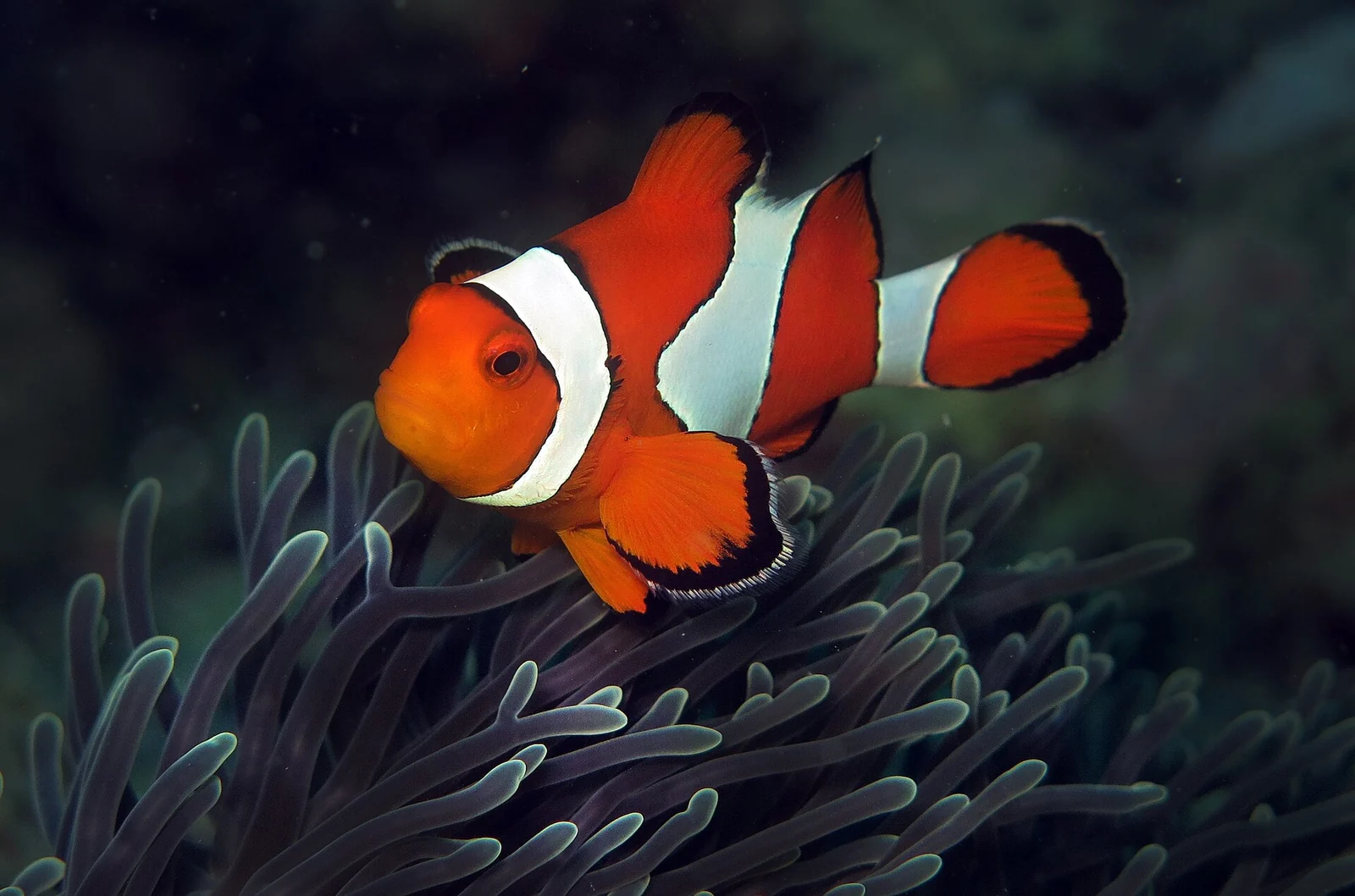
Ocellaris Anemonefish (Amphiprion ocellaris), photographed in the Andaman Islands

Photo: Vyacheslav Argenberg

Zoological Survey of India scientists have recorded 1,601 fish species in the Andaman and Nicobar Islands, and 1,111 of them live on coral reefs. Around Havelock (Swaraj Dweep), the reef fish you will most likely see are damselfish, clownfish, wrasses, butterflyfish, parrotfish and groupers. Many live in shallow water, so snorkellers see them too. December to April is the calmest, driest season.

Look, don't touch

Most reef fish are harmless. A few have venomous spines or sharp teeth, and one big triggerfish guards its nest. Learn these before you get in. Andaman diving rules ask everyone to avoid touching marine life in any case.

All 56 fish

Filter by group or search by name. Tap a fish to see how to spot it, how deep it lives, what it eats and where in the Andamans it has been seen.

Showing 56 fish. Tap any fish to read about it.

No. 01Common Seen snorkellingIUCN: Least Concern

Ocellaris Anemonefish

Amphiprion ocellaris

Also called Clownfish or Clown Anemonefish

This is the "Nemo" clownfish. In a 2000-2005 survey of anemonefish across the Andaman and Nicobar Islands it was the most widespread kind, found at every site except Car Nicobar and Campbell Bay. The same survey found that anemonefish numbers had dropped.

Family
Damselfishes
Size
Up to about 11 cm
In the Andamans
The most widespread clownfish in an island-wide survey
Habitat
Sea anemones on shallow reefs
Diet
Plankton, algae
Snorkel or dive?
Snorkellers and divers

How to spot it

  • Bright orange body with three white bars.
  • Each white bar has a thin black edge.
  • The middle bar bulges forward towards the head.
  • Fins have black edges.
Did you know?

At Chidiyatapu, the survey found clownfish that were brown all over apart from their white bars. It was the only anemonefish in the islands with this dark form.

Where to see it in the Andamans

Always inside a large sea anemone, in calm, shallow lagoons and on coral reefs. In the Andamans it usually lives in the Magnificent Sea Anemone, sometimes in the Giant Carpet Anemone. The survey found it at Havelock (Swaraj Dweep), North Bay, Wandoor, Chidiyatapu and many other sites, and it lives on Neil (Shaheed Dweep) too.

Food and habits

One anemone holds one group. In the Andaman survey that meant a breeding pair and 1-3 young fish. All clownfish start life as males, and the biggest fish in the group is the female. The pair lays eggs on a rock next to the anemone, and the male guards and fans them.

Easy to confuse with

  • Orange Clownfish (Amphiprion percula): Almost the same fish, with thicker black edges on the white bars. It lives far to the east, and its records from India are doubtful.

Sources: FishBase, Wild Life, CMFRI, Eschmeyer's Catalog of Fishes, iNaturalist

No. 02Common Seen snorkellingIUCN: Least Concern

Clark's Anemonefish

Amphiprion clarkii

Also called Yellowtail Clownfish

No other clownfish lives in as many kinds of sea anemone. In the Andaman survey it was often found deeper than the other clownfish.

Family
Damselfishes
Size
Up to about 15 cm
In the Andamans
Found across the islands, often deeper than other clownfish
Habitat
Sea anemones, lagoons to slopes
Diet
Plankton, algae, small animals
Snorkel or dive?
Snorkellers and divers

How to spot it

  • Dark brown to black body with an orange-yellow snout, belly and fins.
  • Two wide white bars on the head and body.
  • A third, narrow white bar at the base of the tail.
  • Yellow tail.
  • Young fish in the Andamans are yellow all over with three white bars.
Did you know?

Only ten kinds of sea anemone are known to host clownfish, and Clark's Anemonefish has been found in all ten.

Where to see it in the Andamans

Lagoons and outer reef slopes. In the Andamans it usually lived in the Adhesive Sea Anemone, often at 8-10 m with the anemone buried in muddy sand. Recorded at Havelock (Swaraj Dweep), Neil (Shaheed Dweep), North Bay, Chidiyatapu, North and Middle Andaman, and the Nicobars.

Food and habits

A pair shares one anemone with their young, and the female is the biggest. It eats plankton, algae and small animals. Eggs are laid on a rock beside the anemone, where the male stays to guard and fan them. One has been recorded living 11 years.

Easy to confuse with

  • Sebae Anemonefish: Has only two white bars, and the second one slants backwards. Clark's has a third, narrow bar at the tail base.

Sources: FishBase, Wild Life, CMFRI, Eschmeyer's Catalog of Fishes, iNaturalist
No. 03Uncommon Seen snorkellingIUCN: Least Concern

Spine-cheek Clownfish

Amphiprion biaculeatus

Also called Maroon Clownfish

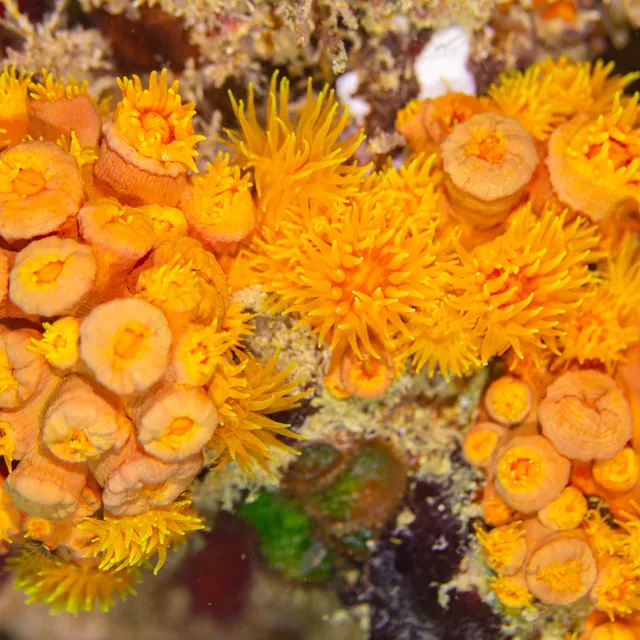
The cheek spine sets this clownfish apart from all the others. The female grows much bigger than her mate.

Family
Damselfishes
Size
Up to about 17 cm
In the Andamans
Found at 4 of 14 sites in the island survey
Habitat
Bubble-tip anemones in shallow water
Diet
Plankton, algae
Snorkel or dive?
Snorkellers and divers

How to spot it

  • Deep red to maroon or brown body.
  • Three narrow pale bars, which can be broken.
  • A large spine below the eye, pointing back across the cheek.
  • The female is much bigger than the male.
Did you know?

In Andaman colonies measured between 2000 and 2005, the females were about 15 cm long and their mates only about 8 cm.

Where to see it in the Andamans

Lagoon and outer reefs, mostly in sheltered water near the coast. In the Andamans it lived among coral rubble and rocks in very shallow water, usually in the Bubble-tip Anemone. Recorded at Havelock (Swaraj Dweep), North Bay and Chidiyatapu.

Food and habits

A pair lives in one anemone and feeds on plankton and algae. The male looks after the eggs, guarding and fanning them.

Easy to confuse with

  • Other clownfish: Only this one has the big spine across the cheek and a deep maroon body.

Sources: FishBase, Wild Life, CMFRI, Eschmeyer's Catalog of Fishes, iNaturalist
No. 04Common on reefs Seen snorkellingIUCN: Least Concern

Three-spot Dascyllus

Dascyllus trimaculatus

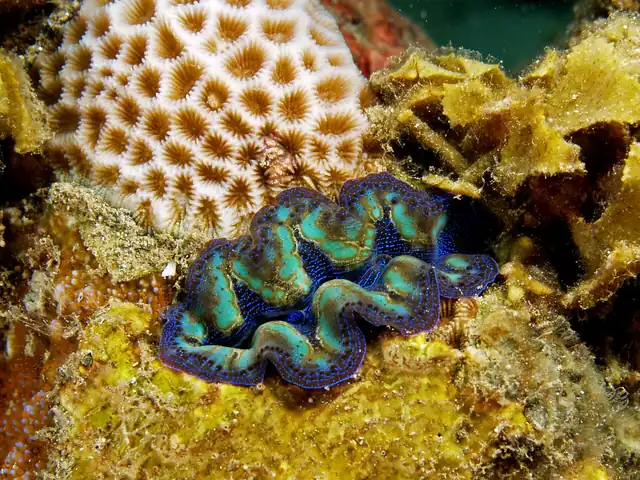
A small, round damselfish. The young are jet black with three white spots. Adults turn greyer and the spots fade.

Family
Damselfishes
Size
Up to about 14 cm
In the Andamans
Photographed at Havelock and Neil
Habitat
Coral and rocky reefs
Diet
Algae, plankton
Snorkel or dive?
Snorkellers and divers

How to spot it

  • Young fish: jet black with a white spot on the forehead and one on each side.
  • Adults: black to grey with dark-edged scales.
  • In adults the forehead spot disappears and the side spots get smaller or fade.
  • Deep, round body.
Did you know?

Young three-spots often live in sea anemones alongside clownfish, protected by the stinging tentacles, before moving out onto the reef as adults.

Where to see it in the Andamans

Coral and rocky reefs, in small to large groups. Young fish shelter in large sea anemones, among sea urchin spines or in small coral heads. Photos from the Andamans come from Havelock (Swaraj Dweep) and Neil (Shaheed Dweep).

Food and habits

Adults feed on algae and plankton in the water above the reef. Courting males make quick up-and-down "signal jumps", and later guard and fan the eggs.

Sources: FishBase, Wild Life, Eschmeyer's Catalog of Fishes, iNaturalist, GBIF

No. 05Common on reefs Seen snorkellingIUCN: Least Concern

Indo-Pacific Sergeant Major

Abudefduf vaigiensis

Also called Indo-Pacific Sergeant

Groups of this striped damselfish hang in the open water above the reef, close to the surface where the reef is shallow.

Family
Damselfishes
Size
Up to about 20 cm
In the Andamans
Often photographed at Havelock and Neil
Habitat
Upper reef slopes, rocky shores
Diet
Plankton, algae, small animals
Snorkel or dive?
Snorkellers and divers

How to spot it

  • Silvery white with a blue-green back.
  • Five narrow black bars. The last one is on the base of the tail.
  • Often a yellow patch on the upper body, brighter when it is guarding eggs.
  • Forked tail with no black stripes.
Did you know?

Adults gather in large numbers to spawn at times of big tides, which carry their young far out to sea. Young sergeants often shelter under drifting seaweed.

Where to see it in the Andamans

The top of outer reef slopes and rocky reefs near the shore. Divers and snorkellers have photographed it at Havelock (Swaraj Dweep) and Neil (Shaheed Dweep).

Food and habits

Groups feed on plankton, algae and small animals. Pairs lay eggs on rocks, and the male stays to guard and fan them.

Easy to confuse with

  • Scissortail Sergeant: Has a black stripe along each lobe of the tail and no yellow on the back.
  • Bengal Sergeant: Has seven black bars and a rounded tail with a white edge. Usually alone or in pairs in very shallow water.

Sources: FishBase, Wild Life, Eschmeyer's Catalog of Fishes, iNaturalist, GBIF

No. 06Common on reefs Seen snorkellingIUCN: Least Concern

Lemon Damsel

Pomacentrus moluccensis

Small and yellow from nose to tail, this damselfish is easy to spot over shallow coral.

Family
Damselfishes
Size
Up to about 9 cm
In the Andamans
Photographed at Havelock and Neil
Habitat
Branching corals
Diet
Algae, plankton
Snorkel or dive?
Snorkellers and divers

How to spot it

  • Bright lemon-yellow all over, including the fins and tail.
  • A small blue spot on the gill cover.
  • A small black spot at the base of the side fin.
  • Usually in small groups just above branching coral.
Did you know?

The Andaman Sea is the western end of its range, which runs east across the western Pacific.

Where to see it in the Andamans

Clear lagoons and outer reefs among branching corals, often in large numbers on shallow coral patches. It has been photographed at Havelock (Swaraj Dweep) and Neil (Shaheed Dweep).

Food and habits

It eats algae and plankton and stays in the water just above the coral. Males guard and fan the eggs.

Easy to confuse with

  • Andaman Damsel: Described as a new species in 2020 and found in the Andaman Islands. Its upper body is pale lavender to bluish grey, and it has a dark eye-spot on the back fin. The Lemon Damsel is yellow all over with no eye-spot.

Sources: FishBase, Wild Life, CMFRI, Allen et al. 2020, Eschmeyer's Catalog of Fishes

No. 07Shallow reef flats Seen snorkellingIUCN: Least Concern

Onespot Demoiselle

Chrysiptera unimaculata

A plain little damselfish of the shallowest part of the reef. Snorkellers meet it more often than divers do.

Family
Damselfishes
Size
Up to about 10 cm
In the Andamans
Photographed at Havelock and Neil
Habitat
Surge-washed reef flats
Diet
Algae
Snorkel or dive?
Snorkellers

How to spot it

  • Dusky yellow to greenish-grey body.
  • Fine blue lines on the head, across the eye.
  • A dark eye-spot at the base of the rear part of the back fin.
Did you know?

It lives in only 0-3 m of water, on reef flats and beach-rock washed by the waves.

Where to see it in the Andamans

Reef flats where the waves surge, on algae, rubble and beach-rock, alone or in small groups. It has been photographed at Havelock (Swaraj Dweep) and at Lakshmanpur on Neil (Shaheed Dweep).

Food and habits

It feeds mainly on algae and keeps low among the rubble and rocks. The male guards the eggs and fans them.

Easy to confuse with

  • Surge Demoiselle: Almost the same. Its eye-spot sits further back, on the base of the tail.

Sources: FishBase, Wild Life, CMFRI, Eschmeyer's Catalog of Fishes, iNaturalist
No. 08Recorded at Havelock Seen snorkellingIUCN: Least Concern

Blue-green Chromis

Chromis viridis

Also called Blue Green Damselfish or Green Puller

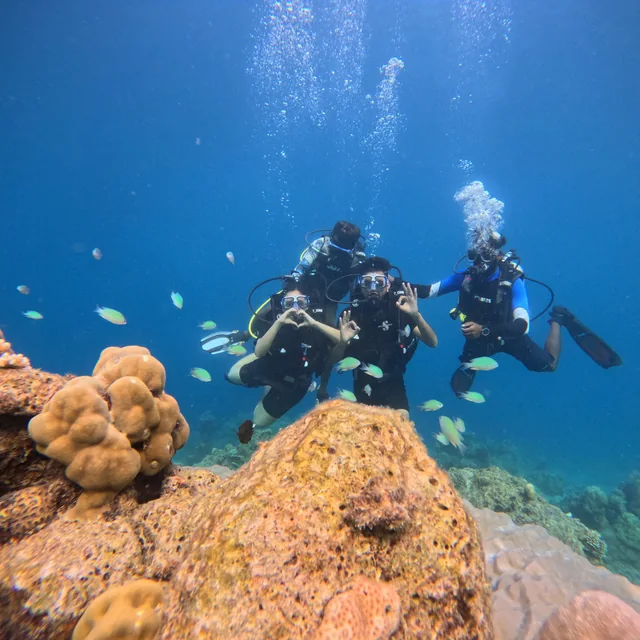
A small, pale blue-green damselfish that lives in big groups above thickets of branching coral.

Family
Damselfishes
Size
Up to about 10 cm
In the Andamans
Few records; photographed at Havelock
Habitat
Over branching coral
Diet
Plankton
Snorkel or dive?
Snorkellers and divers

How to spot it

  • Small, pale blue to apple-green body.
  • No black spot at the base of the side fin.
  • In large groups hovering over branching coral.
Did you know?

The male builds a nest that several females lay their eggs in. He guards the eggs alone and fans them with his tail until they hatch 2-3 days later.

Where to see it in the Andamans

Above thickets of branching Acropora coral in sheltered places such as reef flats and lagoons. Young fish stay close to one coral head. In the Andamans there are few photo records, both from Havelock (Swaraj Dweep).

Food and habits

The group picks plankton from the water above the coral. When something comes near, they all drop into the branches for shelter.

Easy to confuse with

  • Black-axil Chromis: Has a black spot at the base of the side fin. The Blue-green Chromis has none.

Sources: FishBase, Wild Life, CMFRI, Eschmeyer's Catalog of Fishes, iNaturalist

No. 09CommonIUCN: Least Concern

Emperor Angelfish

Pomacanthus imperator

A common angelfish in the Andamans, easy to name once it is grown. The young are dark blue with white rings, and their colours change completely as they grow.

Family
Angelfishes
Size
Up to about 40 cm
In the Andamans
Common across the islands in a 75-site survey
Habitat
Ledges and caves on rich reefs
Diet
Sponges, sea squirts
Snorkel or dive?
Mostly divers

How to spot it

  • Adult: many yellow and blue stripes along the body, and a yellow tail.
  • Adult: light blue face with a dark blue mask over the eyes.
  • Adult: a blackish band behind the head, edged in blue.
  • Young fish: dark blue with white and pale blue rings that close into full circles towards the tail.
  • Adults in the Andamans, as elsewhere in the Indian Ocean, lack the long thread on the back fin that Pacific adults have.
Did you know?

One of its old scientific names, Chaetodon nicobariensis, came from a fish collected in the Nicobar Islands and described in 1801. It is now known to be the same species.

Where to see it in the Andamans

Adults keep to ledges and caves on coral-rich lagoon, channel and outer reefs. The young hide under ledges and in holes on shallower reefs. A survey of butterflyfish and angelfish at 75 island sites rated it common. There are photos of it from Havelock (Swaraj Dweep) and Neil (Shaheed Dweep).

Food and habits

It feeds on sponges, sea squirts and other animals that grow on rock. Most often you will see a pair.

Easy to confuse with

  • Semicircle Angelfish: The young of both are dark blue with white lines. In the Emperor the lines close into full rings near the tail. In the Semicircle they stay as open half-circles.

Sources: FishBase, IUCN Red List, Patankar V., D'Souza E. & Marathe A. 2017, The Wild Life, Eschmeyer's Catalog of Fishes

No. 10UncommonIUCN: Least Concern

Semicircle Angelfish

Pomacanthus semicirculatus

This large angelfish lives on coral-rich reefs. Its young are blue-black with thin curved lines, and look nothing like the adults.

Family
Angelfishes
Size
Up to about 40 cm
In the Andamans
Uncommon in a 75-site survey of the islands
Habitat
Coral-rich coastal reefs
Diet
Sponges, sea squirts, algae
Snorkel or dive?
Mostly divers

How to spot it

  • Adult: greenish-brown to yellowish body speckled with many small blue spots, darker towards the head and tail.
  • Adult: blue edges on the fins, and long trailing tips on the back and belly fins.
  • Young fish: blue-black with thin white lines that curve into half-circles towards the tail.
  • The young change to adult colours at about 8-16 cm.
Did you know?

Its name semicirculatus means "semicircular". It refers to the thin blue and white half-circle lines on the rear of the young fish, a pattern the adult loses completely.

Where to see it in the Andamans

Coastal reefs with plenty of coral and hiding places, and also wrecks. The young stay in shallow, sheltered water. The 75-site island survey rated it uncommon. It has been photographed at Havelock (Swaraj Dweep).

Food and habits

It feeds on sponges, sea squirts and algae, alone or in pairs. Young fish are shy and hard to get close to.

Easy to confuse with

  • Emperor Angelfish: Emperor young have white lines that close into full rings near the tail. Semicircle young have open half-circles.

Sources: FishBase, IUCN Red List, Patankar V., D'Souza E. & Marathe A. 2017, The Wild Life, Eschmeyer's Catalog of Fishes

No. 11Common Seen snorkellingIUCN: Least Concern

Saddleback Butterflyfish

Chaetodon falcula

Also called Blackwedged Butterflyfish

Two black wedges on the back make this one of the easier butterflyfish to name. It is common on reef edges across the islands.

Family
Butterflyfishes
Size
Up to about 20 cm
In the Andamans
Common across the islands in a 75-site survey
Habitat
Reef edge and upper slope
Diet
Coral polyps, worms, small animals
Snorkel or dive?
Snorkellers and divers

How to spot it

  • White body with many thin dark lines running up and down.
  • Two bold black wedge-shaped saddles on the back.
  • A black bar through the eye and a black patch at the base of the tail.
  • Yellow back, belly and tail fins, with the yellow spreading onto the rear of the body.
Did you know?

It was described in 1795, and the two fish it was named from (still kept in a museum in Berlin) came from Tranquebar (Tharangambadi) on the Tamil Nadu coast.

Where to see it in the Andamans

The reef edge and upper slope, usually where there is some current. Young fish hide among corals. Divers and snorkellers have photographed it at the Lighthouse dive site and Beach No. 2 on Havelock (Swaraj Dweep), on Neil (Shaheed Dweep) and at Jolly Buoy.

Food and habits

Coral polyps, worms, small crabs and other small animals make up its food. It moves around in pairs or small groups.

Easy to confuse with

  • Pacific Double-saddle Butterflyfish: Its sister species looks much the same, but it lives from the Cocos-Keeling Islands east into the Pacific. A double-saddled butterflyfish in the Andamans is this one.

Sources: FishBase, IUCN Red List, Patankar V., D'Souza E. & Marathe A. 2017, The Wild Life, Eschmeyer's Catalog of Fishes

No. 12Common Seen snorkellingIUCN: Least Concern

Indian Redfin Butterflyfish

Chaetodon trifasciatus

Also called Melon Butterflyfish

A common butterflyfish that lives in pairs on coral-rich reefs and feeds on live coral and nothing else.

Family
Butterflyfishes
Size
Up to about 15 cm
In the Andamans
Common across the islands in a 75-site survey
Habitat
Coral-rich lagoons and reefs
Diet
Only live coral
Snorkel or dive?
Snorkellers and divers

How to spot it

  • Pale orange to yellowish oval body with thin, slanting purplish stripes.
  • Yellow tail base and a mostly yellow belly fin.
  • A bluish tinge on the upper back and rear of the body.
  • A black band with yellow edges through the eye.
Did you know?

Because it eats only live coral polyps, it usually starves in captivity, even though it is often caught for aquariums.

Where to see it in the Andamans

Coral-rich lagoons and partly sheltered outer reefs. Small young fish hide among corals. The 75-site survey rated it common, and a 2018-19 fisheries survey listed it at reefs around Havelock (Swaraj Dweep), Neil (Shaheed Dweep), North Bay and Wandoor.

Food and habits

Its food is live coral polyps, Pocillopora corals most of all. A pair stays together and chases away other butterflyfish.

Easy to confuse with

  • Oval Butterflyfish: Its Pacific twin, with a white (not yellow) tail base and a mostly dark belly fin. Rare in the Andamans.

Sources: FishBase, IUCN Red List, Patankar V., D'Souza E. & Marathe A. 2017, CMFRI, The Wild Life

No. 13Common Seen snorkellingIUCN: Least Concern

Red-tailed Butterflyfish

Chaetodon collare

Also called Collared Butterflyfish

This dark butterflyfish often swims in groups. Look for the white "collar" behind the eye and the red patch at the tail.

Family
Butterflyfishes
Size
Up to about 18 cm
In the Andamans
Common across the islands in a 75-site survey
Habitat
Reef edge and upper slope
Diet
Coral polyps
Snorkel or dive?
Snorkellers and divers

How to spot it

  • Dark brown to blackish body with pale-centred scales, giving a net-like look.
  • A bold white bar behind the eye, a dark bar over the eye and a smaller white bar in front.
  • Bright red tail base, then a black band.
Did you know?

FishBase notes that it is often exported for home aquariums, but it is hard to keep alive in a tank.

Where to see it in the Andamans

Coral reefs, usually the reef edge and upper slope. A survey of 75 sites across the islands rated it common. The photo records are from Havelock (Swaraj Dweep).

Food and habits

It eats coral polyps. Adults keep to pairs or groups.

Sources: FishBase, IUCN Red List, Patankar V., D'Souza E. & Marathe A. 2017, The Wild Life, Eschmeyer's Catalog of Fishes

No. 14Common Seen snorkellingIUCN: Least Concern

Indian Vagabond Butterflyfish

Chaetodon decussatus

A butterflyfish of the northern Indian Ocean. Its range runs from Oman and Yemen through India, Sri Lanka and the Maldives to the Andaman Sea and Indonesia.

Family
Butterflyfishes
Size
Up to about 20 cm
In the Andamans
Common across the islands in a 75-site survey
Habitat
Coral, rubble and rocky reefs
Diet
Algae, coral polyps
Snorkel or dive?
Snorkellers and divers

How to spot it

  • Silvery-white body with slanting grey lines that meet in a criss-cross pattern.
  • A broad black bar through the eye.
  • The lower rear of the body and the rear fins are largely black.
  • Some yellow on the tail and belly fin.
Did you know?

Scientists first described it in 1829, from India.

Where to see it in the Andamans

Rich coral reefs, and also rubble and rocky areas. A survey of 75 island reefs found it common. It has been photographed at Havelock (Swaraj Dweep) and Neil (Shaheed Dweep).

Food and habits

It feeds on algae and coral polyps. Adults live in pairs and young fish alone, each keeping to its own home area.

Easy to confuse with

  • Vagabond Butterflyfish: Same criss-cross lines, but only a narrow black band crosses the rear, with yellow behind it. In the Indian Vagabond the lower rear of the body and the rear fins are largely black.

Sources: FishBase, IUCN Red List, Patankar V., D'Souza E. & Marathe A. 2017, The Wild Life, Eschmeyer's Catalog of Fishes

No. 15Common Seen snorkellingIUCN: Least Concern

Vagabond Butterflyfish

Chaetodon vagabundus

One of the common butterflyfish of the islands, found on reef flats, in lagoons and out on the outer reef.

Family
Butterflyfishes
Size
Up to about 23 cm
In the Andamans
Common across the islands in a 75-site survey
Habitat
Reef flats, lagoons, outer reefs
Diet
Algae, coral polyps, small animals
Snorkel or dive?
Snorkellers and divers

How to spot it

  • Whitish body with two sets of thin, slanting dark lines that meet in a criss-cross pattern.
  • A black bar through the eye.
  • A black band across the rear of the body, with yellow behind it, and another black bar across the tail.
  • Young fish have a black spot near the rear of the back fin.
Did you know?

It copes with murky water and fresh water flowing off the land, so it can turn up on reefs near the mouths of streams.

Where to see it in the Andamans

Reef flats, lagoons and outer reefs, including murky water and places where fresh water runs off the land. The 75-site island survey rated it common, and there are photos from Havelock (Swaraj Dweep) and Neil (Shaheed Dweep).

Food and habits

It eats algae, coral polyps, small crabs and worms. Pairs stay together and defend a feeding area against other pairs, but often swim along with other kinds of fish.

Easy to confuse with

Sources: FishBase, IUCN Red List, Patankar V., D'Souza E. & Marathe A. 2017, The Wild Life, Eschmeyer's Catalog of Fishes

No. 16Common Seen snorkellingIUCN: Least Concern

Phantom Bannerfish

Heniochus pleurotaenia

A bannerfish of the Indian Ocean. Its range runs from the Maldives and Sri Lanka to Java, and north to the Andaman Sea.

Family
Butterflyfishes
Size
Up to about 17 cm
In the Andamans
Common across the islands in a 75-site survey
Habitat
Coral-rich reef crests
Diet
Small animals, coral
Snorkel or dive?
Snorkellers and divers

How to spot it

  • A dark brown mask over the mouth and eyes that reaches back to the front of the back fin.
  • Whitish body with chocolate-brown areas, including an upside-down V on the lower side.
  • Short white feathery tips on the front of the back fin, not a long pennant.
  • A small horn between the eyes and a bump on the forehead.
Did you know?

It is found only in the Indian Ocean. In the Pacific, the Horned Bannerfish takes its place.

Where to see it in the Andamans

Coral-rich lagoons and outer reefs, often on shallow reef crests with some surge, mostly above 15 m. The 75-site survey rated it common. It has been photographed at Havelock (Swaraj Dweep) and Neil (Shaheed Dweep).

Food and habits

It eats small animals and coral, in pairs or groups. In some places, such as the Maldives, it gathers in large numbers.

Easy to confuse with

  • Longfin Bannerfish: White with two clean black bands, yellow rear fins and a long white pennant. No brown mask.

Sources: FishBase, IUCN Red List, Patankar V., D'Souza E. & Marathe A. 2017, The Wild Life, Eschmeyer's Catalog of Fishes

No. 17UncommonIUCN: Least Concern

Longfin Bannerfish

Heniochus acuminatus

Also called Pennant Coralfish

Black and white, with a long white streamer on its back fin. At first look it can pass for a Moorish Idol.

Family
Butterflyfishes
Size
Up to about 25 cm
In the Andamans
Uncommon in a 75-site survey of the islands
Habitat
Deeper lagoons and slopes
Diet
Plankton, small animals
Snorkel or dive?
Divers

How to spot it

  • White body with two broad, slanting black bands.
  • The front of the back fin is drawn out into a long white pennant.
  • Yellow rear back fin, tail and side fins.
  • A black band joining the eyes.
Did you know?

Young ones sometimes work as cleaners, picking parasites off the skin of other fish.

Where to see it in the Andamans

Deep sheltered lagoons and channels, and the deeper parts of outer reef slopes. The 75-site survey rated it uncommon. It has been photographed at Havelock (Swaraj Dweep).

Food and habits

It picks plankton from the water a few metres above the reef, and also eats coral polyps and small animals. Adults swim in pairs, young fish usually alone.

Easy to confuse with

  • Moorish Idol: Has a long tube-like snout, a yellow patch on the snout and a black tail. Bannerfish have a short snout and a yellow tail.
  • Schooling Bannerfish: Almost the same colours, but a shorter snout. Usually seen in big schools well above the reef.

Sources: FishBase, IUCN Red List, Patankar V., D'Souza E. & Marathe A. 2017, The Wild Life, Eschmeyer's Catalog of Fishes

No. 18Reef resident Seen snorkellingIUCN: Least Concern

Moorish Idol

Zanclus cornutus

Bold black, white and yellow bands and a tube-like snout make this reef fish easy to know. It is often photographed at Havelock and Neil.

Family
Moorish Idol
Size
Up to about 23 cm
In the Andamans
Often photographed at Havelock and Neil
Habitat
Lagoons and reefs
Diet
Sponges, small animals
Snorkel or dive?
Snorkellers and divers

How to spot it

  • Very flat, disc-shaped body with a long tube-like snout.
  • White with two broad black bands and a yellow patch on the rear.
  • A yellow saddle on the snout.
  • A long white whip-like streamer from the back fin.
  • Black tail with a white edge.
Did you know?

Its young drift in the open sea for a long time and only settle on a reef at about 7.5 cm long. This is why the same fish, with the same colours, is found from East Africa to the Americas.

Where to see it in the Andamans

Murky inner lagoons, reef flats and clear outer reefs. The Andaman photo records come from Havelock (Swaraj Dweep) and Neil (Shaheed Dweep).

Food and habits

It feeds on small animals that grow on the reef. In one study, sponges made up about 70% of its food. Usually seen in twos or threes, sometimes in big groups.

Easy to confuse with

  • Longfin Bannerfish: A short snout, not a tube, and a yellow tail. No yellow patch on the snout.

Sources: FishBase, IUCN Red List, CMFRI, The Wild Life, Eschmeyer's Catalog of Fishes

No. 19Reef resident Seen snorkellingIUCN: Least Concern

Round Batfish

Platax orbicularis

Also called Orbicular Batfish

A round, flat, silver fish of sheltered water, often found around wrecks.

Family
Batfishes and spadefishes
Size
Up to about 60 cm
In the Andamans
Photographed at Havelock and Neil
Habitat
Sheltered water, lagoons, wrecks
Diet
Algae, small animals, small fish
Snorkel or dive?
Snorkellers and divers

How to spot it

  • Adult: very round, flat, silvery to yellowish body.
  • A dark bar through the eye and another just behind the head.
  • Back and belly fins with dark rear edges.
  • Young fish: reddish-brown with black blotches, shaped like a dead leaf.
Did you know?

Small young fish hide among mangroves and floating debris and look just like a dead leaf drifting in the water.

Where to see it in the Andamans

Sheltered coastal water down to deeper, silty areas. Young fish live among mangroves and in sheltered lagoons. A leaf-like young one has been photographed in the shallows at Beach No. 5 on Havelock (Swaraj Dweep), and adults on Neil (Shaheed Dweep).

Food and habits

It eats algae, small animals and small fish. Adults swim alone, in small groups or sometimes in big schools.

Easy to confuse with

  • Longfin Batfish: Usually has a black blotch on the belly, inside a dark bar. The Round Batfish has no belly blotch.

Sources: FishBase, IUCN Red List, The Wild Life, Eschmeyer's Catalog of Fishes, iNaturalist

No. 20Reef resident Seen snorkellingIUCN: Least Concern

Moon Wrasse

Thalassoma lunare

A fast, bright green wrasse that swims high over the reef. The yellow crescent in its tail gives it its name.

Family
Wrasses
Size
Usually up to about 25 cm
In the Andamans
Often photographed at Havelock and Neil
Habitat
Shallow reefs and coral heads
Diet
Small animals, fish eggs
Snorkel or dive?
Snorkellers and divers

How to spot it

  • Green to blue body with short red to purple lines on the scales.
  • Pink to violet bands on the head.
  • A big yellow crescent in the tail.
  • Blue side fins with a large pink to purple patch.
  • Big males turn blue on the head.
Did you know?

Most Moon Wrasses start life as females and turn into males at around 11 cm long, though a few are born male. Males gather at display grounds called leks to breed.

Where to see it in the Andamans

The upper parts of lagoon and coastal reefs, usually over ledges and coral heads. Andaman photos of it come from Havelock (Swaraj Dweep) and Neil (Shaheed Dweep).

Food and habits

It eats small animals that live on the reef, and fish eggs. You may see it alone or in a group.

Easy to confuse with

  • Green Moon Wrasse: The Moon Wrasse has blue side fins with a purple centre.

Sources: FishBase, Wild Life, Eschmeyer's Catalog of Fishes, iNaturalist, GBIF

No. 21Reef resident Seen snorkellingIUCN: Least Concern

Checkerboard Wrasse

Halichoeres hortulanus

This wrasse hunts over the sand and rubble next to the reef. Its checkerboard pattern makes it easy to name.

Family
Wrasses
Size
Up to about 27 cm
In the Andamans
Photographed at Havelock and Neil
Habitat
Sand patches by the reef
Diet
Shellfish, crabs, sea urchins
Snorkel or dive?
Snorkellers and divers

How to spot it

  • Checkerboard of dark marks on a pale body, with finer spots lower down.
  • One or two yellow saddles on the back.
  • Females and smaller fish: yellow head with pink lines.
  • Males: greener, with a bluer tail.
  • Small young fish: black and white bands with yellow around the head.
Did you know?

Even sea urchins are food for it. Most of what it eats has a hard shell.

Where to see it in the Andamans

Sand patches in lagoons and on outer reefs to at least 30 m. Young fish stay at the bottom of surge channels. It has been photographed at Havelock (Swaraj Dweep) and Neil (Shaheed Dweep).

Food and habits

It searches sand and rubble for hard-shelled food such as small shellfish, crabs and sea urchins. Pairs form when breeding.

Sources: FishBase, Wild Life, Eschmeyer's Catalog of Fishes, iNaturalist, GBIF

No. 22Reef resident Seen snorkellingIUCN: Least Concern

Bluestreak Cleaner Wrasse

Labroides dimidiatus

It runs a "cleaning station" on the reef. Other fish, many of them far bigger than it, come to have parasites picked off their bodies.

Family
Wrasses
Size
Up to about 14 cm
In the Andamans
Photographed at Havelock and Neil
Habitat
Coral-rich reefs
Diet
Parasites from other fish
Snorkel or dive?
Snorkellers and divers

How to spot it

  • Slim body with a pointed snout and the mouth at the very tip.
  • A black stripe runs from the snout through the eye and gets wider towards the tail.
  • Grey to white in front, turning blue towards the tail.
  • Young fish are black with a bright blue line along the back.
Did you know?

In a 2019 study, cleaner wrasses were given a small brown mark on the throat that looked like a parasite. Three of the four fish tried to scrape it off, but only when they could see the mark in a mirror. It was the first time a fish was reported to pass this "mirror mark test".

Where to see it in the Andamans

Coral-rich lagoons, reef flats and outer reefs. Divers and snorkellers have photographed it at Havelock (Swaraj Dweep) and Neil (Shaheed Dweep).

Food and habits

It eats tiny parasites and mucus from other fish. A cleaning station is run by a pair, a group of young fish, or one male with several females. It greets visitors with a bobbing, dancing swim, and sometimes comes up to divers. If the male disappears, the top female turns into a male within 14-18 days.

Easy to confuse with

  • False Cleanerfish: A blenny that copies the cleaner almost perfectly, but its mouth is under the snout, not at the tip. Instead of cleaning, it bites off bits of skin and fin.

Sources: FishBase, Wild Life, Kohda 2019, Eschmeyer's Catalog of Fishes, iNaturalist

No. 23EndangeredIUCN: Endangered

Humphead Wrasse

Cheilinus undulatus

Also called Napoleon Wrasse

One of the largest reef fish, listed as Endangered and never common anywhere.

Family
Wrasses
Size
Up to about 2.3 m and 190 kg
In the Andamans
Photographed at Havelock, Neil and Fusilier Channel
Habitat
Outer reef slopes and channels
Diet
Shellfish, fish, sea urchins
Snorkel or dive?
Divers

How to spot it

  • Very large wrasse. Adults grow a big hump on the forehead and have thick lips.
  • Body olive to green, with a dark bar on each scale.
  • Head blue-green with wavy yellowish lines. Two black lines run back from the eye.
  • Young fish are pale, almost white, with black lines spreading out from the eye.
Did you know?

It is one of the few fish that eat poisonous animals such as sea hares, boxfish and crown-of-thorns starfish.

Where to see it in the Andamans

Steep outer reef slopes, channels and lagoon reefs. Young fish stay in coral-rich lagoons and seagrass. In the Andamans divers have photographed it at Havelock (Swaraj Dweep), Neil (Shaheed Dweep) and Fusilier Channel. It usually moves around alone or in pairs.

Food and habits

It eats shellfish, fish, sea urchins, crabs and other small animals. By day it swims around the reef, and at night it rests in caves and under ledges. It is harmless to divers.

Protection

It is listed in CITES Appendix II, so international trade is controlled. In India it appears in Schedule IV of the Wild Life (Protection) Act (the list of CITES species), not in Schedule I or II.

Easy to confuse with

  • Bumphead Parrotfish: Also humped, but plain dark green with a pale beak instead of thick lips, and usually in groups.

Sources: FishBase, The Wild Life, Sluka & Lazarus, WoRMS, iNaturalist

No. 24UncommonIUCN: Vulnerable

Bumphead Parrotfish

Bolbometopon muricatum

Also called Green Humphead Parrotfish

A big, dark green parrotfish that moves around the reef in small groups. It is listed as Vulnerable. In the Andamans a survey of 75 reef sites found it at only 9.

Family
Parrotfishes
Size
Up to about 1.3 m and 46 kg
In the Andamans
Uncommon; seen at 9 of 75 sites in a survey of the islands
Habitat
Clear outer reefs
Diet
Algae, live coral, shellfish
Snorkel or dive?
Lucky divers

How to spot it

  • Very large parrotfish, up to 1.3 m long, with a steep forehead.
  • Adults have a big bump on the forehead, which starts to show at about 25 cm.
  • Adults are dark green all over. The pale, beak-like teeth often show.
  • Young fish are brownish green with rows of small white spots.
  • Usually seen in small groups, not alone.
Did you know?

One large adult is estimated to grind away about 5.5 tonnes of reef rock a year, around half of it live coral.

Where to see it in the Andamans

Young fish live in lagoons. Adults keep to clear outer reefs, down to at least 30 m. The island survey recorded it at Neil (Shaheed Dweep), John Lawrence, Rutland, Cinque and other islands. It was more common where the reef had a lot of live coral, and inside protected areas.

Food and habits

It feeds on algae, live coral and shellfish, and sometimes rams the reef with its head to break coral. At night it sleeps in caves and wrecks, often in groups in shallow water, which makes it easy for night spearfishers to catch. Andaman and Nicobar fishers who had caught it said it was taken by chance, with hand spears or harpoons, not hunted on purpose.

Easy to confuse with

  • Humphead Wrasse: The wrasse also has a hump, but it has thick lips instead of a beak, and wavy yellow lines on its blue-green head.

Sources: FishBase, The Wild Life, Patankar, Wagh & Marathe, Research Matters: Researchers study the distribution of..., Thomson et al.

No. 25Reef resident Seen snorkellingIUCN: Least Concern

Redlip Parrotfish

Scarus rubroviolaceus

Also called Ember Parrotfish

A large parrotfish of the outer reef. Big males and females are coloured very differently.

Family
Parrotfishes
Size
Up to about 70 cm
In the Andamans
Photographed at Havelock and Chidiyatapu
Habitat
Outer reefs and boulder slopes
Diet
Algae
Snorkel or dive?
Snorkellers and divers

How to spot it

  • Male: two-tone body, dark green or brownish on the head and front half, lighter green behind.
  • Male: steep, angled snout and a tail with long upper and lower tips.
  • Female: reddish-brown to grey with small black spots, dark lines and white flecks.
Did you know?

The big green males start life as females and change sex as they grow. In Hawaii, where this fish has been carefully aged, the change happens at around 5 years old, and it can live to about 20.

Where to see it in the Andamans

Reefs facing the open sea, over rock or coral, including boulder slopes. Big adults stay higher up on deep slopes. It has been photographed at Havelock (Swaraj Dweep) and Chidiyatapu.

Food and habits

It scrapes algae off rock and dead coral with its beak. Look for it alone or in pairs, and sometimes in big groups on boulder slopes.

Easy to confuse with

  • Swarthy Parrotfish: The female Swarthy is red on the head and belly with wavy black and white stripes. The Redlip female is reddish-brown to grey with small black spots.

Sources: FishBase, The Wild Life, WoRMS, iNaturalist

No. 26Reef resident Seen snorkellingIUCN: Least Concern

Swarthy Parrotfish

Scarus niger

Also called Dusky Parrotfish

A mid-sized parrotfish of coral-rich reefs, usually seen on its own.

Family
Parrotfishes
Size
Up to about 44 cm
In the Andamans
Photographed at Havelock, Neil and Port Blair
Habitat
Coral-rich lagoons and slopes
Diet
Algae
Snorkel or dive?
Snorkellers and divers

How to spot it

  • Male: dusky green-brown, reddish in front, with a red upper lip.
  • Male: a bright yellow-green spot with a dark edge at the top of the gill cover, just behind the eye.
  • Female: red head, belly and fins, with wavy black and white stripes on the sides and dark green bands around the mouth and eye.
  • Both: an orange back fin with a blue edge.
Did you know?

Male and female look like two different fish. The female is red with wavy stripes, the male dusky green with a bright green "ear spot".

Where to see it in the Andamans

Coral-rich parts of clear lagoons, channels and outer reef slopes. Young fish stay in small groups on shallow reefs near the shore. Divers and snorkellers have photographed it at Havelock (Swaraj Dweep), Neil (Shaheed Dweep) and Port Blair.

Food and habits

It scrapes algae off the reef. A male keeps a small group of females and spawns with them one at a time.

Easy to confuse with

  • Redlip Parrotfish: The Redlip female is reddish-brown to grey with small black spots and white flecks, without the wavy stripes and green face bands of the Swarthy female.

Sources: FishBase, The Wild Life, WoRMS, iNaturalist

No. 27Reef residentIUCN: Least Concern

Coral Grouper

Cephalopholis miniata

Also called Coral Hind

An orange-red grouper of clear, open reefs that feeds mostly on small fish.

Family
Groupers
Size
Up to about 50 cm
In the Andamans
Photographed off Havelock
Habitat
Clear coral reefs
Diet
Mostly small fish
Snorkel or dive?
Mostly divers

How to spot it

  • Orange-red to reddish-brown body.
  • Covered in bright blue spots, smaller than its eye, on the head, body and fins.
  • Tail and rear fins have a thin blue edge.
  • Sometimes shows faint, slanting olive bars.
Did you know?

One male guards a group of up to 12 females, and the group can hold a patch of reef of about 475 square metres.

Where to see it in the Andamans

Clear water on coral reefs, more often on open, exposed reefs than in sheltered bays. Divers have photographed it off Havelock (Swaraj Dweep).

Food and habits

About 80% of its food is fish, mostly the small orange Scalefin Anthias that hover over the reef. One male lives with 2-12 females, and the group holds a territory together.

Easy to confuse with

  • Peacock Grouper: Dark brown, not orange-red, with black-edged blue spots and often pale bars on the rear of the body.

Sources: FishBase, The Wild Life, CMFRI, WoRMS, iNaturalist

No. 28Reef resident Seen snorkellingIUCN: Least Concern

Peacock Grouper

Cephalopholis argus

Also called Peacock Hind

A common reef grouper that likes shallow water, so snorkellers can see it too.

Family
Groupers
Size
Up to about 60 cm
In the Andamans
Photographed at Havelock, Neil and Chidiyatapu
Habitat
Coral reefs, often shallow
Diet
Mostly fish
Snorkel or dive?
Snorkellers and divers

How to spot it

  • Dark brown body covered in small blue spots with black edges.
  • Often 5-6 pale bars on the rear of the body.
  • Often a big pale patch on the chest.
  • Rounded tail.
Did you know?

Its name argus comes from Argus, a giant with a hundred eyes in Greek stories. The blue spots are its "eyes".

Where to see it in the Andamans

Many kinds of coral reef, from tide pools down to 40 m, but it prefers 1-10 m. Young fish hide in shallow coral thickets. It has been photographed at Havelock (Swaraj Dweep), Neil (Shaheed Dweep) and Chidiyatapu.

Food and habits

Most of its food is fish. It lives in groups of up to 12 with one male, and each female holds her own small territory inside the group's area. In the Red Sea it has been seen feeding mostly early in the morning and late in the afternoon.

Easy to confuse with

  • Coral Grouper: Orange-red instead of dark brown, with no pale bars or pale chest patch.

Sources: FishBase, The Wild Life, CMFRI, WoRMS, iNaturalist

No. 29Protected, rareIUCN: Data DeficientProtected in India: Schedule I

Giant Grouper

Epinephelus lanceolatus

This grouper can grow to 2.7 m. The fisheries institute CMFRI says it is not very common around India, but Andaman waters are one of the places it is still found. A diver photographed one at Johnny's Gorge, Havelock, in 2024.

Family
Groupers
Size
Up to about 2.7 m and 400 kg
In the Andamans
Rare; recorded in Andaman waters and once photographed at Havelock
Habitat
Caves, wrecks, big reefs
Diet
Lobsters, crabs, fish, small sharks
Snorkel or dive?
Lucky divers

How to spot it

  • Huge, heavy body with a small eye and a rounded tail.
  • Adults are dark brown with faint mottling. The fins have many small black spots.
  • Small young fish are yellow with three big black patches.

Stay safe

Give a fish this big plenty of room. Never feed it and never try to touch it.

Did you know?

It is the largest bony fish found on coral reefs, reaching 2.7 m and 400 kg.

Where to see it in the Andamans

Reefs, caves and wrecks, from shallow water down to about 100 m. Big adults often stay at one cave or wreck for a long time. The only Andaman dive photo found for this guide is from Johnny's Gorge off Havelock (Swaraj Dweep).

Food and habits

It eats spiny lobsters, crabs and fish, and has been known to take small sharks, rays and young sea turtles. Young fish hide well and are rarely seen.

Protection

The Giant Grouper is in Schedule I of the Wild Life (Protection) Act, the highest level of protection in India. It is the only grouper on that list. Catching, keeping or selling it is against the law.

Easy to confuse with

  • Brown-marbled Grouper: Much smaller, pale yellow-brown with big dark blotches, and a small black saddle on top of the tail base.

Sources: FishBase, Fennessy, Pollard & Samoilys, The Wild Life, CMFRI, WoRMS

No. 30Reef resident Seen snorkellingIUCN: Least Concern

Checkered Snapper

Lutjanus decussatus

A snapper of coral reefs and lagoons. Brown stripes along the side and a checkerboard above them make it easy to name.

Family
Snappers
Size
Up to about 35 cm
In the Andamans
Photographed at Havelock, Neil and Chidiyatapu
Habitat
Coral reefs and lagoons
Diet
Small fish, crabs, shrimps
Snorkel or dive?
Snorkellers and divers

How to spot it

  • Whitish body with a checkerboard pattern on the upper half.
  • 5-6 brown stripes along the side, two of them on the lower half.
  • A big black spot at the base of the tail.
Did you know?

Its name decussatus is Latin for "divided crosswise", after the checkerboard pattern on its back.

Where to see it in the Andamans

Coral reefs, lagoons and outer reef slopes. Small young fish stay on shallow, sheltered reef flats. There are photos of it from Havelock (Swaraj Dweep), Neil (Shaheed Dweep) and Chidiyatapu.

Food and habits

It feeds on smaller fish and crustaceans, alone or in a group.

Easy to confuse with

  • Two-spot Snapper: Dark brown back with one broad white stripe and two white spots below the back fin. No checkerboard and no black tail spot.

Sources: FishBase, The Wild Life, WoRMS, iNaturalist, Fishes of Australia

No. 31Schools on reefs Seen snorkellingIUCN: Least Concern

Bluestriped Snapper

Lutjanus kasmira

Also called Common Bluestripe Snapper

A snapper that spends the day in big groups. It lives from shallow lagoons down to deep water.

Family
Snappers
Size
Up to about 40 cm
In the Andamans
Photographed off Havelock and at Chidiyatapu
Habitat
Coral heads, caves, wrecks
Diet
Fish, shrimps, crabs, squid
Snorkel or dive?
Snorkellers and divers

How to spot it

  • Bright yellow on the upper two-thirds, white below.
  • Four blue stripes along the side.
  • Yellow fins.
  • Sometimes a small black spot below the middle of the back fin.
Did you know?

It was taken from the Marquesas Islands to Hawaii in 1958 and has lived there ever since.

Where to see it in the Andamans

Coral reefs, from shallow lagoons to outer slopes. Young fish live in seagrass near small reefs. It has been photographed off Beach No. 2 on Havelock (Swaraj Dweep) and at Chidiyatapu.

Food and habits

By day it hangs in large groups around coral heads, caves and wrecks. It eats fish, shrimps, crabs, squid and octopus, and also small floating animals. It lives up to about 6 years.

Easy to confuse with

  • Five-lined Snapper: Five blue stripes instead of four, and a round black spot about the size of its eye below the back fin.

Sources: FishBase, The Wild Life, WoRMS, iNaturalist, Seatizens

No. 32Reef residentIUCN: Least Concern

Oriental Sweetlips

Plectorhinchus vittatus

A striped fish with big lips that spends the day resting under ledges, alone or in small groups.

Family
Sweetlips and grunts
Size
Up to about 72 cm
In the Andamans
Photographed at Neil and Chidiyatapu
Habitat
Coral and rocky reefs
Diet
Small animals, at night
Snorkel or dive?
Mostly divers

How to spot it

  • Adults: 6-12 broad black stripes on a pale body.
  • Yellow lines on the forehead and snout, and a yellow eye.
  • Thick lips that get bigger with age.
  • Yellow fins with black spots.
  • Young fish: black blotches on a white body and black side fins. The blotches turn into stripes as the fish grows.
Did you know?

The young look nothing like adults. They start as a blotchy black and white fish with black side fins, and the blotches slowly break up into the adult's neat stripes.

Where to see it in the Andamans

Coral reefs and rocky reefs near the shore. Young fish live alone in clear, shallow, sheltered lagoons. In the Andamans it has been photographed at Neil (Shaheed Dweep) and Chidiyatapu.

Food and habits

It rests during the day and feeds at night on small animals on the sea floor.

Sources: FishBase, The Wild Life, WoRMS, Eschmeyer's Catalog of Fishes, iNaturalist

No. 33Common on reefs Seen snorkellingIUCN: Least Concern

Bridled Monocle Bream

Scolopsis bilineata

Also called Two-lined Monocle Bream

A small, common reef fish, usually seen in pairs. The young wear a different pattern altogether: black and yellow stripes.

Family
Monocle breams
Size
Up to about 25 cm
In the Andamans
Photographed at Havelock and Chidiyatapu
Habitat
Most reef habitats
Diet
Small fish, small animals
Snorkel or dive?
Snorkellers and divers

How to spot it

  • Adult: dark grey head and back, separated from the white body by a slanting white band with black edges.
  • Adult: a white blotch under the rear of the back fin.
  • Adult: three yellow stripes on top of the head.
  • Young fish: black and yellow stripes on the upper half, white below.
Did you know?

The striped young fish is thought to copy the look of a venomous fang blenny, so that predators mistake it for a fish with a nasty bite.

Where to see it in the Andamans

Most reef habitats. Young fish stay near the shore, in lagoons or rubble. There are photos of it from Havelock (Swaraj Dweep) and Chidiyatapu.

Food and habits

It eats small fish and small animals that live on the sea floor, in pairs or sometimes alone. Fish start life as females and some later change to males.

Sources: FishBase, The Wild Life, WoRMS, iNaturalist

No. 34Shallow surge zones Seen snorkellingIUCN: Least Concern Look, don't touch

Striped Surgeonfish

Acanthurus lineatus

Also called Lined Surgeonfish

A busy, striped fish of the shallow surge zone, where the waves break over the reef. Like all surgeonfish it carries a sharp "scalpel" on each side of the tail base.

Family
Surgeonfishes
Size
Up to about 38 cm
In the Andamans
Photographed at Havelock, Neil and Chidiyatapu
Habitat
Wave-washed outer reefs
Diet
Algae
Snorkel or dive?
Snorkellers

How to spot it

  • Upper body with blue and yellow stripes edged in black. On the head they run at a slant.
  • Lower body pale lavender to bluish white.
  • Yellow-orange belly fins.
  • Dark, crescent-shaped tail with a long blade-like spine on each side of the tail base.

Stay safe

The spine on each side of the tail base is long and venomous and can give a painful cut. Do not touch it or try to hold it.

Did you know?

It can live a long time for a reef fish: FishBase gives a maximum recorded age of 46 years.

Where to see it in the Andamans

Shallow gutters and surge zones on reefs that face the open sea, mostly 1-3 m deep. Young fish hide in shallow rubble. It has been photographed at Havelock (Swaraj Dweep), Neil (Shaheed Dweep) and Chidiyatapu.

Food and habits

It grazes on algae and is almost always moving. Big males hold feeding territories with a group of females. Adults often swim in groups, while young fish live alone and hide.

Sources: FishBase, The Wild Life, Eschmeyer's Catalog of Fishes, iNaturalist

No. 35Reef residentIUCN: Least Concern

Elegant Unicornfish

Naso elegans

Also called Orangespine Unicornfish

A unicornfish with no horn. It is the Indian Ocean form of the well-known Orangespine Unicornfish, and the two were long treated as one species.

Family
Surgeonfishes
Size
Up to about 45 cm
In the Andamans
Photographed at Havelock, Neil and Chidiyatapu
Habitat
Reef flats and rocky bottoms
Diet
Algae
Snorkel or dive?
Mostly divers

How to spot it

  • Grey-brown body with no horn on the forehead.
  • A curved yellow band from the corner of the mouth to the eye, with a black snout in front of it.
  • Yellow back fin with a black band at its base.
  • Two bony plates on each side of the tail base, each with an orange-yellow spot.
  • Adult males grow a long streamer from each tip of the tail.
Did you know?

You can pick out an adult male by the long streamer at each corner of its tail.

Where to see it in the Andamans

Reef flats and rocky bottoms near the coast, about 5-30 m deep. On Havelock (Swaraj Dweep) it has been photographed at Govind Nagar and Radhanagar, and it has also been photographed on Neil (Shaheed Dweep) and at Chidiyatapu.

Food and habits

It feeds on algae from the sea floor and moves around in small groups on reef flats.

Easy to confuse with

  • Orangespine Unicornfish (Naso lituratus): Its Pacific twin. Indian records of it are treated as mistakes, so a fish with this look in the Andamans is the Elegant Unicornfish. The yellow back fin is the field mark.

Sources: FishBase, The Wild Life, Eschmeyer's Catalog of Fishes, iNaturalist, National Museum of Nature and Science, Tokyo: Fishes of...

No. 36Shallow inshore reefs Seen snorkellingIUCN: Least Concern Look, don't touch

Golden Rabbitfish

Siganus guttatus

A deep, flat fish with golden spots that swims in small groups near the shore. It looks harmless, but its fin spines are venomous.

Family
Rabbitfishes
Size
Up to about 42 cm
In the Andamans
Photographed at Havelock and Chidiyatapu
Habitat
Inshore reefs near mangroves
Diet
Algae
Snorkel or dive?
Snorkellers and divers

How to spot it

  • Dusky blue above and silver below, covered in golden-orange spots.
  • Golden lines and spots on the head.
  • A bright yellow spot, about the size of its eye, under the end of the back fin.
  • Deep, flat body. Usually in groups of 10-15.

Stay safe

The spines on its fins are sharp and venomous. Do not touch or try to catch it. If you are pricked, get out of the water and see a doctor.

Did you know?

It usually spawns around midnight.

Where to see it in the Andamans

Murky reefs near the shore and among mangroves. It can live in water that is less salty. Young fish settle in seagrass near river mouths. In the Andamans it has been photographed at Havelock (Swaraj Dweep) and Chidiyatapu.

Food and habits

It grazes on algae and stays in a group all its life. Unlike most rabbitfish, which feed by day, it is reported to be active at night.

Easy to confuse with

  • Golden-lined Spinefoot: Has the same yellow spot near the tail, but its body has golden lines instead of spots.

Sources: FishBase, The Wild Life, WoRMS, iNaturalist

No. 37Bites divers Seen snorkellingIUCN: Least Concern Look, don't touch

Titan Triggerfish

Balistoides viridescens

The largest triggerfish on Andaman reefs. FishBase describes it as often hostile to divers, and a female guarding her nest may charge and bite anyone who comes too close.

Family
Triggerfishes
Size
Up to about 75 cm
In the Andamans
Photographed many times at Havelock and Neil
Habitat
Lagoons and reef slopes
Diet
Sea urchins, coral, crabs, shells
Snorkel or dive?
Snorkellers and divers

How to spot it

  • Very large, deep-bodied triggerfish with a big head.
  • A deep groove in front of the eye.
  • A dark area around the lips that runs back from the mouth like a moustache.
  • Rows of small forward-curving spines on the side of the tail base.

Stay safe

A nesting female defends a cone-shaped area that widens from the nest up towards the surface. She will charge and often bite a diver or snorkeller who enters it. If one comes at you, swim away sideways, along the reef. Swimming upwards keeps you inside her zone for longer.

Did you know?

It is the biggest triggerfish on Indian Ocean reefs, up to 75 cm long. Only the Stone Triggerfish of the eastern Pacific grows larger.

Where to see it in the Andamans

Lagoons, outer reefs and sheltered reef slopes. Young fish stay near patches of branching coral or rubble on shallow sand. It has been photographed many times at Havelock (Swaraj Dweep), including off Radhanagar Beach, and at Neil (Shaheed Dweep) near the jetty.

Food and habits

It eats sea urchins, coral, crabs, shellfish and tube worms. To reach hidden food it flips rocks and bites off pieces of coral. Usually alone or in pairs. Pairs lay eggs in a nest on the sea floor, and the female guards it.

Easy to confuse with

  • Yellowmargin Triggerfish: Brown with a crosshatch pattern, an orange snout and cheeks and yellow to orange fin edges. No dark moustache.

Sources: FishBase, The Wild Life, Patankar 2018, Eschmeyer's Catalog of Fishes, iNaturalist

No. 38Common Seen snorkellingIUCN: Least Concern

Flagtail Triggerfish

Sufflamen chrysopterum

Also called Halfmoon Triggerfish

One of the most common triggerfish in the islands. A 2011-13 survey counted 205 of them at 46 of 75 sites. Only the Orange-lined Triggerfish turned up at more sites.

Family
Triggerfishes
Size
Up to about 30 cm
In the Andamans
Common; seen at 46 of 75 sites in an island survey
Habitat
Lagoons and outer reefs
Diet
Small animals, algae
Snorkel or dive?
Snorkellers and divers

How to spot it

  • Dark brown body with a bluish chin and belly.
  • A narrow pale bar (yellow-orange or white) behind the eye.
  • Yellow-brown tail with a white edge.
  • Young fish are dark brown above and white below.
Did you know?

The female builds the nest. The day before spawning she pushes her snout into the sand again and again to clear away stones and bits of coral, and later guards the eggs herself.

Where to see it in the Andamans

Reefs near the coast to outer reefs, from silty lagoons to clear walls. Divers and snorkellers have photographed it at Havelock (Swaraj Dweep), Neil (Shaheed Dweep) and Sound Island in Middle Andaman.

Food and habits

It eats algae, crabs, sponges, small animals and small fish. It lives alone and holds a territory: a male defends an area where a female lives.

Easy to confuse with

  • Scythe Triggerfish: Grey to brown with a white chin and belly and a curved, scythe-shaped mark below the eye. No white-edged yellow tail.

Sources: FishBase, Patankar 2018, The Wild Life, Eschmeyer's Catalog of Fishes, iNaturalist

No. 39Common Seen snorkellingIUCN: Least Concern

Orange-lined Triggerfish

Balistapus undulatus

Curved orange lines on dark green make this triggerfish easy to name. A 2011-13 survey found it at 51 of 75 island sites, more than any other triggerfish.

Family
Triggerfishes
Size
Up to about 30 cm
In the Andamans
The most widespread triggerfish in an island survey (51 of 75 sites)
Habitat
Coral-rich reefs
Diet
Sea urchins, algae, shellfish, sponges
Snorkel or dive?
Snorkellers and divers

How to spot it

  • Dark green-brown body covered in curved, slanting orange lines.
  • Narrow blue and orange stripes from the mouth to below the side fin.
  • A large round black blotch on the tail base.
  • Orange fins.

Stay safe

FishBase lists it as able to wound people, without giving details. Do not touch or hand-feed it.

Did you know?

Scientists studying East African reefs call it a "keystone predator". It is a main eater of sea urchins there, and where it is fished out, the urchins multiply and overgraze the reef.

Where to see it in the Andamans

Coral-rich parts of lagoons and outer reefs, from just below the surge zone to at least 50 m. Photo records come from Beach No. 2 on Havelock (Swaraj Dweep), from Neil (Shaheed Dweep) and from Chidiyatapu.

Food and habits

It feeds on a wide range of things from the sea floor: algae, sea urchins, starfish, small fish, shellfish and sponges. It holds a territory. The eggs are laid in a shallow pit in sand or rubble, guarded by one or two adults, and hatch at night.

Sources: FishBase, Patankar 2018, The Wild Life, Eschmeyer's Catalog of Fishes, iNaturalist

No. 40Common Seen snorkellingIUCN: Least Concern Look, don't touch

Blackspotted Puffer

Arothron nigropunctatus

Common on Andaman reefs. Its body holds a strong poison, so this puffer must never be eaten.

Family
Puffers
Size
Up to about 33 cm
In the Andamans
Common across the islands in a 2011-13 survey
Habitat
Reef crests and slopes
Diet
Coral tips, crabs, shells, sponges
Snorkel or dive?
Snorkellers and divers

How to spot it

  • Round white to grey body with a few large, scattered black spots.
  • Thick black lips and a short snout.
  • A black patch at the base of the side fin.
  • Skin covered in tiny prickles.

Stay safe

Poisonous to eat. A 2015 study found tetrodotoxin in this puffer, most of it in the skin, and advised that it should not be eaten. Look, but do not handle it.

Did you know?

Its poison sits mostly in the skin: tests found more tetrodotoxin in the skin than in the liver or flesh.

Where to see it in the Andamans

Coastal reefs to outer reef crests and slopes with plenty of sponges and corals. A 2011-13 survey listed it as common across the islands. It has been photographed off Beach No. 2 and Radhanagar Beach on Havelock (Swaraj Dweep) and on Neil (Shaheed Dweep).

Food and habits

It nibbles the tips of branching coral and also eats crabs, shellfish, sponges, sea squirts and algae. It is seen alone or, as an adult, in a pair.

Easy to confuse with

  • Starry Puffer: Pale grey and covered in many small black spots. The Blackspotted Puffer has only a few big spots.
  • White-spotted Puffer: Grey with white spots, a white ring around the eye and a white-edged black ring around the side fin base.

Sources: FishBase, Patankar 2018, The Wild Life, Puilingi 2015, Eschmeyer's Catalog of Fishes

No. 41Uncommon Seen snorkellingIUCN: Least Concern

Yellow Boxfish

Ostracion cubicum

Its body sits inside a hard shell of plates, which gives it the shape of a box. The young often hide among branching coral.

Family
Boxfishes
Size
Up to about 45 cm
In the Andamans
Few counted in a survey, but photographed a number of times at Havelock
Habitat
Lagoons and sheltered reefs
Diet
Algae, worms, small animals
Snorkel or dive?
Snorkellers and divers

How to spot it

  • Box-shaped body inside a hard shell.
  • Young fish: bright yellow with black spots.
  • Adults: dull mustard to yellow-brown, with dark-ringed bluish spots.
  • Big adults turn bluish with yellow lines between the plates.
  • A small bump on the tip of the snout.
Did you know?

When stressed it releases a soap-like skin poison (pahutoxin) into the water. In a closed tank or bag it can kill the other fish around it. FishBase lists it as harmless to people.

Where to see it in the Andamans

Lagoons and partly sheltered outer reefs. Small young fish hide in narrow cracks and among branching coral. A 2011-13 survey counted only 3 at 75 sites, but it hides well, and snorkellers and divers have photographed it a number of times off Havelock (Swaraj Dweep).

Food and habits

It eats mainly algae, plus worms, small crabs, shellfish and sponges. It lives alone, though a male keeps a group of 2-4 females.

Easy to confuse with

  • Spotted Boxfish: Dark brown back with white spots, and males have blue sides with orange spots. In the island survey it was seen only at Camorta in the Nicobars.

Sources: FishBase, Patankar 2018, The Wild Life, Kalmanzon 2001, Kalmanzon et al. 2000

No. 42Reef hunterIUCN: Least Concern

Bluefin Trevally

Caranx melampygus

The most common trevally on coral reefs. It hunts along the reef, usually alone and sometimes in groups.

Family
Jacks and trevallies
Size
Up to about 1.2 m
In the Andamans
Photographed at Havelock, Fusilier Channel and Cinque
Habitat
Around reefs, open water
Diet
Mostly fish
Snorkel or dive?
Divers, sometimes snorkellers

How to spot it

  • Adults: brassy head and upper body with a blue sheen and many small blue-black spots.
  • Electric-blue rear fins and tail.
  • A row of hard, bony scales along the rear part of the side line.
  • Young fish are plain silver-grey with yellow side fins and no spots.

Stay safe

Big fish (over about 50 cm) are often poisonous to eat because of ciguatera.

Did you know?

The blue-black spots only appear once the fish is about 16-22 cm long, and increase as it grows. Young bluefins are plain silver with yellow side fins.

Where to see it in the Andamans

Around reefs, near the coast and in open water. Young fish visit shallow sandy shores. It has been photographed at Havelock (Swaraj Dweep) and Fusilier Channel, and a marine biologist photographed a school at Cinque Island in 2014.

Food and habits

It eats mostly other fish, and some crabs and shrimps. Divers have nothing to fear from it.

Easy to confuse with

  • Giant Trevally: Much bigger and heavier, silver-grey to black with plain grey to black fins. No electric-blue fins and no small spots.

Sources: FishBase, The Wild Life, Eschmeyer's Catalog of Fishes, iNaturalist, Wikimedia Commons: Shoal of bluefin trevally at Cinque...

No. 43Big hunterIUCN: Least Concern

Giant Trevally

Caranx ignobilis

A powerful hunter of clear lagoons and outer reefs. Adults usually hunt alone.

Family
Jacks and trevallies
Size
Up to about 1.7 m and 80 kg
In the Andamans
Photographed at Havelock and Narcondam
Habitat
Clear lagoons and outer reefs
Diet
Crabs, lobsters, fish
Snorkel or dive?
Divers

How to spot it

  • Very large, heavy trevally.
  • Silver-grey to black above, paler below.
  • Fins usually plain grey to black.

Stay safe

Big fish can carry ciguatera poison and should not be eaten.

Did you know?

It is the largest trevally in the world: up to 1.7 m long and 80 kg.

Where to see it in the Andamans

Clear lagoons and outer reefs over sand and rock. Young fish live in estuaries. In the Andamans it has been photographed at Havelock (Swaraj Dweep) and Narcondam Island.

Food and habits

It feeds on crabs, spiny lobsters and fish, mostly at night. It spawns on shallow outer reefs and offshore banks. It is no danger to divers.

Easy to confuse with

  • Bluefin Trevally: Smaller, with electric-blue fins and a brassy body covered in small blue-black spots.

Sources: FishBase, The Wild Life, Eschmeyer's Catalog of Fishes, iNaturalist

No. 44Schools on reefsIUCN: Least Concern

Blackfin Barracuda

Sphyraena qenie

By day this barracuda gathers in big schools that hang almost still in the current.

Family
Barracudas
Size
Up to about 1.7 m (usually about 80 cm)
In the Andamans
Schools photographed off Havelock in 2011 and 2025
Habitat
Reefs with current
Diet
Fish
Snorkel or dive?
Divers

How to spot it

  • Long silver body with many dark bars that cross the side line.
  • The bars slant on the upper body and turn almost straight down on the lower body.
  • Tail fin mostly black.

Stay safe

Not known to be aggressive to divers. Ciguatera poisoning has been reported from eating it.

Did you know?

A school can stay at the same spot on a reef for months or even years.

Where to see it in the Andamans

Near lagoon and outer reefs with current. A marine biologist photographed a school of about 40 at Havelock (Swaraj Dweep) in 2011, and divers photographed one there again in 2025. Barracudas are hard to tell apart in photos, so these may include the similar Sawtooth Barracuda.

Food and habits

It eats fish. The daytime schools probably spread out at night to hunt.

Easy to confuse with

  • Great Barracuda: Bigger and usually alone. Its bars stay above the side line, and its black tail has white tips.
  • Pickhandle Barracuda: Same bars, but the tail is mostly yellowish, not black.
  • Sawtooth Barracuda: Also lives in the Andamans and forms schools, with V-shaped bars and a blackish tail. Very hard to tell apart underwater.

Sources: FishBase, The Wild Life, Eschmeyer's Catalog of Fishes, iNaturalist, Wikimedia Commons: Barracudas, Havelock, Andaman

No. 45Schools in open waterIUCN: Least Concern

Yellowback Fusilier

Caesio xanthonota

A slim, fast relative of the snappers, coloured in three bands: yellow on top, blue in the middle and white below.

Family
Fusiliers (snapper family)
Size
Up to about 40 cm
In the Andamans
Photographed at Havelock and Neil
Habitat
Open water by the reef
Diet
Plankton
Snorkel or dive?
Mostly divers

How to spot it

  • Upper third of the body and the whole tail bright yellow.
  • Middle third blue.
  • Lower third white.
  • Slim, streamlined body.
Did you know?

It is an Indian Ocean fish, found from East Africa to Indonesia. Reports of it from the Pacific are thought to be a look-alike, the Yellow and Blueback Fusilier.

Where to see it in the Andamans

Deep lagoons and outer reefs, mainly around coral reefs. It has been photographed off the east coast of Havelock (Swaraj Dweep) and on Neil (Shaheed Dweep).

Food and habits

It feeds on tiny floating animals in large schools in open water. Its small eggs drift in the open sea.

Easy to confuse with

  • Yellow and Blueback Fusilier (Caesio teres): Also found in the Andamans. The yellow starts just before the back fin and slants down to cover the whole rear of the body, not just a band along the upper back.
  • Lunar Fusilier: All bluish with a blue tail, and black tips on the tail lobes.

Sources: FishBase, The Wild Life, Eschmeyer's Catalog of Fishes, iNaturalist

No. 46Vulnerable Seen snorkellingIUCN: Vulnerable

Blacktip Reef Shark

Carcharhinus melanopterus

A small shark of shallow reefs and lagoons, listed as Vulnerable. It is recorded in the Andamans, but nobody has a good count of how often it is seen.

Family
Requiem sharks
Size
Up to about 2 m
In the Andamans
Recorded in the islands; few recent photos
Habitat
Shallow reefs, reef flats, mangroves
Diet
Mostly fish
Snorkel or dive?
Lucky snorkellers and divers

How to spot it

  • Small shark with a short, rounded snout.
  • Every fin has a clear black tip.
  • The black tip of the first back fin has a pale band below it.
  • Yellow-brown above, white below, with a dark band along the side.

Stay safe

FishBase notes it may become aggressive towards spearfishers and has bitten people wading in shallow water. Never feed or chase it.

Did you know?

It lives in mangroves too, and has even been recorded in fresh water close to the sea.

Where to see it in the Andamans

Shallow water close to the shore on coral reefs and reef flats, near drop-offs, and in mangroves, moving in and out with the tide. In the Andamans it is known from museum and checklist records and a few recent photos from South Andaman.

Food and habits

It eats mostly fish, and also crabs, squid and octopus. It may be alone or in a small group. Females give birth to 2-4 live pups.

Protection

Listed in CITES Appendix II (with the whole requiem shark family, since November 2023), which controls international trade.

Easy to confuse with

  • Whitetip Reef Shark: White tips, not black, on the first back fin and the top of the tail.
  • Grey Reef Shark: A wide black edge along the back of the tail, but its back fins do not have black tips.

Sources: FishBase, CMFRI, Tyabji 2018, The Wild Life, iNaturalist

No. 47VulnerableIUCN: Vulnerable

Whitetip Reef Shark

Triaenodon obesus

A slim reef shark that spends the day resting in caves and under ledges. It was reported as very common around the islands in 2013, but a 2018 shark study says it is now rarely recorded.

Family
Requiem sharks
Size
Up to about 2.1 m
In the Andamans
Reported very common in 2013, rarely recorded by 2018; still photographed off Havelock
Habitat
Caves and ledges on reefs
Diet
Fish, octopus, lobsters, crabs
Snorkel or dive?
Lucky divers

How to spot it

  • Small, slim shark with a very short, broad snout.
  • Clear white tips on the first back fin and the top of the tail.
  • Second back fin almost as big as the first.
  • Grey above, lighter below, sometimes with dark spots.

Stay safe

It rarely attacks people, but can be dangerous when there are speared fish in the water.

Did you know?

Each shark keeps to a small area: tracked sharks moved only about 0.3-3 km over periods of up to a year.

Where to see it in the Andamans

Lagoons and outer reefs. By day it rests in caves, under ledges, on sand patches or in channels. Divers still photograph it off Havelock (Swaraj Dweep) now and then, including on the north-east coast.

Food and habits

It hunts fish, octopus, spiny lobsters and crabs on the bottom, mostly at night. Females give birth to 1-5 live pups.

Protection

Listed in CITES Appendix II (with the whole requiem shark family, since November 2023), which controls international trade.

Easy to confuse with

  • Blacktip Reef Shark: Black tips, not white, on all fins.
  • Grey Reef Shark: A wide black edge along the back of the tail, and never a white tip on the top of the tail.

Sources: FishBase, CMFRI, Tyabji 2018, The Wild Life, iNaturalist

No. 48Protected, rare Seen snorkellingIUCN: EndangeredProtected in India: Schedule I

Whale Shark

Rhincodon typus

The largest fish in the world, and harmless to people. In the Andamans it is very rare: only one published record is known from the islands.

Family
Whale shark
Size
About 12 m (largest reliably measured)
In the Andamans
Rare; one published record from the islands
Habitat
Open ocean, sometimes near reefs
Diet
Plankton, small fish
Snorkel or dive?
Very lucky snorkellers and divers

How to spot it

  • Huge shark with a broad, flat head and a very wide mouth at the front.
  • A checkerboard of pale spots and stripes on a grey, bluish or green-brown back.
  • Ridges along the body.

Stay safe

Harmless to people. Keep your distance and never touch or ride it: it is protected by law.

Did you know?

One pregnant female was found carrying 300 unborn young.

Where to see it in the Andamans

The open ocean, but it sometimes comes close to shore and cruises near outer reef walls. Andaman records are very few.

Food and habits

It filters plankton, small fish and squid from the water, often hanging upright with its head near the surface. It travels very long distances but returns to the same feeding places each year.

Protection

The Whale Shark is in Schedule I of the Wild Life (Protection) Act, the highest level of protection in India. Since March 2026 it is also in CITES Appendix I, which bans commercial international trade.

Sources: FishBase, CMFRI, Tyabji 2018, The Wild Life, iNaturalist

No. 49Protected, rareIUCN: VulnerableProtected in India: Schedule I

Reef Manta Ray

Mobula alfredi

A giant ray that eats plankton. It is listed as Vulnerable and is rare in the Andamans. A 2016 study found most manta sightings were at Barren Island and the Twins, and called sightings elsewhere unpredictable.

Family
Devil rays
Size
Up to about 4.5-5 m across
In the Andamans
Rare; sightings mostly at Barren Island and in the marine national park
Habitat
Reefs and coasts with rich plankton
Diet
Plankton
Snorkel or dive?
Lucky divers

How to spot it

  • Very large ray with a wide, diamond-shaped body and the mouth at the front of the head.
  • Black back with white shoulder patches that form a black "Y" across the head.
  • White belly with dark spots, including between the gill slits.
  • Thin, whip-like tail with no sting.

Stay safe

Harmless. Do not touch or chase it: it is protected by law.

Did you know?

A female has a single pup, usually only once every 4 to 5 years.

Where to see it in the Andamans

Coastal reefs, rocky reefs and island groups with lots of plankton. In the Andamans, a 2016 study named Barren Island, the Twins and the Mahatma Gandhi Marine National Park as the main places mantas and devil rays were seen, but did not say which kind.

Food and habits

It feeds on plankton. By day it often comes to shallow reefs to visit cleaning stations, and it can travel more than 500 km.

Protection

The Reef Manta is in Schedule I of the Wild Life (Protection) Act, the highest level of protection in India. Since March 2026 all manta and devil rays are also in CITES Appendix I, which bans commercial international trade.

Easy to confuse with

  • Giant Manta Ray: Has sharp, T-shaped white shoulder patches and no spots between the gill slits.

Sources: FishBase, IUCN Red List, CMFRI, van de Sande H. 2016. Andaman Manta Rays, Rufford Small..., The Wild Life

No. 50EndangeredIUCN: Endangered

Spotted Eagle Ray

Aetobatus ocellatus

Also called Ocellated Eagle Ray

A big ray with white spots on a dark back and a tail almost three times as long as its body is wide. It is listed as Endangered.

Family
Eagle rays
Size
Up to about 3 m across
In the Andamans
Photographed off west Havelock
Habitat
Coastal waters
Diet
Clams, snails, crabs
Snorkel or dive?
Lucky divers

How to spot it

  • Large eagle ray with a dark greenish-grey back covered in white spots.
  • A very long, thin tail with stinging spines near the base.

Stay safe

It has stinging spines on its tail. Never grab it or swim it into a corner.

Did you know?

It crushes clams and snails with flat tooth plates. The lower plates are shaped like a chevron (V).

Where to see it in the Andamans

Coastal waters, including river mouths. In the Andamans it has been photographed off the west coast of Havelock (Swaraj Dweep) and at Junglighat, Port Blair.

Food and habits

It eats mostly hard-shelled animals from the sea floor, such as hermit crabs, snails, oysters and clams, and also worms, octopus and small fish. Females give birth to live young, usually 4 or fewer.

Sources: FishBase, CMFRI, The Wild Life, Eschmeyer's Catalog of Fishes, iNaturalist

No. 51Venomous sting Seen snorkellingIUCN: Least Concern Look, don't touch

Bluespotted Ribbontail Ray

Taeniura lymma

Also called Ribbontail Stingray

A small stingray that often hides under ledges. Like all stingrays it has a venomous sting on its tail.

Family
Stingrays
Size
Up to about 35 cm across (about 70 cm with the tail)
In the Andamans
On the island checklists; few recent photos
Habitat
Sand near coral, caves
Diet
Shellfish, worms, shrimps, crabs
Snorkel or dive?
Snorkellers and divers

How to spot it

  • Oval body with large, bright blue spots.
  • Two blue stripes along the sides of the tail.
  • A stout tail with a fin underneath, and usually one sting set well back on the tail.
  • Grey-brown to olive or reddish above, white below.

Stay safe

Its tail sting is venomous and very painful. Never touch or stand on a ray. If stung: get out of the water, rinse the wound gently with salt water, press on any heavy bleeding and get medical help. Only pull out a spine that sits at the skin surface, never one in the neck, chest or belly.

Did you know?

It rides the rising tide into shallow sandy areas to feed and leaves again as the tide falls.

Where to see it in the Andamans

Around coral reefs, sheltering in caves and under ledges. It is on the Andaman and Nicobar fish checklists, but recent photos from the islands are few.

Food and habits

Groups move onto shallow sand to feed on shellfish, worms, shrimps and crabs. It rarely buries itself in the sand.

Sources: FishBase, CMFRI, The Wild Life, iNaturalist, MSD Manual Consumer Version: Stingray stings

No. 52Venomous Seen snorkellingIUCN: Least Concern Look, don't touch

Lionfish

Pterois miles

Also called Devil Firefish

The most photographed lionfish in the islands, with 29 photo records around Havelock alone. Its long spines carry a strong venom, so watch it from a distance.

Family
Scorpionfishes
Size
Up to about 43 cm
In the Andamans
Photographed many times around Havelock and Neil
Habitat
Reefs, ledges, wrecks
Diet
Small fish, shrimps, crabs
Snorkel or dive?
Snorkellers and divers

How to spot it

  • Reddish to tan or grey body with many thin dark bars.
  • Large, wide fan-like side fins.
  • 13 long spines on the back.
  • A tentacle above each eye.

Stay safe

Its fin spines are venomous. A sting causes strong pain and swelling, and sometimes sickness or fainting, but it is rarely life-threatening. Never touch it or swim it into a corner. If stung, get out of the water and get medical help. First aid is to soak the wound in hot water of about 40-45°C (as hot as the person can bear; test it with an unhurt hand so numb skin is not scalded) for 30-90 minutes.

Did you know?

The lionfish that invaded the Atlantic Ocean appear to be hybrids, with this Indian Ocean species as one parent.

Where to see it in the Andamans

Reefs, ledges and wrecks. The Andaman lionfish is Pterois miles, the Indian Ocean species. Divers have photographed it many times around Havelock (Swaraj Dweep) and Neil (Shaheed Dweep).

Food and habits

It hunts mostly small fish, plus shrimps and crabs, using its big side fins to corner them.

Easy to confuse with

  • Broadbarred Firefish: A long, banded tentacle above the eye and dark blotches near the base of the side fins.

Sources: FishBase, Wilcox et al. 2018, Zannaki et al. 2019, The Wild Life, Eschmeyer's Catalog of Fishes

No. 53Most venomous fish Seen snorkellingIUCN: Least Concern Look, don't touch

Stonefish

Synanceia verrucosa

It looks just like a rock or a lump of coral, so most stonefish are probably never noticed. The 12-14 spines on its back each carry venom.

Family
Stonefishes
Size
Up to about 40 cm
In the Andamans
Photographed a few times at Havelock
Habitat
Sand and rubble on reef flats
Diet
Fish, crabs
Snorkel or dive?
Snorkellers and divers (if they spot it)

How to spot it

  • Lumpy, warty fish whose colours match the rocks around it.
  • Often covered in algae.
  • 12-14 thick spines along the back, each with a venom sac at its base.

Stay safe

Its sting is extremely painful and can sometimes kill. Never walk barefoot on reef flats and never put your hands on the bottom. If stung, get medical help at once: there is an antivenom, and it works best if given soon after the sting. Meanwhile, control any bleeding and soak the wound in hot water of about 40-45°C for 30-90 minutes.

Did you know?

FishBase calls it the most venomous fish in the world.

Where to see it in the Andamans

Sand or rubble on reef flats and in shallow lagoons, and in small pools at low tide. It has been photographed off Beach No. 2 on Havelock (Swaraj Dweep).

Food and habits

It lives alone and lies still on the bottom. It eats fish and crabs.

Easy to confuse with

Sources: FishBase, The Wild Life, Eschmeyer's Catalog of Fishes, iNaturalist, MedlinePlus

No. 54VenomousIUCN: Least Concern Look, don't touch

Tassled Scorpionfish

Scorpaenopsis oxycephala

It sits still on rock and coral and changes colour to match. Its spines are venomous, one more reason never to rest your hands on the reef.

Family
Scorpionfishes
Size
Up to about 36 cm
In the Andamans
On the island checklists
Habitat
Rock and coral on reef slopes
Snorkel or dive?
Mostly divers

How to spot it

  • Colour changes a lot to match the reef.
  • Adults have many skin tassels on the head, like a beard.
  • A very long snout.
  • Young fish are slim with a tall back fin.

Stay safe

Its spines are venomous. Do not touch the bottom or rest on rocks. If stung, get medical help and soak the wound in hot water of about 40-45°C for 30-90 minutes, as for a stonefish sting.

Did you know?

The young look quite different from adults: slim, with a tall back fin.

Where to see it in the Andamans

Clear outer reef slopes and channels, 1-35 m deep, on mixed rock and coral. It is on the Andaman and Nicobar fish checklists.

Food and habits

It lives alone and sits still on coral and rocky bottoms.

Easy to confuse with

  • Stonefish: Lumpier and wartier, without the long snout. Even more venomous.

Sources: FishBase, The Wild Life, iNaturalist, MedlinePlus

No. 55Bites if provoked Seen snorkellingIUCN: Least Concern Look, don't touch

Giant Moray

Gymnothorax javanicus

A huge eel, up to 3 m long, that lives alone in a hole in the reef and usually shows only its head.

Family
Moray eels
Size
Up to about 3 m and 30 kg
In the Andamans
The moray most often photographed in the islands
Habitat
Holes in lagoons and reefs
Diet
Mostly fish
Snorkel or dive?
Snorkellers and divers

How to spot it

  • Very large, heavy moray.
  • Adults have black specks that turn into leopard-like spots behind the head.
  • A black patch around the gill opening.
  • Young ones are tan with large black spots.

Stay safe

It bites if provoked. Never put your hands into holes and never feed morays. Its flesh often carries ciguatera poison.

Did you know?

In the Red Sea it hunts as a team with groupers, which signal to the moray to start a joint search for prey.

Where to see it in the Andamans

Lagoons and outer reefs, often along deep slopes. Young ones hide on reef flats. It is the moray most often photographed in the islands, including off Havelock (Swaraj Dweep) and in Fusilier Channel.

Food and habits

It hunts mostly fish, and sometimes crabs.

Easy to confuse with

  • Yellow-edged Moray: Yellowish with dense dark mottling, yellow-green fin edges and reddish eyes.

Sources: FishBase, Bshary et al. 2006, The Wild Life, Eschmeyer's Catalog of Fishes, iNaturalist

No. 56Lives with a shrimpIUCN: Least Concern

Steinitz' Prawn-goby

Amblyeleotris steinitzi

This small goby shares a burrow in the sand with a snapping shrimp, and keeps watch for both of them.

Family
Gobies
Size
Up to about 13 cm
In the Andamans
Photographed at Havelock and Neil
Habitat
Sand by the reef
Snorkel or dive?
Divers

How to spot it

  • Yellow-white body with five brown bars on the head and body.
  • Usually thin orange bars between the brown ones.
  • Tiny yellow spots on the back fins.
  • Sits at the mouth of a burrow in the sand, often with a shrimp nearby.
Did you know?

The shrimp keeps one feeler on the goby, so it can feel the warning flicks of the goby's fins.

Where to see it in the Andamans

Sandy areas next to outer reefs and lagoons, usually around 20 m deep. Divers and snorkellers have photographed it at Havelock (Swaraj Dweep) and Neil (Shaheed Dweep).

Food and habits

Its partner is a pale or marbled snapping shrimp. When danger comes, the goby flicks its fins and the shrimp dives back into the burrow.

Easy to confuse with

  • Wheeler's Shrimpgoby: Very similar. Steinitz' has duller brown bars.

Sources: FishBase, Karplus et al. 1979, The Wild Life, Eschmeyer's Catalog of Fishes, iNaturalist

No fish matches that search. Try another name.

How to see fish in Andaman

A few habits help you see more fish and do less harm to the reef.

Snorkel or dive?

Each fish page has a depth bar. If the teal band reaches into the striped top part, you can see that fish while snorkelling. Many reef fish, like clownfish, damsels and parrotfish, live in the top few metres. Groupers, sweetlips, sharks and rays are usually deeper, so you need to dive.

Pick the season

December to April is the driest and calmest time. The south-west monsoon normally reaches the Andaman Sea around 22 May, and May to September is the wettest period. The sea stays warm all year, about 27-30°C.

Don't touch anything

Andaman diving rules ask divers to avoid touching marine animals. All stony corals are protected in Schedule I of the Wild Life (Protection) Act, the highest level. Some fish sting or bite, and a touch can harm the fish too.

Don't feed the fish

A 2020 study in the Cook Islands found that feeding bread to reef fish changed which fish gathered, and some butterflyfish stopped eating their natural food. Keep snacks on the boat.

Take only photos

Collecting corals, shells or any marine life is strictly prohibited in the Andaman and Nicobar Islands and is punishable under the Wild Life (Protection) Act.

Look closely

  • Clownfish live inside sea anemones
  • Butterflyfish often swim in pairs
  • Cleaner wrasse run "cleaning stations" on coral heads
  • Sweetlips rest on the reef by day and feed at night
Havelock (Swaraj Dweep)A 2018-19 fisheries survey (CMFRI) at Havelock's Nemo and Turtle beaches and nearby sites recorded 82 reef fish species, mostly damselfish and wrasses.
Neil (Shaheed Dweep)Part of the same survey (Lakshmanpur). Many fish in this guide have been photographed here.
Rani Jhansi Marine NPOutram, Henry Lawrence and John Lawrence islands, near Havelock. Havelock itself is not inside the park. Diving here needs a permit and a fee.
Mahatma Gandhi Marine NPWandoor, south-west of Port Blair, set up in 1983. Jolly Buoy and Red Skin are the islands open to visitors.

Meet them on Havelock

See them on Havelock, with a guide

Most of the fish in this guide live on the reefs around Havelock. Snorkel the shallows with a guide, or try scuba with an instructor to go deeper. Neither needs any experience.

Questions people ask

How many fish species are found in Andaman?

Zoological Survey of India scientists list 1,601 fish species for the Andaman and Nicobar Islands, and 1,111 of them are coral reef fish (Rajan & Mishra, 2018). Their checklist counts seventeen species found only in these islands.

Can I see Andaman fish without scuba diving?

Yes. Many reef fish live in the top few metres of water, so you can see them while snorkelling. Every fish page in this guide shows its depth range. Clownfish, damselfish, butterflyfish, parrotfish and many wrasses are easy to see from the surface.

Are there sharks in Andaman?

Yes. 59 shark species have been recorded for the islands, but most are offshore or deep-water species known from fish landings. Of the reef sharks, divers photograph the whitetip reef shark around Havelock now and then. It was reported as very common in 2013, but a 2018 study says it is now rarely recorded. Seeing a shark on a dive is down to luck, so do not expect one.

Which fish in Andaman are dangerous to touch?

Do not touch any marine life: Andaman rules ask divers to avoid physical contact with marine animals. Some fish are dangerous too: lionfish, stonefish and scorpionfish have venomous spines, and the titan triggerfish may bite to defend its nest. See the "Look, don't touch" section above.

Is it okay to feed the fish?

No. Feeding changes how reef fish behave. A 2020 study found that bread-feeding changed which fish gathered and stopped some butterflyfish eating their natural food.

Can I take shells or coral home?

No. Collecting corals, marine plants, animals or other sea wealth is strictly prohibited in the Andaman and Nicobar Islands and is punishable under the Wild Life (Protection) Act. All stony corals and sea cucumbers are in Schedule I, the highest level of protection.

When is the best time to see marine life in Andaman?

December to April is the driest, calmest season. The south-west monsoon normally reaches the Andaman Sea around 22 May, and May to September is the wettest period. The water stays about 27-30°C all year, warmest in April and May.

Is Havelock inside a marine national park?

No. Havelock is part of Ritchie's Archipelago, but the nearby Rani Jhansi Marine National Park covers only Outram, Henry Lawrence and John Lawrence islands. Diving in a marine national park needs permission from the Chief Wildlife Warden and a fee of ₹500 per person per day for Indians and ₹1,000 for foreigners.

Which Andaman fish are protected by law in India?

In this guide, the Giant Grouper, Whale Shark and Reef Manta Ray are in Schedule I of the Wild Life (Protection) Act, the highest level of protection. Most reef fish are not listed, but all stony corals are, and the A&N rules ban collecting any marine life.

Sources and photo credits

Facts on this page were checked in October 2026. Fish names follow FishBase and Eschmeyer's Catalog of Fishes; other common names are listed on each fish's page, so search still finds them. Every fish has its own sources at the bottom of its page. All photos are free-licence photos from Wikimedia Commons, credited below.

  1. Rajan & Mishra (2018). Fishes of Andaman and Nicobar Islands: an updated checklist. J. Andaman Sci. Assoc.
  2. Rajan, Sreeraj & Immanuel (2011). Fish fauna of coral reef, mangrove, freshwater, offshore and seagrass beds of Andaman and Nicobar Islands. ZSI
  3. FishBase: fishes of the Andaman and Nicobar Islands
  4. Eschmeyer's Catalog of Fishes (California Academy of Sciences)
  5. IUCN Red List of Threatened Species
  6. The Wild Life (Protection) Amendment Act, 2022 (Gazette of India)
  7. A&N Administration (2025). Guidelines for scuba diving in the Andaman and Nicobar Islands
  8. Madhu & Madhu (2007). Occurrence of anemonefishes and host sea anemones in Andaman and Nicobar Islands. J. Mar. Biol. Ass. India
  9. Patankar, D'Souza & Marathe (2017). Butterflyfish and angelfish of the Andaman and Nicobar Islands. Marine Biodiversity
  10. Patankar et al. (2018). Tetraodontiform fishes of the Andaman and Nicobar Islands. Check List
  11. Patankar, Wagh & Marathe (2020). Bumphead parrotfish in the Andaman and Nicobar Islands. Oryx
  12. Tyabji, Jabado & Sutaria (2018). New records of sharks from the Andaman and Nicobar Archipelago. Biodiversity Data Journal
  13. Laxmilatha et al. (2021). Coral reef biodiversity of selected sites in the Andaman Islands. CMFRI
  14. Krishnan et al. (2011). Elevated sea surface temperature during May 2010 induces mass bleaching of corals in the Andaman. Current Science
  15. Bhatt et al. (eds) (2012). Coral reefs in India: status, threats and conservation measures. IUCN
  16. Ministry of Earth Sciences (2024). Lok Sabha answer on the fourth global coral bleaching event
  17. India Meteorological Department (2021). Monsoon onset dates
  18. NOAA Coral Reef Watch: Andaman, India station
  19. Prinz et al. (2020). To feed or not to feed? Coral reef fish responses to artificial feeding. Frontiers in Marine Science
  20. Key Biodiversity Areas: Rani Jhansi Marine National Park

Photo credits

  1. Ocellaris Anemonefish: Photo: Vardhan Patankar (Commons user Vardhanjp), CC BY-SA 4.0, via Wikimedia Commons. Taken in Andaman and Nicobar Islands.
  2. Clark's Anemonefish: Photo: Diego Delso, CC BY-SA 4.0, via Wikimedia Commons. Taken in Ad Dimaniyat Islands, Oman.
  3. Spine-cheek Clownfish: Photo: Steve Childs, CC BY 2.0, via Wikimedia Commons. Taken in the Andaman Islands, India.
  4. Three-spot Dascyllus: Photo: Diego Delso, CC BY-SA 4.0, via Wikimedia Commons. Taken in Ras Muhammad National Park, Egypt.
  5. Indo-Pacific Sergeant Major: Photo: Diego Delso, CC BY-SA 4.0, via Wikimedia Commons. Taken in Zanzibar, Tanzania.
  6. Lemon Damsel: Photo: Rickard Zerpe, CC BY 2.0, via Wikimedia Commons. Taken in Lembeh, Indonesia.
  7. Onespot Demoiselle: Photo: Francois Libert, CC BY-SA 2.0, via Wikimedia Commons. Taken in Marsa Alam, Egypt.
  8. Blue-green Chromis: Photo: Diego Delso, CC BY-SA 4.0, via Wikimedia Commons. Taken in Ras Muhammad NP, Red Sea, Egypt.
  9. Emperor Angelfish: Photo: Rickard Zerpe, CC BY 2.0, via Wikimedia Commons. Taken in Raja Ampat, Indonesia.
  10. Semicircle Angelfish: Photo: Rickard Zerpe, CC BY 2.0, via Wikimedia Commons. Taken in Raja Ampat, Indonesia.
  11. Saddleback Butterflyfish: Photo: Frédéric Ducarme, CC BY-SA 4.0, via Wikimedia Commons. Taken in Landaagiraavaru, Baa Atoll, Maldives.
  12. Indian Redfin Butterflyfish: Photo: Diego Delso, CC BY-SA 4.0, via Wikimedia Commons. Taken in Mahé, Seychelles.
  13. Red-tailed Butterflyfish: Photo: Diego Delso, CC BY-SA 4.0, via Wikimedia Commons. Taken in Ad Dimaniyat Islands, Oman.
  14. Indian Vagabond Butterflyfish: Photo: Graham Edgar / Reef life Survey, CC BY 3.0, via Wikimedia Commons. Taken in Tulamben, Bali, Indonesia.
  15. Vagabond Butterflyfish: Photo: Rickard Zerpe, CC BY 2.0, via Wikimedia Commons. Taken in Romblon, Philippines.
  16. Phantom Bannerfish: Photo: Storm Martin, CC BY 4.0, via Wikimedia Commons. Taken in the Maldives.
  17. Longfin Bannerfish: Photo: Thomas Quine, CC BY-SA 2.0, via Wikimedia Commons. Taken in Ko Lanta, Thailand.
  18. Moorish Idol: Photo: Diego Delso, CC BY-SA 4.0, via Wikimedia Commons. Taken in Mauritius.
  19. Round Batfish: Photo: Diego Delso, CC BY-SA 4.0, via Wikimedia Commons. Taken in Mahé, Seychelles.
  20. Moon Wrasse: Photo: Rickard Zerpe, CC BY 2.0, via Wikimedia Commons. Taken in Lembeh, Indonesia.
  21. Checkerboard Wrasse: Photo: Diego Delso, CC BY-SA 4.0, via Wikimedia Commons. Taken in Mahé, Seychelles.
  22. Bluestreak Cleaner Wrasse: Photo: Diego Delso, CC BY-SA 4.0, via Wikimedia Commons. Taken in the Red Sea, Egypt.
  23. Humphead Wrasse: Photo: MDC Seamarc Maldives, CC BY-SA 4.0, via Wikimedia Commons. Taken in Huludhoo, Baa Atoll, Maldives.
  24. Bumphead Parrotfish: Photo: Rickard Zerpe, CC BY 2.0, via Wikimedia Commons. Taken in Morotai, Indonesia.
  25. Redlip Parrotfish: Photo: Julien Bidet for MDC Seamarc, CC BY-SA 4.0, via Wikimedia Commons. Taken in Baa Atoll, Maldives.
  26. Swarthy Parrotfish: Photo: Julien Bidet for MDC Seamarc, CC BY-SA 4.0, via Wikimedia Commons. Taken in Baa Atoll, Maldives.
  27. Coral Grouper: Photo: Rickard Zerpe, CC BY 2.0, via Wikimedia Commons.
  28. Peacock Grouper: Photo: Diego Delso, CC BY-SA 4.0, via Wikimedia Commons. Taken in Mahé, Seychelles.
  29. Giant Grouper: Photo: Christo.j.brown, CC0, via Wikimedia Commons. Taken in Gold Coast, Queensland, Australia.
  30. Checkered Snapper: Photo: Diego Delso, CC BY-SA 4.0, via Wikimedia Commons. Taken in Anilao, Philippines.
  31. Bluestriped Snapper: Photo: Rickard Zerpe, CC BY 2.0, via Wikimedia Commons.
  32. Oriental Sweetlips: Photo: Storm Martin, CC BY 4.0, via Wikimedia Commons. Taken in the Maldives.
  33. Bridled Monocle Bream: Photo: Diego Delso, CC BY-SA 4.0, via Wikimedia Commons. Taken in Anilao, Philippines.
  34. Striped Surgeonfish: Photo: Rickard Zerpe, CC BY 2.0, via Wikimedia Commons. Taken in Raja Ampat, Indonesia.
  35. Elegant Unicornfish: Photo: Diego Delso, CC BY-SA 4.0, via Wikimedia Commons. Taken in the Red Sea, Egypt.
  36. Golden Rabbitfish: Photo: portioid, CC BY 4.0, via Wikimedia Commons. Taken in Thailand.
  37. Titan Triggerfish: Photo: Diego Delso, CC BY-SA 4.0, via Wikimedia Commons. Taken in Nosy Sakatia, Madagascar.
  38. Flagtail Triggerfish: Photo: Diego Delso, CC BY-SA 4.0, via Wikimedia Commons. Taken in Mauritius.
  39. Orange-lined Triggerfish: Photo: Diego Delso, CC BY-SA 4.0, via Wikimedia Commons. Taken in the Red Sea, Egypt.
  40. Blackspotted Puffer: Photo: Paul Kli, CC BY-SA 2.0, via Wikimedia Commons.
  41. Yellow Boxfish: Photo: Diego Delso, CC BY-SA 4.0, via Wikimedia Commons. Taken in Mauritius.
  42. Bluefin Trevally: Photo: Diego Delso, CC BY-SA 4.0, via Wikimedia Commons. Taken in Mahé, Seychelles.
  43. Giant Trevally: Photo: Bernard DUPONT, CC BY-SA 2.0, via Wikimedia Commons. Taken in Menjangan Island, Bali, Indonesia.
  44. Blackfin Barracuda: Photo: Vardhan Patankar (Vardhanjp), CC BY-SA 4.0, via Wikimedia Commons. Taken in Havelock.
  45. Yellowback Fusilier: Photo: Diego Delso, CC BY-SA 4.0, via Wikimedia Commons. Taken in Mauritius.
  46. Blacktip Reef Shark: Photo: USFWS Pacific, USFWS photo: Ryan Hagerty, Public domain, via Wikimedia Commons. Taken in Palmyra Atoll, central Pacific.
  47. Whitetip Reef Shark: Photo: Diego Delso, CC BY-SA 4.0, via Wikimedia Commons. Taken in Nosy Tanikely, Madagascar.
  48. Whale Shark: Photo: Tchami, CC BY-SA 2.0, via Wikimedia Commons. Taken in the Maldives.
  49. Reef Manta Ray: Photo: Tchami, CC BY-SA 2.0, via Wikimedia Commons. Taken in the Maldives.
  50. Spotted Eagle Ray: Photo: Paul Asman and Jill Lenoble, CC BY 2.0, via Wikimedia Commons. Taken in Wakaya Island, Fiji.
  51. Bluespotted Ribbontail Ray: Photo: Diego Delso, CC BY-SA 4.0, via Wikimedia Commons. Taken in the Red Sea, Egypt.
  52. Lionfish: Photo: Diego Delso, CC BY-SA 4.0, via Wikimedia Commons. Taken in the Red Sea, Egypt.
  53. Stonefish: Photo: Diego Delso, CC BY-SA 4.0, via Wikimedia Commons. Taken in Mauritius.
  54. Tassled Scorpionfish: Photo: Diego Delso, CC BY-SA 4.0, via Wikimedia Commons. Taken in Ad Dimaniyat Islands, Oman.
  55. Giant Moray: Photo: Diego Delso, CC BY-SA 4.0, via Wikimedia Commons. Taken in the Red Sea, Egypt.
  56. Steinitz' Prawn-goby: Photo: Rickard Zerpe, CC BY 2.0, via Wikimedia Commons. Taken in Lembeh Strait, Indonesia.
  57. Page background: Vyacheslav Argenberg, CC BY 4.0, via Wikimedia Commons. Taken on Havelock Island.