A field guide to Andaman and Nicobar birds

Birds of Andamanand where to see them

Photos, calls, look-alikes and sighting places for 54 birds of the Andaman and Nicobar Islands. Every fact was checked against BirdLife, eBird and the IOC world list. Tap any bird to open its page.

  • 54birds in this guide
  • 30found only in the A&N Islands
  • 350+species recorded in A&N
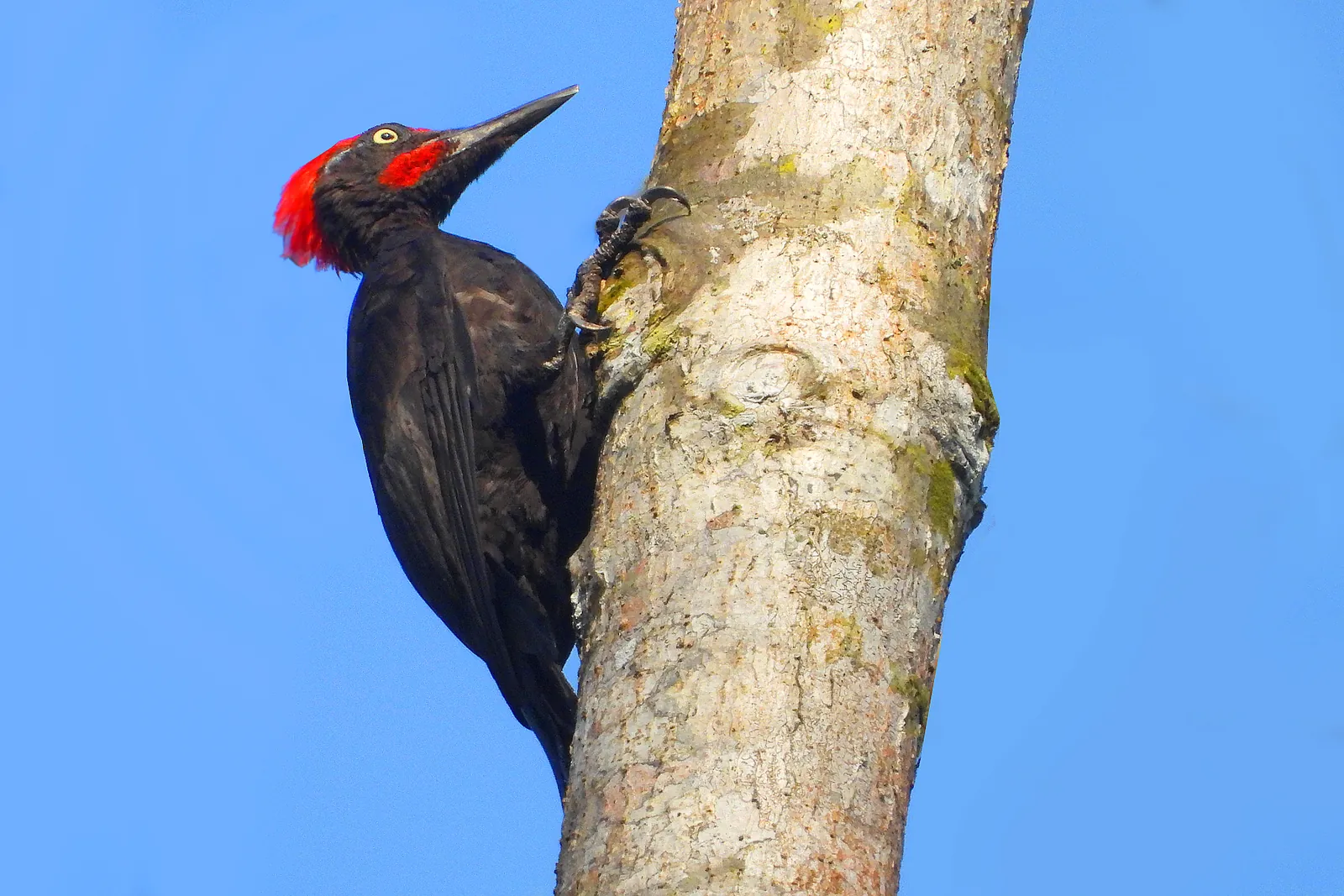
Andaman Woodpecker (Dryocopus hodgei), photographed in the Andaman Islands

Photo: Vyacheslav Argenberg

More than 350 bird species have been recorded in the Andaman and Nicobar Islands. 30 of them live nowhere else on earth, and 21 of those are found in the Andamans, among them the Andaman Woodpecker, Andaman Teal and Andaman Crake. For bird watching in Andaman, go between October and April, early in the morning, to Chidiyatapu, Mount Harriet or Havelock (Swaraj Dweep).

Found only in these islands

These are the 14 endemic birds in this guide. None of them lives anywhere outside the Andaman and Nicobar Islands, apart from a few that also reach Myanmar's small Coco Islands next door. Tap one to read more.

All 54 birds

Filter by group or search by name. Each bird opens a full page with how to identify it, its call and where it has been seen.

Showing 54 birds. Tap any bird to read about it.

PLATE 01ResidentIUCN: Least Concern

White-bellied Sea-Eagle

Icthyophaga leucogaster

It stays on the Andaman coast all year and does not migrate. Island bird surveys record it regularly, alone or in pairs, sitting on a tall tree by the shore or soaring over the water.

Family
Hawks, eagles and kites
Length
About 66-90 cm (females larger); wingspan up to about 2.2 m
In the Andamans
Resident, all year
Best time
All year
Habitat
Coasts, mangroves, creeks
Diet
Mainly fish

How to identify it

  • Adult: white head, neck and underparts with a grey back and wings.
  • From below, white wing linings against black flight feathers.
  • Short, wedge-shaped tail, white with a grey base.
  • Soars with its wings raised in a shallow V.
  • Young birds are mottled brown with a paler head. They take several years to turn white.

Call

Loud honking calls, often given by a pair together.

Did you know?

On a 2009 survey of South and Middle Andaman, birders watched these eagles carrying nest material, and others eating fish while perched on dead palm stumps in salt marshes left by the 2004 tsunami.

Where and when to see it

Coasts, creeks, mangroves and wetlands near the sea, all through the islands. Sightings include Chidiyatapu, Baratang, Little Andaman, Neil (Shaheed Dweep) and Havelock (Swaraj Dweep).

Food and habits

It eats mostly fish but also takes reptiles, birds, small mammals and carrion. It hunts by flying low over the water or by dropping from a perch. Pairs build a big stick nest in a tall tree near water.

Easy to confuse with

  • Osprey: The Osprey has a different wing shape and pale flight feathers. The adult sea-eagle shows black flight feathers against white wing linings.

Sources: BirdLife DataZone, eBird, IOC World Bird List, Indian BIRDS, Ezhilarasi et al. 2006

PLATE 02Andaman raceIUCN: Least Concern

Crested Serpent-Eagle

Spilornis cheela

This widespread Asian eagle has a race of its own in the Andamans, davisoni, found nowhere else. It shares the islands with the Andaman Serpent-Eagle, and the two mostly keep to different kinds of forest.

Family
Hawks, eagles and kites
Length
Varies a lot across its range
In the Andamans
Resident; the Andaman race davisoni lives only here
Best time
All year
Habitat
Coastal forest
Diet
Snakes, lizards, frogs

How to identify it

  • Large, heavily built eagle. A bushy, white-tipped crest makes the head look big.
  • Bare yellow skin between the eye and the bill; yellow eyes and legs.
  • Brown underparts with neat white spots.
  • Adult in flight: broad rounded wings with a white band, and a black tail with one broad white band.
  • Young birds are mostly whitish below with dark streaks and a dark mask.

Call

A loud scream of one to three notes, often given in flight. It is usually written as "kluee-wip-wip".

Did you know?

There are two kinds of serpent-eagle in the Andamans. This one keeps mostly to coastal forest. The smaller, darker Andaman Serpent-Eagle prefers the forest further inland.

Where and when to see it

Coastal forest on the bigger islands, in small numbers. Birders have seen it on Havelock (Swaraj Dweep), Neil (Shaheed Dweep), Baratang and Little Andaman.

Food and habits

It eats mainly snakes and lizards, and also frogs. It sits upright on a perch inside the trees and watches the ground below, then soars and calls over the canopy.

Easy to confuse with

Sources: BirdLife DataZone, eBird, IOC World Bird List, Indian BIRDS, Avibase

PLATE 03Andaman endemicIUCN: Vulnerable

Andaman Serpent-Eagle

Spilornis elgini

Its whole range runs from North Andaman down to Little Andaman. It needs big, closed forest, so it is found mainly on the larger islands. It is listed as Vulnerable.

Family
Hawks, eagles and kites
Length
About 50 cm
In the Andamans
Found only in the Andamans
Best time
All year
Habitat
Evergreen forest
Diet
Rats, lizards, snakes, crabs

How to identify it

  • Fairly small eagle, plain dark chocolate brown all over.
  • Bright yellow bare skin between the eye and the bill.
  • Small white spots on the underparts and the wings.
  • In flight, narrow black-and-white bands on the wings and thick black bands on the tail.
  • Young birds look like adults but have a pale cream head.

Call

A series of four or five short whistles that sound like chirps.

Did you know?

The whole world population lives in the Andamans and is estimated at only 1,000 to 4,000 adult birds. That small number, together with a slow decline as forest is cleared, is why it is listed as Vulnerable.

Where and when to see it

Wet evergreen and semi-evergreen forest on the larger islands, sometimes down to the coast. Look for it at Mount Harriet, Chidiyatapu and Baratang. There are also records from Neil (Shaheed Dweep) and Havelock (Swaraj Dweep).

Food and habits

It sits on a perch under the canopy and waits for prey: rats, lizards and snakes. It also takes crabs and prawns from the ground. Very little is known about how it breeds.

Easy to confuse with

  • Crested Serpent-Eagle: Larger and heavier, with a bushy crest and paler, spotted underparts. It keeps more to coastal forest.

Sources: BirdLife DataZone, eBird, IOC World Bird List, Indian BIRDS, Ezhilarasi et al. 2006
PLATE 04Andaman raceIUCN: Least Concern

Changeable Hawk-Eagle

Nisaetus cirrhatus

Andaman birds form their own small race, andamanensis, found only in these islands. This quiet hunter sits hidden in the trees and drops onto its prey.

Family
Hawks, eagles and kites
Length
About 60-75 cm (Andaman birds are about 60 cm)
In the Andamans
Resident; the race andamanensis lives only here
Best time
All year
Habitat
Forest and forest edge
Diet
Birds, mammals, reptiles

How to identify it

  • Medium-sized, slim eagle with broad, rounded wings. The head looks small in flight.
  • Pale form: dark brown above, white below with heavy dark streaks.
  • Strongly barred flight feathers and tail.
  • Andaman birds are said to have only a short crest.
  • Young birds are paler, with cleaner white underparts.

Call

A shrill, rising series of whistled notes, heard mostly in the breeding season.

Did you know?

During a 2009 survey in the Andamans, one landed on the ground. Greater Racket-tailed Drongos gave harsh alarm calls for more than ten minutes and then mobbed it, but the eagle paid no attention.

Where and when to see it

Forest, forest edge and plantations, always in small numbers. Records come from Chidiyatapu, Baratang, Neil (Shaheed Dweep) and Havelock (Swaraj Dweep).

Food and habits

It hunts from a hidden perch and takes birds, mammals and reptiles. It usually lays a single egg.

Easy to confuse with

  • Crested Serpent-Eagle: Young serpent-eagles look chunkier, with a bigger head and a shorter tail with fewer bars.

Sources: BirdLife DataZone, eBird, IOC World Bird List, Indian BIRDS, Ezhilarasi et al. 2006
PLATE 05Winter visitorIUCN: Least Concern

Chinese Sparrowhawk

Tachyspiza soloensis

This hawk breeds in China, Korea and south-east Russia and spends the winter mostly in South-east Asia. The Andamans sit at the western edge of that winter range, yet eBird shows it here every year in small numbers from October to April.

Family
Hawks, eagles and kites
Length
29-36 cm
In the Andamans
Regular winter visitor in small numbers
Best time
October to April
Habitat
Forest edge, wooded country
Diet
Large insects, lizards, frogs

How to identify it

  • Small hawk with narrow, pointed wings that show only four "fingers" at the tip.
  • Adult: plain grey above, whitish below with a peach-orange wash, and a bright orange-yellow patch above the bill.
  • From below in flight: pale, almost plain wing linings and solid black wing tips.
  • Adult males have dark red eyes; females have yellow eyes and are browner above.
  • Young birds are dark brown above, streaked and barred below.

Where and when to see it

Forest edge and wooded open country, from October to April, usually one to three birds together. A few have been recorded on Havelock (Swaraj Dweep).

Did you know?

Weather radar in Taiwan once estimated that as many as 409,000 Chinese Sparrowhawks passed over in a single spring migration, in 2004.

Food and habits

In winter it eats many cicadas and other large insects, and also lizards. It travels in flocks along island chains on migration and often lets people come close when it is perched.

Easy to confuse with

  • Besra: The Besra shows five "fingers" in flight and does not have plain pale wing linings with black tips.

Sources: BirdLife DataZone, eBird, IOC World Bird List, Sivaperuman 2018, Indian BIRDS

PLATE 06Andaman endemicIUCN: Least Concern

Andaman Boobook

Ninox affinis

Found only in the Andaman Islands, this small owl was once called the Andaman Hawk-Owl. It copes well with plantations and village clearings, which may be why it is doing better than some other island birds.

Family
Owls
Length
25-28 cm
In the Andamans
Found only in the Andamans
Best time
All year (active at night)
Habitat
Forest, plantations, clearings
Diet
Moths, beetles

How to identify it

  • Small owl with a round head, no ear tufts and yellow eyes.
  • Brown face and back.
  • Pale underparts with bold rusty-brown streaks from the neck to the belly.
  • Usually a white patch under the tail; barred tail.

Call

A deep, throaty "kroooo", repeated every few seconds. You will usually hear it long before you see it.

Did you know?

BirdLife listed it as Near Threatened from 1988 to 2016, then moved it to Least Concern in 2017 because it seems to manage in man-made habitats.

Where and when to see it

Lowland forest, plantations and clearings near villages. Go at dusk and listen. Birders have found it at Chidiyatapu, Baratang, Neil (Shaheed Dweep) and Havelock (Swaraj Dweep).

Food and habits

It comes out at night and is fairly shy. It eats mainly insects and has been seen catching moths and beetles in flight. Almost nothing is known about how it breeds.

Easy to confuse with

  • Hume's Boobook: Plain dark chocolate brown with no bold rusty streaks, and a fluty two-note "whoo-up" call.

Sources: BirdLife DataZone, eBird, IOC World Bird List, Ezhilarasi et al. 2006, Avibase

PLATE 07Andaman endemicIUCN: Least Concern

Hume's Boobook

Ninox obscura

In 2005 it was recognised as a species of its own, found only in the Andamans. Many older books call it Hume's Hawk-Owl, and some still list it as the Brown Hawk-Owl. It is fairly common around forest edges and plantations.

Family
Owls
In the Andamans
Found only in the Andamans
Best time
All year (active at night)
Habitat
Forest edge, groves, plantations
Diet
Flying insects

How to identify it

  • Medium-sized owl with a round head and no ear tufts.
  • Plain dark chocolate brown, with bright yellow eyes.
  • A small white spot between the eyes.
  • The lower belly is often paler, sometimes with a little barring.

Call

A fluty, two-note whistle, "whoo-up".

Did you know?

In South Andaman it has been watched hunting insects under street lamps on roads through paddy fields, mostly between 8 and 11 pm.

Where and when to see it

Forest, forest edges, groves and plantations; it also hunts over paddy fields. Sightings come from Wandoor, Baratang, Neil (Shaheed Dweep) and Havelock (Swaraj Dweep).

Food and habits

It sleeps by day in thick canopy, alone or in pairs, and hunts insects in flight at night.

Easy to confuse with

  • Andaman Boobook: Pale underparts with bold rusty streaks, and a deep "kroooo" call.

Sources: BirdLife DataZone, eBird, IOC World Bird List, Indian BIRDS, Avibase

PLATE 08Andaman endemicIUCN: Least Concern

Andaman Nightjar

Caprimulgus andamanicus

Until the mid-2000s this Andaman-only nightjar was treated as an island race of the Large-tailed Nightjar. It is active at night.

Family
Nightjars
In the Andamans
Found only in the Andamans
Best time
All year (active at night)
Habitat
Open woodland, clearings, mangroves
Diet
Night-flying insects

How to identify it

  • Dark, medium-sized nightjar with fairly long wings and tail.
  • The crown and back look paler grey than the rest of the bird.
  • White throat patch, sometimes hidden.
  • In flight, a white patch near the wing tip.

Call

A loud, hard "chowk-chowk-chowk", usually four or five notes in a level series.

Did you know?

It was split from the Large-tailed Nightjar in 2004-2005, mainly because of its song: a quick run of short "chow" notes without the Large-tailed Nightjar's deep "chonk".

Where and when to see it

Open woodland, forest clearings, plantations and mangroves. Records include the Wandoor mangroves, Baratang and Havelock (Swaraj Dweep).

Food and habits

It sits still on the ground or a low branch by day and comes out at dusk to hunt insects. A pair flushed in the Wandoor mangroves flew off slowly and landed again under thorny bushes.

Sources: BirdLife DataZone, eBird, IOC World Bird List, Indian BIRDS, Avibase

PLATE 09ResidentIUCN: Least Concern

Brown-backed Needletail

Hirundapus giganteus

A huge, powerful swift, seen regularly over South and Middle Andaman. Birds here are of the race indicus, which is mostly resident.

Family
Swifts
Length
About 21-25 cm
In the Andamans
Resident (race indicus)
Best time
All year
Habitat
Open sky over forest
Diet
Flying insects

How to identify it

  • Very large swift with a heavy, cigar-shaped body and long, broad wings.
  • Short square tail; the spine-like feather tips can be seen even in fast flight.
  • Dark brown body with a white horseshoe running from the flanks round under the tail.
  • Andaman birds have a white spot in front of the eye.
  • A paler brown patch on the back, often hard to see.

Where and when to see it

High over forest and open country. Chidiyatapu, Baratang, Neil (Shaheed Dweep) and Havelock (Swaraj Dweep) all have records.

Did you know?

Needletails are named for the bare, needle-like feather tips that stick out of the end of the tail. You can see them even when the bird races past.

Food and habits

It feeds on flying insects caught high in the air, often with other needletails. Its flight is very fast and strong.

Easy to confuse with

  • Plume-toed Swiftlet: Much smaller (about 10 cm), with fluttering flight and a whitish, speckled belly. No white horseshoe.

Sources: BirdLife DataZone, eBird, IOC World Bird List, Indian BIRDS, Ezhilarasi et al. 2006
PLATE 10Andaman & Nicobar raceIUCN: Least Concern

Plume-toed Swiftlet

Collocalia affinis

This is one of the commonest birds in the islands. A 2007 bird survey found it on five of the six Andaman and Nicobar islands it visited; only tiny Narcondam had none. The race here, affinis, lives only in the Andaman and Nicobar Islands.

Family
Swifts
Length
9-10 cm
In the Andamans
Common resident; the race affinis lives only in the A&N Islands
Best time
All year
Habitat
Over forest, fields, towns
Diet
Tiny flying insects

How to identify it

  • Tiny swiftlet with a square tail.
  • Glossy blue-black above; the sheen shows best when it flies low.
  • Whitish belly with dark speckles, sharply cut off from the dark throat and chest.
  • Dark rump.

Call

Mostly silent. It gives sharp, grating twitters at the nest.

Did you know?

The species was first described in 1867 from birds collected at Port Blair. So it was named from Andaman birds, even though it lives as far away as Borneo.

Where and when to see it

Everywhere: over forest, fields, villages and water, including Chidiyatapu, Baratang, Neil (Shaheed Dweep) and Havelock (Swaraj Dweep).

Food and habits

It flies low in flocks with fast, jerky flight, catching small insects from near the ground up to just above the treetops. It nests in colonies in caves and on buildings and is used to people.

Easy to confuse with

  • Brown-backed Needletail: More than twice the size, with a white horseshoe under the tail and very fast, direct flight.

Sources: BirdLife DataZone, eBird, IOC World Bird List, Indian BIRDS, Ezhilarasi et al. 2006

PLATE 11Near-endemicIUCN: Least Concern

Andaman Coucal

Centropus andamanensis

This large cuckoo is common in the Andamans and you will likely see one crossing a road. Small numbers also live on Myanmar's Coco and Table Islands, just north of the chain, so it is a near-endemic.

Family
Cuckoos
Length
About 40-48 cm
In the Andamans
Andamans, plus Myanmar's Coco and Table Islands
Best time
All year
Habitat
Forest edge, gardens, paddy, mangroves
Diet
Insects, small animals

How to identify it

  • Large, long-tailed bird that spends a lot of time on the ground.
  • Pale grey-buff to tawny-brown head, neck and underparts.
  • Rich chestnut back and wings.
  • Long tail, paler at the base and darker towards the tip.
  • Black bill and legs.

Call

A series of deep, booming "hoop" notes.

Did you know?

It is a cuckoo, but it does not lay its eggs in other birds' nests. Coucals build their own nests and raise their own young.

Where and when to see it

Forest edge, gardens, groves, paddy fields and mangroves. Seen at Chidiyatapu, Baratang, Little Andaman, Neil (Shaheed Dweep) and Havelock (Swaraj Dweep).

Food and habits

It creeps through shrubs and low cover, moving rather clumsily on the ground, and hunts grasshoppers, other insects and small animals, including small birds. It builds its own large, ball-shaped nest.

Sources: BirdLife DataZone, eBird, IOC World Bird List, Ezhilarasi et al. 2006, Indian BIRDS

PLATE 12Andaman raceIUCN: Least Concern

Collared Kingfisher

Todiramphus chloris

Of all the kingfishers, this is the one you are most likely to meet on the beach. It is common all year along the coast and in mangroves. Andaman birds are the race davisoni, which also lives on Myanmar's Coco Islands.

Family
Kingfishers
Length
23-25 cm
In the Andamans
Common resident; race davisoni
Best time
All year
Habitat
Coasts, mangroves, gardens
Diet
Crabs, insects, small fish

How to identify it

  • Turquoise or blue-green cap, back, wings and tail.
  • A broad white collar right round the neck.
  • Clean white underparts.
  • Black stripe through the eye.
  • Big black bill with a pale base to the lower half.

Call

Very loud and sudden: repeated harsh "kyow" or "kee-kee-kee" notes.

Did you know?

This used to be one species with about 50 races across Asia and the Pacific. It has since been split into six species, and the Andaman birds keep the old name.

Where and when to see it

Coasts, mangroves, farmland and gardens. On Havelock, birders have recorded it at Radhanagar Beach, Govind Nagar Beach, Kalapathar and the jetty. Elsewhere, try Chidiyatapu, Corbyn's Cove and the Garacharma and Chouldari wetlands.

Food and habits

On the coast it lives mostly on small crabs. It also eats shrimps, insects, frogs, lizards and small fish. It nests in a hole in a tree, a tree termite nest or an earth bank. In 2009 a pair in the Andamans was seen displaying and then digging a tunnel in a mud bank.

Easy to confuse with

Sources: BirdLife International, eBird, GBIF (eBird records), IOC World Bird List, Koparde, P. & Manchi, S.S.

PLATE 13Andaman raceIUCN: Least Concern

White-throated Kingfisher

Halcyon smyrnensis

No kingfisher is recorded more often in the Andamans. Look for it on wires and posts along village roads. The islands have a race of their own, saturatior.

Family
Kingfishers
Length
26-29 cm
In the Andamans
Common resident; race saturatior
Best time
All year
Habitat
Fields, ponds, gardens
Diet
Insects, lizards, small animals

How to identify it

  • Large kingfisher with a heavy, deep-red bill and red legs.
  • Chestnut-brown head, shoulders and belly.
  • Bright white throat and centre of the chest.
  • Bright blue back, wings and tail.
  • Large white patches show on the open wings in flight.

Call

A loud, harsh "kee-kee-kyee-kyee", often given in flight.

Did you know?

Many people think kingfishers need water. This one often hunts far from any pond or stream, and has even been known to catch small birds.

Where and when to see it

Ponds, canals, marshes, fields and gardens. Havelock spots include Radhanagar Beach, Kalapathar, Govind Nagar Beach and the jetty. It is also common at Sippighat, Chidiyatapu and Mount Harriet.

Food and habits

It sits in the open and drops onto prey on the ground. It takes large insects such as grasshoppers, and also lizards, snakes, rodents, frogs, crabs and fish. It nests in a tunnel it digs in an earth bank.

Easy to confuse with

Sources: BirdLife International, eBird, GBIF (eBird records), IOC World Bird List, Koparde, P. & Manchi, S.S.

PLATE 14Andaman raceIUCN: Least Concern

Stork-billed Kingfisher

Pelargopsis capensis

The biggest kingfisher in the islands, and hard to mistake once you see the bill. It lives along tree-lined creeks, wetlands and mangroves. Here it has a race of its own, osmastoni.

Family
Kingfishers
Length
35-41 cm
In the Andamans
Resident; race osmastoni
Best time
All year
Habitat
Creeks, mangroves, wetlands
Diet
Fish, crabs, frogs

How to identify it

  • Very large kingfisher with a huge, bright red bill.
  • Light brown or olive-brown head.
  • Buff-orange collar and underparts.
  • Green back, blue wings and tail.
  • Red legs.

Call

Noisy. A low, far-carrying "peer-por-por" every few seconds, and a cackling "ke-ke-ke-ke-ke".

Did you know?

It is one of the biggest kingfishers in Asia and very territorial. It has been known to chase off birds of prey, even eagles.

Where and when to see it

Wooded creeks, wetlands and mangroves. On Havelock it turns up near Radhanagar Beach, Kalapathar and Govind Nagar Beach. It is also seen at the Stewartgunj, Ograbraj, Chouldari and Garacharma wetlands and at Chidiyatapu.

Food and habits

It sits quietly while hunting and eats fish, crabs, frogs, rodents and young birds. It nests in a hole in a bank, a rotten tree or a tree termite nest.

Easy to confuse with

Sources: BirdLife International, eBird, GBIF (eBird records), IOC World Bird List, BirdForum Opus

PLATE 15Andaman raceIUCN: Least Concern

Ruddy Kingfisher

Halcyon coromanda

A shy kingfisher of mangroves and shady forest. Its Andaman race, mizorhina, is found nowhere else. In north-east Asia the species migrates, but the birds here stay all year.

Family
Kingfishers
Length
25-27 cm
In the Andamans
Resident; race mizorhina lives only here
Best time
All year
Habitat
Mangroves, shady forest
Diet
Fish, crabs, insects, frogs

How to identify it

  • Rusty-orange head and underparts.
  • Back, wings and tail washed purple or violet.
  • A pale sky-blue patch on the lower back, best seen in flight.
  • Large rose-red bill and red legs.

Call

A loud, falling trill. Listen for it in the mangroves.

Did you know?

Because it hides in mangroves and shady forest, it has been recorded far less often than the open-country kingfishers, even though it lives here all year.

Where and when to see it

Mangroves, tidal forest and shaded forest streams. On Havelock it has been seen at Kalapathar, along the Radhanagar Beach walk and in mangroves near the jetty. Also try Shoal Bay, Chidiyatapu and the Dhani Nallah mangrove walkway in Middle Andaman.

Food and habits

It keeps to deep shade, alone or in pairs. It eats fish, crabs and other crustaceans, large insects and frogs.

Easy to confuse with

Sources: BirdLife International, eBird, GBIF (eBird records), IOC World Bird List, Koparde, P. & Manchi, S.S.

PLATE 16Andaman raceIUCN: Least Concern

Blue-eared Kingfisher

Alcedo meninting

A small, dark-blue kingfisher that sits low over shaded forest streams and mangrove creeks. It is easily mistaken for the Common Kingfisher, so look closely.

Family
Kingfishers
Length
16-17 cm
In the Andamans
Resident; race rufigastra
Best time
All year
Habitat
Shaded forest streams
Diet
Small fish, insects

How to identify it

  • Small kingfisher with dark cobalt-blue upperparts.
  • Blue ear patch behind the eye.
  • Rufous spot in front of the eye and a white patch on the side of the neck.
  • Deep rufous underparts.
  • Male: black bill, reddish at the base. Female: an almost all-red bill.
  • Young birds have rufous ear patches, like the Common Kingfisher.

Where and when to see it

Pools and streams in dense, shaded forest, and sometimes mangroves. Havelock (Swaraj Dweep) records come from Kalapathar and around Radhanagar. Also seen at Chidiyatapu, Sippighat and the Chouldari wetland.

Did you know?

In adults, the quickest way to tell it from the Common Kingfisher is the patch behind the eye: blue in this bird, orange in the Common Kingfisher. Young Blue-eared Kingfishers have orange ear patches too, so check the darker blue back as well.

Food and habits

It perches on low branches over shaded water and dives in for small fish, crustaceans and insect larvae. It nests in a tunnel dug into a stream bank.

Easy to confuse with

  • Common Kingfisher: Common in winter. Orange ear patch at all ages, and paler, greener-blue upperparts.

Sources: BirdLife International, eBird, GBIF (eBird records), IOC World Bird List, BirdForum Opus

PLATE 17Andaman raceIUCN: Least Concern

Chestnut-headed Bee-eater

Merops leschenaulti

Common at forest edges, in clearings and around villages. It waits on a bare branch or wire, then flies out to catch insects in mid-air. The islands have their own race, andamanensis.

Family
Bee-eaters
Length
18-20 cm
In the Andamans
Common resident; race andamanensis
Best time
All year
Habitat
Forest edge, clearings, villages
Diet
Bees, wasps, flying insects

How to identify it

  • Rich chestnut crown and back of the neck.
  • Yellow chin and throat, a black stripe through the eye and a thin dark band below the throat.
  • Green body with a pale blue rump.
  • Thin, black, slightly curved bill.
  • Square tail with no long central feathers.

Where and when to see it

Forest edges, clearings, plantations and coastal scrub. Havelock records come from Radhanagar Beach, Govind Nagar and Kalapathar. It is also common at Chidiyatapu and Burmanallah.

Did you know?

Unlike many bee-eaters, it has no long pin feathers sticking out of the middle of the tail, so its tail looks square.

Food and habits

It catches bees, wasps, hornets and other flying insects in the air. It digs its nest tunnels in sandy banks.

Sources: BirdLife International, eBird, GBIF (eBird records), IOC World Bird List, Koparde, P. & Manchi, S.S.

PLATE 18Winter visitorIUCN: Least Concern

Common Sandpiper

Actitis hypoleucos

A common winter visitor to Andaman shores, here from about August to May.

Family
Sandpipers
Length
18-20 cm
In the Andamans
Common winter visitor
Best time
August to May
Habitat
Beaches, creeks, rocky shores
Diet
Insects, small crustaceans

How to identify it

  • Small wader, grey-brown above and on the sides of the chest.
  • White underparts, with a white wedge pushing up between the wing and the chest.
  • White ring round the eye.
  • Short bill; yellowish legs.
  • Bobs the back half of its body up and down as it walks.

Call

A high "pee-pee-pee" in flight.

Did you know?

The Common Sandpipers on Andaman beaches in winter breed far to the north, nesting on the ground near fresh water in northern Asia. eBird records from the islands almost stop in June and July, when the birds are away breeding.

Where and when to see it

Beaches, creeks, jetties, rocky shores and pond edges. Try Radhanagar Beach, Govind Nagar Beach, Kalapathar and the jetty on Havelock, or Sippighat, Garacharma and Chouldari near Port Blair.

Food and habits

It is usually alone, walking along the water's edge and picking up insects and small crustaceans.

Sources: BirdLife International, eBird, GBIF (eBird records), IOC World Bird List, Koparde, P. & Manchi, S.S.

PLATE 19ResidentIUCN: Least Concern

Pacific Reef-Heron

Egretta sacra

This heron hunts on rocky shores, reef flats and jetties, timing its feeding to the tide. It is common all round the islands, and jetties are a good place to see one.

Family
Herons and egrets
Length
58-66 cm
In the Andamans
Common resident
Best time
All year
Habitat
Rocky shores, reefs, jetties
Diet
Small fish, crabs

How to identify it

  • Comes in a dark form (slate grey all over) and a white form; in-between birds also occur.
  • Dark birds often have a small white chin.
  • Thick, dull yellow to brownish bill.
  • Short, thick yellow-green legs that give it a squat, hunched look.

Call

Mostly silent. A low "ork" when feeding and harsh croaks between birds.

Did you know?

You can see both the grey and the white birds on Andaman shores, sometimes close together. No one knows for sure why the two forms exist.

Where and when to see it

Rocky shores, reefs and jetties. On Havelock it turns up at the jetty, Govind Nagar Beach, Radhanagar Beach and Kalapathar. Also at Chatham jetty and Corbyn's Cove in Port Blair, Chidiyatapu and Little Andaman.

Food and habits

It stalks slowly over rocks and reef flats uncovered by the tide and stabs at small fish, including mudskippers, and small crabs. It feeds by day or by night, depending on the tide.

Easy to confuse with

  • Little Egret: Compared with a white reef heron, it is slimmer, with a thin black bill and long black legs.
  • Medium Egret: Long-necked and long-legged, with a yellow bill; it feeds in wetlands and paddy, not on reefs.

Sources: BirdLife International, eBird, GBIF (eBird records), IOC World Bird List, Heron Specialist Group

PLATE 20Seen all yearIUCN: Least Concern

Medium Egret

Ardea intermedia

A white egret of wetlands and paddy fields. It is seen in every month, but it is reported about twice as often from November to April as from June to October, so more birds seem to arrive in winter. Breeding in the islands has not been confirmed.

Family
Herons and egrets
Length
56-72 cm
In the Andamans
Seen all year, more birds in winter; breeding here not confirmed
Best time
All year; more from November to April
Habitat
Wetlands, paddy fields
Diet
Small fish, frogs, insects

How to identify it

  • All-white egret, smaller than the Great Egret.
  • Fairly short, thick yellow bill, often with a dark tip outside the breeding season.
  • The line of the mouth ends below the eye. In the Great Egret it runs well behind the eye.
  • Rounded head; the neck has only a slight kink.
  • Breeding birds grow long lacy plumes and the bill turns black.

Call

Usually quiet. A harsh "kraa" in flight.

Did you know?

Older field guides call it the Intermediate Egret. The old species was split into three, and the Asian bird was renamed Medium Egret.

Where and when to see it

Wetlands, paddy fields and ponds, and sometimes mangroves and mudflats. On Havelock it has been seen in the fields around Kalapathar village and near the jetty. Also at Sippighat, Garacharma, Stewartgunj, Ograbraj and Chouldari.

Food and habits

It eats small fish, eels, frogs, snakes and insects. It nests in colonies, often with other herons and egrets.

Easy to confuse with

  • Great Egret: Bigger, with a longer neck that has a sharp kink, and a mouth line that runs behind the eye.
  • Little Egret: Slimmer, with a thin black bill and yellow feet.
  • Eastern Cattle-Egret: Much smaller and stockier, with a shorter bill and a short neck.

Sources: BirdLife International, eBird, GBIF (eBird records), IOC World Bird List, Heron Specialist Group

PLATE 21Winter visitorIUCN: Least Concern

Lesser Crested Tern

Thalasseus bengalensis

A sea tern that visits the islands mostly from November to March. You see it over bays, beaches and jetties, plunge-diving for small fish.

Family
Gulls and terns
Length
35-43 cm
In the Andamans
Winter and passage visitor
Best time
Mostly November to March
Habitat
Coasts, bays, open sea
Diet
Fish, prawns

How to identify it

  • Medium-large tern with a long, thin orange bill.
  • Black cap; in winter the forehead turns white.
  • Grey back and wings, white underparts.
  • Black legs.

Call

A noisy, grating "kerrrick".

Did you know?

It has been seen from dive boats off Havelock. In November 2024 birders logged a flock of 25 at a site they called "Slope diving point".

Where and when to see it

Coasts, bays and the open sea. Havelock (Swaraj Dweep) records come from the jetty and offshore. Also at Rangat Bay, Kalipur Beach near Diglipur, Hut Bay in Little Andaman and Mahatma Gandhi Marine National Park at Wandoor.

Food and habits

It flies over the sea and dives straight down into the water for fish and prawns. It does not breed in the Andamans as far as is known.

Easy to confuse with

  • Great Crested Tern: Larger and darker grey above, with a thicker yellow or greenish-yellow bill.

Sources: BirdLife International, eBird, GBIF (eBird records), IOC World Bird List, BirdForum Opus

PLATE 22Andaman endemicIUCN: Near Threatened

Andaman Teal

Anas albogularis

Until 2005 it was treated as a race of the Sunda Teal. It lives only in the Andaman Islands (IOC also lists Myanmar's nearby Coco Islands). Flocks of hundreds gather on the Sippighat and Ograbraj wetlands in South Andaman, the best places to see it.

Family
Ducks
Length
About 40 cm
In the Andamans
Andamans (and Myanmar's Coco Islands)
Best time
All year
Habitat
Wetlands, creeks, paddy
Diet
Seeds, insects

How to identify it

  • Small brown duck with a dark, scaly-looking body.
  • Dark head with a white ring round the eye and white on the throat. The amount of white varies a lot from bird to bird.
  • Blue-grey bill.
  • A white panel on the upper wing in flight, and white under the wing.
  • Males and females look alike.

Where and when to see it

Freshwater and brackish wetlands, paddy fields, creeks, mangroves and lagoons. Sippighat and Ograbraj are the best sites; also try Stewartgunj, Garacharma, Chouldari and Wandoor, and Baratang and Mayabunder further north. Havelock has only a handful of records, so do not count on it there.

Did you know?

The 2004 earthquake and tsunami lowered parts of South Andaman and raised parts of North Andaman, and new wetlands formed. The teal moved in: its numbers grew in South Andaman and more birds now live in North Andaman.

Food and habits

It dabbles in shallow water and mud for seeds and insects, and rests in flocks on open water, mudflats and rocks at low tide. Its breeding is poorly known. One nest with 9 eggs was found on an islet near Redskin Island, Wandoor, in May 1999.

Sources: BirdLife International, BirdLife DataZone, eBird, GBIF (eBird records), IOC World Bird List

PLATE 23Andaman raceIUCN: Near Threatened

Green Imperial-Pigeon

Ducula aenea

One of the most often reported pigeons in the Andamans, from Chidiyatapu to Havelock. Andaman birds are the race andamanica; the Nicobar birds just to the south are now a different species.

Family
Pigeons and doves
Length
40-47 cm
In the Andamans
Common resident; race andamanica
Best time
All year
Habitat
Lowland forest, mangroves
Diet
Fruit

How to identify it

  • Large, heavy pigeon with a pearl-grey head, neck and underparts.
  • Deep green wings, back and tail, with a bronze or bluish sheen.
  • Dark chestnut-maroon feathers under the tail.
  • Males and females look alike.

Call

Very vocal. A deep, throaty "rrruh-RUOOHH", sometimes longer or with a change in pitch.

Did you know?

It is common in the Andamans, but it is now rated Near Threatened worldwide (BirdLife, 2021). Many older lists still show it as Least Concern.

Where and when to see it

Lowland forest of all kinds, forest gardens and mangroves. Very common at Chidiyatapu and Mount Harriet. On Havelock it has been recorded near Radhanagar Beach and Kalapathar, and it is also seen on Neil (Shaheed Dweep) and Little Andaman.

Food and habits

It stays high in fruiting trees, alone, in pairs or in small groups, and is noisy. As a large fruit-eater it probably spreads the seeds of many forest trees.

Easy to confuse with

Sources: BirdLife DataZone, eBird, GBIF (eBird records), IOC World Bird List, Indian BIRDS

PLATE 24A&N endemicIUCN: Near Threatened

Andaman Wood-Pigeon

Columba palumboides

You will find this pigeon only in the Andaman and Nicobar Islands. It keeps to dense evergreen forest and feeds near the canopy, so it is uncommon and easy to miss. It moves between islands to find fruiting trees.

Family
Pigeons and doves
Length
36-41 cm
In the Andamans
Found only in the Andaman and Nicobar Islands
Best time
All year
Habitat
Dense evergreen forest
Diet
Figs, berries, fruit

How to identify it

  • Large pigeon with dark slate-grey wings and back.
  • Pale grey, almost whitish, head and underparts.
  • A silvery neck with fine dark bars.
  • Reddish bare skin round the eye and a pale bill.
  • Pale grey under the tail, not chestnut.

Where and when to see it

Dense evergreen forest. Most records come from Chidiyatapu and Mount Harriet. Havelock has fewer, from near Radhanagar Beach and Kalapathar.

Did you know?

BirdLife puts the whole world population at 2,500 to 9,999 adult birds, all of them in the Andaman and Nicobar Islands.

Food and habits

It feeds in pairs or small groups on large berries and figs near the top of the forest. At Wandoor it was seen eating ripe figs in a mixed flock with Andaman Green-Pigeons, hill mynas and Asian Fairy-bluebirds.

Easy to confuse with

Sources: BirdLife DataZone, eBird, GBIF (eBird records), IOC World Bird List, Indian BIRDS

PLATE 25ResidentIUCN: Least Concern

Pied Imperial-Pigeon

Ducula bicolor

A pigeon of small islands and coasts. In the Andamans most sightings come from Port Blair, Little Andaman and Narcondam. It turns up on Havelock only now and then.

Family
Pigeons and doves
Length
35-42 cm
In the Andamans
Local resident, mostly small islands and coasts
Best time
All year
Habitat
Small islands, coastal forest
Diet
Fruit

How to identify it

  • Large white to creamy-white pigeon.
  • Black flight feathers and a black tail tip, so it looks black-trimmed in flight.
  • Dark eye; blue-grey bill with a dark tip.
  • Males and females look alike.

Call

A very low "woo-oo-woooo", the last note drawn out and fading.

Did you know?

Flocks often sleep on small offshore islands and fly across the sea every day to feed in forests on bigger islands, then fly back to roost.

Where and when to see it

Coastal forest, mangroves and small offshore islands. Try Chatham jetty and Ross Island in Port Blair, and Hut Bay on Little Andaman. On Havelock (Swaraj Dweep) it is only an occasional visitor.

Food and habits

It lives in flocks, often ten or more, and perches high on bare branches or wires. It eats fruit.

Easy to confuse with

Sources: BirdLife DataZone, eBird, GBIF (eBird records), IOC World Bird List, Indian BIRDS

PLATE 26Near-endemicIUCN: Near Threatened

Andaman Green-Pigeon

Treron chloropterus

Long treated as an island form of the Pompadour Green-Pigeon, this is now its own species. It lives only in the Andaman and Nicobar Islands and on Myanmar's Coco Island, and is fairly common in Andaman forests.

Family
Pigeons and doves
Length
About 27 cm
In the Andamans
Andaman & Nicobar Islands, plus Myanmar's Coco Island
Best time
All year
Habitat
Evergreen forest and edge
Diet
Figs and other fruit

How to identify it

  • Large, dull green pigeon with a whitish forehead and a grey crown.
  • Thick, pale bill.
  • Dark olive-green wings with clear yellow lines. Males have a small dark maroon patch on the upper back; females are all green there.
  • Dull yellow under the tail, with green patches.

Call

A low, nasal whistle.

Did you know?

One fruiting fig at Wandoor drew this pigeon, Andaman Wood-Pigeons, hill mynas and Asian Fairy-bluebirds, all feeding together in one flock.

Where and when to see it

Evergreen forest and forest edge. Chidiyatapu has by far the most records, followed by Mount Harriet, Little Andaman and Havelock (Swaraj Dweep), where birds have been seen near Radhanagar Beach and Kalapathar.

Food and habits

It feeds in flocks, sometimes large, high in fruiting trees, especially figs. It often joins mixed flocks of fruit-eating birds.

Easy to confuse with

  • Green Imperial-Pigeon: Much bigger and grey on the head and body, with no yellow wing lines and no maroon.

Sources: BirdLife DataZone, eBird, GBIF (eBird records), IOC World Bird List, Indian BIRDS

PLATE 27Andaman raceIUCN: Least Concern

Asian Emerald Dove

Chalcophaps indica

This forest dove spends most of its time on the ground. You usually see it only when it flies up from a shady trail and shoots away low between the trees.

Family
Pigeons and doves
Length
23-27 cm
In the Andamans
Common resident; race maxima
Best time
All year
Habitat
Forest floor, trails, mangroves
Diet
Seeds, fallen fruit

How to identify it

  • Stocky, small dove with bright emerald-green wings and back.
  • Coral-red bill; pinkish-purple head and underparts.
  • Male: silvery-grey cap, white forehead and a white mark at the bend of the wing.
  • Female: no silver cap, and browner.

Call

A slow run of soft, hiccuping coos: "ti-woo, ti-woo, ti-woo".

Did you know?

The Andamans and the Nicobars each have their own race of this dove: maxima in the Andamans and augusta in the Nicobars.

Where and when to see it

Forest of all kinds, forest edge, plantations and mangroves. Havelock sightings come from near Radhanagar Beach, Kalapathar and the Elephant Beach trail. Chidiyatapu and Mount Harriet have many records too.

Food and habits

It walks on the forest floor under cover, picking up seeds and fallen fruit.

Easy to confuse with

  • Nicobar Pigeon: Much bigger and darker, with long neck plumes, a dark bill and a white tail.

Sources: BirdLife DataZone, eBird, GBIF (eBird records), IOC World Bird List, Indian BIRDS

PLATE 28Scarce residentIUCN: Near Threatened

Nicobar Pigeon

Caloenas nicobarica

It lives on small, forested islets and breeds there in colonies. In the Andamans it is local and scarce: most records come from Little Andaman and Narcondam, and Havelock has only a handful.

Family
Pigeons and doves
Length
About 33-40 cm
In the Andamans
Local and scarce; small islands
Best time
All year (scarce)
Habitat
Small forested islets
Diet
Fallen fruit, seeds

How to identify it

  • Large ground pigeon, dark green mixed with grey, blue and bronze depending on the light.
  • Long hanging plumes on the neck.
  • Short, snow-white tail, best seen when it flies up.
  • Dark grey head and a dark bill with a small knob at the base.
  • Young birds have a black tail and little gloss.

Where and when to see it

Small offshore islands and the lowland forest of nearby bigger islands. Little Andaman (Harminder Bay, Hut Bay) and Narcondam are the places to try. Do not expect it on Havelock.

Did you know?

DNA studies suggest that the Nicobar Pigeon is the closest living relative of the Dodo, the extinct bird of Mauritius.

Food and habits

It walks on the forest floor eating fallen fruit and seeds, and is shy. It moves between islets and bigger islands to feed. It nests in trees and shrubs on very small wooded islands and lays a single egg.

Easy to confuse with

  • Asian Emerald Dove: Much smaller, with a coral-red bill, a pinkish head and no neck plumes.

Sources: BirdLife DataZone, eBird, GBIF (eBird records), IOC World Bird List, Shapiro 2002

PLATE 29Andaman raceIUCN: Near Threatened

Red-breasted Parakeet

Psittacula alexandri

One of the commonest and noisiest birds in the islands, and among the most reported on Havelock and Neil. Andaman birds are a race of their own, abbotti, and the species is not found in the Nicobars.

Family
Parrots
Length
33-38 cm
In the Andamans
Very common resident; race abbotti
Best time
All year
Habitat
Forest edge, plantations, villages
Diet
Fruit, seeds, flowers, nectar

How to identify it

  • Bright green parakeet with a grey-blue head and a salmon-pink chest.
  • Broad black "moustache" from the bill down the cheek.
  • Male: bright red upper bill. Female: all-black bill.
  • Long, pointed blue-green tail.

Call

High, grating shrieks, usually given in fast flight overhead.

Did you know?

On one November evening in 2009, more than 1,400 parakeets flew in to roost on tiny Parrot Island near Baratang in just 25 minutes. Over 840 of them were Red-breasted Parakeets.

Where and when to see it

Forest edge, mangroves, coconut plantations, farmland and villages. Very common on Havelock (Swaraj Dweep), including around Radhanagar, Kalapathar and Govind Nagar. Also at Chidiyatapu, Sippighat and Little Andaman.

Food and habits

It moves in noisy flocks of 6 to 10, sometimes many more, eating fruit, berries, flowers, nectar, seeds and grain. In the evening, flocks gather at big shared roosts.

Easy to confuse with

  • Long-tailed Parakeet: Red cheeks instead of a grey-blue head, and a much longer, thinner tail.
  • Alexandrine Parakeet: Bigger, all green with a red patch on the shoulder and no pink chest.

Sources: BirdLife DataZone, eBird, GBIF (eBird records), IOC World Bird List, Indian BIRDS

PLATE 30Andaman raceIUCN: Vulnerable

Long-tailed Parakeet

Psittacula longicauda

A noisy parakeet of coastal forest, mangroves and plantations, often seen with Red-breasted Parakeets. Birds here are the race tytleri, and it is common on Havelock.

Family
Parrots
Length
40-48 cm
In the Andamans
Common resident; race tytleri
Best time
All year
Habitat
Coastal forest, mangroves, plantations
Diet
Fruit, seeds, flowers

How to identify it

  • Medium-sized green parakeet with red cheeks.
  • Black stripe above the eye and another below the cheek.
  • Male: brighter, with a red bill. Female: duller, with a black bill.
  • Very long, thin central tail feathers, though these are not always there.

Call

Loud, harsh screams, usually as it shoots past overhead.

Did you know?

It is listed as Vulnerable worldwide, mainly because 38-45% of the forest across its South-east Asian range was lost in the 21 years to 2023. The Andaman forests are still fairly intact, which makes the islands important for it.

Where and when to see it

Lowland and coastal forest, mangroves, plantations and gardens. Common on Havelock (Swaraj Dweep) and at Chidiyatapu, Mount Harriet and Sippighat.

Food and habits

It is very social and noisy, feeding on fruit, seeds and flowers. It feeds in gardens but nests in groups in tree holes, mostly in undisturbed forest, so it still needs forest to breed.

Easy to confuse with

  • Red-breasted Parakeet: Grey-blue head, black moustache and a salmon-pink chest.
  • Alexandrine Parakeet: Bigger and heavier, with a red patch on the shoulder and no red cheeks.

Sources: BirdLife DataZone, eBird, GBIF (eBird records), IOC World Bird List, Indian BIRDS

PLATE 31ResidentIUCN: Least Concern

Vernal Hanging-Parrot

Loriculus vernalis

Only 13-14 cm long, this tiny parrot is common in the Andamans. It stays high in the canopy, so its thin call as it flies over is usually the first sign of it.

Family
Parrots
Length
13-14 cm
In the Andamans
Common resident
Best time
All year
Habitat
Wooded country, gardens
Diet
Fruit, figs, nectar

How to identify it

  • Tiny, short-tailed, bright green parrot.
  • Bright red bill and red rump.
  • Male: a powder-blue patch on the throat. Female: little or no blue.
  • Young birds have a duller rump and no throat patch.

Call

A thin, high "zi-zi-zi" in flight, and squeaky, shrill notes.

Did you know?

Hanging-parrots get their name from the way they rest. They roost hanging upside down from a branch, like a bat.

Where and when to see it

Wooded country, forest edge and gardens. Common on Havelock (Swaraj Dweep) and at Chidiyatapu, Mount Harriet, Sippighat and Wandoor.

Food and habits

It eats berries, fruit, figs and nectar, and visits banana flowers for nectar. It nests in a hole in a rotting branch or trunk.

Easy to confuse with

Sources: BirdLife DataZone, eBird, GBIF (eBird records), IOC World Bird List, Indian BIRDS

PLATE 32ResidentIUCN: Least Concern

Violet Cuckoo

Chrysococcyx xanthorhynchus

A small, glossy cuckoo of forest edges and mangroves. It is resident in the Andamans and recorded in every month, most often heard in the wet season. It is easy to overlook, and far more often heard than seen.

Family
Cuckoos
Length
About 16 cm
In the Andamans
Resident, recorded in every month
Best time
All year; most often heard in the wet season
Habitat
Forest edge, mangroves, gardens
Diet
Insects, hairy caterpillars

How to identify it

  • Adult male: glossy purple-violet head, back and chest, with a white belly barred dark.
  • Orange bill (duller in females); adult males also have a red ring round the eye.
  • Female: greenish-brown above with pale barring up to the face.
  • Young birds look like females but are more rufous on the wings.

Call

The male gives explosive, falling trills and a loud "chom-wit!", often in flight.

Did you know?

It never builds a nest or raises its own chicks. The female lays her eggs in other small birds' nests, and sunbirds are among the recorded foster parents.

Where and when to see it

Moist lowland forest, forest edge, mangroves, gardens and plantations. Chidiyatapu has the most records; it is also recorded at Mount Harriet, Little Andaman and on Havelock (Swaraj Dweep).

Food and habits

It creeps slowly along branches in the canopy and eats mainly insects, including hairy caterpillars.

Easy to confuse with

  • Asian Emerald Cuckoo: A rare winter visitor. Its females have an even green sheen and no orange bill.

Sources: BirdLife DataZone, eBird, GBIF (eBird records), IOC World Bird List, Oiseaux.net

PLATE 33Seen all yearIUCN: Least Concern

Watercock

Gallicrex cinerea

A large rail that hides in tall, wet vegetation in paddy fields and marshes. It is recorded in every month, though breeding in the islands has not been confirmed. Sippighat wetland near Port Blair is the best-known place to find it.

Family
Rails
Length
36-43 cm (males larger)
In the Andamans
Seen all year; breeding here not confirmed
Best time
All year
Habitat
Wet paddy fields, marshes
Diet
Insects, small fish, seeds

How to identify it

  • Large rail, bigger than a moorhen, with long legs and toes.
  • Breeding male: black body, a red-and-yellow bill and a raised red shield on the forehead.
  • Female and young: large and brown, speckled above, with a tan face and no shield.

Call

Breeding males give deep gulping sounds, like water glugging out of a bottle. Both sexes give clucks and a sharp "keek" in alarm.

Did you know?

It is the only species in its genus, Gallicrex.

Where and when to see it

Wet paddy fields and marshes. Sippighat has by far the most records. It turns up on Havelock (Swaraj Dweep) only occasionally.

Food and habits

It probes mud and shallow water for insects, small fish and seeds. It is secretive but sometimes walks out into the open, and is noisiest at dawn and dusk.

Easy to confuse with

  • Eurasian Moorhen: Smaller, with no raised horn. The brown, speckled female Watercock looks like no moorhen.

Sources: BirdLife DataZone, eBird, GBIF (eBird records), IOC World Bird List, Oiseaux.net

PLATE 34Andaman raceIUCN: Least Concern

Red-whiskered Bulbul

Pycnonotus jocosus

Few birds turn up on more Andaman checklists. You find it in towns, villages, gardens and at the forest edge. Andaman birds are a native race, whistleri.

Family
Bulbuls
Length
18-21 cm
In the Andamans
Native resident; race whistleri
Best time
All year
Habitat
Gardens, villages, forest edge
Diet
Fruit, nectar, insects

How to identify it

  • Tall, pointed black crest.
  • Small red patch behind the eye and a thin black line on white cheeks.
  • White underparts with a dark spur onto the side of the chest.
  • Brown back; long brown tail with white tips.
  • Red under the tail. Young birds have no red cheek patch.
  • Andaman birds are said to be warmer brown, with a heavier bill and a shorter crest than mainland birds.

Call

Rich, warbled phrases. Calls include high pips, a long buzzy note and a sharp "pik-pik-a-wew".

Did you know?

The Red-whiskered Bulbuls of the Nicobar Islands are not native there. People carried them over from Port Blair, so the Nicobar birds come from the Andaman race.

Where and when to see it

Gardens, villages, farmland and forest edge almost everywhere. On Havelock (Swaraj Dweep) it is common around Radhanagar and Kalapathar. Also common in Port Blair, Chidiyatapu, Mount Harriet and Sippighat.

Food and habits

It sits in the open on treetops and wires, especially in the morning, when it calls a lot. It eats mostly fruit (lantana berries are a favourite), and also nectar, flower buds and insects. It builds a cup nest in a bush or small tree.

Easy to confuse with

  • Andaman Bulbul: Olive-yellow with a dark face and throat, no crest and no red anywhere.

Sources: BirdLife DataZone, IUCN Red List, eBird, GBIF (eBird records), IOC World Bird List

PLATE 35Andaman endemicIUCN: Least Concern

Andaman Bulbul

Microtarsus fuscoflavescens

It is locally common around Mount Harriet, though Birds of the World calls it generally uncommon, and it avoids areas changed by people. On Havelock it turns up only now and then.

Family
Bulbuls
Length
About 19 cm
In the Andamans
Found only in the Andamans
Best time
All year
Habitat
Forest and thick second growth
Diet
Small fruit, berries, insects

How to identify it

  • Plain, rounded bulbul with no crest.
  • Blackish forehead, face and throat.
  • Olive-green back.
  • Bright yellow underparts.
  • A dark band near the tip of the tail, with yellow tips beyond it. Females are duller, with a paler head.

Call

A song of metallic, tinkling notes; calls are soft single or double metallic notes. Often silent.

Did you know?

Its scientific name has changed three times in 20 years. It was split from the Black-headed Bulbul in 2005, moved to the genus Brachypodius in 2014, and moved again to Microtarsus by eBird in 2023 and the IOC list in 2025.

Where and when to see it

Evergreen and light deciduous forest, forest edge and thick second growth. Mount Harriet and Chidiyatapu are the best places. Havelock (Swaraj Dweep) has a few records, from around Kalapathar and Radhanagar.

Food and habits

It usually moves in pairs, often with mixed flocks of other forest birds, and feeds low in the forest on small fruits, berries and insects.

Easy to confuse with

  • Red-whiskered Bulbul: Tall black crest, white cheeks and underparts, and red on the face and under the tail.

Sources: BirdLife DataZone, IUCN Red List, eBird, GBIF (eBird records), IOC World Bird List

PLATE 36A&N raceIUCN: Least Concern

Asian Fairy-bluebird

Irena puella

A shining blue-and-black forest bird, resident in the Andamans. It is often seen at Chidiyatapu and Mount Harriet and regularly on Havelock. Island birds are the race andamanica.

Family
Fairy-bluebirds
Length
About 25 cm
In the Andamans
Resident; race andamanica of the Andaman and Nicobar Islands
Best time
All year
Habitat
Forest canopy, fruiting trees
Diet
Fruit, figs, nectar

How to identify it

  • Male: shining blue crown, back and under the tail.
  • Male: velvety black face, throat, belly, wings and tail.
  • Red eye in both sexes.
  • Female: dull blue-green all over with blackish wing feathers.

Call

Various notes, often in pairs, such as "wit!" and "wi-wit!", and "tik" calls in flight.

Did you know?

Its family is tiny: there are just three species of fairy-bluebird in the world, and this is the only one found in India.

Where and when to see it

Forest and forest edge, feeding in the canopy. Try Chidiyatapu and Mount Harriet; on Havelock it has been seen around Radhanagar and Kalapathar.

Food and habits

It gathers in fruiting trees with other fruit-eating birds and eats mostly fruit, from small berries to figs, and some nectar. Now and then it catches flying insects at the forest edge.

Easy to confuse with

  • Black-naped Monarch: Much smaller and blue, with a small black tuft on the head and no red eye.

Sources: BirdLife DataZone, IUCN Red List, eBird, GBIF (eBird records), IOC World Bird List

PLATE 37Andaman raceIUCN: Least Concern

Black-naped Oriole

Oriolus chinensis

A bright yellow bird of forest edge, villages and gardens, common across the islands. The Andaman population, race andamanensis, stays all year, while some other populations of the species migrate.

Family
Orioles
Length
23-28 cm
In the Andamans
Common resident; race andamanensis
Best time
All year
Habitat
Forest edge, villages, gardens
Diet
Figs, fruit, large insects

How to identify it

  • Bright golden-yellow bird.
  • Black band through the eye that joins across the back of the head.
  • Pink bill and red eye.
  • Black and yellow wings and tail.
  • Females are duller, with a greener back. Young birds are streaked below and have no black band.

Where and when to see it

Open forest, plantations, gardens and mangroves. On Havelock (Swaraj Dweep) it has been seen at Radhanagar and Kalapathar; elsewhere at Chidiyatapu, Mount Harriet, Wandoor and in Port Blair.

Did you know?

Genetic studies show that the Black-naped Oriole is made up of several deeply different lines. The Andaman birds group with the Nicobar race and the East Asian migrants, so the species may be split one day.

Food and habits

It eats figs, other fruit and berries, and also large insects. It builds a cup nest of bark, twigs, grass and roots and lays 2 or 3 eggs.

Easy to confuse with

  • Indian Golden Oriole: A rare visitor here, with only a couple of records. It lacks the broad black band that joins across the back of the head.

Sources: BirdLife DataZone, IUCN Red List, eBird, GBIF (eBird records), IOC World Bird List

PLATE 38Andaman raceIUCN: Least Concern

Freckle-breasted Woodpecker

Dendrocopos analis

A small, busy woodpecker of forest edges and wooded gardens. Its Andaman race, andamanensis, is cut off by the sea from the rest of the species in South-east Asia, Sumatra, Java and Bali.

Family
Woodpeckers
Length
16-18 cm
In the Andamans
Resident; race andamanensis
Best time
All year
Habitat
Forest edge, gardens, wooded areas
Diet
Ants, larvae, berries

How to identify it

  • Small black-and-white woodpecker; black back and wings with heavy white bars.
  • Buff chest and belly with small dark spots and streaks.
  • Red under the tail.
  • Whitish cheeks edged with a black line.
  • Male: red crown. Female: black crown.

Call

A sharp, repeated "chick" or "tsik".

Did you know?

Andaman birds are the most heavily freckled of all the races; the Indonesian birds are the palest. Older books call it the Fulvous-breasted Woodpecker.

Where and when to see it

Open and second-growth forest, wooded gardens and the edges of fields. Chidiyatapu and Mount Harriet are good, and Havelock records come from around Radhanagar and Kalapathar.

Food and habits

It eats insects, including ants and large larvae, and also berries and fruit.

Easy to confuse with

Sources: BirdLife DataZone, IUCN Red List, eBird, GBIF (eBird records), IOC World Bird List

PLATE 39Andaman endemicIUCN: Vulnerable

Andaman Woodpecker

Dryocopus hodgei

It is found only in the Andaman Islands, mainly in the lowlands. It is listed as Vulnerable and is protected under Schedule I of India's Wild Life (Protection) Act, the highest level. Its drumming has been recorded on Havelock.

Family
Woodpeckers
Length
About 38 cm
In the Andamans
Found only in the Andamans
Best time
All year
Habitat
Lowland evergreen forest, mangroves
Diet
Ants, insects

How to identify it

  • Large, all-black woodpecker with a bright red crest.
  • Very pale, yellowish eye and a long dark bill.
  • Male: red forehead and a red moustache stripe.
  • Female: red only on the crest.
  • Young birds are duller than adults.

Call

Loud, sharp and shrill calls, usually of one or two notes. It also drums loudly on dead wood.

Did you know?

BirdLife's 2017 assessment put the whole world population at 1,000 to 2,499 adults, all in the Andamans, and listed it as Vulnerable. A 2026 review has recommended moving it to Near Threatened.

Where and when to see it

Evergreen and semi-evergreen forest, mangroves and open places with tall trees. The most reliable sites are Chidiyatapu, Kalatang and Mount Harriet. On Havelock (Swaraj Dweep) it has been recorded around Radhanagar and Kalapathar.

Food and habits

It usually moves in pairs, sometimes small family groups, feeding on ants and other insects on the trunks of big trees and sometimes on the ground. It digs its nest hole 6 to 14 m up in a dead trunk and breeds from January to March.

Easy to confuse with

Sources: BirdLife DataZone, IUCN Red List, eBird, GBIF (eBird records), IOC World Bird List

PLATE 40Andaman endemicIUCN: Least Concern

Andaman Drongo

Dicrurus andamanensis

A common forest bird found only in the Andaman island chain, including Myanmar's Coco Islands at its northern end. At Chidiyatapu and Mount Harriet it is among the forest birds recorded most often, and it is frequent on Havelock.

Family
Drongos
Length
28-29 cm
In the Andamans
Andamans (and Myanmar's Coco Islands)
Best time
All year
Habitat
Forest and forest edge
Diet
Flying insects

How to identify it

  • Glossy black all over.
  • Long, deeply forked tail whose outer tips curl outwards.
  • Large black bill with a hooked tip.
  • No tail wires or rackets.
  • Young birds are browner and less glossy.

Call

Tinkling sounds, metallic whistles and many short harsh notes; also a liquid "tseep" repeated for minutes.

Did you know?

Not all Andaman Drongos live in India. A larger race, dicruriformis, lives on Great Coco and Table Islands, which belong to Myanmar.

Where and when to see it

Forest, forest edge and scrub in the lowlands and hills. On Havelock, look around Radhanagar and Kalapathar; on Neil (Shaheed Dweep), try Sitapur.

Food and habits

It catches insects in flight. It is often in small groups of up to 20 and joins mixed flocks with birds such as the Asian Fairy-bluebird and White-headed Starling. It builds a shallow cup of fine twigs high in a large tree.

Easy to confuse with

Sources: BirdLife DataZone, IUCN Red List, eBird, GBIF (eBird records), IOC World Bird List

PLATE 41Andaman raceIUCN: Least Concern

Greater Racket-tailed Drongo

Dicrurus paradiseus

A bold, noisy forest bird, common across the Andamans, including Havelock and Neil. Its island race, otiosus, has a much smaller crest than mainland birds.

Family
Drongos
Length
30-65 cm with tail
In the Andamans
Common resident; race otiosus
Best time
All year
Habitat
Forest, plantations, gardens
Diet
Flying insects

How to identify it

  • Black with a metallic blue gloss and a red eye.
  • Two very long outer tail feathers: bare wires ending in twisted "rackets". They can be broken or missing.
  • Andaman birds have only a small crest.
  • Young birds are browner, with shorter rackets.

Call

Very varied: loud whistles, metallic and nasal notes, and excellent copies of other birds. It often starts calling before dawn.

Did you know?

It is one of the best mimics in Asian forests. Besides its own loud metallic calls, it copies many other birds, including their alarm calls.

Where and when to see it

Forest, forest edge, plantations and wooded gardens. Common around Radhanagar and Kalapathar on Havelock (Swaraj Dweep) and at Sitapur Beach on Neil (Shaheed Dweep). Also at Chidiyatapu and Mount Harriet.

Food and habits

It catches insects in flight from an open perch. It is bold near its patch and mobs intruders, even big birds of prey. It builds a small, cradle-like nest of twigs and grass high in a tree.

Easy to confuse with

  • Andaman Drongo: Smaller, with a forked tail that curls out at the tips but no long wires or rackets.

Sources: BirdLife DataZone, IUCN Red List, eBird, GBIF (eBird records), IOC World Bird List

PLATE 42Andaman raceIUCN: Least Concern

Black-naped Monarch

Hypothymis azurea

An active flycatcher of forest and thick second growth, seen regularly at Chidiyatapu, Mount Harriet and on Havelock. Its Andaman race, tytleri, stays here all year.

Family
Monarch flycatchers
Length
15-17 cm
In the Andamans
Resident; race tytleri
Best time
All year
Habitat
Forest with thick undergrowth
Diet
Insects

How to identify it

  • Male: bright azure blue, with a small black tuft on the back of the head and a thin black band across the throat.
  • Male: darker blue-grey wings. Andaman males are blue-grey below, not white.
  • Female: no black marks; duller, with a grey-brown back and wings.
  • Sits very upright on a perch.

Call

The song is a plain "wi-wi-wi-wi-wi". Calls include a harsh, nasal "wheh" and an explosive "whi-cheh!".

Did you know?

The islands have three different races of this bird: tytleri in the Andamans, idiochroa on Car Nicobar and nicobarica in the southern Nicobars.

Where and when to see it

Forest, forest edge and second growth with thick undergrowth. Good sites are Chidiyatapu and Mount Harriet, and on Havelock (Swaraj Dweep), the area around Radhanagar and Kalapathar.

Food and habits

It catches insects in short flights from a perch, moving actively through the lower forest. It builds a small, neat cup nest of fine grass and moss in a tree fork.

Easy to confuse with

  • Asian Fairy-bluebird: Much bigger, with shining blue from the crown to the tail, a black face, belly and wings, and a red eye.

Sources: BirdLife DataZone, IUCN Red List, eBird, GBIF (eBird records), IOC World Bird List

PLATE 43Winter visitorIUCN: Least Concern

Brown Shrike

Lanius cristatus

A common winter visitor that breeds in Siberia, Mongolia, China, Korea and Japan. It is here from about September to May, and is often seen on Havelock and around Port Blair and Sippighat.

Family
Shrikes
Length
17-20 cm
In the Andamans
Common winter visitor from East Asia
Best time
September to May; most October to February
Habitat
Open country, gardens, wires
Diet
Large insects, lizards

How to identify it

  • Brown back and a rounded brown tail.
  • Black mask through the eye with a white eyebrow above it.
  • Creamy underparts with warm buff flanks; no white patch on the wing.
  • Most Andaman birds that observers name to race are the "Philippine" form, with a grey crown fading into the brown back.
  • Females have fine scaly marks below.

Call

Loud chattering or rattling calls, used to defend its winter patch.

Did you know?

Each Brown Shrike holds a small patch of its own in winter. A ringing study in Malaysia caught some of the same birds in the same patch a year later, after they had flown thousands of kilometres to breed and back.

Where and when to see it

Open country with bushes, forest edges, farmland, gardens and towns, often on wires. Havelock sightings come from Govind Nagar, Radhanagar and Kalapathar; also try Sippighat, Port Blair and Chidiyatapu.

Food and habits

It watches from a perch and drops to the ground to catch large insects, including wasps and bees, and sometimes lizards and small birds.

Sources: BirdLife DataZone, IUCN Red List, GBIF (eBird records), eBird, Indian BIRDS

PLATE 44Andaman endemicIUCN: Least Concern

Andaman Crake

Rallina canningi

An Andaman-only bird of marshes and streams inside moist forest. It was once thought rare, but surveys in 2004 found it fairly common in the right habitat. Seeing one is another matter: it is very shy and seldom comes into the open.

Family
Rails
Length
About 34 cm
In the Andamans
Found only in the Andamans
Best time
All year
Habitat
Forest streams, marshes
Diet
Worms, insects

How to identify it

  • Large crake with a deep chestnut head, neck, chest and back.
  • Black-and-white bars on the belly and flanks.
  • Green bill and green legs.
  • Red eye.
  • Young birds are duller and less barred.

Call

A throaty, croaking "kroop kroop", and a sharp "chik" when alarmed.

Did you know?

A study in North Andaman found 155 Andaman Crake nests. Most were at the base of big forest trees near water, and the birds chose trees with larger buttress roots more often than others.

Where and when to see it

Marshes and streams in or near moist forest, sometimes mangroves, in dense cover such as rattan and pandanus. Kalatang, Chidiyatapu and Mount Harriet have the most records. Havelock (Swaraj Dweep) has only a few.

Food and habits

It creeps on the ground in dense forest and eats worms, caterpillars and insects such as beetles and grasshoppers. It nests mostly at the base of large trees near water.

Easy to confuse with

  • Ruddy-breasted Crake: Smaller, and has no green bill or green legs.

Sources: BirdLife DataZone, IUCN Red List, eBird, GBIF (eBird records), IOC World Bird List

PLATE 45ResidentIUCN: Least Concern

Indian White-eye

Zosterops palpebrosus

Small, lively flocks of this bird work through gardens, forest edges and mangroves. Its old name is Oriental White-eye.

Family
White-eyes
In the Andamans
Resident, recorded in every month
Best time
All year
Habitat
Gardens, forest edge, mangroves
Diet
Small insects, nectar, fruit

How to identify it

  • Very small yellow-green bird.
  • A clear white ring round the eye.
  • Off-white belly.
  • Light, bouncing flight, usually in small flocks.

Call

Faint but bright "zwee!" calls while feeding and in flight.

Did you know?

It is the only white-eye in the Andamans, so a tiny yellow-green bird with a white eye-ring here can only be this one.

Where and when to see it

Forest edge, open woodland, gardens, plantations, coastal scrub and mangroves. Havelock records come from Govind Nagar, Radhanagar and Kalapathar. Also at Chidiyatapu, Mount Harriet, Wandoor and on Neil (Shaheed Dweep).

Food and habits

It moves restlessly through the leaves, sometimes with other small birds, eating small insects, nectar, fruit, buds and seeds.

Easy to confuse with

Sources: BirdLife DataZone, BirdLife International, eBird, IOC World Bird List, Indian BIRDS

PLATE 46Andaman endemicIUCN: Least Concern

Andaman Shama

Copsychus albiventris

The Andaman Shama lives in lowland forest and nowhere outside the Andamans. It also uses plantations, village gardens and the edges of mangroves. It was split from the White-rumped Shama of the mainland in 2005.

Family
Old World flycatchers
Length
About 25 cm
In the Andamans
Found only in the Andamans
Best time
All year
Habitat
Lowland forest, gardens, mangrove edge
Diet
Insects

How to identify it

  • Large, long-tailed, robin-like bird.
  • Glossy black face, chest, back, wings and tail.
  • White belly, rump and underside of the tail; orange flanks.
  • Often raises its tail.
  • Shorter tail than the mainland White-rumped Shama. Males and females look much alike.

Call

A song of mellow, throaty trills and whistles.

Did you know?

When BirdLife first assessed it as a separate species, in 2016, it was listed as Near Threatened. A year later it was moved to Least Concern.

Where and when to see it

Lowland forest, plantations, village gardens, scrub and mangrove edges. Chidiyatapu, Mount Harriet and Wandoor are good places. On Havelock (Swaraj Dweep) it has been recorded at Kalapathar and Radhanagar.

Food and habits

It is shy and easy to miss. It feeds low in the forest and on the forest floor.

Easy to confuse with

  • Oriental Magpie-Robin: Has a broad white wing-bar and white outer tail feathers, no orange flanks, and sings from high, open perches in villages.

Sources: BirdLife DataZone, BirdLife International, eBird, IOC World Bird List, Ezhilarasi et al. 2006

PLATE 47Andaman raceIUCN: Least Concern

Ornate Sunbird

Cinnyris ornatus

The commonest sunbird in the islands, found on almost every one of them, and one of the birds recorded most often. Andaman birds form their own race, andamanicus.

Family
Sunbirds
Length
10-11.5 cm
In the Andamans
Very common resident; race andamanicus
Best time
All year
Habitat
Gardens, forest edge, mangroves
Diet
Nectar, small insects, spiders

How to identify it

  • Tiny, active sunbird with a thin curved bill.
  • Both sexes: plain olive back, yellow belly and white edges to the tail.
  • Male: shining blue-black forehead, throat and chest.
  • Female: yellow throat and a yellow stripe over the eye.

Call

A rising "dwee", a common sound even in towns.

Did you know?

eBird split it from the Olive-backed Sunbird in 2023 and the IOC list did the same in 2024, based on DNA and very different songs. BirdLife still lumps them, and India's national checklist keeps the old name, so older books and most Indian sources still say Olive-backed Sunbird.

Where and when to see it

Forest edge, gardens, mangroves and farmland. Very common on Havelock (Swaraj Dweep): around Radhanagar, Kalapathar, Govind Nagar and the jetty. Around Port Blair it is everywhere.

Food and habits

It feeds low down, often hovering to pick insects off leaves, alone or in small groups. It drinks nectar from flowers and also eats spiders and small fruit.

Easy to confuse with

  • Andaman Flowerpecker: No yellow throat or eye-stripe and no white tail edges; pale below with only a smudge of yellow.

Sources: BirdLife DataZone, BirdLife International, eBird, IOC World Bird List, Indian BIRDS

PLATE 48Andaman endemicIUCN: Not assessed separately

Andaman Flowerpecker

Dicaeum virescens

It lives only in the Andamans and is one of the endemics reported most often. It was split from the Plain Flowerpecker in 2005. It spends most of its time high in the treetops, where it is hard to pick out.

Family
Flowerpeckers
In the Andamans
Found only in the Andamans
Best time
All year
Habitat
Forest canopy
Diet
Fruit, flowers, insects

How to identify it

  • Tiny, plain bird with a short tail.
  • Slim, dark, slightly curved bill.
  • Olive-green back.
  • Pale underparts with a smudge of yellow on the belly.

Call

Buzzy, single-note calls that often give away a bird hidden in the canopy.

Did you know?

It is found nowhere else in the world, yet it has no IUCN Red List status of its own, because BirdLife still counts it as part of the Plain Flowerpecker.

Where and when to see it

Forest and well-wooded areas, mostly in the treetops. Chidiyatapu, Mount Harriet and Wandoor are good; Havelock sightings come from around Radhanagar, Kalapathar and Govind Nagar.

Food and habits

It flits about restlessly in the canopy, usually alone or in pairs, eating fruit and flowers and searching for insects under leaves.

Easy to confuse with

  • Ornate Sunbird: The female sunbird has a yellow throat, a yellow eye-stripe, a yellow belly and white tail edges.
  • Indian White-eye: Brighter yellow-green, with a clear white eye-ring, and moves in flocks.

Sources: BirdLife DataZone, BirdLife International, eBird, IOC World Bird List, Ezhilarasi et al. 2006

PLATE 49Andaman raceIUCN: Least Concern

Scarlet Minivet

Pericrocotus speciosus

A bird of tall forest, reported often across the islands. Its Andaman race, andamanensis, lives nowhere else.

Family
Cuckooshrikes and minivets
Length
17-22 cm
In the Andamans
Resident; race andamanensis lives only here
Best time
All year
Habitat
Tall forest canopy
Diet
Caterpillars, insects

How to identify it

  • Male: black head and back; bright red underparts, rump and tail edges.
  • Black wings with a red band and a separate red patch, so the wing pattern looks broken.
  • Female: grey above and yellow where the male is red, with a yellow forehead.
  • Usually in small flocks high in the trees.

Call

High, whistled "wheeep" notes as flocks fly over the treetops.

Did you know?

Male and female look like two different birds: he is red and black, she is yellow and grey.

Where and when to see it

Tall forest with a good canopy, and wooded gardens. Try Chidiyatapu, Mount Harriet, Wandoor and Ferrargunj, or Kalapathar and Radhanagar on Havelock.

Food and habits

It moves in small flocks that hop from treetop to treetop, eating caterpillars, grasshoppers, crickets, cicadas and spiders.

Easy to confuse with

  • Small Minivet: Smaller; the male has a grey, not black, head and back and an orange chest that fades to whitish.

Sources: BirdLife DataZone, BirdLife International, eBird, IOC World Bird List, Ezhilarasi et al. 2006

PLATE 50ResidentIUCN: Least Concern

Small Minivet

Pericrocotus cinnamomeus

A common resident of the Andamans, recorded in every month. Its race, vividus, also lives in east India and Myanmar, so this is not an island form.

Family
Cuckooshrikes and minivets
Length
About 16 cm
In the Andamans
Common resident (race vividus)
Best time
All year
Habitat
Forest edge, villages, gardens
Diet
Moths, caterpillars, beetles

How to identify it

  • The smallest minivet.
  • Male: slate-grey crown, cheeks and back; black throat and wings; an orange patch on the wing.
  • Male: orange chest fading to yellowish-white on the belly.
  • Female: paler grey above, white throat, light yellow below.
  • Both: orange rump and a black tail with pale edges.

Call

A high, thin "swee swee", given often as the flock moves.

Did you know?

Though it is common, it is listed in Schedule I of India's Wild Life (Protection) Act, the highest level of protection.

Where and when to see it

In the Andamans mostly at forest edges, in villages and in gardens. On Havelock it turns up around Govind Nagar, Radhanagar and Kalapathar, and elsewhere at Chidiyatapu, Sippighat and Wandoor.

Food and habits

It travels in small, restless flocks, picking insects off leaves and sometimes catching them in mid-air.

Easy to confuse with

  • Scarlet Minivet: Bigger; the male has a black head and back and bright red, not orange, underparts.

Sources: BirdLife DataZone, BirdLife International, eBird, IOC World Bird List, Indian BIRDS

PLATE 51Andaman raceIUCN: Least Concern

Oriental Cuckooshrike

Coracina javensis

A big grey bird of forest edges and villages, resident in the Andamans as its own race, andamana. Do not mix it up with the Andaman Cuckooshrike, a separate endemic species.

Family
Cuckooshrikes and minivets
In the Andamans
Resident; race andamana lives only here
Best time
All year
Habitat
Forest edge, villages

How to identify it

  • Large grey bird with a strong, hooked bill.
  • A dark patch from the bill to just behind the eye gives it a masked look.
  • Grey back with black wing feathers.
  • Male: grey throat and upper chest, paler belly.
  • Female: paler below with faint grey barring.

Call

A loud, two-note, rather nasal "gii-yaak", in flight and from a perch.

Did you know?

Older books, and BirdLife today, call it the Large Cuckooshrike. Since 2024 eBird, and now the IOC list, call it the Oriental Cuckooshrike. Its scientific name, javensis, comes from the birds of Java, which used to be a separate species, the Javan Cuckooshrike.

Where and when to see it

Lightly wooded country and forest edge. Chidiyatapu, Kalatang and Mount Harriet are good, and on Havelock it shows up around Kalapathar, Radhanagar and Govind Nagar.

Food and habits

It is noisy and calls often, both in flight and from perches.

Easy to confuse with

  • Andaman Cuckooshrike: An endemic species. Slightly smaller and slimmer, darker grey, barred right across the underparts, and keeps to the canopy of dense forest.

Sources: BirdLife DataZone, BirdLife International, eBird, IOC World Bird List, Ezhilarasi et al. 2006

PLATE 52ResidentIUCN: Least Concern

Mangrove Whistler

Pachycephala cinerea

A plain little bird of mangroves and nearby coastal woods. It does not migrate and is recorded in every month. It sits still for long periods inside the leaves, so its loud whistles are the best clue.

Family
Whistlers
Length
15.5-17 cm
In the Andamans
Resident of mangroves and coastal woods
Best time
All year
Habitat
Mangroves, coastal woods
Diet
Insects

How to identify it

  • Plain, drab bird with no strong markings.
  • Grey-brown to ashy-grey head and back.
  • White underparts.
  • Thick black bill, heavier than a flycatcher's.

Call

Loud, ringing whistles. The song is a run of loud musical notes ending in one or two louder ones.

Did you know?

In India it lives only in the mangroves of the east coast, such as the Sundarbans, and in the Andaman Islands.

Where and when to see it

Mainly mangroves; also coastal woods, plantations and wooded gardens. Good sites are Chidiyatapu, Chouldari and the Wandoor mangroves. On Havelock (Swaraj Dweep) it has been recorded near Govind Nagar Beach and Radhanagar.

Food and habits

It picks insects off branches and trunks or snatches them in short flights, and sometimes joins mixed flocks of small birds.

Easy to confuse with

  • Asian Brown Flycatcher: A winter visitor that beginners can mix up with it. It has a bright white eye-ring and a much finer bill.

Sources: BirdLife DataZone, BirdLife International, eBird, IOC World Bird List, Ezhilarasi et al. 2006

PLATE 53Winter visitorIUCN: Least Concern

Blyth's Paradise-Flycatcher

Terpsiphone affinis

A scarce visitor to the Andamans. All its records here fall between October and April, mostly November to January, so it is probably a winter visitor or a passage migrant.

Family
Monarch flycatchers
Length
19-23 cm, plus the male's tail streamers
In the Andamans
Scarce winter visitor
Best time
October to April
Habitat
Forest, gardens, mangroves
Diet
Insects

How to identify it

  • Glossy dark head with a short, rounded crest and a blue ring round the eye.
  • Adult males have very long central tail streamers.
  • Males come in two forms: rufous, or white with a black head.
  • Female: rufous-chestnut back and tail, slate-grey head and chest, no streamers.

Call

The song is a ringing "wiwiwiwiwiwi"; the call a nasal "ji-jeh".

Did you know?

A breeding male's tail streamers can be almost twice as long as the rest of the bird.

Where and when to see it

Forest, forest edge, gardens and mangroves. Most Andaman records come from Chidiyatapu, a few from Mount Harriet and Havelock (Swaraj Dweep).

Food and habits

It feeds high in shady trees and catches insects in short flights from a perch.

Easy to confuse with

  • Amur Paradise-Flycatcher: Also recorded here. Rufous Amur birds are white, not pale rufous, under the tail. White males cannot always be told apart.
  • Indian Paradise-Flycatcher: Also recorded. It has a longer, pointed crest.

Sources: BirdLife DataZone, BirdLife International, eBird, IOC World Bird List, Birds of the World

PLATE 54Winter visitorIUCN: Least Concern

Taiga Flycatcher

Ficedula albicilla

A small flycatcher that visits for the winter. All its Andaman records fall between October and April. It is the commonest Ficedula flycatcher here, though the Asian Brown Flycatcher is seen far more often.

Family
Old World flycatchers
Length
About 13 cm
In the Andamans
Winter visitor from northern Asia
Best time
October to April
Habitat
Forest edge, scrub, gardens
Diet
Insects

How to identify it

  • Small brown-grey flycatcher.
  • Black tail with bright white sides at the base.
  • All-dark bill; whitish under the tail.
  • Breeding male: a small orange throat patch edged with grey. Most winter birds show little or no orange.

Call

A dry trill.

Did you know?

"Taiga" is the great northern forest. This flycatcher breeds there, in Russia, northern Mongolia and north-east China, and spends the winter in South and South-east Asia, including the Andamans.

Where and when to see it

Forest edge, scrub, parks and gardens. Chidiyatapu, Kalatang, Sippighat and Chouldari have the most records. Havelock (Swaraj Dweep) has only a few, for example at Radhanagar Beach.

Food and habits

It often cocks its tail and drops from a perch to feed on the ground.

Easy to confuse with

  • Asian Brown Flycatcher: Has no black tail with white sides, and has a bright white eye-ring.

Sources: BirdLife DataZone, BirdLife International, eBird, Ezhilarasi et al. 2006, IOC World Bird List

No bird matches that search. Try another name.

Tips for bird watching in Andaman

A few small habits decide how many birds you get to see.

Go early

Birds are most active in the first hours after dawn, so start at first light. Late afternoon is the second-best time.

Pick the season

October to April is the main season; local guides rate January and February the best. Heavy rain from about late May to September makes birding much harder, and October to December can still be wet.

Owls and nightjars

The Andaman Boobook, Hume's Boobook and Andaman Nightjar come out at dusk. Listen for their calls first. They can be found without playing recordings.

What to bring

  • Clothes in muted greens, browns and greys
  • Binoculars if you have them
  • Water, a cap and insect repellent
  • Comfortable walking shoes

Be kind to the birds

  • Limit playback of calls, especially for endemics
  • Stay on trails and keep back from nests and roosts
  • Never chase a bird for a photo

Follow the rules

Pay entry fees in national parks. On the Andaman Trunk Road through the Jarawa Tribal Reserve, do not stop, keep cameras and phones away and never give anything to the Jarawa. Breaking these rules is a legal offence.

ChidiyatapuSouth Andaman. Evergreen forest south of Sri Vijaya Puram (Port Blair), the most-visited birding site in the islands, with many endemics and owls at dusk.
Mount HarrietNow Mount Manipur National Park. Hill forest with mixed flocks, Andaman Crake and other forest specials. Entry fee at the gate.
Sippighat and OgrabrajSouth Andaman wetlands, Sippighat formed after the 2004 tsunami. Ograbraj is a known Andaman Teal site, and teal turn up at Sippighat in some years. Waders in winter.
WandoorCoastal village at the edge of Mahatma Gandhi Marine National Park, with mangroves, Andaman Shama and Mangrove Whistler.
Ferrargunj and KalatangForest trails on South Andaman. Kalatang is a listed bird trail; Blue-eared Kingfisher has been seen along its stream.
Havelock (Swaraj Dweep)Over 130 species on eBird, including Andaman Woodpecker, Andaman Shama and Andaman Green-Pigeon.
Neil (Shaheed Dweep)A smaller island next to Havelock, with more than 100 species on eBird.
Little AndamanFar to the south. Most Andaman records of the Nicobar Pigeon come from here, mainly from November to February.

Bird watching on Havelock

See them on Havelock with a naturalist

Two slow hours in Havelock's forest, early morning or late afternoon, with a naturalist who knows the calls. Small group, beginners welcome, and you do not need your own binoculars.

₹3,000per person, inclusive of GST
See the bird watching trip Ask on WhatsApp

Questions people ask

Which birds are found in the Andaman and Nicobar Islands?

More than 350 species have been recorded in the Andaman and Nicobar Islands on eBird. Forest birds include the Andaman Woodpecker, Andaman Shama and Andaman Drongo. There are also sea-eagles, kingfishers, pigeons and parakeets, and in winter visitors such as sandpipers, shrikes and flycatchers arrive.

How many endemic birds are there in Andaman and Nicobar?

30 bird species live only in the Andaman and Nicobar Islands: 17 only in the Andamans, 9 only in the Nicobars and 4 in both. (The IOC world list counts 18 Andaman-only, because it treats the Andaman Wood-Pigeon as Andaman-only.) Older books say 28, because some birds were split into new species later.

What is the state bird of the Andaman and Nicobar Islands?

The Andaman Wood-Pigeon (Columba palumboides). It is a shy pigeon of dense evergreen forest, found only in the Andaman and Nicobar Islands.

What is the best time for bird watching in Andaman?

October to April, when the winter visitors are in; local guides rate January and February the best. Go out at dawn. Heavy rain from about late May to September makes birding harder.

Can I go bird watching on Havelock Island?

Yes. Havelock (Swaraj Dweep) has more than 130 species on eBird, including endemics such as the Andaman Woodpecker and Andaman Shama. Frogman runs a two-hour bird watching walk with a naturalist for ₹3,000 per person, inclusive of GST.

Do I need binoculars or birding experience?

No. Most people who join a bird walk have never looked closely at a bird before. Bring binoculars if you have a pair, but you can enjoy the walk without them.

Sources and photo credits

Facts on this page were checked in October 2026. Bird names follow eBird/Clements 2025; older names are listed in each bird's search so you can still find them. Conservation status is from BirdLife International, which assesses birds for the IUCN Red List. Places where a bird has been seen come from eBird records (shared through GBIF); those counts show where birders go, not how many birds there are.

  1. IOC World Bird List v15.2
  2. eBird: Andaman and Nicobar Islands bird list
  3. eBird hotspot: Havelock Island
  4. Avibase: Andaman and Nicobar checklist
  5. BirdLife International DataZone
  6. GBIF: eBird Observation Dataset
  7. Sekhsaria 2013, Indian BIRDS 8(4): Tribal reserves, IBAs and bird conservation in the A&N Islands
  8. A&N Directorate of Tourism: Bird Watching brochure
  9. State of India's Birds

Photo credits

  1. White-bellied Sea-Eagle: Photo: Dhruvaraj S, CC BY 2.0, via Wikimedia Commons. Taken in the Andaman Islands.
  2. Crested Serpent-Eagle: Photo: T R Shankar Raman, CC BY-SA 4.0, via Wikimedia Commons. Taken near Wandoor, South Andaman.
  3. Andaman Serpent-Eagle: Photo: Harikrishnan S, CC BY-SA 4.0, via Wikimedia Commons. Taken in the Andaman Islands.
  4. Changeable Hawk-Eagle: Photo: Tisha Mukherjee, CC BY-SA 4.0, via Wikimedia Commons. Taken in Sanjay Dubri Tiger Reserve, Madhya Pradesh, India.
  5. Chinese Sparrowhawk: Photo: Ian Dugdale (ian_dugdale), CC BY 4.0, via Wikimedia Commons. Taken in Phuket area, Thailand.
  6. Andaman Boobook: Photo: Savithri Singh, CC BY-SA 4.0, via Wikimedia Commons. Taken in the Andaman Islands.
  7. Hume's Boobook: Photo: Albinjacob, CC BY-SA 4.0, via Wikimedia Commons. Taken in the Andaman Islands.
  8. Andaman Nightjar: Photo: DhirajSIS, CC BY-SA 4.0, via Wikimedia Commons. Taken in the Andaman Islands.
  9. Brown-backed Needletail: Photo: Davidvraju, CC0, via Wikimedia Commons.
  10. Plume-toed Swiftlet: Photo: Jiro Iguchi, CC BY 4.0, via Wikimedia Commons. Taken in Malaysia.
  11. Andaman Coucal: Photo: Albinjacob, CC BY-SA 4.0, via Wikimedia Commons. Taken in the Andaman Islands.
  12. Collared Kingfisher: Photo: Satdeep Gill, CC BY 4.0, via Wikimedia Commons. Taken in Neil Island.
  13. White-throated Kingfisher: Photo: Dhruvaraj S, CC BY 2.0, via Wikimedia Commons. Taken in the Andaman Islands.
  14. Stork-billed Kingfisher: Photo: T. R. Shankar Raman, CC BY-SA 4.0, via Wikimedia Commons. Taken in Sippighat, South Andaman.
  15. Ruddy Kingfisher: Photo: Drsssuresh1961, CC BY-SA 4.0, via Wikimedia Commons. Taken in the Andaman Islands.
  16. Blue-eared Kingfisher: Photo: Tisha Mukherjee, CC BY-SA 4.0, via Wikimedia Commons. Taken in Kuldiha Wildlife Sanctuary, Odisha, India.
  17. Chestnut-headed Bee-eater: Photo: Shiv's fotografia, CC BY 4.0, via Wikimedia Commons.
  18. Common Sandpiper: Photo: Tisha Mukherjee, CC BY-SA 4.0, via Wikimedia Commons. Taken in Baruipur, West Bengal, India.
  19. Pacific Reef-Heron: Photo: Drsssuresh1961, CC BY-SA 4.0, via Wikimedia Commons. Taken in the Andaman Islands.
  20. Medium Egret: Photo: lensnmatter, CC BY 2.0, via Wikimedia Commons.
  21. Lesser Crested Tern: Photo: Shino jacob koottanad, CC BY-SA 4.0, via Wikimedia Commons.
  22. Andaman Teal: Photo: Drsssuresh1961, CC BY-SA 4.0, via Wikimedia Commons. Taken in the Andaman Islands.
  23. Green Imperial-Pigeon: Photo: Shiv's fotografia, CC BY 4.0, via Wikimedia Commons. / Photo: Dhruvaraj S, CC BY 2.0, via Wikimedia Commons.
  24. Andaman Wood-Pigeon: Photo: Mvshreeram, CC BY-SA 4.0, via Wikimedia Commons. Taken in Mount Harriett National Park, South Andaman.
  25. Pied Imperial-Pigeon: Photo: JJ Harrison (https://tiny.jjharrison.com.au/t/awbKQM2Ekae0XKza), CC BY-SA 4.0, via Wikimedia Commons. Taken in Chinese Garden, Singapore.
  26. Andaman Green-Pigeon: Photo: T R Shankar Raman, CC BY-SA 4.0, via Wikimedia Commons. Taken in North Andaman Island.
  27. Asian Emerald Dove: Photo: Shiv's fotografia, CC BY 4.0, via Wikimedia Commons.
  28. Nicobar Pigeon: Photo: rohitnaniwadekar, CC BY 4.0, via Wikimedia Commons. Taken in Narcondam Island, Andaman and Nicobar Islands.
  29. Red-breasted Parakeet: Photo: Tisha Mukherjee, CC BY-SA 4.0, via Wikimedia Commons. Taken in Chandannagar, West Bengal, India.
  30. Long-tailed Parakeet: Photo: Lip Kee, CC BY-SA 2.0, via Wikimedia Commons. Taken in Singapore.
  31. Vernal Hanging-Parrot: Photo: Tareq Uddin Ahmed, CC BY 2.0, via Wikimedia Commons. Taken in Bangladesh.
  32. Violet Cuckoo: Photo: Kesavamurthy N, CC BY-SA 3.0, via Wikimedia Commons. Taken in Jirkatang, South Andaman.
  33. Watercock: Photo: Sanjeev Jassal, CC BY-SA 4.0, via Wikimedia Commons.
  34. Red-whiskered Bulbul: Photo: T R Shankar Raman, CC BY-SA 4.0, via Wikimedia Commons. Taken in Port Blair, South Andaman.
  35. Andaman Bulbul: Photo: Antony Grossy, CC BY-SA 4.0, via Wikimedia Commons. Taken in the Andaman Islands.
  36. Asian Fairy-bluebird: Photo: Amara Bharathy, CC BY-SA 4.0, via Wikimedia Commons. Taken in Dhimbam ghat road, Tamil Nadu, India.
  37. Black-naped Oriole: Photo: Dhruvaraj S, CC BY 2.0, via Wikimedia Commons. Taken in the Andaman Islands.
  38. Freckle-breasted Woodpecker: Photo: Dhruvaraj S, CC BY 2.0, via Wikimedia Commons. Taken in the Andaman Islands.
  39. Andaman Woodpecker: Photo: Drsssuresh1961, CC BY-SA 4.0, via Wikimedia Commons. Taken in the Andaman Islands.
  40. Andaman Drongo: Photo: Drsssuresh1961, CC BY-SA 4.0, via Wikimedia Commons. Taken in the Andaman Islands.
  41. Greater Racket-tailed Drongo: Photo: Vivekpuliyeri, CC BY-SA 4.0, via Wikimedia Commons. Taken in Nilambur, Kerala, India.
  42. Black-naped Monarch: Photo: Tisha Mukherjee, CC BY-SA 4.0, via Wikimedia Commons. Taken in Rabindra Sarobar, Kolkata, West Bengal.
  43. Brown Shrike: Photo: T. R. Shankar Raman, CC BY-SA 4.0, via Wikimedia Commons. Taken in Sippighat, South Andaman.
  44. Andaman Crake: Photo: T R Shankar Raman, CC BY-SA 4.0, via Wikimedia Commons. Taken in the Andaman Islands.
  45. Indian White-eye: Photo: T M Cyriac, CC BY-SA 4.0, via Wikimedia Commons. Taken in Munnar, Kerala, India.
  46. Andaman Shama: Photo: S S Suresh, CC BY 4.0, via Wikimedia Commons. Taken in Chidiya Tapu, South Andaman.
  47. Ornate Sunbird: Photo: Asif N Khan, CC BY 4.0, via Wikimedia Commons. Taken in the Andaman Islands, India.
  48. Andaman Flowerpecker: Photo: Drsssuresh1961, CC BY-SA 4.0, via Wikimedia Commons. Taken in the Andaman Islands.
  49. Scarlet Minivet: Photo: Dhruvaraj S, CC BY 2.0, via Wikimedia Commons. Taken in the Andaman Islands.
  50. Small Minivet: Photo: Rushen, CC BY-SA 2.0, via Wikimedia Commons. Taken in Bangkok, Thailand.
  51. Oriental Cuckooshrike: Photo: Tisha Mukherjee, CC BY-SA 4.0, via Wikimedia Commons. Taken in Kurseong, West Bengal, India.
  52. Mangrove Whistler: Photo: Drsssuresh1961, CC BY-SA 4.0, via Wikimedia Commons. Taken in the Andamans.
  53. Blyth's Paradise-Flycatcher: Photo: JJ Harrison, CC BY-SA 3.0, via Wikimedia Commons. Taken in Danum Valley, Sabah, Borneo.
  54. Taiga Flycatcher: Photo: Lawrence Hylton, CC BY 4.0, via Wikimedia Commons. Taken in Thailand.
  55. Page background (Havelock forest): Vyacheslav Argenberg, CC BY 4.0, via Wikimedia Commons. Taken on Havelock Island.