There is a particular type of diver I love seeing walk into our shop. Certification card in hand, logbook somewhere at the bottom of a backpack, and one question: “So where are the good sites?” This article is my proper answer to that question.
So, what is a fun dive? It is recreational diving for certified divers who are done with training and just want to dive. No skills on the sandy bottom, no instructor signing anything. Scuba diving purely for fun: you, a guide who knows the reef, and some of the best diving in India. I have been running these dives since 2023, and I will give you the honest picture: which sites are worth it, what they cost, what the rules in Andaman actually are, and when to come.
If you are not certified yet, this article is not for you. Start with our beginner diving page instead, or come do the RAID Open Water course with us and then read this again as a certified diver. That second read feels good, I promise.
The quick version
A fun dive is a guided recreational dive for someone who already holds a scuba certification. No course, no skills to practise, no instructor signing anything: you turn up with your card, we match you to a site and a guide, and you go scuba diving purely for the fun of it. In Havelock that means depths of 10 to 30 metres depending on your card, water around 27 to 30 degrees year round, and a choice between easy close-in reefs (₹3,500 for one dive) and the famous offshore pinnacles like Johnny’s Gorge and Dixon’s Pinnacle (₹10,000 for two dives). Open Water divers go to 18 metres, Advanced divers to 30. That is the whole thing in a paragraph. The rest is the detail.
Written by Suchit, founder of Frogman Scuba Diving Centre and a RAID-certified diver running fun dives in Havelock since 2023. Last updated June 2026.
What does a fun dive day in Havelock look like?
We go out early. The sea around Havelock is calmest in the morning and the light underwater is at its best, so our boats leave well before the island wakes up properly. We run a fast speedboat, which matters more than it sounds: the far offshore sites are 18 to 19 kilometres out, and a quick boat ride turns what would be a long trip into just 40 to 45 minutes.
Groups are small, maximum four divers per guide. And we dive to 50 bar or 50 plus minutes, whichever comes first. We do not end your dive because someone else in another group breathed their tank down fast. Your tank, your time.
The usual day is two boat dives with a proper surface interval between them: tea, snacks, and the guide quietly planning the second dive around what the current is doing. Water is warm year round, roughly 27 to 30 degrees, so a 3 mm suit is plenty.
Which standard dive sites are worth diving?
The word “standard” undersells these. These are the reefs close to the island, and on a good day the visibility here runs 15 to 25 metres. All of them are on our dive sites in Havelock page with full details, but here is my short version.
The Wall is the one I send people to when they say they want drama close to shore. It sits in the channel near Peel Island, starts at about 10 metres and drops almost vertically to 55. Open Water divers stay on the upper section and still get the full effect: gorgonian fans on the rock face, octopus and cuttlefish in the shallows, big jacks hunting off the edge. Because it sits near the ferry route, dives here run on fixed time slots, so we plan it for you rather than around you.
Tribe Gate and Red Pillar are the relaxed ones. Coral slopes, anthias clouds, turtles at Tribe Gate, a coral pillar covered in reddish growth at Red Pillar with snappers schooling around the base. Both make excellent second dives after a deeper morning site, especially if you carry a camera.
Lighthouse slopes gently from 3 metres down to about 23, which is why it suits every certification level, and it is one of the few sites here we use for night dives. Nemo Reef is the only shore-entry site on the island. Certified divers mostly use it as a warm-up after a long gap, and honestly, a slow hour with the clownfish there is not a bad way to spend a morning.
What are the premium offshore sites (Johnny’s Gorge, Dixon’s Pinnacle, Jackson’s Bar)?
Now the real reason certified divers come to Havelock. About 18 to 19 kilometres east of the island, a set of deep offshore sites rises out of the sand, and the local guides call three of them the holy trinity. These need an Advanced certification or equivalent, because the action sits at 20 to 30 plus metres.
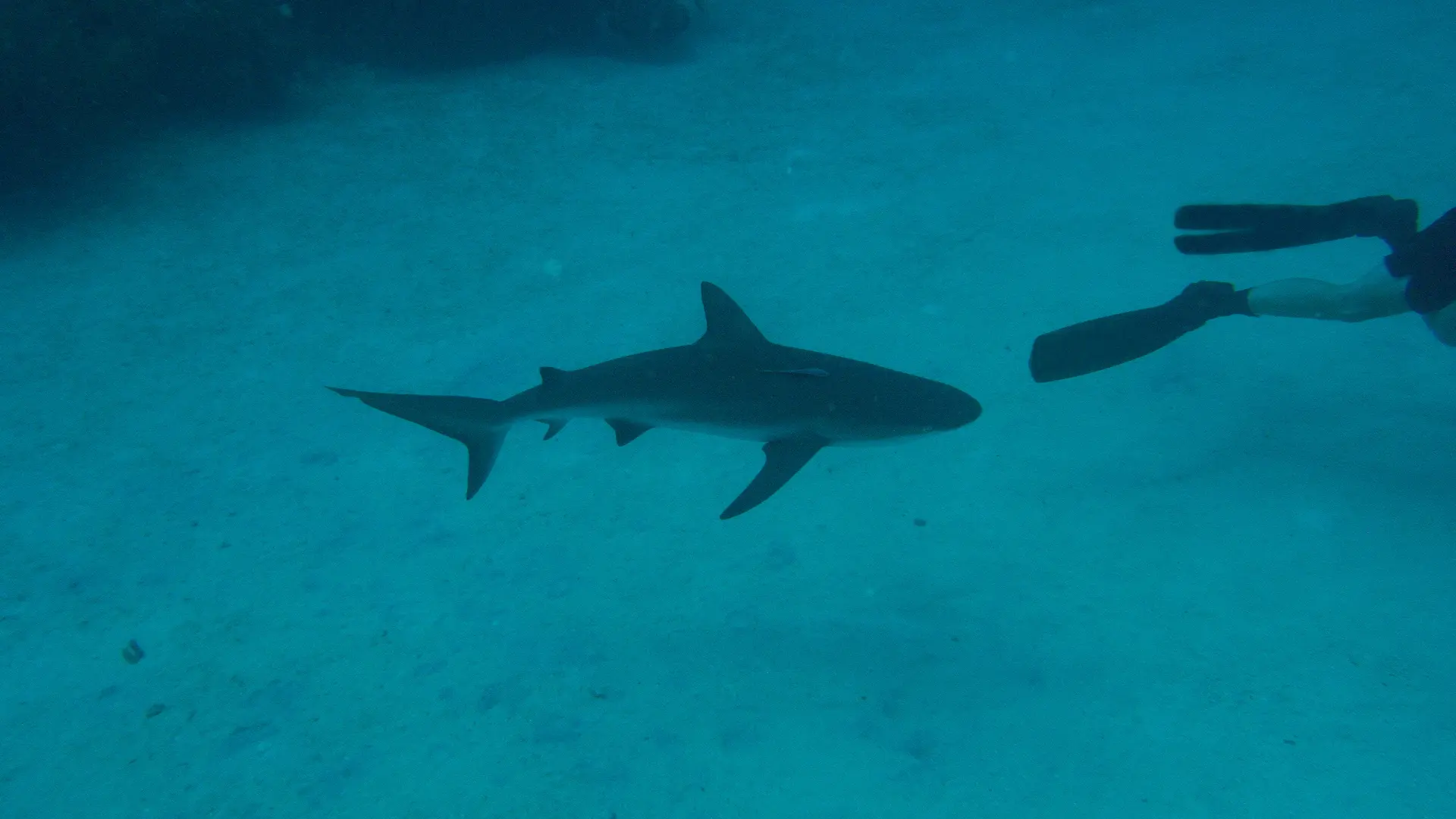
Johnny’s Gorge is the shark site. A circular reef at 24 to 30 metres, surrounded by sand on every side, and the whole structure works as a natural cleaning station. White-tip reef sharks rest on the bottom and patrol the edges, and on a good day you stop counting them. Above your head, barracuda and trevally form those swirling towers of fish that look fake on video until you are inside one. Nobody can promise you a specific animal, but if sharks are on your list, this is where I would put your money.
Dixon’s Pinnacle is three big rock pinnacles starting around 16 to 18 metres and dropping to 30 to 35, every surface carpeted in yellow soft coral. It works as a cleaning station for the big visitors: manta rays and mobulas come through, and a few times a season someone surfaces shouting about a whale shark. I have had quiet dives here too. That is the deal with pelagic sites, and anyone who tells you otherwise is selling something.
Jackson’s Bar is the current site. A rocky plateau from about 18 metres sloping past 30, with current running across it that brings in eagle rays, big snapper schools, sweetlips, and the occasional tuna moving past like a train. This one is for divers who are comfortable when the water pushes back. If that is you, it might be the most exciting dive on this list.
Two more I rate highly. The SS Inchkeith wreck is a cargo ship that went down in 1955 and now sits on sand at about 18 to 22 metres, propeller still visible, cargo holds open, the whole thing slowly turning into reef. Visibility is lower here than at the pinnacles, which gives the dive a moody feel that photographers either love or really love. Ghost pipefish and nudibranchs hide all over the structure. And Minerva Ledge is a huge flat coral garden at 12 to 24 metres that you drift across with the current. The old story is that Jacques Cousteau charted it in the seventies. True or not, it is too big to cover in one dive, which is its own kind of recommendation.
How much do fun dives cost in 2026?
Our current pricing is simple, and these are the real numbers from our fun dives page, not an estimate:
.fm-dt-wrap{margin:1.5em 0;}
.fm-dt{width:100%;border-collapse:collapse;font-size:0.95em;}
.fm-dt th,.fm-dt td{padding:10px 12px;border:1px solid #ddd;text-align:left;vertical-align:top;}
.fm-dt thead th{background:#00CED1;color:#fff;white-space:nowrap;}
.fm-dt tbody tr:nth-child(even){background:#f7f7f7;}
.fm-dt .fm-price{white-space:nowrap;}
@media(max-width:600px){
.fm-dt,.fm-dt tbody,.fm-dt tr,.fm-dt td{display:block;width:100%;box-sizing:border-box;}
.fm-dt thead{display:none;}
.fm-dt tbody tr{margin:0 0 18px;border:1px solid #ddd;border-radius:12px;overflow:hidden;box-shadow:0 2px 10px rgba(0,0,0,.07);background:#fff!important;}
.fm-dt td{border:none;border-bottom:1px solid #eee;padding:11px 14px;display:flex;justify-content:space-between;align-items:baseline;gap:14px;text-align:right;font-size:0.95rem;}
.fm-dt td:last-child{border-bottom:none;}
.fm-dt td::before{content:attr(data-label);font-weight:700;color:#0a4a82;text-align:left;flex:0 0 40%;}
.fm-dt td.fm-head{background:#00CED1;color:#fff;font-weight:700;font-size:1.05rem;text-align:center;display:block;padding:13px;}
.fm-dt td.fm-head::before{content:none;}
}
| Fun dive type | Certification | Depth | Sample sites | 1 dive | 2 dives |
|---|---|---|---|---|---|
| Standard (close-in reefs) | Open Water (to 18 m) | 10 to 24 m | The Wall, Tribe Gate, Red Pillar, Lighthouse, Nemo Reef | ₹3,500 | ₹6,500 |
| Premium (offshore pinnacles) | Advanced (to 30 m) | 18 to 35 m | Johnny’s Gorge, Dixon’s Pinnacle, Jackson’s Bar, Minerva Ledge | Two dives only | ₹10,000 |
- Standard sites (The Wall, Tribe Gate, Red Pillar, Lighthouse, Slope, Nemo Reef, Juvi’s): ₹3,500 for one dive, ₹6,500 for two dives in a day.
- Premium sites (Dixon’s Pinnacle, Johnny’s Gorge, Jackson’s Bar, Turtle Beach, Aquarium, Minerva Ledge, Pilot Reef): ₹10,000 for two dives, which is the only way the premium sites are sold.
Every package includes full Scubapro gear, the boat, your divemaster, and underwater photos. Nitrox (32 or 36) is ₹750 a tank if you hold the certification, and I do recommend it for the deep pinnacles since it buys you meaningful extra bottom time at 25 to 30 metres. Pre-book it a day ahead so we can blend your tanks. If you travel with your own full kit, take ₹500 off per dive. Dive computer rental is ₹500 a day, GoPro ₹2,000 a day, and a private one-to-one guide is ₹2,000 extra per dive, which photographers tell me pays for itself.
The premium sites cost more for a boring reason: fuel. They are nearly 20 kilometres offshore. Worth it.
Been out of the water for a while?
Here is the thing nobody likes admitting on a dive boat: most travelling divers are rusty. If your last dive was more than 12 months ago, we will ask you to do a refresher before joining a fun dive group. It is ₹2,000, takes about two hours in shallow water, and covers mask clearing, regulator recovery, and a buoyancy check. You can do it the same morning as your dives.
I know it feels like being sent back to school. It is not. It is two hours that turn your first real dive from “nervous and gripping the line” into “actually enjoying Johnny’s Gorge.” Every diver who grumbles about it thanks me afterwards. Almost every diver. Some just nod.
Bring your certification card or the digital version, and your logbook if you have one. You will also fill the standard medical form; if anything on it needs a doctor’s sign-off, sort that before you travel rather than hunting for a clinic on the island.
What are the scuba diving rules in Andaman?
A few regulations here catch divers who have only dived abroad, so let me save you the surprise.
All recreational diving in the Andamans is guided. Even if you are a Divemaster on holiday, you dive with our guide. Solo diving and buddy-pair-only diving are not done here. Depth limits follow your card strictly: 18 metres for Open Water, 30 for Advanced, and no decompression diving at all, for anyone. The reef rules are firm too: no touching coral, no feeding fish, keep your distance from animals, and nothing comes home with you, not even a dead shell. The Wildlife Protection Act is not gentle about this, and frankly neither am I. Fins up off the bottom is how real divers behave anyway.
And the one that wrecks itineraries: no flying within 24 hours of your last dive. Plan your dive days so your last dive finishes a full day before your flight out of Port Blair. I wrote a whole piece on flying after scuba diving if you want the detail.
When should you come?
October to May is the season, with December to February the peak: calm seas, visibility that can stretch past 25 metres, and every site open. October, November, March, April and May are quieter and still very good. June to September is monsoon. We still dive when the weather allows, mostly the closer sites, and visibility drops, but prices and crowds drop with it. If your only window is monsoon, message us first and we will tell you honestly what is running that week.
Peak season fills up. Book your dives 3 to 7 days ahead normally, and two weeks or more ahead for December to February, especially if you want the premium sites on specific days.
Fun dive FAQs: what divers ask me
What does a fun dive actually mean? A fun dive is a guided recreational dive for someone who is already certified. No course, no skills on the sand, nothing to sign at the bottom. You dive with a guide who knows the reef, for the pleasure of diving and nothing else. People also call it recreational diving, or just scuba diving for fun. Same thing.
Is scuba diving actually fun, or just nerve-wracking? Honest answer: the first ninety seconds underwater feel strange, then your breathing settles and it turns into the calmest hour of your trip. For certified divers there is no real stress, you already know the drill. Hanging weightless over a reef while a turtle ignores you is about as good as a holiday gets. The name is not an accident.
How deep is a fun dive in Andaman? It depends on your certification. Open Water divers dive to 18 metres, Advanced divers to 30. The close-in reefs sit comfortably between 10 and 24 metres, and the premium offshore sites put the good stuff at 20 to 35. No decompression diving for anyone, ever, whatever your card says.
How do fun dives work on the day? You book ahead and arrive early. We run two boat dives with a surface interval between them, small groups of four divers per guide, all gear provided. You get a site briefing, you dive to 50 bar or 50 plus minutes, then tea and snacks before the second dive. If your last dive was over a year ago, you do a short refresher first.
What are the requirements for a fun dive? A recognised certification card (RAID, SSI or equivalent), reasonable health on the standard medical form, and a refresher if you have not dived in over 12 months. That is it. You do not need to be young, especially fit, or a strong swimmer. You do need to be honest on the medical form.
Fun dive or the Open Water course: what is the difference? A fun dive is for people who already hold a certification. The Open Water course is how you earn that certification in the first place. If you have never dived or never been certified, you cannot join a fun dive group: you start with the course, or with a Try Scuba try-dive. Once the card is in your pocket, fun dives are what you do for the rest of your diving life.
Can I choose which site we dive? You can tell us your wishlist and we genuinely try. Final call sits with the divemaster on the day, based on wind, current and the certifications in the group. If Johnny’s Gorge is your dream dive, give us two or three days on the island so we have weather options.
Is an Open Water certification enough for the famous sites? For The Wall’s upper section, Tribe Gate, Red Pillar, Lighthouse and Minerva Ledge, yes. For Johnny’s Gorge, Dixon’s Pinnacle and Jackson’s Bar you need Advanced or equivalent, because the dives sit beyond 18 metres. If you are here for a few days, you can do the Advanced course with us and finish it at those exact sites.
How long is each dive? We dive to 50 bar or 50 plus minutes. At the deep pinnacles your no-decompression limit usually ends the dive before your air does, which is exactly why Nitrox earns its ₹750 there.
Do you provide dive computers? Rental computers are ₹500 a day and I would call one essential rather than optional at the premium sites. Bring your own if you have one.
Can I dive several days in a row? Yes, with normal surface intervals and sensible profiles. Plenty of guests do six or eight dives across three or four days. If you are diving many days back to back, a rest day in the middle is kind to your body, and Havelock has decent beaches for exactly that.
Come dive with us
If you got certified somewhere and the card has been sitting in a drawer since, Havelock is a very good reason to take it out. The reefs here are healthy, the sharks at Johnny’s Gorge do not care about your nerves, and my team will look after everything else.
Message us on WhatsApp or call 095318 53676 with your travel dates before you book ferries, and we will line your dives up properly, premium sites on the calmest days, last dive a safe 24 hours before your flight. Bring the card, bring the logbook if you can find it. We have got the rest.