In 2017 I could not swim. Not “I swim a little.” I mean I was scared of water deep enough to cover my knees. I was trading stocks on the mainland, nowhere near an ocean, and if you had told me I would one day run a dive centre in Havelock, I would have laughed at you.
So when a nervous person walks into Frogman and says “I cannot swim, can I still do this,” I do not give them a rehearsed answer. I was that person. The whole dive centre exists because somebody was once patient with me, and I decided to build a place that is patient with everyone.
This post is the honest version of what scuba diving with Frogman in Havelock is actually like. Not the brochure. If you are already a certified diver looking for reef-and-pinnacle action, I wrote a separate guide on fun dives in Havelock just for you. This one is for first-timers, nervous swimmers, non-swimmers, and anyone still deciding whether to try scuba at all.
Why Frogman exists
I started Frogman in 2023 and named it after the frogmen of World War II, the underwater commandos who went where most people would not. That is what diving felt like to me the first time: doing something I was certain I could not do, calmly and on purpose.
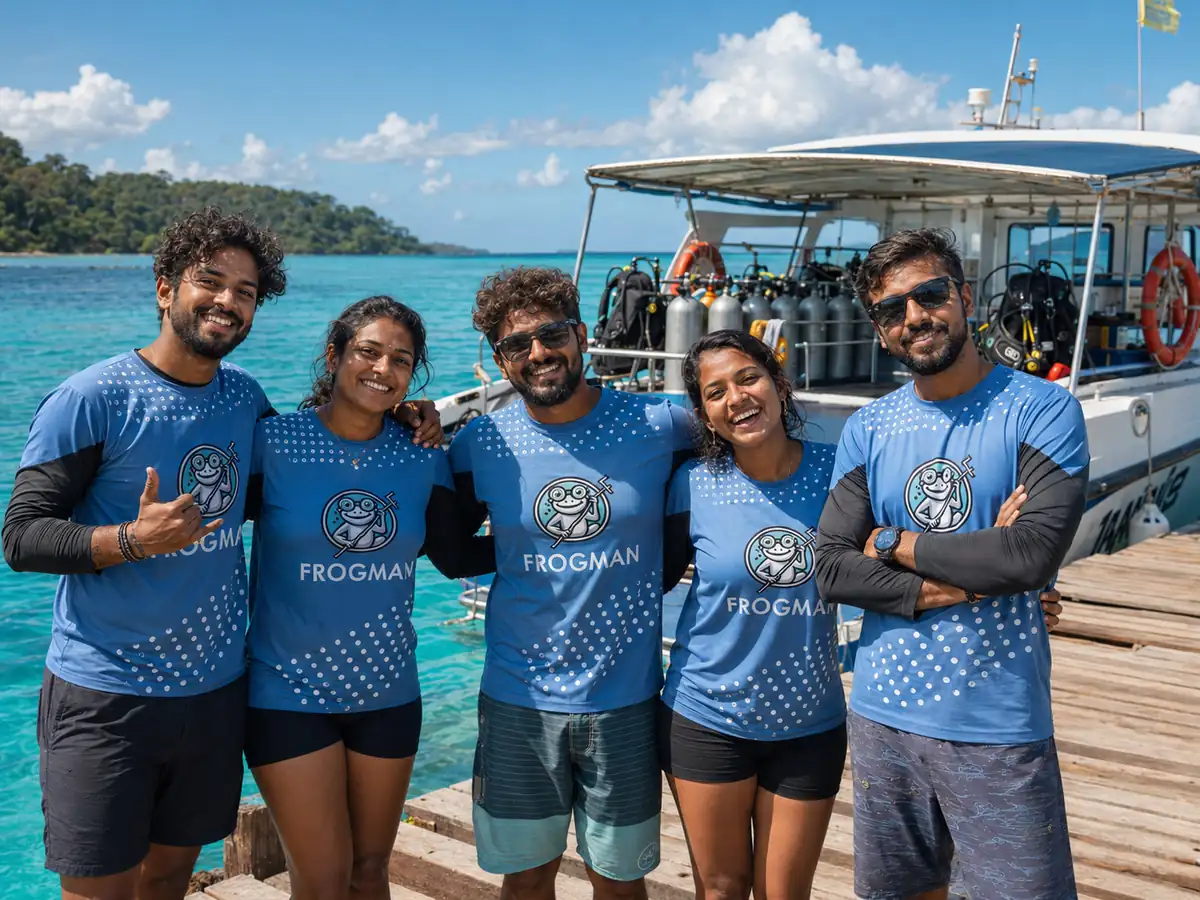
We are a team of about ten people from different parts of India. Dinesh and James are our divemasters, Ribin teaches alongside me, Amit captains the boat, Sujit runs ground support, and Leziya at the front desk is probably the first voice you will hear when you message us. Small team, and that is deliberate. I want to know every guest who gets in the water with us.
One number I am genuinely proud of: our safety record is 100 percent. Not because the ocean is always gentle. Because we say no when conditions are wrong, we check gear twice, and we never put a beginner anywhere a beginner should not be.
Your first dive, step by step
Most first-timers start with our shore dive at Nemo Reef, and there is a good reason for that. The site sits in a sheltered bay near Beach No. 2 in Govind Nagar, with almost no current. You walk in from a sandy beach, waist deep, on flat ground. No jumping off a rocking boat on your first try.
Here is what actually happens:
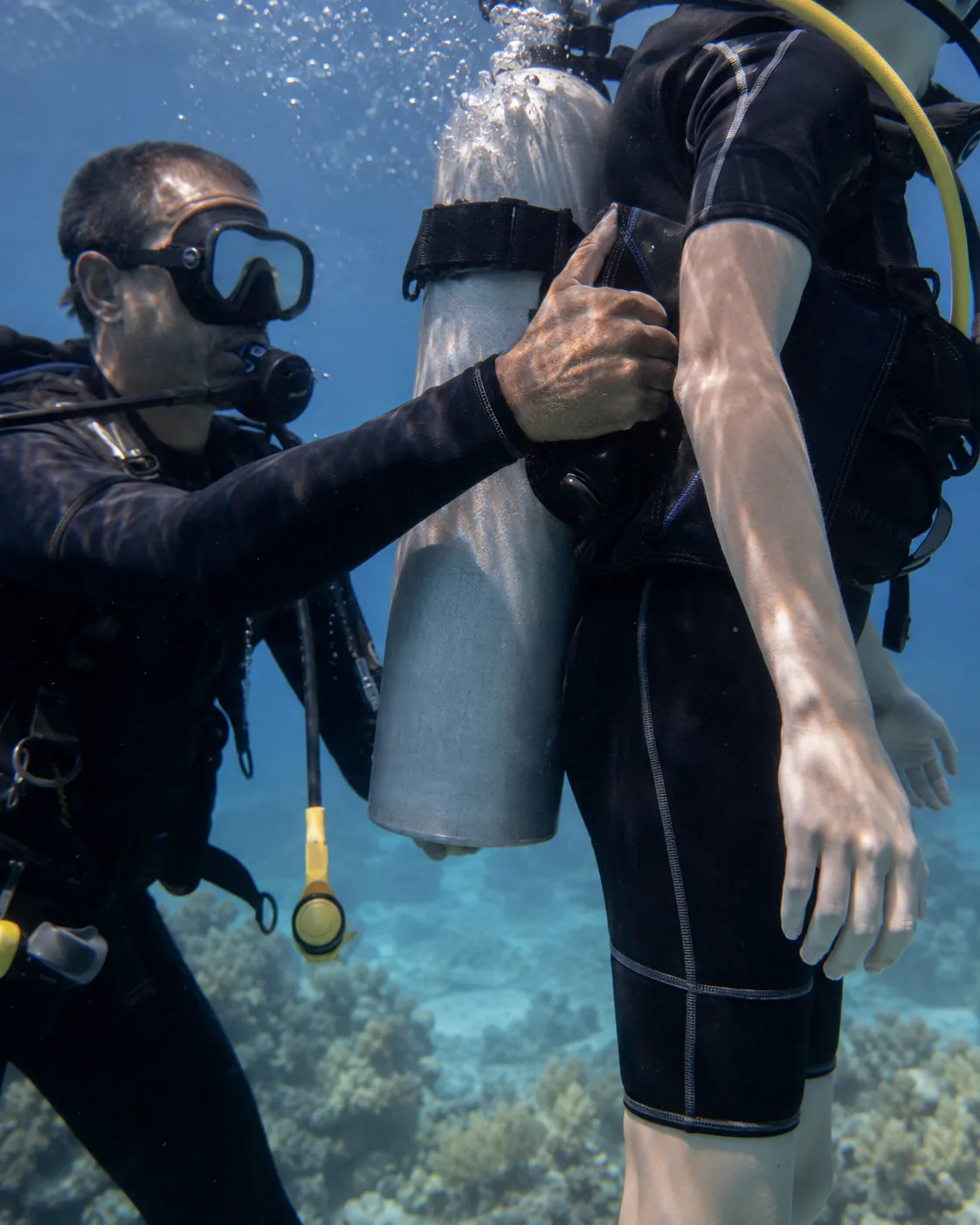
You fill a short medical form. We brief you on the basics: how to breathe through the regulator, how to equalize your ears, three or four hand signals. Then we get you in shallow water and you take your first breaths underwater while standing. That first ninety seconds feels strange. Then it feels normal. Everyone goes through the same ninety seconds, including me once.
Then your instructor takes you out over the reef. One instructor, one student. For every uncertified diver we keep a strict 1:1 ratio, and the instructor controls your buoyancy and depth the whole time. Your only jobs are breathing and looking around. The dive itself runs about 30 minutes at 6 to 12 meters.
And what you see on a Nemo Beach scuba dive is not a warm-up reef. Clownfish guarding their anemones. Staghorn thickets, table corals, brain corals. There is even a sunken Mahindra jeep at about 6 to 8 meters, now crusted over with sponges and home to octopus and nudibranchs. My team calls it the Ghost Jeep. Beginners surface talking about it more than anything else.
If you want the deeper story on whether you personally can do this, I answered it properly in is scuba diving in Andaman safe for non swimmers. Short version: yes, and non-swimmers are some of my favourite students.
What it costs (the straight numbers)
Prices below are inclusive of GST. They are correct as of June 2026; check our rates page when you book because these do change.
- Nemo Reef shore dive: Rs 3,500
- Red Pillar boat dive: Rs 4,000
- Tribe Gate boat dive: Rs 4,500
- Juvi’s Rs 5,500, Lighthouse Rs 6,000 or The Slope Rs 6,500
- Turtle Beach Rs 7,000 or Aquarium Rs 7,500, premium boat dives
The price difference is fuel and distance, not a difference in how much we care. A shore dive skips the boat entirely, so it costs less. The far sites need a longer ride, so they cost more. The underwater time is roughly the same 30 minutes everywhere, and you can add a 15 minute extension for Rs 1,500 if you do not want to come up. Most people do not want to come up.
Two things we include that I refuse to treat as upsells: your photos and videos. Every introductory dive comes with 20 to 30 professional photos and 3 to 4 short videos in the base price. I have seen operators charge separately for this after the dive, when you have no choice. We do not do that.
If you want your first dive to count for something on paper, you can upgrade a try dive to a Try Scuba Diving experience for Rs 1,000 more. That adds a proper 30 minute confined-water skills session and registers your certification with the training agency, and it gives you credit toward a full Open Water course later.
The boat dives: where we take beginners beyond the shore
You do not need certification to do a boat dive in Havelock with us. The same 1:1 rule applies, just with a short speedboat ride first.
Tribe Gate is about five minutes from the jetty, a round seamount rising off white sand. It has the highest concentration of giant clams I know of in the region, the big Tridacna ones with blue-green lips that snap shut when your shadow passes. All five Andaman anemonefish species live on this one reef. I still find that slightly absurd.
Juvis is the one I send people to when they whisper “any chance of a shark?” There is a long garden of potato corals there, and white-tip reef sharks patrol the 8 to 12 meter edge often enough that beginners see them regularly. They are calm, smallish, and completely uninterested in you. Watching a first-timer’s eyes go wide behind the mask is one of the best parts of my job.
Lighthouse slopes gently from 3 meters down to about 23, which makes it work for almost everyone. Green sea turtles show up reliably, especially February to April. It is also the only site where we run night dives, because the water there stays calm.
There are over twenty sites in our rotation, from training reefs to deep pinnacles. The full list with depths and what lives where is on our dive sites in Havelock hub if you want to go down that rabbit hole.
When one dive turns into a course
Roughly half the people who do a try dive with us come back asking about certification. I never push it. The ocean does the selling.
The main course is the RAID Open Water course: four days, theory plus confined water skills plus open ocean dives, and at the end you are a certified diver to 18 meters, anywhere in the world, for life. The price is Rs 29,000, inclusive of GST. We also teach RAID courses, where the entry certification takes you to 20 meters and the training pushes horizontal trim and buoyancy hard from day one. Honestly, the agency on the card matters less than the instructor in the water with you. Ask me which suits you and I will tell you straight, even if the answer is “wait a year.”
For the truly bitten, there is a path all the way from your first breath underwater to working divemaster. A few of the people now leading dives in Havelock started exactly where you are: nervous, on the sand, at Nemo Reef.
The safety part nobody puts on Instagram
Some honest things we do that you will not notice unless you look:
We run Scubapro, Mares and Aqualung gear and clean it daily. Every boat carries an emergency oxygen kit. We enforce the medical form properly: heart conditions, lung conditions, epilepsy and severe asthma mean we say no, and anyone over 50 needs a doctor’s fit-to-dive certificate. I have turned away paying guests for this. It is not fun, but it is the job.
And we protect the reef the way real divers do. No touching coral, no chasing turtles, fins up off the bottom. At Nemo Reef there is a wide sandy channel between the two reef sections, and we run all skills practice over that bare sand so nobody learns buoyancy on top of living coral. Small decisions like that are why the reef is still worth showing you.
When should you come?
December to February is peak: flat seas, visibility that can hit 30 meters and beyond, and water around 28 degrees. It is also the busiest and most expensive window, so book dives and ferries early.
October to November and March to May are the smart-value months. Visibility is still a healthy 15 to 25 meters and everything is easier to book. If you are flexible, this is when I would come.
June to September is the monsoon, and here is the honest version: the open-sea sites close when swells come up, but Havelock’s geography quietly saves us. Nemo Reef sits in a sheltered bay and the Aquarium site hides on the protected southwest coast, so beginner dives and courses run almost year round. A monsoon trip is not a wasted trip. It is just a calmer, cheaper, greener one.
Plan your ferry before your dive. The fast boats from Port Blair take about 90 minutes, morning departures are calmer and cheaper, and we schedule afternoon dive slots specifically for people arriving on the midday ferries, so your first day on the island does not have to be a wasted day.
Questions people actually ask us
I cannot swim at all. Are you sure this works? Sure enough that I built the business around it. You wade in from the beach, your instructor controls everything, and you never have to swim a stroke. I was a non-swimmer with a genuine fear of water and I now do this for a living.
How long does the whole thing take? Plan for about two to three hours door to door for a shore dive, including paperwork, briefing, practice and the dive itself. The underwater part is around 30 minutes, extendable to about 45.
What if I panic underwater? Almost everyone worries about this and almost nobody actually panics. You are in shallow, calm water with an instructor holding your gear. If you want to go up, you signal, and we go up together. No drama, no judgement, and you can try again when you are ready.
Is there an age limit? Kids can start a try dive in the sea from age 10, and 8 and 9 year olds can do a shallow Try Dive Cadet session up to 2 metres. There is no upper age limit. You only need a doctor’s fit-to-dive certificate if you answer yes to a question on the medical form. If you are unsure about a medical condition, message us before you book and we will tell you honestly.
Do I need to book in advance? In peak season, yes, a few days ahead at minimum. Booking is simple: book on the dive page or message us on WhatsApp, pick a batch time, and pay a 10% advance to hold your slot. You pay the balance at the centre. If you cancel 72 hours or more before your dive, you get a full refund minus a 5% fee and GST. Inside 72 hours there is no refund.
Can I wear glasses or contact lenses? Contact lenses are fine under the mask; soft lenses are best. Glasses do not fit, but most people with moderate eyesight manage fine without them since water magnifies everything by about a third anyway. If your eyesight is on the heavier side, message us before you come and we will work something out.
Come meet us
You do not have to decide today. But if you are coming to the Andamans anyway, do one dive. Thirty minutes underwater will tell you more than anything I can write here.
Message us on WhatsApp with your travel dates before you lock your ferries, and Leziya or I will line your dive up with your schedule. Or call us on 095318 53676 if you prefer talking to a person.
Worst case, you tried something new and got a couple of dozen photos out of it. Best case, I see you again in four days for your Open Water course. It happens more often than you would think.