Every season I have the same conversation on the boat. Someone is mid-dive, having the best day of their trip, and on the way back they mention their flight leaves Port Blair tomorrow morning. And I have to be the guy who says no. You cannot get on that plane, not that soon.
It is the one rule about diving that catches people completely off guard. They have planned the snorkeling, the beaches, the ferry, everything. Nobody told them that the diving and the flying do not mix if you stack them too close together.
So let me tell you the real version, why you can’t fly after scuba diving, exactly how long you need to wait, and how to plan your Andaman trip so you never end up stuck with this problem on your last day.
The short answer
If you did one single dive, wait at least 12 hours before you fly. If you did more than one dive in a day, or you dove across several days, which is what most people do here, wait at least 18 hours. When in doubt, leave a full clear day between your last dive and your flight. That is the honest, safe version, and it is also the one I actually tell my divers.
That is the answer. Now here is why, because once you understand it you will never be tempted to cut it close.
What actually happens to your body underwater
You are breathing air down there. Air is mostly nitrogen, and your body does nothing useful with nitrogen. It just dissolves into your blood and tissues, and the deeper and longer you go, the more of it builds up. This is normal. Every diver does it on every dive.
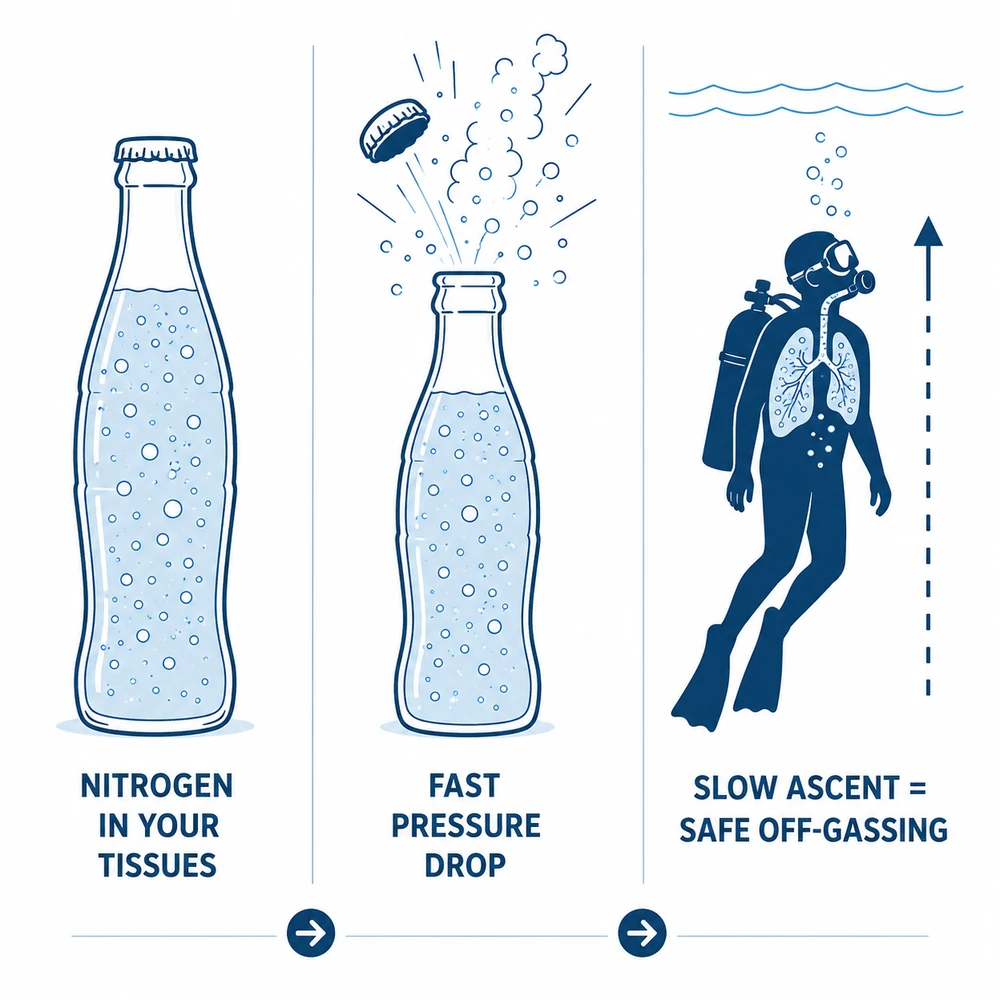
Think of a bottle of soda with the cap on. The gas is dissolved in the liquid, invisible, under pressure. That is the nitrogen in you while you are at depth.
When you come up slowly, and when you do your safety stop, your body lets that nitrogen come out gently through your lungs as you breathe. No drama. That is the whole point of ascending slow and stopping at five meters for three minutes. We are giving the gas time to leave quietly.
Now picture cracking the cap on that soda bottle fast. It fizzes everywhere. That is what a pressure drop does to dissolved gas. And here is the thing most people do not realize: a plane cabin is a pressure drop.
A plane cabin is not sea level
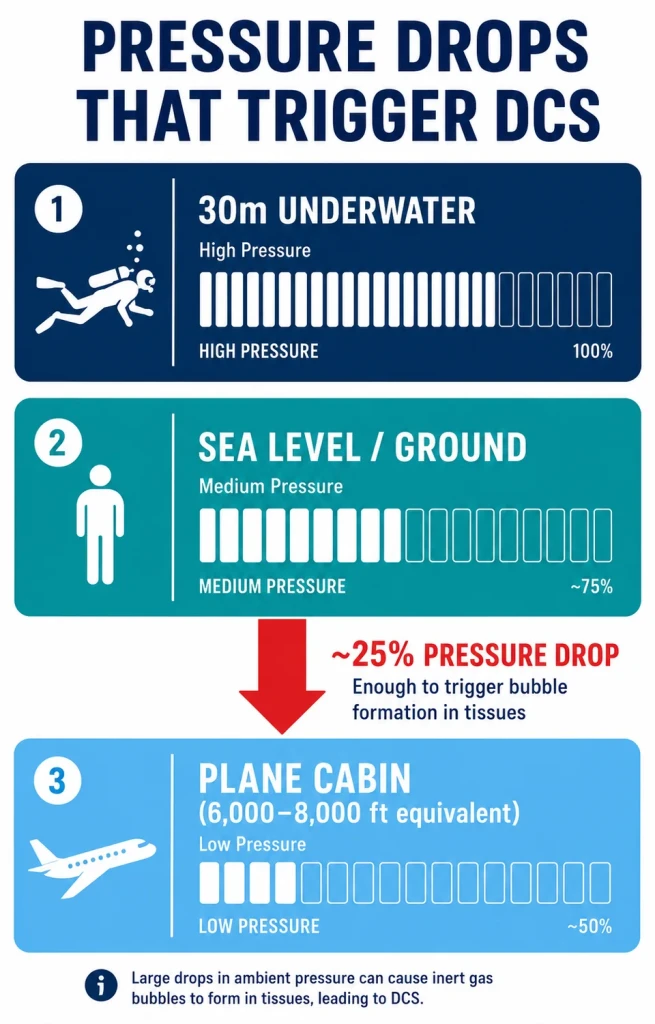
This is the part that surprises everyone. The cabin on a commercial flight is not pressurized to ground level. It is pressurized to roughly the equivalent of 6,000 to 8,000 feet of altitude, somewhere up a mountain. That is about a 25 percent drop in pressure compared to the ground.
For a normal passenger that is nothing, your ears pop and you forget about it. But for a diver who still has leftover nitrogen in their tissues, that pressure drop is exactly the cap coming off the soda. The nitrogen that was sitting there quietly can come out of solution fast and form bubbles inside you. In your joints, your blood, sometimes your spine or your inner ear.
That is decompression sickness. The bends. And it is genuinely serious, ranging from aching joints and weird fatigue to dizziness, numbness, and worse. The nearest proper recompression chamber is not around the corner when you are at 30,000 feet over the Bay of Bengal. So we do not gamble on it. Not even a little.
How long to wait, by what you actually did
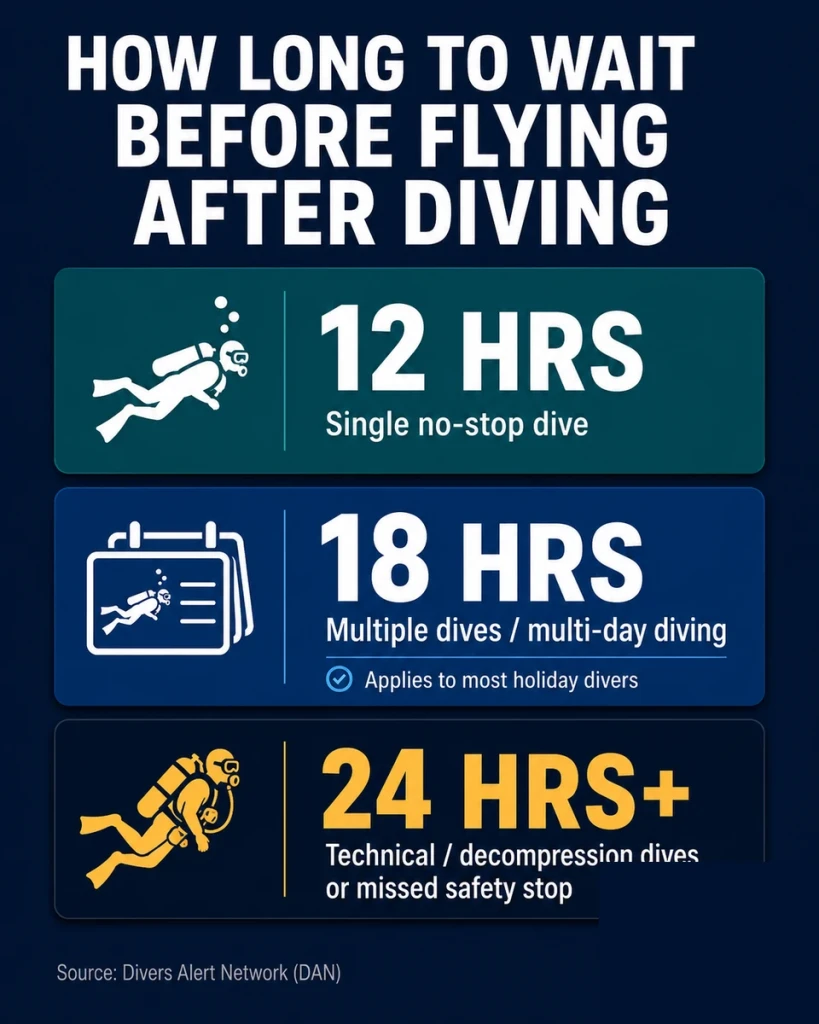
The flying after diving guidelines here come from the Divers Alert Network and the dive medical community, built on decades of chamber trials and accident data. I am not making these numbers up and neither is any honest dive center.
A single no-stop dive: wait a minimum of 12 hours.
More than one dive in a day, or diving on several days in a row: wait a minimum of 18 hours. This is the one that applies to almost everyone who comes to Havelock, because nobody flies all the way to the Andamans to do just one dive. You do two or three a day, across two or three days. So 18 hours is your real floor.
Technical or decompression dives, the deeper stuff with mandatory stops: 24 hours, often more. If you are doing that kind of diving you already know to ask, but I will say it anyway.
And if anything went a bit wrong, you blew through a no-stop limit, or you missed your safety stop because of a current or an ear problem: 24 hours minimum, no shortcuts.
Honestly, my own rule of thumb is simpler than the table. Give yourself a clear day. Last dive on one day, fly the next. That comfortably covers the 18 hours for almost any normal holiday diving, with a buffer, and it means you are never doing nervous math on your phone at the dive shop. And if you are new to diving, my scuba diving tips for beginners guide covers the other basics beyond flying.
Trust your dive computer’s time-to-fly
If you dive on a computer, and most certified divers do now, it has a little countdown on it called “time to fly” or no-fly time. It starts after your last dive and counts down the hours. It is doing the same math we just talked about, tracked precisely for your actual dives.
Use it. If your computer says you have 16 hours left and your flight is in 14, the computer wins. It tends to run a touch conservative, and for something like your spinal cord, that is exactly how I want it. One thing though: use the same computer for your whole trip, because it is keeping a running tally across all your dives, not just the last one.
How this plays out on an Andaman trip, and how to plan around it

This is the bit nobody tells you before you book, so pay attention because it will save your trip.
You dive in Havelock. But you fly out of Port Blair. Between those two things is a ferry, and ferries take time and have fixed timings. So the sequence on your departure is usually: finish diving, ferry from Havelock to Port Blair, overnight in Port Blair, fly out the next morning.
If you try to dive in the morning and catch an evening flight the same day, you are nowhere near 18 hours. Not even close. I will not let you do your last dives in that window, and you should not want me to.
So here is how I tell people to build the trip. Do all your diving in the first part of your stay. Make your last full day of diving end at least a day, ideally a clear day and a bit, before your flight. Use your final day in the islands for the dry stuff: Radhanagar at sunset, Kalapathar in the morning, a slow breakfast, the ferry back to Port Blair. You lose nothing. You just front-load the diving and back-load the beaches.
Message us your travel dates and your flight time before you lock in your dives, and we will line everything up so your last dive sits safely outside your no-fly window. We do this every single week. It is not a hassle, it is just planning.
One more thing: driving and hills count too
It is not only flying. Going up to real altitude on land does the same thing, the pressure drops the higher you go. This rarely matters in flat coastal Havelock, but it is worth knowing for the general rule: the no-fly wait is really a “no going to altitude” wait. If your trip after diving involves a flight to a hill station or a long drive up a mountain, treat it exactly like a flight.
Small habits that lower your risk
None of these replace the wait time. They just stack the odds in your favor while you off-gas.
Drink water. A lot of it, before and after diving. Dehydrated blood moves nitrogen out of your tissues less efficiently, and plane cabins are brutally dry, so you land more dehydrated than you took off. Skip the celebratory beers on dive days too, because alcohol dries you out further. Save the drinks for your non-diving day.
Take it easy after your last dive. Heavy exercise, lugging bags, a hard hike, all of it can nudge bubbles along. Rest is genuinely the right move.
And if you ever feel off after diving, unusual tiredness, a joint that aches for no reason, tingling, dizziness, do not get on a plane and do not write it off as a bad night’s sleep. Tell us, or call a dive emergency line. Flying while you already have symptoms is the single worst thing you can do, it turns a small problem into a big one. Staying on the ground and getting checked is always the right call.
Quick questions people actually ask me
Can I dive on the morning of my flight if it is just one shallow dive?
No. Even a single dive needs 12 hours, and your travel day does not have 12 spare hours in it once you count the ferry. Make your departure day a no-diving day. Every time.
What if I only snorkel, no scuba?
Then you are fine. Snorkeling does not load your tissues with nitrogen the way breathing compressed air at depth does. Snorkel all you like on your last day, then fly.
Is 24 hours overkill if I only did easy dives?
Not overkill, just safe. The minimum for repetitive diving is 18 hours, and a full day gives you a buffer on top of that. I would rather you have the buffer than the bends. A clear day is the easiest insurance you will ever buy.
My dive computer says I am clear before 18 hours. Can I trust it?
Trust the longer of the two: your computer or the 18-hour guideline. If they disagree, wait the longer one. This is not the place to optimize for speed.
Does Nitrox let me fly sooner?
Diving on Nitrox does leave you with less nitrogen, which is a real advantage. But the standard wait times still apply, so plan for the same window. Treat the lower nitrogen as extra safety margin, not as a way to shave hours off.
Come dive, just give yourself the day
I know this all sounds like a lot when you are excited to get in the water. It really is not. It is one line in your itinerary: dive early in the trip, keep the last day dry, fly the morning after. That is the whole trick.
If you are planning an Andaman trip and you want to dive with us in Havelock, send us your dates and your flight out of Port Blair before you book anything. We will fit your dives around your travel so you get the most water time possible and still walk onto that plane completely safe. That is our job, and we are happy to do it.
You came all this way to dive. Let’s just make sure the flying part stays boring.