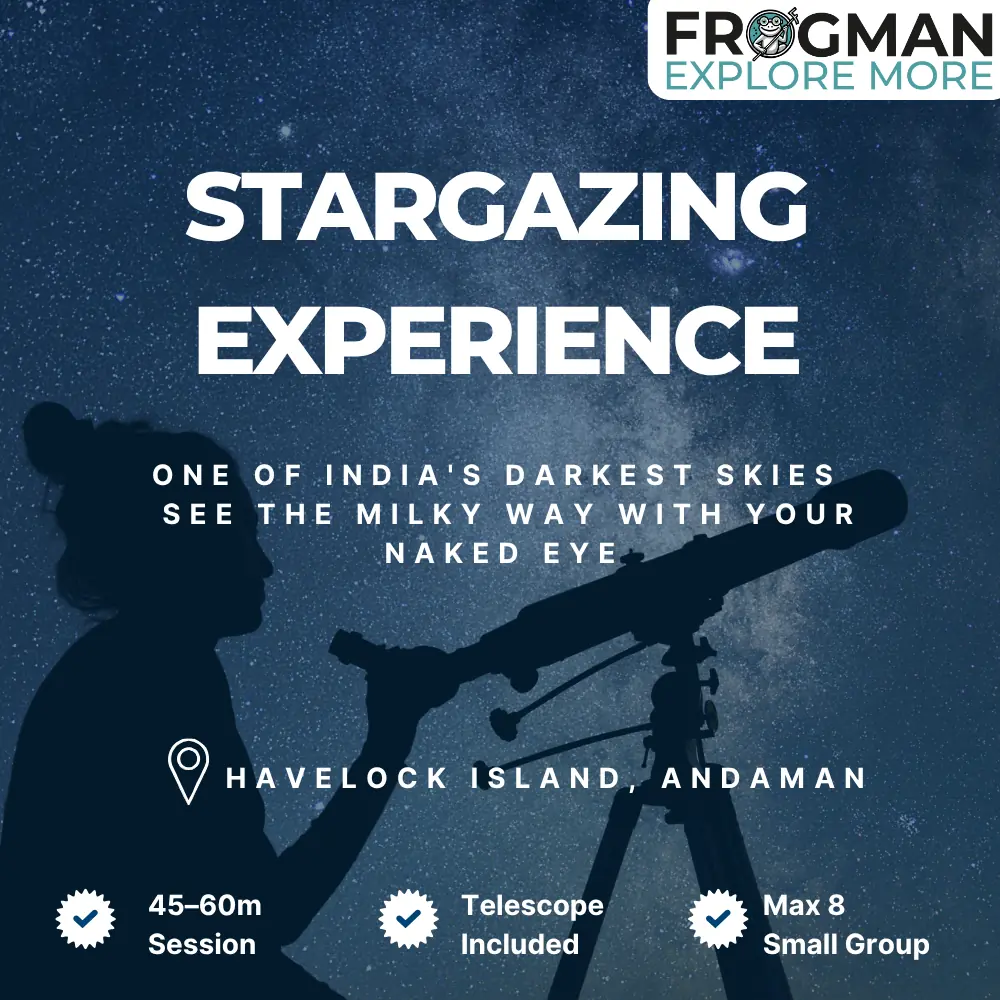
Stargazing in Havelock Island – guided night sky experience Andaman
Course Code: FRG-STAR-HVL

Stargazing in Havelock Island – Night Sky Experience, Andaman

₹2,000 + GST
4.9 1,800+ Google reviews

One of India's rarest night sky experiences – Havelock Island's Bortle Class 2–3 dark sky, guided telescope viewing, constellation tour, and the Milky Way visible to the naked eye.

Things to Know
Booking confirmation sent via WhatsApp within 30 minutes
Free cancellation up to 48 hours before your dive
Secure payment 10+ years experience 4.9★ rated

Stargazing in Havelock

Havelock Island sits at 12°N latitude, surrounded entirely by ocean, with almost no artificial light pollution. On a clear night the Milky Way is visible to the naked eye as an unbroken band across the sky. Most people from cities have never actually seen it this clearly. Our guided session gives you a telescope, a guide who knows the sky well, and a dark spot away from resort lights.

No astronomy knowledge needed. The guide walks you through everything at a relaxed pace - what each object is, how to find it, and what you're actually looking at when you look through the eyepiece. Most people are surprised by how much is visible.

Duration
45-60 minutes
Timing
Post-sunset (confirmed day before)
Group Size
Small group (max 8 people)
Suitable For
All ages, families welcome
Best Conditions
Clear sky & new moon period
Meeting Point
Frogman Centre, Beach No. 3

Why Havelock for stargazing?

  • Bortle Class 2-3 sky - among the darkest in India, on par with remote Himalayan valleys
  • No mountains blocking the horizon - 360° open sky, ocean on all sides
  • Southern sky visibility - at 12°N you can see the Southern Cross (Crux), which isn't visible from most of mainland India
  • Beaches that work for this - warm year-round, and the sea breeze keeps mosquitoes manageable
  • No light dome - no nearby cities, so the sky stays dark all the way to the horizon

Best months to visit

October - February
Peak stargazing season

Post-monsoon clear skies. Orion, Taurus, the Pleiades, and the winter Milky Way are all up. Driest period with the fewest cloudy nights.

March - May
Good conditions

Mostly clear skies. Scorpius rises in the east, Leo is overhead, and the summer Milky Way starts building toward its peak brightness.

New moon windows
Best any month

Moon phase matters more than season. Even a half-moon washes out faint objects. Book around new moon for the clearest views.

This is a weather-dependent activity. We confirm the session the evening before based on cloud cover and sky conditions. If the sky is unsuitable, we reschedule to the next available clear night or offer a full refund.

What you'll see

The exact objects visible depend on the time of year and moon phase, but here's what Havelock's skies regularly offer:

The Milky Way

Visible to the naked eye as a dense, glowing band across the sky. The galactic core - the brightest section - rises over Havelock from March through September. It looks completely different from anything you'd see near a city.

Southern Cross (Crux)

Visible from Havelock's latitude (12°N) but not from most of mainland India. A compact southern constellation used by sailors for navigation for centuries. Best seen from February to June.

Planets

Venus is often the brightest object in the sky after the moon. Jupiter's four Galilean moons are visible through the telescope. Saturn's rings are clearly visible too - that one tends to stop people.

Orion & winter constellations

Orion's belt, the Orion Nebula (a star-forming region visible through the telescope), Sirius (the brightest star in the night sky), Taurus, and the Pleiades cluster. Best from November to February.

Scorpius & Sagittarius

The two constellations that frame the galactic centre, both fully visible from Havelock's latitude. When Sagittarius is high, you're looking directly toward the heart of the Milky Way. Best from May to September.

Deep sky objects

Through the telescope: the Andromeda Galaxy (2.5 million light-years away), open clusters like the Beehive and Pleiades, and globular clusters. The guide explains what you're looking at and how far away it actually is.

Astrophotography tips

Your phone can capture more than you'd expect. The guide will help you set up:

  • iPhone - Night Mode on, exposure set to max, propped against something stable
  • Android - Pro or Manual mode, ISO 1600-3200, shutter 15-25 sec, f/1.8 if available
  • Dedicated camera - bring a tripod if you have one (we have basics on site); the guide will help dial in settings
  • We provide red-light torches to preserve your night vision between shots

What's included at ₹2,000

Telescope viewing

Quality reflector telescope set up and operated by the guide. Everyone gets time at the eyepiece - planets, clusters, and nebulae, up close.

Guided constellation tour

A full walkthrough of the visible sky - names, shapes, mythology, and how to find each constellation using bright stars as anchors. Works whether you know a lot or nothing at all.

Astronomy explanation

The guide explains the scale and distance behind what you're seeing - simply, not like a lecture. What's a light-year? How far is Andromeda? Why does Saturn have rings?

Red-light torches

Red light preserves night vision (white light resets it). We provide these for the group so your eyes stay dark-adapted throughout the session.

Small group setting

Maximum 8 people per session - small enough to ask questions freely and spend real time at the telescope without much waiting.

Astrophotography help

The guide helps you set up your phone or camera for night shots - ISO, exposure time, and framing. You'll actually get photos of stars, not just black rectangles.

What to bring

  • Light jacket or shawl (evenings near the beach can be breezy)
  • Insect repellent
  • Your phone or camera, and a tripod if you have one
  • Comfortable footwear for walking to the viewing spot

Weather & rescheduling

Stargazing depends entirely on the sky. We check cloud cover and forecasts before each session. If conditions are unsuitable on your booked night:

  • Free rescheduling to the next available clear night during your stay
  • Full refund if no suitable night is available before you leave
  • We don't run sessions with heavy cloud cover - it's not worth it for anyone

Frequently asked questions

Do I need any astronomy knowledge?

None at all. The guide starts from scratch - what you're looking at, why it's interesting, and how to find things yourself. People with no background often enjoy it more because everything is new.

What if it's cloudy on my booked night?

We check the forecast in the afternoon and confirm by 5 PM. If the sky is unsuitable, we reschedule to the next clear night during your stay, or offer a full refund if you're departing. We don't run sessions in bad conditions.

What time does the session start?

After full darkness - typically 30-45 minutes after sunset, which in Havelock is around 6:30 PM year-round. The exact start time is confirmed the evening before.

Is it suitable for children?

Yes. Looking through a telescope at Saturn's rings for the first time tends to make an impression on kids of any age. Families are very welcome.

Can I take photos through the telescope?

Yes, though results depend on your phone and the object. The Moon, Venus, and Jupiter photograph reasonably well. The guide will help you position your phone at the eyepiece (afocal photography). Bring a tripod if you have one - it helps a lot.

Does the full moon affect the experience?

Yes, quite a bit. A bright moon washes out faint stars and the Milky Way. We still run sessions during full moon periods - the moon itself is worth looking at through a telescope - but new moon windows give the best results. Ask us when planning your dates.

Can this be combined with other Frogman activities on the same day?

Yes. The stargazing is in the evening, so there's no conflict with morning or afternoon activities. Some guests do a morning dive, an afternoon kayak, and finish with stargazing.

Loved by Travelers

See why we are the top rated dive center in Andaman (Havelock) on Google & TripAdvisor